The “Shinansha,” Or The South Pointing Carriage
The “Shinansha,” Or The South Pointing Carriage: The compass, with its needle always pointing to the North, is quite a common thing, and no one thinks that it
Origin & Tradition
The Shinansha (指南車, “south-pointing carriage”) is a legendary device from ancient Chinese tradition that entered the Japanese cultural record through early historical texts and encyclopaedias. The story of its invention — attributed in various sources to the Yellow Emperor (Huangdi), to the Duke of Zhou, or to later Han-dynasty craftsmen — is preserved in Japanese as part of the broader tradition of karamono (唐物, Chinese things) that shaped Japanese intellectual culture. The Japanese retelling of the shinansha legend emphasises its function as a navigational instrument in a terrain of deliberate confusion: the enemy who creates a fog to disorient an army, and the device that renders that confusion powerless. It belongs to the genre of meisaku-tan (名作譚, tales of famous inventions and wise deeds) and has been cited in Japanese scientific literature as one of the earliest records of mechanical engineering applied to epistemological problems.
Beat I — The Fog of Chi You
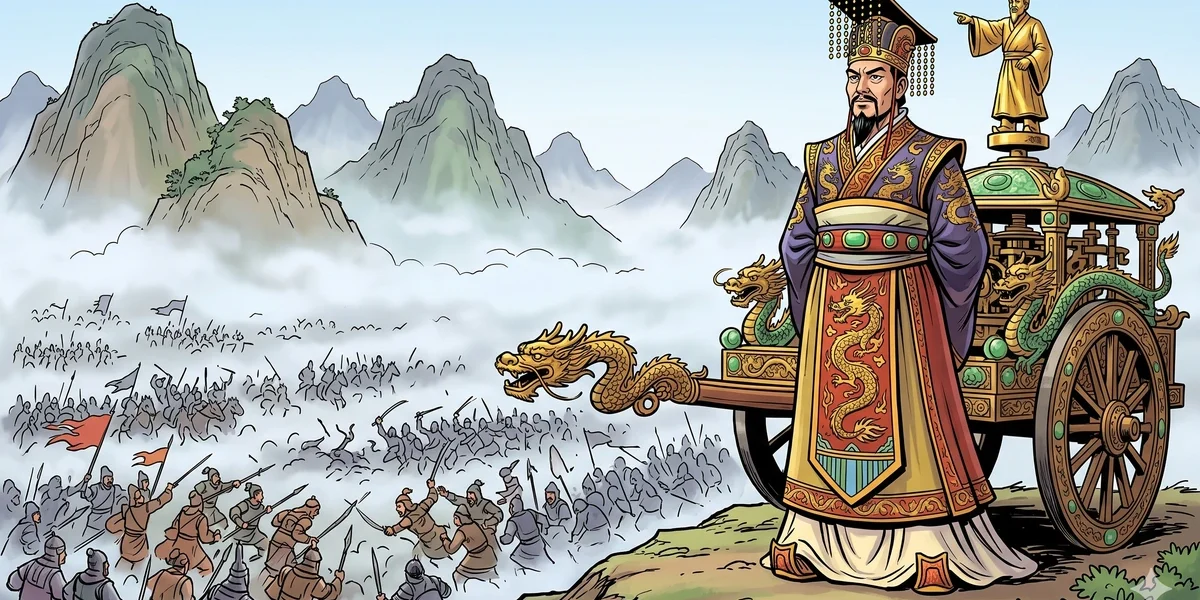
The Yellow Emperor, sovereign of ancient China, is at war with the rebel warlord Chi You — a figure of supernatural power who commands armies and the elements. In the decisive battle, Chi You deploys his most effective weapon: not soldiers but weather. He raises a fog so thick and so persistent that the Yellow Emperor’s army cannot determine direction. They march in circles; they attack their own flanks; the battlefield becomes a trap in which movement only deepens confusion. Chi You’s forces, unaffected, cut through the fog with confidence.
The Yellow Emperor withdraws to his tent and examines the problem with the precision that characterises his legendary intelligence. The enemy’s advantage is not military but epistemological: Chi You controls the information environment. In the fog, the Yellow Emperor’s soldiers cannot distinguish north from south, advance from retreat, allied position from enemy. The fog is a technology of disorientation, and the answer to disorientation is an instrument that cannot be disoriented.
He sets his craftsmen to work. The result is the shinansha — a carriage mounted with a mechanical figure that uses a differential gear system to maintain its pointing direction regardless of the carriage’s rotation. The figure always points south. In the thickest fog, at any speed, after any number of turns, the figure points south. The emperor’s army can now navigate the fog as reliably as open ground.
Beat II — Truth That Survives Confusion
The decisive battle resumes. Chi You raises his fog. The Yellow Emperor’s army moves through it in formation — not hesitantly, not in circles, but with the measured confidence of soldiers who know where they are going. The shinansha carriage at the centre of the formation is the reference point around which all movement is calibrated. Chi You’s advantage evaporates. His soldiers, watching the enemy move through their fog as if it were not there, lose the confidence that the fog was supposed to provide them. The Yellow Emperor wins.
The legend’s accounts of the shinansha’s mechanism vary: some describe a magnetic compass, others a mechanical differential system in which gears compensate for the carriage’s rotation to keep the pointing figure stable. Modern engineering historians regard the mechanical differential account as plausible and note that a working reconstruction was built in China in the third century CE. The Japanese tradition preserves the story primarily for its epistemological point rather than its mechanical specifics: the shinansha is the device that maintains invariant truth in a field of manufactured confusion.
Beat III — The Compass as Epistemological Instrument
Japanese scientific and philosophical tradition, which received the shinansha story through Chinese encyclopaedic texts, has consistently read it as a parable about the relationship between invariant truth and deliberate disorientation. Chi You’s fog is not merely a meteorological phenomenon — it is a strategic manipulation of the information environment, designed to make the enemy’s accumulated knowledge useless. The army that has marched a thousand campaigns cannot apply that experience when it cannot determine which direction it is walking.
The shinansha’s response is not to dispel the fog — it makes no attempt to change Chi You’s information environment. It provides, within the fog, an instrument that is immune to the fog’s effects. The pointing figure does not know about the fog; it is not confused by the fog; it simply maintains its orientation through a mechanical principle that does not depend on visibility, sensation, or interpretation. This is the instrument’s genius: it is not smarter than the fog, it is indifferent to it.
Meiji-era Japanese intellectuals who encountered Western scientific epistemology found in the shinansha legend a native precedent for the principle that reliable instruments of measurement are more useful than improved powers of perception. The compass does not see better; it measures differently. And measuring differently, in this case, is what survives a world deliberately constructed to defeat seeing.
Beat IV — The Leader Who Trusts the Instrument
The legend’s final claim is about leadership as much as technology. The Yellow Emperor does not simply possess the shinansha — he trusts it absolutely, in the fog, when every sensory impression argues against the direction it indicates. His soldiers follow its testimony rather than their intuitions. The instrument is valuable only because the person who holds it is capable of overriding what feels true in favour of what the instrument measures.
This is the story’s practical wisdom: an instrument of invariant truth is useless to someone who will abandon it the moment it contradicts their experience. The Yellow Emperor’s soldiers, marching confidently through a fog that told them they were lost, are the image of a specific kind of intellectual courage — the willingness to trust a reliable method even when the world feels like it is arguing otherwise.
“The compass that always points the same direction is useful only when you trust it absolutely — and the leader who follows the instrument of truth even when the landscape argues otherwise will find the way out that the landscape was designed to conceal.”
Why This Story Lasted
The shinansha legend has lasted in Japan and China because it names a problem that every generation recognises in new forms: the deliberate construction of an environment designed to make reliable judgment impossible. Chi You’s fog is a metaphor that has been applied to propaganda, to information overload, to institutional opacity. The shinansha’s answer — a device immune to the confusion rather than a device for seeing through it — remains a useful way of thinking about what reliable methodology actually provides.
Historical and Scientific Context
The south-pointing carriage appears in Chinese historical records from the third century CE onward, with accounts of working mechanical constructions. The earliest documentary references connect the device to the legendary Yellow Emperor, but the historical implementations are associated with the craftsmen of the Three Kingdoms period (220–280 CE). The mechanical principle — a differential gear system that compensates for carriage rotation — was independently rediscovered in Europe in the seventeenth century. The magnetic compass, which is the device’s conceptual descendant, entered Japanese maritime navigation in the medieval period and was central to the period of Japanese naval expansion. The shinansha legend thus connects mythological time to the practical navigation that shaped Japanese history.
Frequently Asked Questions
What is the moral of The Shinansha?
In a world deliberately constructed to produce disorientation, the most valuable tool is not improved perception but an invariant instrument — one that measures truth through a method immune to the confusion. The shinansha legend argues that reliable methodology (the compass) can be more powerful than superior intelligence, because intelligence operates on the same information that the confusion has corrupted.
How does the south-pointing carriage work?
Historical accounts describe a mechanical differential gear system: a figure mounted on a carriage that is connected through gears to the wheels so that when the carriage turns, the gears rotate the figure in the opposite direction by the same amount, keeping it pointing in a constant direction regardless of the carriage’s orientation. A working reconstruction was documented in China in the third century CE. Some later accounts conflate the device with a magnetic compass, which works through a different principle but achieves the same navigational function.
Who is Chi You and what does he represent?
Chi You (蚩尤) is a figure from Chinese mythology — a rebel warlord or war deity who fought the Yellow Emperor in the mythological founding conflict of Chinese civilisation. He is associated with metal weapons, war, and in some traditions with shamanic power over weather and mist. His fog in the shinansha legend represents the deliberate manipulation of the information environment — not natural confusion but engineered disorientation deployed as a military and epistemological weapon.
Why did the Yellow Emperor invent the shinansha instead of fighting through the fog?
Because the fog’s advantage is epistemological rather than physical: it does not harm the Yellow Emperor’s soldiers, it makes their knowledge and experience useless by depriving them of orientation. Fighting through the fog without the shinansha would simply mean sustaining more circular marching and more casualties from friendly fire. The correct response to an epistemological weapon is an epistemological counter — a device that removes the fog’s advantage without requiring the fog to be lifted.
How was the shinansha received in Japan?
The legend entered Japan through Chinese encyclopaedic and historical texts in the Nara and Heian periods, where it was read primarily as evidence of ancient Chinese ingenuity and as a model of sovereign wisdom. Meiji-era Japanese intellectuals, encountering Western scientific methodology, found in the shinansha a native Asian precedent for the principle that reliable instruments of measurement can substitute for or exceed the capabilities of unaided human perception. The story has been used in Japanese science education as an introduction to the concept of invariant measurement.
You May Also Like
 Japanese Folk Tales
All Ages
Japanese Folk Tales
All Ages
The Quarrel Of The Monkey And The Crab
The Quarrel Of The Monkey And The Crab: Long, long ago, one bright autumn day in Japan, it happened, that a pink-faced monkey and a yellow crab were playing
 Japanese Folk Tales
All Ages
Japanese Folk Tales
All Ages
How An Old Man Lost His Wen
How An Old Man Lost His Wen: Many, many years ago there lived a good old man who had a wen like a tennis-ball growing out of his right cheek. This lump was a
 Japanese Folk Tales
All Ages
Japanese Folk Tales
All Ages
The Goblin Of Adachigahara
The Goblin Of Adachigahara: Long, long ago there was a large plain called Adachigahara, in the province of Mutsu in Japan. This place was said to be haunted by