The Tongue-Cut Sparrow
The Tongue-Cut Sparrow: Long, long ago in Japan there lived an old man and his wife. The old man was a good, kind-hearted, hard-working old fellow, but his
Origin & Tradition
The Tongue-Cut Sparrow (Shita-kiri Suzume, 舌切り雀) is one of the most beloved and widely told tales in the Japanese oral and literary tradition, included in the foundational Edo-period collection Otogi-zōshi (お伽草子) and subsequently in every major anthology of Japanese children’s stories. It belongs to the genre of on-gaeshi (恩返し, return of grace-debt) tales — narratives in which a creature helped by a human repays the kindness through supernatural generosity — but its structure is complicated by a second figure whose actions provide the story’s moral contrast. The tale has been analysed as a study in the consequences of cruelty, a commentary on the nature of desire, and a folk-tradition explanation of why certain people find abundance and others find ruin in apparently identical circumstances.
Beat I — The Old Man’s Sparrow
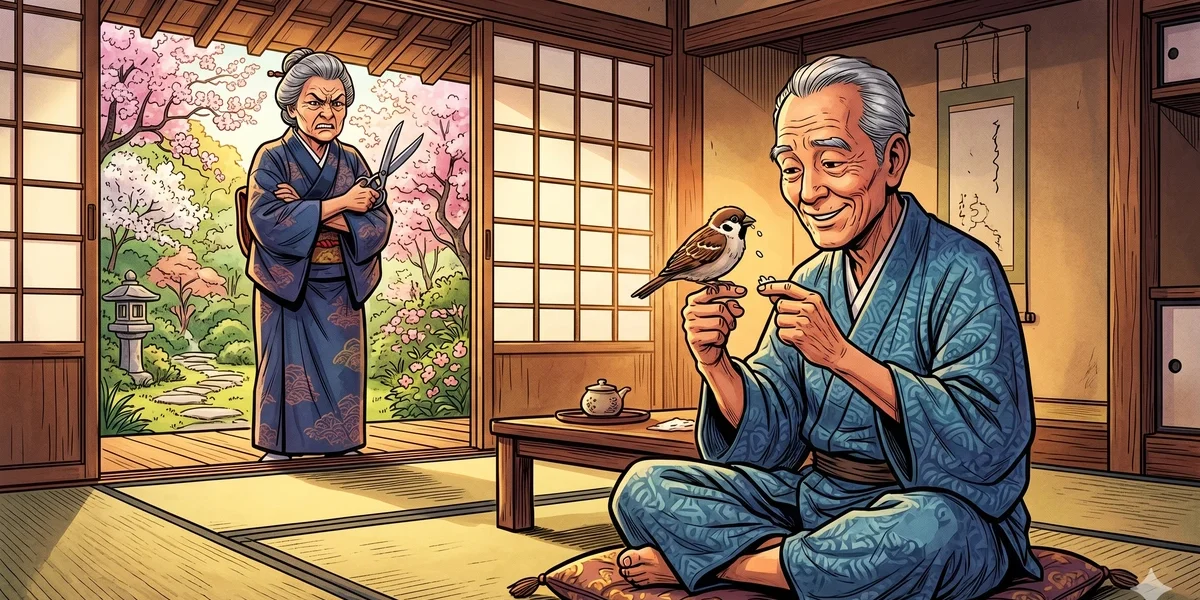
An old man who lives simply and cheerfully finds a young sparrow injured in his garden. He takes it in, feeds it rice from his own bowl, and nurses it back to health over weeks of patient care. The sparrow, fully recovered, becomes a household companion — it sings in the morning, follows him on his walks, and eats alongside him at mealtimes. His wife, a sharp-tempered woman whose orientation toward the world is consistently extractive, has always resented the bird’s consumption of rice that she regards as her resource. One day, while the old man is out, she finds the sparrow eating from her starch paste and cuts its tongue with scissors. The sparrow flies away in pain and does not return.
When the old man comes home and learns what happened, he sets out immediately to find the sparrow. He travels through forests and over hills, asking the birds he meets if they know where the tongue-cut sparrow has gone, until he is directed to a bamboo grove where the sparrow has established a household of its own — a small palace, clean and beautifully arranged, where the sparrow and its family live in evident contentment.
Beat II — Two Visits and Two Baskets
The sparrow receives the old man with the full hospitality of the on-gaeshi tradition: a feast, songs, dancing, three days of celebrations that make him feel younger than he has in years. When he finally prepares to leave, the sparrow presents him with a choice: a large basket or a small basket, both sealed. The old man, who carried nothing heavy on the journey and feels no need of treasure, takes the small basket and carries it home. When he opens it, it is full of gold and jewels — enough to keep him comfortable for the rest of his life.
The wife, who has been watching for his return with the focused attention she brings to any situation that might produce material advantage, demands to know where he went and what he found. He tells her everything. She sets out immediately for the bamboo grove — not to apologise for cutting the sparrow’s tongue, not from any feeling of remorse, but because a feast and a basket of gold are available and she intends to claim them.
The sparrow receives her. The hospitality is formally correct. When it is time to leave, she is offered the same choice: large basket or small basket. She takes the large basket — naturally, obviously, without a moment’s hesitation — and carries it home as fast as she can manage. When she opens it far from the bamboo grove, it is full of wasps, snakes, and creatures she cannot name. They are not pleased to be enclosed in a basket.
Beat III — Karmic Self-Selection and the Quality of Desire
Japanese literary commentary on this tale consistently focuses on the basket choice as something more precise than a simple test of greed. The old man chooses the small basket not from virtue performed for an audience — he does not know what either basket contains — but from the natural expression of a character that has always been oriented toward sufficiency. He does not want more than he needs; he never has. When he holds the small basket, it feels right to him in a way that has nothing to do with calculation.
The wife chooses the large basket from the natural expression of an equally genuine character — one that has always been oriented toward maximum acquisition. She does not calculate whether the large basket might be a trap; it does not occur to her that it could be, because in her understanding of the world, more is always better. The basket reflects what she carries inside her: the capacity for unlimited wanting without a corresponding sense of sufficiency at any point.
The contents of the baskets are therefore not punishments imposed from outside but consequences that emerge from the choosers’ own orientations. The sparrow does not decide to punish the wife; it offers both figures the same genuine choice and the same genuine opportunity. What each receives is the natural complement of what each sought. This is the Japanese folk-tradition concept of jigō jitoku (自業自得, one’s own deeds return to oneself) expressed through the mechanism of desire rather than action: the wife is harmed not by what she did to the sparrow but by what she is, which the basket choice makes visible.
Beat IV — The Sparrow That Forgives Without Being Asked
The tale’s most ethically complex element is the sparrow’s treatment of the wife during her visit. It does not refuse to receive her, does not punish her for the tongue-cutting, does not deliver a speech about consequences. It extends the same hospitality it gave the old man — feast, song, dancing — and offers the same choice. This is not indifference to the cruelty she inflicted; it is something more demanding: the decision to let the wife’s own nature determine what happens next. The sparrow does not need to punish her. It needs only to give her a genuine choice, and her own desire will do the rest.
This is also why the old man is rewarded before the wife arrives, which removes any question of the sparrow’s motivation. The gold in the small basket is the expression of genuine on-gaeshi to the person who genuinely helped the sparrow. What happens to the wife is a separate matter entirely — a consequence that the sparrow observes but does not author.
“Cruelty to the small and defenceless does not go unnoticed by the world — and the choice between two baskets is not merely a story about greed but a precise test of what you carry inside you when you think no one is watching.”
Why This Story Lasted
The Tongue-Cut Sparrow has lasted because the basket choice is one of the most psychologically precise moments in world folk literature: a genuine choice, no external pressure, no information advantage — just two people bringing their entire characters to a single decision. The story’s claim is that character, at scale, is reliable: the person who has always wanted sufficiency will choose the small basket; the person who has always wanted more will choose the large one. The sparrow does nothing but provide the test.
In the Japanese Literary Tradition
Shita-kiri Suzume was included in Lafcadio Hearn’s influential English-language collection of Japanese folktales in the late nineteenth century, which introduced the story to Western audiences. In Japan it remains a standard text in early childhood education, taught alongside Momotarō and Urashima Tarō as one of the three essential Japanese folk narratives. The sparrow (suzume) is a common figure in Japanese poetry and art, associated with cheerfulness, small-scale domesticity, and the ordinary pleasures of daily life — qualities the story endorses against the wife’s extractive orientation.
Frequently Asked Questions
What is the moral of The Tongue-Cut Sparrow?
Kindness offered without expectation of return creates an obligation in the world that the world will eventually honour; cruelty inflicted on the defenceless produces consequences not through supernatural punishment but through the natural operation of the cruel person’s own character, which the sparrow’s basket choice makes visible. Jigō jitoku — one’s own deeds return to oneself — operates through desire as much as through action.
Why does the wife cut the sparrow’s tongue?
Because the sparrow ate from her starch paste — a resource she regarded as exclusively hers. The tongue-cutting is an act of disproportionate cruelty in response to a minor irritation, which reveals a character that responds to perceived loss with punishment rather than with proportion. This is the same character that chooses the large basket without hesitation.
Why does the sparrow offer both visitors the same choice?
Because the sparrow’s on-gaeshi (return of grace-debt) to the old man is genuine and complete — it offers him a real choice and real treasure. What happens to the wife is a separate matter: the sparrow does not need to punish her. It offers the same genuine choice, and the wife’s own orientation determines what she receives. The sparrow does not author her consequence; it only provides the opportunity for her character to express itself.
What does the basket choice test?
The orientation of desire — whether the chooser’s inner life is calibrated toward sufficiency or toward maximum acquisition. The old man has never wanted more than he needs, so the small basket feels natural to him. The wife has always wanted more than she has, so the large basket is the only possible choice. Neither thinks about the choice for long; both simply express what they are. The test is a mirror, not a trap.
What is on-gaeshi and how does it work in Japanese folk tradition?
On-gaeshi (恩返し, return of grace-debt) is the obligation felt and discharged when a creature has received genuine, uncalculated benefit from a human. In Japanese folk tradition, animals — cranes, foxes, sparrows, turtles — frequently carry on-gaeshi debts that they repay through supernatural generosity. The sparrow’s hospitality and the basket of gold are the precise, proportionate return for years of care and companionship. On-gaeshi operates between species as naturally as between people: the moral economy of the natural world in Japanese tradition is as binding as any human contract.
You May Also Like
 Japanese Folk Tales
All Ages
Japanese Folk Tales
All Ages
The Story Of The Man Who Did Not Wish To Die
The Story Of The Man Who Did Not Wish To Die: Long, long ago there lived a man called Sentaro. His surname meant “Millionaire,” but although he was not so rich
 Japanese Folk Tales
Ages 9-12
Japanese Folk Tales
Ages 9-12
Princess Hase: The Bamboo Princess of Yamato
Princess Hase: The Bamboo Princess of Yamato: In the province of Yamato, where bamboo groves swayed like dancers and mountain mists clung to valleys like
 Japanese Folk Tales
Ages 6-8
Japanese Folk Tales
Ages 6-8
The Tongue-Cut Sparrow: A Japanese Folktale
The Tongue-Cut Sparrow: A Japanese Folktale: In a village set among the gentle mountains of old Japan, there lived a kind-hearted old man named Takehiro and