The Story Of The Man Who Did Not Wish To Die
The Story Of The Man Who Did Not Wish To Die: Long, long ago there lived a man called Sentaro. His surname meant “Millionaire,” but although he was not so rich
Origin & Tradition
The Story of the Man Who Did Not Wish to Die belongs to the Japanese tradition of immortality tales — narratives about those who sought or achieved deathlessness and discovered its cost. This tale-type is documented in several Edo-period collections and connects to the broader East Asian tradition of elixir-of-life narratives found in Chinese Daoist texts and Buddhist teaching stories. The Japanese version is characterised by its specific emotional register: not horror at immortality’s failure but melancholy at its success. The man achieves what he sought, and the achievement reveals, with patient precision, everything he did not understand about what he was asking for. It is a meditation on mujō (無常, impermanence) — the Buddhist principle that all things change and pass, and that this impermanence is not the enemy of value but its ground.
Beat I — The Man Who Found the Elixir
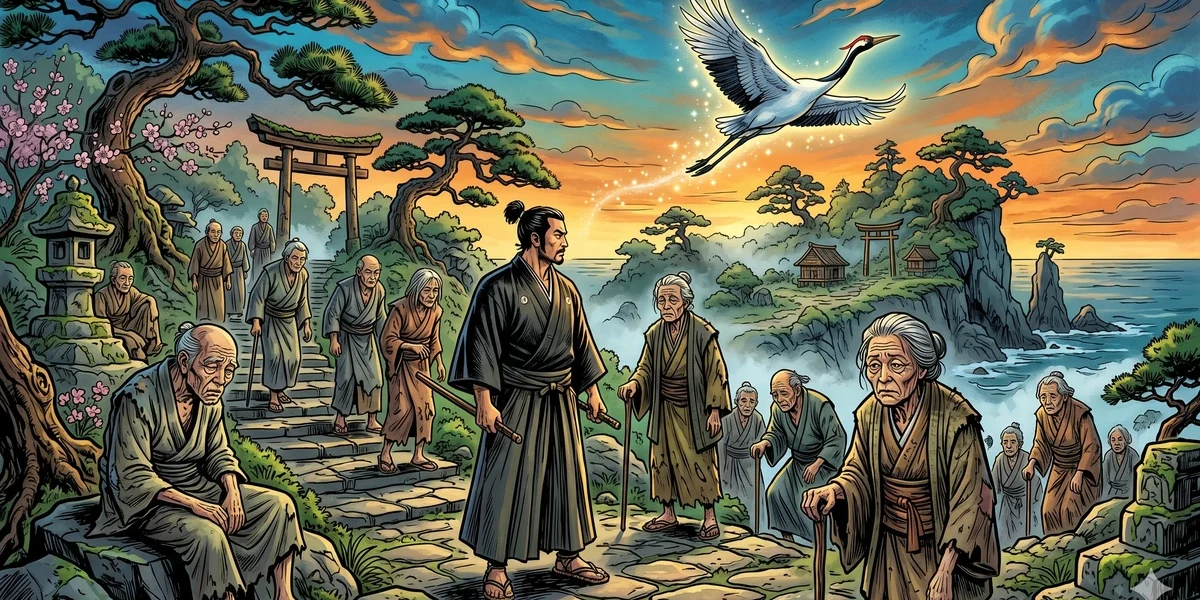
A man who fears death above all things hears of a mountain where a herb grows that, if eaten, grants immortality. He searches for years — through forests, over ranges, past the usual limits of human exploration — and finds it. He eats it. He waits. Nothing appears to change, but as years pass he notices that he is not aging. He returns to his village and his family. Ten years later, then twenty, then forty — he is unchanged. His parents die. His siblings age and die. His wife ages and dies. His children age and die.
He moves to another village, and another, and another — always eventually conspicuous by his unchanging face, always eventually feared or resented by those who grow old around him while he stays the same. He learns to keep moving before anyone notices. He carries no possessions, because possessions accumulate history and history marks time’s passage in ways his face no longer can. He becomes an expert in impermanence — not through wisdom but through repeated loss.
Beat II — What the Immortal Discovers
Centuries pass. The man who did not wish to die has now outlasted everyone he did not wish to be separated from — not only the people he loved but the landscapes he loved, the buildings he knew, the language he spoke as a child. He is not unhappy in any acute way; the grief of each individual loss has long since become bearable through repetition. What he is instead is alone in a way that has no remedy, because the specific form of aloneness he experiences — being the only person who remembers what the world was like — cannot be shared with anyone who is still alive.
He begins to understand, centuries in, that what he wanted when he sought the elixir was not deathlessness but the preservation of the specific life he had at the moment he found the herb. He wanted his wife not to die; he wanted his parents to remain; he wanted the village he grew up in to stay as it was. The elixir gave him the continuation of his body but not the continuation of anything that gave his body a reason to continue. He confused the container with the contents.
Beat III — Mujō as the Ground of Beauty
Japanese Buddhist tradition, particularly as it was expressed through the Heian aesthetic concept of mono no aware (物の哀れ, the pathos of things), understands impermanence not as a defect of existence but as the condition that makes beauty possible. The cherry blossoms are beautiful because they fall; the moon is moving because clouds pass across it; the person you love is precious because they will die and so will you. Remove impermanence and you remove the poignancy — the sense that what is here now is here now and not for always.
The immortal man in the tale embodies the logical inverse of this insight: he has removed impermanence from himself and discovered that the beauty his life contained was precisely the beauty of sharing a finite time with other finite people. His immortality makes him unable to participate in this beauty in any but the most transient way — he can observe it in others but cannot share it, because sharing it requires being subject to the same ending that gives the shared time its weight.
The tale does not offer the man a way out. He is immortal; he cannot undo the herb. What he can do — and what the best versions of the story show him doing — is learn to be genuinely present for the finite lives of those he encounters, knowing he will outlive them, offering what presence he can without pretending that it is equal to what they offer each other. This is a limited and melancholy gift, but it is what is available to him, and learning to give it fully is the closest thing to redemption the tale allows.
Beat IV — The Gift He Could Not Give Back
Japanese storytellers have consistently read this tale as a warning about the specific form of desire that wishes to stop time — to hold onto what is most loved by preventing it from changing. The man who ate the elixir wanted to prevent loss, but what he actually prevented was participation in life’s ongoing movement. To live is to move with time; to stop moving with time is to become a witness rather than a participant, present but not present in the way that matters, watching but unable to fully belong to what you are watching.
The story’s final melancholy is that he cannot give the gift of mortality back. He carries it, and will carry it, past every horizon the story can name. The Japanese tradition does not resolve this — it holds the grief open as a reminder that the desire to stop time is the desire to trade life for the preservation of what made life worth living, and that the trade does not work in the direction the buyer expects.
“The desire for eternal life, pursued to its conclusion, discovers that what makes life worth living is not its duration but its participation in the world that changes around you — and the one who stops changing eventually finds themselves a stranger to everything they wished to preserve.”
Why This Story Lasted
The immortality tale has lasted because the desire it depicts — to hold onto what we love by preventing its loss — is one of the most universal human experiences, and the story’s answer is one of the most honest: the holding-onto itself is what ensures the loss. What we love is inseparable from its impermanence, and the elixir that removes the impermanence removes what we loved along with it. Every generation finds in the immortal man’s loneliness the mirror of a smaller-scale experience they have already had.
Immortality Tales in East Asian Tradition
Tales of immortality seekers — and the unexpected costs of finding what they sought — are documented across Chinese Daoist literature, Korean folk tradition, and Japanese narrative from the Heian period onward. The Japanese tradition is distinguished by its consistent deployment of mono no aware as the philosophical frame: the immortal is not punished for hubris or greed but confronted with the discovery that the beauty he sought to preserve was inseparable from the impermanence he sought to escape. This insight connects the immortality tale to Japanese aesthetic traditions in poetry, garden design, and the tea ceremony — all of which are structured to make impermanence visible and felt as a positive quality rather than a deficiency.
Frequently Asked Questions
What is the moral of The Man Who Did Not Wish to Die?
What makes life valuable is not its duration but its participation in time alongside other beings who are also subject to time. Immortality removes the person from this participation — they can observe but not fully share in the beauty and weight of finite life — and in doing so, removes the very thing the elixir was sought to preserve. Impermanence is not the enemy of value but its source.
What is mujō and how does it apply to this story?
Mujō (無常, impermanence) is the Buddhist principle that all conditioned phenomena are impermanent, constantly arising and passing away. In Japanese aesthetic tradition, this is not understood as depressing but as the ground of beauty — things are beautiful because they change and pass. The immortal man’s story is the thought experiment that proves this: remove impermanence from a person and you remove their capacity to participate in the beauty that impermanence makes possible.
Why does the man keep moving from village to village?
To avoid being noticed as someone who doesn’t age — which would make him an object of fear or superstition rather than a member of the community. His constant movement is a symptom of his immortality: he can never be fully known by any community because being fully known requires being there long enough to be seen to change, and he does not change. He is always slightly outside any context he inhabits.
How does this tale relate to Urashima Tarō?
Both involve the experience of being displaced from ordinary time — Urashima through involuntary temporal acceleration, the immortal through the voluntary suspension of aging. The emotional core is the same: the discovery that the world has moved past the point where re-entry is fully possible. The difference is consent: Urashima did not choose his displacement, the immortal did, and the immortal’s grief therefore includes the knowledge that he chose this, which Urashima’s does not.
What is mono no aware and how does it connect to this story?
Mono no aware (物の哀れ, the pathos of things) is the Heian-period aesthetic concept that describes the bittersweet feeling produced by beautiful things that are passing or impermanent. It is the feeling that gives Japanese art — cherry blossoms, autumn leaves, fading temple ceremonies — its characteristic emotional register. The immortal man has, by removing himself from impermanence, removed himself from the possibility of mono no aware — he can witness it in others but cannot experience it in himself, because experiencing it requires being subject to the same ending that makes the passing thing precious.
You May Also Like
 Japanese Folk Tales
All Ages
Japanese Folk Tales
All Ages
The Adventures Of Kintaro, The Golden Boy
The Adventures Of Kintaro, The Golden Boy: Long, long ago there lived in Kyoto a brave soldier named Kintoki. Now he fell in love with a beautiful lady and
 Japanese Folk Tales
All Ages
Japanese Folk Tales
All Ages
The Story Of Urashima Taro, The Fisher Lad
The Story Of Urashima Taro, The Fisher Lad: Long, long ago in the province of Tango there lived on the shore of Japan in the little fishing village of
 Japanese Folk Tales
All Ages
Japanese Folk Tales
All Ages
My Lord Bag Of Rice
My Lord Bag Of Rice: Long, long ago there lived, in Japan a brave warrior known to all as Tawara Toda, or “My Lord Bag of Rice.” His true name was Fujiwara