My Lord Bag Of Rice
My Lord Bag Of Rice: Long, long ago there lived, in Japan a brave warrior known to all as Tawara Toda, or “My Lord Bag of Rice.” His true name was Fujiwara
Origin & Tradition
My Lord Bag of Rice is the popular English rendering of the legend of Tawara Tōda (俵藤太, “Bag-of-Rice Fujita”), a historical figure from early Heian-period Japan (late ninth to early tenth century) around whom a cycle of semi-legendary tales accumulated. The central episode — Tōda’s slaying of the giant centipede that threatened the Dragon King of Lake Biwa — was documented in the Konjaku Monogatarishū (今昔物語集, Tales of Times Now Past, c. 1120), one of the great medieval Japanese tale collections, and has been retold in illustrated books, kabuki plays, and popular literature ever since. The story belongs to the genre of eiyū tan (英雄譚, heroic narrative) but with a distinctively Japanese inflection: the hero’s greatness is demonstrated not by desire for glory but by the readiness to respond to need without weighing the personal cost.
Beat I — The Warrior Who Didn’t Step Over the Serpent
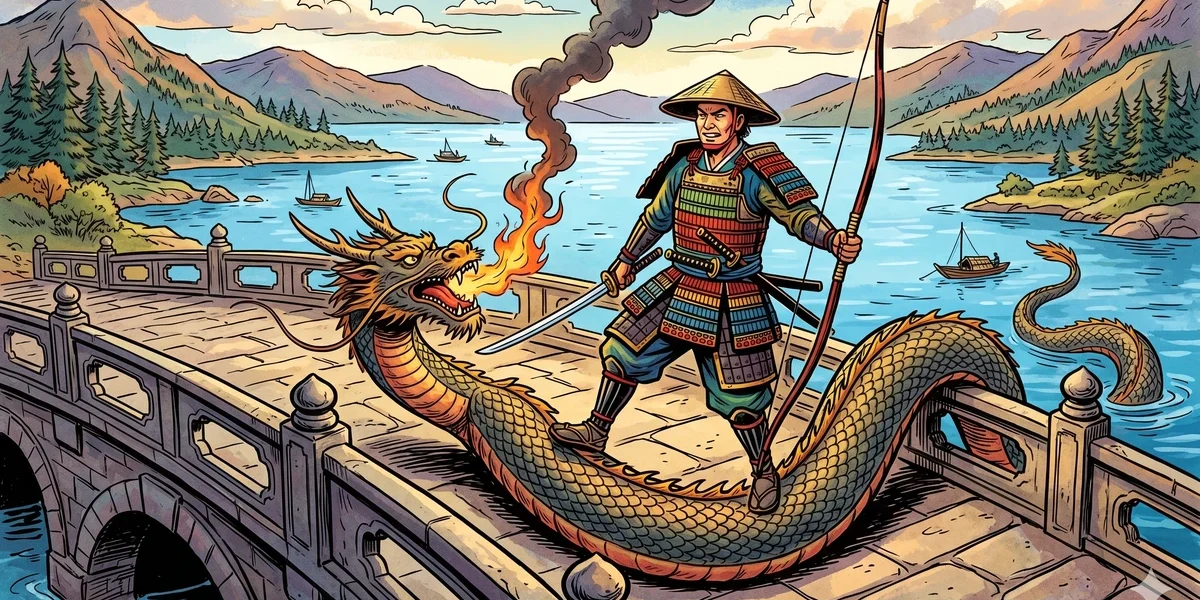
Fujiwara no Hidesato — the historical figure behind the Tawara Tōda legend — is crossing the bridge at Lake Biwa when he encounters an enormous serpent lying across the road. Most travellers would detour, step carefully around it, or retreat. Hidesato steps over it without hesitation and continues on his way.
He has gone only a little distance when a voice calls him back. He turns and finds a young man in fine clothing where the serpent had lain — the dragon of Lake Biwa, assuming human form. The dragon bows and explains: he chose this test deliberately. He has been troubled for a long time by a giant centipede (mukade) that descends from Mount Mikami at night and devours his people. He has asked many warriors to help him; all have shown fear at the test of the serpent and been dismissed as unworthy of the task. Hidesato alone passed without flinching. Will he help?
Hidesato agrees. He asks only to see the enemy.
Beat II — The Centipede and the Arrow
At the appointed hour the centipede appears on the mountain — a creature of monstrous length, its body lighting the hillside with phosphorescent fire, its hundreds of legs moving with a slow certainty that makes the watching warriors reach for their weapons. Hidesato strings his bow and shoots. The arrow strikes the centipede’s head and falls away — the armour is too thick. He shoots again. The same result.
He has one arrow left. He remembers a tradition: human saliva applied to an arrowhead has power against supernatural creatures. He licks the tip of the arrow, draws the bow, and releases. The arrow drives through the centipede’s head. The light goes out. The body stills. The mountain is quiet.
The dragon of Lake Biwa is free. The gratitude is proportionate to the relief: he invites Hidesato to a feast in his underwater palace, and when the warrior prepares to leave, the dragon’s family brings gifts. A bronze bell. A roll of silk. A cooking pot. A suit of armour. And a bag of rice — a bag that, no matter how much rice is taken from it, is never empty.
Beat III — Bushi no Nasake and the Weight of the Unasked Return
The Japanese warrior code of the Heian period, still forming in the era of this legend, included the principle of bushi no nasake (武士の情け, warrior’s compassion) — the obligation to respond to genuine need and genuine distress even when the response is dangerous and when no personal advantage is apparent. Hidesato does not help the dragon because he expects reward. He steps over the serpent because he is not afraid of serpents; he agrees to fight the centipede because a request has been made by someone who is genuinely suffering and who cannot solve the problem alone.
The specific form of the dragon’s gratitude — a bag of inexhaustible rice — is the story’s most precisely calibrated detail. Hidesato did not perform an act of heroism to become famous or to accumulate wealth. He performed an act of service because it needed doing and he could do it. The appropriate return for such service is not a trophy or a title or a military position — it is the assurance that the basic necessities of life will always be present. The inexhaustible rice bag is the material form of the dragon’s statement: you will never lack for what you need, because you did what was needed without calculating whether it would give you more than you need.
This is also why Hidesato’s name in the legend — Tawara Tōda, “Bag of Rice Fujita” — is the gift itself. He is remembered not by the title he might have sought but by the most ordinary of the dragon’s gifts, the one that sustained his household for the rest of his life. In being named for rice rather than for the centipede he killed, he is defined by what the dragon’s gratitude provided rather than by what his own ambition would have claimed.
Beat IV — The Heroic in the Ordinary
Japanese medieval literature frequently returns to this theme: that the measure of a warrior’s quality is not the scale of their ambition but the completeness of their response to what is immediately in front of them. Hidesato encounters a serpent, steps over it, is asked for help, and gives it. There is no moment of deliberation about whether the dragon is worthy of his skills, whether the centipede is a credible threat, whether the reward will justify the risk. He acts from the warrior’s clarity: the task is here, I can do it, I will do it.
The inexhaustible rice bag ensures that this quality of response — immediate, uncalculating, complete — is rewarded with exactly what it deserves: not glory that fades but sustenance that does not run out. The story’s implicit argument is that the heroic and the ordinary are not opposed categories. The most heroic thing a person can do is to be fully available to what the moment requires, every time the moment requires it, for the rest of their life.
“True courage is measured not in the scale of what you defeat but in the willingness to take on a task that needs doing, to see it through without ceremony, and to accept in return not glory but the simple abundance that honest service earns.”
Why This Story Lasted
The Tawara Tōda legend has lasted because it elevates the ordinary — the bag of rice, the household necessity, the daily sustenance — to the level of heroic reward without irony. It says that the person who acts from duty rather than ambition is the one whose needs the universe tends to meet, and that the greatest possible gift is not gold but the assurance that what you need will always be there. Every generation of Japanese readers has understood this in terms of the economy they actually live in, not the one heroes inhabit in stories.
Historical Basis and Legacy
Fujiwara no Hidesato was a real tenth-century warrior who suppressed the Taira no Masakado rebellion in 940 CE — a genuine military achievement around which legendary material accumulated. The Lake Biwa centipede episode is first documented in the Konjaku Monogatarishū and has been illustrated in woodblock prints (ukiyo-e), performed in kabuki, and retold in children’s literature across the centuries. The inexhaustible rice bag as his defining attribute speaks to the centrality of rice in Japanese culture: to have rice that never runs out is to have security that never runs out, which is the greatest thing anyone can wish for a warrior who fought on behalf of others.
Frequently Asked Questions
What is the moral of My Lord Bag of Rice?
The warrior who acts from duty rather than ambition — who responds to genuine need without calculating the return — receives in exchange not glory but the assurance of sufficiency: what you need will always be there, because you gave what was needed without measuring it first. The story argues that this is the only heroism worth remembering.
Why does Hidesato step over the serpent without flinching?
The story offers no internal explanation — Hidesato does not think about the serpent, he simply steps over it. This is the point: the dragon chose this test precisely because it reveals a quality below deliberation. A warrior who calculates whether the serpent is dangerous before stepping over it is a warrior who will calculate whether the centipede is worth fighting. Hidesato’s fearlessness is not performed; it is constitutive.
Why does human saliva work against the centipede?
The tradition that human saliva has apotropaic power against supernatural creatures is widespread in Japanese folk belief. The centipede (mukade) in Japanese folklore is specifically associated with supernatural malevolence — it appears in other legends as the enemy of dragons and the servant of dark forces. The saliva on the arrowhead is the warrior’s human essence deployed against a supernatural enemy: flesh against spirit, the ordinary against the monstrous.
Why is Hidesato named “Bag of Rice” rather than “Centipede-Slayer”?
Because the inexhaustible rice bag — the most ordinary of the dragon’s gifts — became the most significant thing in his life. In being named for rice rather than for combat, Hidesato is defined by what sustained his household rather than by what his ambition might have claimed. The name is the story’s argument: the heroic act earned ordinary abundance, and ordinary abundance is what matters.
What is the historical basis for the Tawara Tōda legend?
Fujiwara no Hidesato was a real tenth-century warrior who suppressed the Taira no Masakado rebellion in 940 CE, one of the formative military events of early Heian Japan. The centipede legend attached to his name sometime thereafter and was first recorded in the Konjaku Monogatarishū (c. 1120). The legend does not record his actual historical achievements; it records the character his culture attributed to him — and the character it valued most was not ambition but uncalculating readiness to serve.
You May Also Like
 Japanese Folk Tales
All Ages
Japanese Folk Tales
All Ages
The Story Of The Old Man Who Made Withered Trees To Flower
The Story Of The Old Man Who Made Withered Trees To Flower: Long, long ago there lived an old man and his wife who supported themselves by cultivating a small
 Japanese Folk Tales
All Ages
Japanese Folk Tales
All Ages
The Story Of The Man Who Did Not Wish To Die
The Story Of The Man Who Did Not Wish To Die: Long, long ago there lived a man called Sentaro. His surname meant “Millionaire,” but although he was not so rich
 Japanese Folk Tales
Ages 6-8
Japanese Folk Tales
Ages 6-8
The Crane Wife (Tsuru no Ongaeshi)
The Crane Wife (Tsuru no Ongaeshi): In a small mountain village, where winter snow fell like blessings from heaven and spring brought cascades of pink