The Story Of Urashima Taro, The Fisher Lad
The Story Of Urashima Taro, The Fisher Lad: Long, long ago in the province of Tango there lived on the shore of Japan in the little fishing village of
Origin & Tradition
Urashima Tarō (浦島太郎) is one of Japan’s oldest and most enduring narratives, with documentary evidence in the Nihon Shoki (720 CE) and the Man’yōshū poetry anthology (c. 759 CE), making it one of the few Japanese folk tales with a pre-Heian literary record. The name Urashima appears in the Man’yōshū as the subject of a poem about time and loss, and the story has been retold across every subsequent period of Japanese literature and art. It belongs to the global family of tales about mortals who visit magical realms and return to find time has passed differently — but the Japanese version is distinguished by its specific focus on the sealed box, the irreversibility of aging, and the particular sadness of a return that cannot be completed.
Beat I — The Turtle and the Undersea Palace
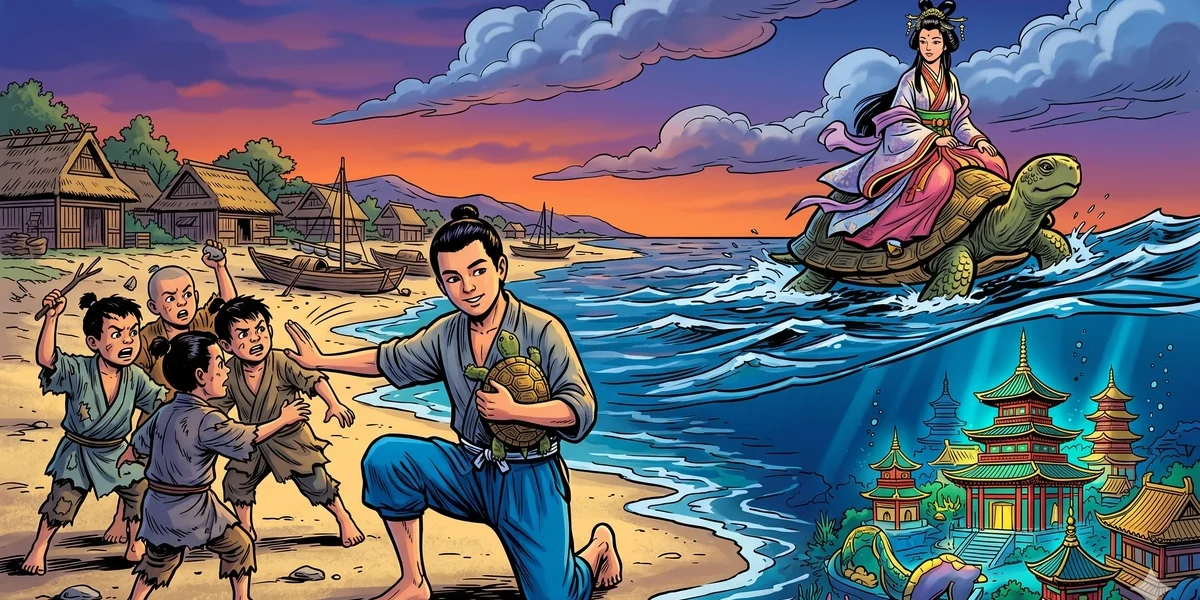
Urashima Tarō is a young fisherman, kind and unassuming, who finds a group of children tormenting a sea turtle on the beach. He sends the children away and releases the turtle into the sea. Days later, fishing from his boat, he is approached by the turtle — which speaks, offering to take him to the undersea palace of Ryūgū-jō (龍宮城, Dragon Palace) as a reward for his kindness.
Urashima agrees and descends. Ryūgū-jō is a place of luminous beauty — coral walls, singing fish, a princess called Otohime who welcomes him with warmth and ceremony. The food is extraordinary, the entertainment endless, the company of the palace inhabitants genuinely delightful. Days pass. Or what feel like days. Urashima is happy — more completely happy than he has ever been — and the days continue to pass.
Eventually he begins to think of his mother, his village, the boat he left on the shore. He tells Otohime he must return. She does not argue. She gives him a lacquered box — the tamatebako (玉手箱, jewelled casket) — and tells him he must never open it. He promises.
Beat II — The Return That Cannot Be Completed
The turtle carries him to the surface. He walks up the beach to his village and finds that nothing is familiar. The houses are different; the faces are different; the children playing in the road do not know the names he knows. He asks an old man if he knows the family of Urashima Tarō. The old man thinks carefully: Urashima Tarō — there is a story about a man of that name, from perhaps three hundred years ago, who went to the Dragon Palace and never returned.
Three hundred years. Urashima has been in Ryūgū-jō for three centuries of the world’s time. Everyone he loved is long dead. The village he left is not the village he stands in. There is nowhere to go.
He opens the box.
White smoke pours out — the three hundred years that Ryūgū-jō held in suspension. It enters him. His black hair turns white in moments; his face lines; his back bends; he ages three hundred years in the time it takes the smoke to disperse, and then he is gone. Some versions end there; others transform him into a crane, the bird of longevity, which carries the story’s unresolved grief into the sky.
Beat III — The Tamatebako and the Unsealable Past
Japanese literary tradition has debated the tamatebako for over a millennium. What exactly does it contain? The most consistent interpretation across classical and modern commentary is that it contains the time Urashima spent at Ryūgū-jō — not in the sense of the memories but in the sense of the years themselves, sealed away from his body so that he did not age while he was there. When he opens the box, those years are released and claim what was always owed to them.
This interpretation makes the tamatebako not a punishment but a physiological necessity: the only way to survive in a realm where time runs differently from the mortal world is to seal your mortal time in a container and carry it with you. The price of the palace’s timelessness is that the time cannot be discarded — it must go somewhere when you leave, and the box is where it waits. Otohime’s warning not to open it is not a test of obedience but a medical instruction: if you open it, everything that should have happened to your body in those three centuries will happen at once.
The story’s deepest melancholy is that Urashima cannot integrate his two experiences. He has lived three hundred years of the world’s time in what felt like days at the palace, and now he stands at the intersection of the two timelines with no way to occupy both. He cannot live in the palace, which has released him. He cannot live in the world, which has moved past him. The tamatebako holds not magic but the literal impossibility of existing in two times simultaneously — and opening it is the only way to resolve the contradiction, at the cost of everything.
Beat IV — Time as the Irreversible Dimension
Urashima Tarō has been read across Japanese literary history as a story about the nature of time itself — specifically about the experience of moving through time at a different rate from those you love and then trying to return. The Man’yōshū poem on the story focuses on loss and longing; Heian-period retellings emphasise the palace’s beauty and the sadness of the return; Edo-period versions for popular audiences often play up the comic aspects of the confusion before the tragic ending reasserts itself.
What all versions agree on is that the box should not be opened and that it will be opened. Not because Urashima is foolish or disobedient but because a person standing alone on a beach where nothing is familiar, where everyone they loved has been dead for three centuries, with a box that was given to them by the only person who was kind to them — that person will open the box. It is the only thing left to do. The story knows this, and does not judge him for it.
“Time spent in a world of perfect happiness is not lost — but the person who returns from it has no way to re-enter the life they left, because both the world and the person have moved past the point where return is possible.”
Why This Story Lasted
Urashima Tarō has lasted for over thirteen centuries because it names an experience that becomes more rather than less familiar with age: the discovery that time spent in one way of living cannot be recovered in another, that the person who returns from an absorbing world of work or love or grief to the ordinary life they left finds both changed beyond recognition, and that the box of sealed time — whatever form it takes — will eventually be opened, because the alternative is to carry it forever and that too is unbearable.
From Man’yōshū to Modern Culture
The Man’yōshū poem on Urashima (Book 9, Poem 1740) is the oldest surviving literary reference, framed as a meditation on loss. The story appears in the Nihon Shoki as a brief historical notice. Heian literary culture elaborated it; Edo woodblock prints made it iconic. In contemporary Japan, Urashima Tarō is immediately recognisable from childhood, and the story has been adapted into manga, anime, video games, and film. The phrase urashima tarō genjō is a living Japanese idiom for the experience of returning to a changed world after a long absence — the cultural shorthand for temporal dislocation.
Frequently Asked Questions
What is the moral of Urashima Tarō?
Time cannot be held in suspension indefinitely, and a person who lives outside ordinary time cannot re-enter ordinary life as if the interval had not occurred. The tamatebako is not a villain — it is the mechanism that made the palace visit possible. Opening it is not weakness; it is the only way to resolve the impossible situation of existing between two times that cannot be occupied simultaneously.
What is in the tamatebako?
Classical Japanese commentary consistently interprets it as containing the time Urashima’s body did not experience during his stay at Ryūgū-jō — the three hundred years held in suspension so he could inhabit a timeless realm without aging. When he opens it, those years are released and claim what was always physiologically owed. It is not a punishment but a debt of time that cannot be cancelled, only deferred.
Why does Urashima open the box when he was told not to?
Because he is standing on a beach in a world where everyone he loved has been dead for three centuries, and the box is the last connection to the person who was kind to him. The story does not frame this as disobedience or foolishness — it frames it as the inevitable action of a person who has been given an impossible situation and has only one remaining option. The story knows he will open it, and does not judge him.
How does time work differently in Ryūgū-jō?
The palace exists in a different temporal regime from the mortal world — what feels like days there corresponds to centuries above. This is consistent with the broader Japanese supernatural geography, in which otherworldly realms (the undersea palace, the mountain deity’s domain, the land of the dead) operate outside ordinary human time. The tamatebako is the technology that makes crossing between these regimes survivable — at the cost of carrying the unmoved time as a sealed burden.
What does the crane transformation mean at the end?
In versions where Urashima becomes a crane after opening the box, the transformation converts irresolvable temporal dislocation into symbolic longevity: the crane (tsuru) is the Japanese emblem of long life, associated with the thousand-year span. The transformation is a way of absorbing the three hundred years into a form that can carry them without being destroyed by them — grief converted into the bird that outlives ordinary human time.
You May Also Like
 Japanese Folk Tales
All Ages
Japanese Folk Tales
All Ages
My Lord Bag Of Rice
My Lord Bag Of Rice: Long, long ago there lived, in Japan a brave warrior known to all as Tawara Toda, or “My Lord Bag of Rice.” His true name was Fujiwara
 Japanese Folk Tales
Ages 9-12
Japanese Folk Tales
Ages 9-12
The Sagacious Monkey And The Boar
A clever monkey and a strong boar overcome their differences to work together, discovering that cooperation beats individual struggle.
 Japanese Folk Tales
All Ages
Japanese Folk Tales
All Ages
The Quarrel Of The Monkey And The Crab
The Quarrel Of The Monkey And The Crab: Long, long ago, one bright autumn day in Japan, it happened, that a pink-faced monkey and a yellow crab were playing