The Sagacious Monkey and the Boar
An old performing monkey about to be sold to the butcher asks a wise boar for help, and the two stage a baby-snatching so the monkey can be the hero.
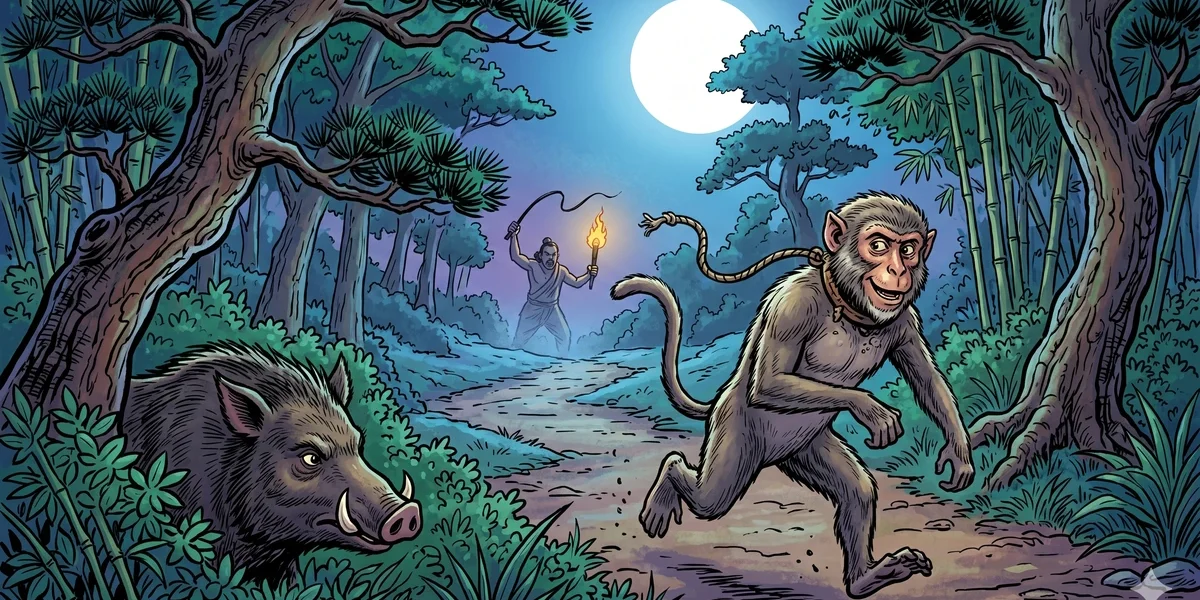
Long ago, in the province of Shinshin, there lived a traveling showman who made his living by taking a monkey from place to place and showing off its tricks. One evening he stormed home in a foul mood and ordered his wife to fetch the butcher first thing next day.
His wife was puzzled. “Why do you want the butcher?”
“There’s no point taking that monkey round any more. He’s old now and can’t remember his tricks. However hard I thrash him, he still won’t dance properly. I’ll have to sell him to the butcher and get what money I can for him. There’s nothing else for it.”
His wife pitied the little creature and begged her husband to spare him, but it was no use. He had made up his mind.
The monkey, though, was just next door and caught every word. He understood that he was going to be killed. “How cruel my master is!” he said to himself. “Year after year I have served him loyally, and rather than let me end my days in peace, he is going to have me cut up by the butcher and cooked and eaten. Whatever shall I do? Ah, I have an idea! There is a wild boar living in the forest nearby, and I have often heard how wise he is. If I go and tell him my trouble, perhaps he will advise me.”
Not a moment could be wasted. Out of the house he crept and off to the woods he raced, where he found the boar in his lair and blurted out the whole sad tale. “Honorable Mr. Boar, everyone speaks of how wise you are. I am in terrible trouble, and only you can help me. I have grown old serving my master, and because I can’t dance properly any more, he means to hand me over to the butcher. What should I do? You are so clever!”
The boar was pleased by the flattery and decided to help. He thought for a moment. “Hasn’t your master got a baby?”
“Oh yes, he has one little son.”
“And doesn’t the baby lie by the door in the morning while your mistress starts her day’s work? Well, early tomorrow I’ll creep up, and the moment nobody is looking I’ll snatch the child and carry it off.”
“And after that?” asked the monkey.
“Why, the mother will be frightened out of her wits, and while your master and mistress are still wondering what to do, chase after me, rescue the child and carry it safely home to its parents. Then, when the butcher turns up, they’ll never be able to bring themselves to sell you.”
The monkey thanked the boar again and again and went home. As you can imagine, he hardly slept that night for thinking about the morning, since his life depended on the boar’s plan. He was up first, waiting anxiously, and it seemed a very long time before his mistress began moving about and opening the shutters to let in the daylight. Then everything happened just as the boar had planned. As she always did, the mother put her baby down by the porch while she tidied the house and made breakfast. The child was cooing happily in the morning sunshine, patting at the light and shadows on the mats.
All at once something rustled in the porch and the baby wailed. The mother dashed from the kitchen only to glimpse the boar vanishing through the gate, her child in its grip. Flinging up her hands with a scream of despair, she ran to wake her husband, who lay snoring in the inner room. He sat up slowly, rubbed his eyes and asked crossly what all the noise was about. When at last he grasped what had happened and the two of them reached the gate, the boar was far off, but they saw the monkey racing after the thief as fast as his legs would carry him.
Husband and wife were full of admiration for the brave, clever monkey, and they could not thank him enough when he carried the child safely back into their arms.
“You see?” said the wife. “And this is the creature you meant to kill. If it weren’t for the monkey, we’d have lost our child forever.”
“You’re right,” her husband admitted, taking the baby indoors. “Tell the butcher to go away when he gets here. Now let’s all have a good breakfast, monkey included.”
So the butcher was turned away at the door, though he was asked to bring some boar meat for supper, and the monkey was petted and lived out the rest of his days in peace. His master never struck him again.
About this fable
“The Sagacious Monkey and the Boar” is the twelfth tale in Yei Theodora Ozaki’s Japanese Fairy Tales and one of the shortest in the book. It is set in the province of Shinshin, among the traveling showmen who made a living from performing monkeys.
The boar and monkey stage a kidnapping and rescue. The parents do not know it is planned, and their terror is real even though the animals intend to return the baby safely. Ozaki ends with a small joke, as the butcher, sent away, is given an order for boar meat instead.
Read the original: Japanese Fairy Tales (Project Gutenberg)
Reading guidance: older children with adult discussion. The tale includes animal beating, a threat to kill an aging animal, and a staged kidnapping of a baby.
Must the monkey prove his worth again?
The showman values the monkey only while he can perform. His wife objects before any rescue, so the story already offers a reason to spare the animal: years of companionship should not end in cruelty when ability declines. The boar’s scheme changes the master’s calculation, but it leaves that deeper issue unresolved.
Readers know the rescue is staged while the parents do not. That dramatic irony makes the trick clever without making the baby’s use as a prop harmless. The final order for boar meat is uncomfortable beside the boar’s help, even though the story does not say that this particular boar is killed.
Give the wife a short speech using only facts she knew before the kidnapping. What case can she make for caring for the monkey without requiring one more performance?
Talk about it
- Why did the showman want to sell the monkey?
- What was the boar’s clever plan?
- Do you think the showman learned anything? What makes you think so?
Related stories
- The Jelly Fish and the Monkey — another clever Japanese monkey saves his own life
- The Quarrel of the Monkey and the Crab — animal friends make a plan together
- The Farmer and the Badger — a Japanese animal tale of tricks and plans
Frequently Asked Questions
Why did the showman want to sell the monkey?
What was the boar's plan?
What happens to the monkey at the end?
You May Also Like
 Japanese Folk Tales
Ages 9-12
Japanese Folk Tales
Ages 9-12
The Story of Urashima Taro, the Fisher Lad
A kind fisherman rescues a tortoise, marries the Sea King’s daughter, and returns home after three days to find that three hundred years have passed.
 Japanese Folk Tales
Ages 9-12
Japanese Folk Tales
Ages 9-12
How an Old Man Lost His Wen
An old man's dance wins favor at a demons' feast and removes his facial lump; a neighbor's attempt to repeat the success has a different result.
 Japanese Folk Tales
Ages 9-12
Japanese Folk Tales
Ages 9-12
The Mirror of Matsuyama
A dying mother gives her daughter a mirror, and the girl’s faith that she sees her mother’s face in it leads a jealous stepmother to accuse her of witchcraft.