Momotaro: The Peach Boy
Momotaro: The Peach Boy: In the days when Japan was still finding its own voice, there lived in a small village nestled between rice paddies and gentle hills
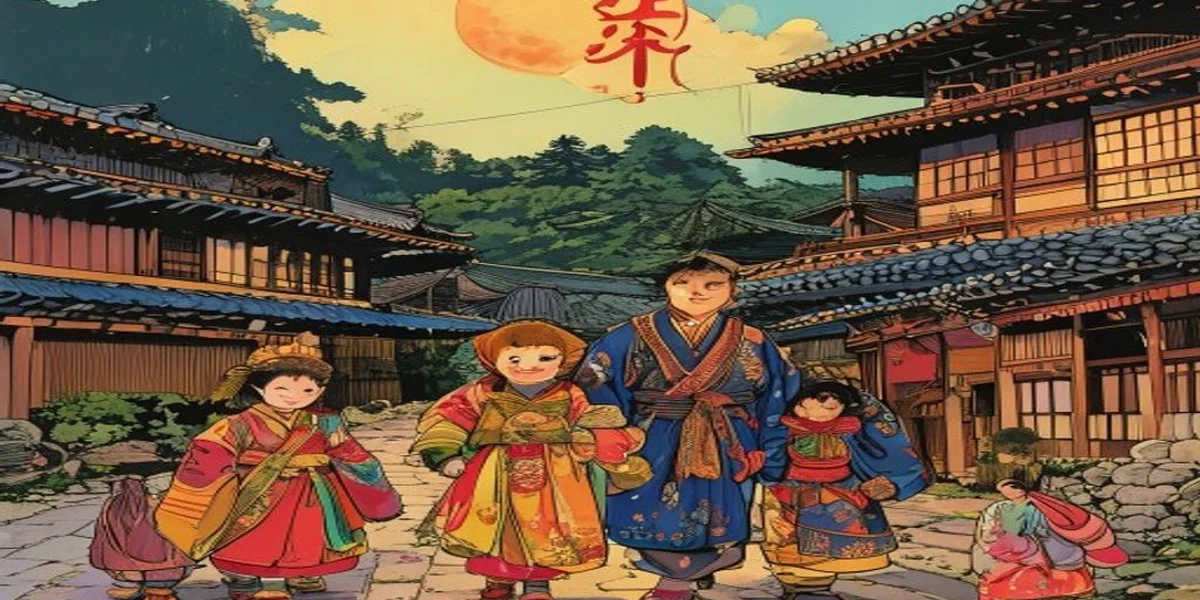
Momotarō the Peach Boy: Miraculous Birth, Domestic Virtue, and the Civic Duty of the Gifted
Of all the tales in the Japanese folk canon, Momotarō is the most nationally beloved—a story so deeply embedded in the culture that its basic outline is known by virtually every Japanese child. Yet its apparent simplicity conceals a sophisticated argument about the relationship between miraculous origin and social obligation. The Peach Boy is not simply a hero born with extraordinary gifts; he is a hero who understands that gifts incur debts, and that the debt is paid not to the benefactor but forward, to the community that the benefactor cannot protect alone.
The tale’s governing concept is on-gaeshi no katachi—the form that repayment of received grace takes. Momotarō receives life from the peach, nourishment from the old couple, and millet dumplings for his journey. His conquest of Onigashima and return with the oni’s treasure is not self-aggrandisement but a structured repayment: he restores to the village what the demons have stolen, and the old couple live out their days in comfort. The heroic circuit is complete when the beneficiary becomes the benefactor.
“He came from a peach and was raised by kindness. So he became kindness in armour—and sailed toward the island of terror on behalf of everyone who could not.”
Beat I — The Miraculous Birth and the Gift of Home
An old woodcutter and his wife, childless and longing, find a giant peach floating down the river. When they cut it open, a boy emerges—Momotarō, born of the peach’s flesh and the river’s grace. The old couple raise him with complete devotion, and he grows with preternatural speed into a boy of extraordinary strength. The domestic frame is not incidental to the story; it is its moral foundation. Momotarō’s power is rooted in the love of ordinary people. He is not a god descended from heaven who condescends to help humans; he is a human child, raised by human hands, who happens to carry within him something of nature’s wild generative force. This grounding in domestic virtue distinguishes him from purely supernatural heroes and makes his subsequent obligations to the community feel earned rather than imposed.
Beat II — The Journey and the Fellowship
Momotarō sets out for Onigashima (Demon Island) to defeat the oni who have been terrorising the land. He carries millet dumplings—kibidango—made by his foster mother. Along the road he encounters a dog, a pheasant, and a monkey, each requesting a dumpling in exchange for their service. Momotarō gives half a dumpling to each, establishing a fellowship not of equals but of a coalition built through measured generosity. Each animal brings a distinct capability: the dog’s tenacity, the pheasant’s aerial reconnaissance, the monkey’s agility. Together they breach Onigashima. The coalition-building sequence is a model of practical leadership: Momotarō does not attempt the quest alone despite his superior strength, recognising that different kinds of intelligence are required for different phases of a complex enterprise.
Beat III — The Reckoning at Onigashima
The battle at the demon fortress is swift and decisive. The pheasant attacks through the air, the monkey scales the walls, the dog holds the gate, while Momotarō fights through the centre. The oni chief, overwhelmed, surrenders and begs for mercy. Momotarō grants it—but exacts return of all the treasure stolen from the human world. This is an important moral detail: he does not slaughter the defeated demons, does not burn their fortress, does not claim the island for human dominion. He recovers what was taken and goes home. His use of force is precisely calibrated to the task, neither inadequate nor excessive. The oni, humbled but alive, are implicitly left to reckon with their defeat—a hint that even demons are capable of learning.
Variants: Numerous regional and literary versions; standardised in Meiji-era school textbooks
Themes: On-gaeshi (repayment of received grace), miraculous birth, coalition-building, proportionate force, civic heroism
Cultural status: Japan’s most recognisable folk-tale hero; embedded in national identity
Beat IV — The Heroic Circuit Completed
Momotarō returns home with the oni’s treasure and presents it to the old woodcutter and his wife. The story ends here—quietly, domestically. There is no court ceremony, no elevation to noble rank, no further adventure. The old couple are comfortable; the village is safe; the hero is home. This deliberate anti-climax is the tale’s final moral statement: heroism is not a career but a service, complete when the debt of grace has been repaid. The miraculous peach that gave Momotarō life asked nothing; the old couple who raised him asked nothing; the community terrorised by oni asked nothing—they simply suffered. Momotarō’s response to all of this unasked-for grace is to give back, proportionately and without hesitation, and then to come home. The heroic circuit closes not with glory but with gratitude made concrete.
Why This Story Lasted
Momotarō endures because it solves the problem of the gifted individual and the community in a way that is emotionally satisfying rather than merely morally correct. He does not lecture; he acts. He does not claim superiority; he recruits. He does not hoard the treasure; he returns it. The story’s longevity also reflects its flexibility: in Meiji-era nationalism it was read as a story of Japanese martial destiny; in postwar Japan it was re-read as a story of cooperative effort and the recovery of what was lost. The tale absorbs the concerns of its era while maintaining its structural integrity because its core argument—that extraordinary capacity creates extraordinary obligation—is not era-specific. It is simply true.
Frequently Asked Questions
What is the significance of being born from a peach?
In Japanese and Chinese folk tradition, the peach is associated with longevity, vitality, and divine blessing. Birth from a peach places Momotarō outside ordinary human origin while grounding him in natural abundance rather than divine hierarchy—he is a gift of the living world to an elderly couple who needed a child.
Why do the animals join Momotarō for half a millet dumpling?
Half a dumpling rather than a whole one signals that Momotarō is prudent—he conserves resources for the journey ahead—while still being generous enough to recruit allies. The modest compensation also implies that the animals join for reasons beyond the dumpling: the moral authority of the mission itself draws them.
Is Momotarō the same story as P-582’s Momotaro?
This is a second, shorter version of the Momotarō legend, focusing on different analytical angles—specifically miraculous birth, on-gaeshi (repayment of grace), and proportionate force—while the earlier version emphasised kibidango as a social technology of fellowship. Multiple variants of the tale exist, each emphasising different elements.
Why are the oni given mercy at the end?
The mercy granted to the defeated oni reflects a strand of Japanese folk ethics in which even supernatural enemies are capable of reform when genuinely overpowered. It also keeps Momotarō’s violence strictly instrumental—he is not a destroyer but a restorer of balance, and balance does not require annihilation.
How was Momotarō used in Japanese nationalism?
During the Meiji and Taisho periods, the story was incorporated into school textbooks and interpreted as a parable of Japanese expansion and military virtue. The oni were sometimes mapped onto foreign powers. Postwar scholarship has critically examined this appropriation, noting how the tale’s cooperative and restorative elements were suppressed in the nationalist reading.
You May Also Like
 Japanese Folk Tales
Ages 6-8
Japanese Folk Tales
Ages 6-8
The Old Man Who Made Dead Trees Bloom
The Old Man Who Made Dead Trees Bloom - a folk tale retold for young readers with a clear moral, simple words, and the warmth of a bedtime story from long ago.
 Japanese Folk Tales
Ages 9-12
Japanese Folk Tales
Ages 9-12
The Rolling Rice Ball (Omusubi Kororin)
The Rolling Rice Ball (Omusubi Kororin): Long ago, in a small village nestled among bamboo groves and rice paddies, there lived an old man of remarkable
 Japanese Folk Tales
Ages 9-12
Japanese Folk Tales
Ages 9-12
Issun-boshi: The One-Inch Boy
Issun-boshi: The One-Inch Boy: In a distant province of Japan, there lived an elderly couple who had no children. For decades they prayed at temples and left