The King and The Foolish Monkey
The King and The Foolish Monkey: In a magnificent kingdom surrounded by lush gardens and sparkling fountains, there once lived a powerful king who was very

The King and the Foolish Monkey
Canonical Attribution and Manuscript Tradition
This tale belongs to Pancatantra Book I, Mitra-bheda, and is one of the collection’s most frequently cited demonstrations of a principle central to Sanskrit political theory: that a foolish friend is more dangerous than a wise enemy. The story is preserved in all major Sanskrit recensions including the Tantrakhyayika (c. 200 BCE, Kashmir) and appears in parallel in the Hitopadesha. Its transmission into Arabic culture through Kalila wa Dimna (c. 750 CE) and subsequently into Persian and European collections has made it one of the most widely circulated tales in world fable literature. The tale’s structural relatives include the Aesopic story of the bear and the gardener. Within the Pancatantra’s didactic programme the story addresses a specific institutional problem: the ruler who places trust and intimacy in a companion who is loyal but who lacks the judgment to deploy that loyalty appropriately. Loyalty alone, the Pancatantra insists, is not sufficient for the confidant role; it must be combined with viveka (discriminating wisdom), and without it, the most devoted friend is a hazard.
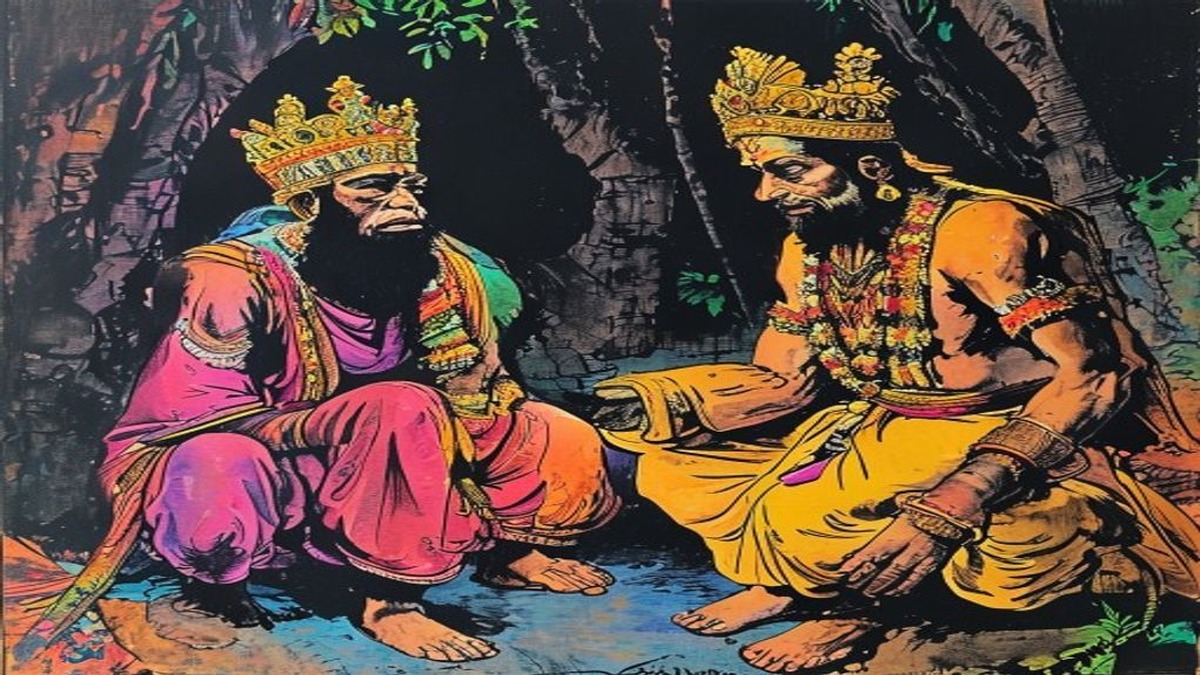
Beat I — The King’s Unusual Companion
A king had a monkey as a personal confidant and companion. The relationship was one of genuine affection: the monkey was devoted to the king and the king trusted the monkey absolutely. The monkey had access to the king’s private chambers, accompanied him throughout the day, and served as the king’s personal attendant during sleep — a position of the highest trust in any royal household, where the safety of the sleeping king is the responsibility of whoever has access to the chamber.
The Pancatantra does not present the monkey as treacherous or evil. The monkey’s devotion is entirely genuine. The problem is not with the monkey’s loyalty but with the monkey’s judgment, and the tale is structured to demonstrate precisely how genuine loyalty, combined with absent judgment, produces an outcome indistinguishable from the damage a deliberate enemy would cause. The king’s error is not in trusting a loyal companion; it is in failing to distinguish between loyalty and the full set of qualities the confidant role requires.
Beat II — The Fly and the Sword
The king fell asleep in his chamber. The monkey, faithful to its role as guardian, sat beside the sleeping king watching for any disturbance. A fly landed on the king’s chest. The monkey brushed it away. The fly returned. The monkey brushed it away again. The fly returned again. The monkey’s frustration grew with each return of the fly. This small creature was defeating the monkey’s protective efforts repeatedly. The monkey’s devotion to the king was absolute; its tolerance for this repeated frustration was not.
The monkey picked up the king’s sword, which was kept beside the sleeping king for protection. The monkey’s intention was entirely protective: it would deal with the fly definitively. The fly landed again on the king’s chest. The monkey struck at it with the sword. The fly escaped; the sword struck the king. The king was severely wounded, in some versions of the tale fatally. The monkey had done, with a sword and in a single instant of poor judgment, what no enemy of the king could have accomplished from outside the chamber.

Beat III — The Pancatantra’s Analysis
Vishnu Sharma’s analysis of the monkey’s error is embedded in the tale’s structure rather than stated separately. The monkey did not lack loyalty; it had total loyalty. It did not lack motivation to protect the king; the protection of the king was its entire purpose at that moment. What it lacked was the capacity to assess the proportionality of means to ends: a fly does not require a sword. More precisely, it lacked the capacity to assess whether a particular means, however effective it might be against the targeted problem, was safe to apply in the present context. A sword effective against a fly is also effective against a sleeping king if the fly is on the king’s chest.
The structural parallel with The Foolish Crane and the Mongoose is exact: in both cases, a well-intentioned protective action is taken without adequate assessment of the means and the context. The crane struck the mongoose to protect its chicks and killed its protector. The monkey struck the fly to protect the king and wounded the king. The common feature is that protective urgency drove the action while the assessment of appropriate means was absent. In the monkey’s case, the additional failure is the choice of a weapon entirely disproportionate to the threat, suggesting that the monkey’s capacity for proportionality assessment was structurally absent rather than merely suppressed by emergency.

Beat IV — What the Foolish Monkey Teaches About the Confidant Role
For Vishnu Sharma’s royal pupils, this tale addresses one of the most practically consequential questions of court life: who should be admitted to the inner circle of the ruler’s trust? The Pancatantra’s answer is precise: not simply those who are loyal, because loyalty alone, divorced from judgment, is a hazard. The confidant must possess both qualities; either alone is insufficient. A disloyal but intelligent advisor is manageable through surveillance and structural constraints; their disloyalty is a known risk that can be mitigated. A loyal but foolish confidant is the more dangerous figure because the loyalty disarms the natural suspicion that would otherwise guard against harm, leaving only the judgment to protect against it — and if the judgment is absent, there is no protection at all.
The Arthashastra of Kautilya addresses this problem through its extensive treatment of the qualities required in ministers and trusted advisors. Among these qualities, Kautilya lists prajna (wisdom), utsaha (energy), and the capacity for proportionate response alongside loyalty. The monkey possesses one of these and none of the others. Vishnu Sharma’s narrative makes the same argument Kautilya makes doctrinally: the selection of advisors and confidants is itself a political act of the highest consequence, and selecting for loyalty alone, while neglecting wisdom, is among the most dangerous errors a ruler can make.

Moral and Sanskrit Wisdom Tradition
“A foolish friend is more dangerous than a wise enemy; loyalty without judgment destroys what it seeks to protect.”
— Moral of The King and the Foolish Monkey, Pancatantra Book I (Mitra-bheda)
This moral is among the most cited in the entire Pancatantra and among the most widely distributed in world wisdom literature through the collection’s transmission. The formulation — foolish friend versus wise enemy — is structurally elegant because it reverses the intuitive priority: we fear our enemies and trust our friends, but the tale demonstrates that the variables of foolishness and wisdom matter more than the variable of enmity or friendship. A wise enemy can be managed; their wisdom means they operate on accurate assessment of costs and benefits, and they can be given costs and benefits that redirect their behaviour. A foolish friend cannot be managed in the same way; their foolishness means that the usual instruments of prediction and constraint do not apply to them.
Why This Story Has Lasted 2,300 Years
The King and the Foolish Monkey endures because the institutional problem it identifies — the loyal but unwise confidant — is genuinely permanent. Every generation produces leaders who surround themselves with those who are devoted to them personally rather than with those who are both devoted and capable of sound judgment. The monkey’s sword is the cleanest possible image of what happens when access and loyalty exist without the wisdom to use them safely. The tale’s structural relative in Aesop and its wide transmission through Arabic and European literary traditions suggest how universally this problem has been recognised. Vishnu Sharma’s solution is not to seek disloyal advisors but to refuse the false choice between loyalty and wisdom, insisting that both are necessary and that the absence of either is a deficiency the ruler cannot afford.
Sanskrit Tradition: Tantrakhyayika (c. 200 BCE, Kashmir); Hitopadesha; Kalila wa Dimna (Arabic, c. 750 CE); structural parallel in Aesop
Key Principle: Loyalty without viveka (discriminating wisdom) is insufficient for the confidant role
Author: Vishnu Sharma (attributed, c. 3rd century BCE)
Arthashastra Parallel: Kautilya’s requirement that advisors possess prajna (wisdom) alongside loyalty
You May Also Like
 Panchatantra Stories
Ages 3-5
Panchatantra Stories
Ages 3-5
The Story Of Cat A Mouse A Lizard And An Owl
The Story Of Cat A Mouse A Lizard And An Owl: This is the story of four creatures, none of whom loved each other, who lived in the same banyan tree in a forest
 Panchatantra Stories
Ages 3-5
Panchatantra Stories
Ages 3-5
The Story of the Frogs and the Black Snake
The Story of the Frogs and the Black Snake: Near Varuna mountain, there lived an old snake, by the name of Mandavishya. One day, he thought toh imsdf, ‘I am
 Panchatantra Stories
All Ages
Panchatantra Stories
All Ages
The Timid Hare and the Flight of the Beasts
The Timid Hare and the Flight of the Beasts: Once upon a time when Brahmadatta reigned in Benares, the Bodhisatta came to life as a young lion. And when fully