The Eight Immortals (Ii)
The Eight Immortals (Ii) - a folk tale retold for young readers with a clear moral, simple words, and the warmth of a bedtime story from long ago.
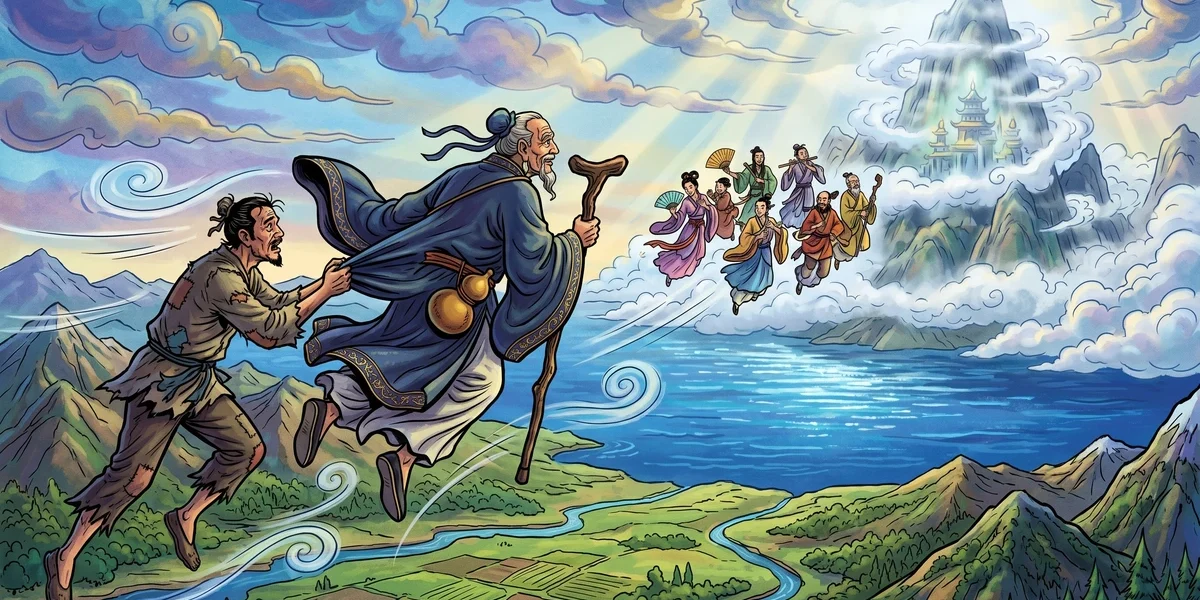
Individual Paths to the Immortal: The Stories Behind the Eight
The Eight Immortals (Part II) explores the individual cultivation legends of the Ba Xian — the specific stories of how each immortal achieved their transcendence, what tests they faced, and what the character of their particular path reveals about the Daoist understanding of spiritual development. Where Part I introduced the ensemble and their collective sea-crossing adventure, this account goes deeper into the individual narratives, examining what each immortal’s specific path of cultivation teaches about the breadth and flexibility of the Daoist vision of enlightenment.
The cultivation legends of the Eight Immortals are collectively a theology of spiritual possibility: taken together, they demonstrate that no human condition, background, failing, or social position is inherently incompatible with the achievement of immortality. The sick can achieve it (Li Tieguai); the formerly dissolute can achieve it (Lu Dongbin); the aristocrat who abandons privilege can achieve it (Cao Guojiu); the woman who listens to a dream-teacher can achieve it (He Xiangu). The stories insist that what matters is not the starting point but the direction of travel — not the condition one begins from but the quality of one’s commitment to the cultivation that leads beyond it.
Lu Dongbin’s Ten Temptations: The Path of the Errant Sage
The most elaborate individual cultivation legend among the Eight Immortals belongs to Lu Dongbin (呂洞賓), whose path to immortality involved the famous Shi Ci Shi Jie (十次試解 — Ten Temptations), administered by his teacher Zhongli Quan. Lu Dongbin’s story begins in ordinary worldly life: he was a Tang dynasty scholar who twice failed the imperial examination, meeting Zhongli Quan at an inn where the master showed him a vision of the misery and transience of the official life he was pursuing. Struck by this vision, Lu Dongbin began his cultivation — but Zhongli Quan, perceiving that his student’s commitment was not yet sufficient to withstand the pressures of genuine spiritual development, subjected him to ten successive tests before transmitting the final secrets of Daoist immortality.
The ten temptations move through the full spectrum of human attachment: wealth appears and disappears; a happy family life is established and destroyed; his teacher appears to die; his family treats him with ingratitude and cruelty; he is falsely accused of terrible crimes; supernatural beings test his erotic self-control; bandits threaten his life. In each case, Lu Dongbin’s initial response reveals remaining attachments — grief, anger, desire, fear — and his deepening practice gradually produces the equanimity that can witness these upheavals without being destroyed by them. The ten temptations are not simply moral tests but a systematic curriculum in the progressive release of attachment to the full range of worldly goods — wealth, family, reputation, physical safety, sensual pleasure — that ordinarily structure human identity and motivation.
Li Tieguai’s Soul Displacement: The Body as Temporary Vessel
The legend of Li Tieguai (李鐵拐 — Iron-Crutch Li) offers Chinese religious thought’s most visceral demonstration of the Daoist principle that the spirit is entirely separable from — and ultimately independent of — the physical body. Li Tieguai, originally a handsome and accomplished man, had developed the ability to send his soul out of his body during meditation — a practice associated with advanced Daoist cultivation — to visit the Jade Emperor’s celestial court. On one such journey, he instructed his disciple to watch over his body for seven days; if he had not returned by then, to assume his death and cremate the body.
His soul’s celestial business ran over the allotted time. The disciple, receiving false news that his own mother was dying, decided he could not wait the full seven days and cremated Li Tieguai’s body before the seven days were complete. When Li Tieguai’s soul returned to find only ash where his body had been, he had no choice but to occupy the nearest available vessel: the recently deceased body of a lame beggar who had just died of starvation by the roadside. Laozi himself, taking pity on the displaced soul, gave the beggar’s body a golden headband and an iron crutch to help Li Tieguai manage his new physical situation. The result is one of the most striking figures in Chinese religious iconography: the ragged, lame, emaciated beggar who is, inside his unprepossessing shell, an immortal of the highest order.
“The soul that has learned to leave the body and return has already learned that the body is a guest-house — convenient when available, not catastrophic when lost.”
— Commentary on the Li Tieguai legend in the Ba Xian tradition
He Xiangu’s Moonbeam Cultivation: The Female Path to Transcendence
He Xiangu (何仙姑 — Immortal Maiden He), the sole woman among the Eight Immortals, achieved her transcendence through a path that reflects the distinctive concerns of Chinese female religious cultivation. According to her legend, she was a young woman of Zengcheng county in Guangdong during the Tang dynasty who one night dreamed of a divine figure — some accounts say it was Lu Dongbin himself — who instructed her to eat powdered mother-of-pearl (mica) in order to make her body light enough to eventually achieve immortality. She followed the instruction, gradually developing the ability to move with supernatural lightness and speed, and eventually achieving the full lightness of immortal being.
He Xiangu’s path — private, dream-instructed, achieved through the patient accumulation of a subtle and non-dramatic practice — reflects the particular conditions of female religious life in traditional Chinese society, where the institutional structures of formal Daoist cultivation (the monastery, the master-disciple relationship of public teaching, the court ceremonies) were less accessible to women than to men. Her moonbeam and mica cultivation represents a form of spiritual practice that requires no institutional affiliation, no public teacher, and no official recognition — a path of interior development that is available precisely in the absence of institutional access. She is the patron of single women and of the household, the divine figure who demonstrates that transcendence is available from within the domestic sphere as well as from without.
Lan Caihe and the Transcendence of Category
Lan Caihe (藍采和) is the most theologically provocative of the Eight Immortals — the figure who embodies the Daoist transcendence of all fixed categories of identity most completely. Lan Caihe’s gender is perpetually ambiguous in the textual tradition: some sources describe a male figure, others a female, still others an explicitly androgynous being who partakes of both without being fully either. One shoe is worn, the other foot bare — a deliberate asymmetry that refuses the completion of any consistent social presentation. Perpetually singing, sometimes drunk, scattering coins to the poor while living in poverty, Lan Caihe represents the Daoist holy fool tradition: the person who has achieved such freedom from the structures of ordinary social identity that their behaviour cannot be classified within the system of social expectations that governs everyone else.
Lan Caihe achieved immortality by living this freedom consistently enough that the ordinary world eventually could no longer hold them: according to legend, Lan Caihe was lifted into heaven by a crane while singing at a party, dropping their shoe, gown, and castanets as they ascended — shedding even the minimal possessions of an already-minimal material existence as the final earthly encumbrances fell away. The story is a perfect emblem of the Daoist understanding of liberation: not a dramatic spiritual achievement but the simple continuation of what one has always been, until the world finally recognises that one was never fully of it.
Why These Stories Endured
The individual cultivation legends of the Eight Immortals endured because they provided the full spectrum of Chinese religious seekers with figures who had walked their specific path before them. The scholar who has failed examinations and feels his worldly ambitions slipping away has Lu Dongbin. The person whose body has been compromised by illness or disability has Li Tieguai. The woman seeking spiritual development within the constraints of domestic life has He Xiangu. The person who refuses fixed social categories and feels alien to the world’s expectations has Lan Caihe. Each immortal’s individual legend is not merely a story about that person’s achievement but an invitation to the reader or listener to recognise their own life circumstances as the specific path along which their own cultivation might unfold — if they are willing to follow it with the commitment that transformed ordinary human beings into something beyond the ordinary.
You May Also Like
 Chinese Folk Tales
Ages 6-8
Chinese Folk Tales
Ages 6-8
A Legend Of Confucius
A Legend Of Confucius: When Confucius came to the earth, the Kilin, that strange beast which is the prince of all four-footed animals, and only appears when
 Chinese Folk Tales
Ages 6-8
Chinese Folk Tales
Ages 6-8
How The River-God’s Wedding Was Broken Off
How The River-God's Wedding Was Broken Off - a folk tale retold for young readers with a clear moral, simple words, and the warmth of a bedtime story from...
 Chinese Folk Tales
Ages 9-12
Chinese Folk Tales
Ages 9-12
The Little Hunting Dog
The Little Hunting Dog: Once upon a time, in the city of Shansi, there lived a scholar who found the company of others too noisy for him. So he made his home