Sky O’Dawn
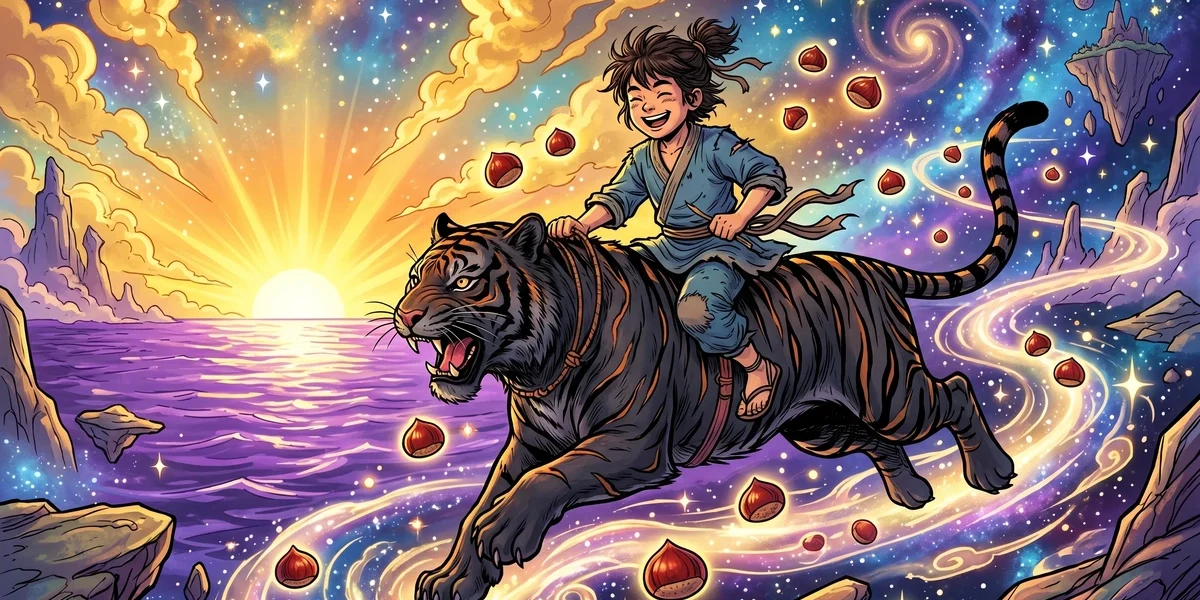
Sky O'Dawn: Once upon a time there was a man who took a child to a woman in a certain village, and told her to take care of him. Then he disappeared. And
Origin and Tradition
Sky O’Dawn belongs to the rich tradition of Chinese solar mythology and its associated cycle of cosmic dawn narratives — stories that explain the origin and maintenance of the daily miracle of sunrise, and that celebrate the threshold moment of daybreak as one of the most cosmologically significant events in the Chinese understanding of the universe’s moral rhythm. The dawn (黎明, líming, or 天明, tiānming — literally “heaven brightening”) occupies a specific and charged position in Chinese cosmological symbolism: it is the moment when yang (陽) energy begins its daily ascent from its overnight nadir, when the cosmic cycle completes another turn, and when the forces of darkness, cold, and stasis are overcome by the gathering power of light, warmth, and renewal.
The character at the heart of this story — whose name means something like “Sky-at-Dawn” or “The Brightness of Heaven” — is a figure born at or associated with this threshold moment, a child whose identity is marked by the cosmic transition he embodies. This narrative type belongs to the broader Chinese tradition of ganying (感應 — sympathetic resonance) between the cosmic order and human fate: the conviction that the circumstances of a person’s birth — the hour, the season, the celestial configuration — resonate with and shape the character and destiny of the life that begins at that moment. A child born at dawn carries something of the dawn’s nature: the quality of being at a threshold, of existing between the exhausted dark and the gathering light, of possessing within himself the seed of a renewal not yet fully expressed.
Chinese Solar Mythology: The Ten Suns and the Dawn Cycle
The foundational Chinese solar myth — the story of the ten suns (十日, shi ri) who are the children of the solar deity Di Jun and the solar goddess Xi He — provides the cosmological background for all Chinese dawn mythology. In the primordial age, all ten suns rose simultaneously, scorching the earth with unbearable heat until the divine archer Yi (后羿, Hou Yi) shot down nine of them, leaving the single sun that maintains the current ordered world. Xi He’s role as the mother of the suns included the daily management of their cosmic journey: each morning she bathed the sun that was due to make its journey, helped it into the branches of the Fusang tree (扶桑, the cosmic tree of the east from which the sun rises), and set it on its daily course.
This myth establishes several key features of Chinese solar cosmology that Sky O’Dawn’s story draws upon: the sun as a living being with a mother and a daily journey; the eastern horizon as the site of cosmic origin and renewal; the dawn as a moment of preparation and sending-forth rather than mere mechanical appearance; and the fragility of the cosmic order (ten suns once rose together; only human heroism and divine intervention established the current managed equilibrium). The character of Sky O’Dawn, associated with this moment of daily cosmic renewal, carries in his name and his story the weight of this entire mythological complex.
The Narrative: A Dawn-Child’s Journey
Sky O’Dawn — born at the precise moment of daybreak, perhaps to a mother who had prayed at the eastern horizon or who had dreamed of the Fusang tree — grows up with an unusual quality of perception and a mysterious connection to the sky’s transitions. Where other children sleep through the dawn hours, he rises naturally at the first hint of light, drawn to the eastern horizon with an instinctive urgency he cannot fully explain. He sees things in the dawn light that others miss: the specific quality of colour that precedes the sun’s appearance, the brief moment when the sky is both dark and bright simultaneously, the movement of celestial beings who use the cover of that in-between state to complete their cosmic business before full daylight constrains them.
His story unfolds as a series of encounters and tasks that his dawn-nature makes possible and necessary: perhaps a journey to find the source of the dawn, an encounter with Xi He’s attendants who are preparing the sun for its daily journey, a test of whether he can maintain his threshold quality — neither fully asleep nor fully awake, neither of the dark nor of the light — under conditions of extreme challenge. The resolution confirms what his name declared: that the in-between is not a lack of commitment to either side but a distinct and invaluable mode of being, one that the extreme positions of darkness and full daylight cannot provide and cannot replace.
“He was born between the last star and the first light; he saw what neither the night-watchers nor the day-walkers could see — the brief, bright moment when the world forgets what it was and has not yet remembered what it will be.”
— Chinese dawn mythology tradition
The Liminal Child: Dawn as a Mode of Being
Chinese cosmological thought had an elaborate understanding of jiao shi (交時 — boundary/transition time) and its relationship to human character and destiny. The hours of dawn and dusk were understood as cosmologically liminal — zones of transition where the normal rules governing the distinction between yin and yang, between the human world and the spirit world, between one day and the next, were temporarily suspended. People born at these transition hours were believed to partake of this liminality in their character: more sensitive to the spiritual dimensions of experience, more comfortable with ambiguity and transformation, less constrained by the fixed categories that govern midday and midnight consciousness.
Sky O’Dawn embodies this liminal character at its fullest development: he is a person for whom the in-between is not a momentary state to be passed through on the way to something more definite, but a permanent home and a mode of perception. This quality connects him to the broader Chinese figure of the seer or shaman-priest (wu, 巫) whose function in ancient Chinese religious life was precisely to inhabit the boundary zones between ordinary human consciousness and the spirit world — to see what others cannot, to communicate with what ordinary consciousness cannot access, and to bring back from those threshold encounters whatever knowledge or help the community requires.
Dawn in Chinese Poetry and Aesthetic Tradition
The aesthetic dimensions of the dawn in Chinese literary culture provide an additional context for understanding the Sky O’Dawn story’s resonance. Chinese poetry — from the Shijing (詩經 — Classic of Poetry) through the Tang dynasty masterworks of Wang Wei, Meng Haoran, and Du Fu — returned obsessively to the quality of dawn light as both a physical phenomenon and a psychological/spiritual state. The specific quality of cheng guang (晨光 — morning light, particularly the light of very early dawn before the sun appears) was associated in the Chinese aesthetic tradition with purity, possibility, and a kind of seeing that is available only in that brief period before ordinary daylight fills the world with its familiar colours and shapes.
Wang Wei’s dawn poems, in particular, achieve a quality of perception that corresponds to what Sky O’Dawn represents mythologically: an attention so refined that it can register the subtlest gradations of light and darkness, the exact moment of transition, the quality of silence that precedes the world’s daily return to sound and activity. The Sky O’Dawn narrative translates this refined aesthetic perception into mythological terms — a character whose very nature is the capacity to inhabit and see from the threshold between dark and light, night and day, the exhausted and the renewed.
Why This Story Endured
The Sky O’Dawn story endured because dawn itself endures as one of the most reliably moving experiences available to human beings — the daily evidence that darkness gives way to light, that the exhausted and cold night is followed by warmth and possibility, that the cosmic cycle continues to turn reliably despite every anxiety about whether it will. In Chinese cosmology, this daily renewal was never taken for granted; the myths of the ten suns, the story of Hou Yi’s archery, the elaborate rituals with which the Zhou court greeted the solstices all reflected an understanding that the cosmic order required human participation and attention to sustain itself. Sky O’Dawn is the human figure who brings this attention most fully — born into the moment of renewal, carrying its quality throughout his life, and returning to it in every act of perception that his liminal nature makes possible.
You May Also Like
 Chinese Folk Tales
Ages 9-12
Chinese Folk Tales
Ages 9-12
How Greed For A Trifling Thing Led A Man To Lose A Great One
A man's obsession with a trifling possession cost him a great opportunity.
 Chinese Folk Tales
Ages 6-8
Chinese Folk Tales
Ages 6-8
The Halos Of The Saints
The Halos Of The Saints: In ancient China, during a time when Buddhism was spreading throughout the land and changing how people understood the world, there
 Chinese Folk Tales
Ages 6-8
Chinese Folk Tales
Ages 6-8
How The River-God’s Wedding Was Broken Off
How The River-God's Wedding Was Broken Off - a folk tale retold for young readers with a clear moral, simple words, and the warmth of a bedtime story from...