The Dragon After His Winter Sleep
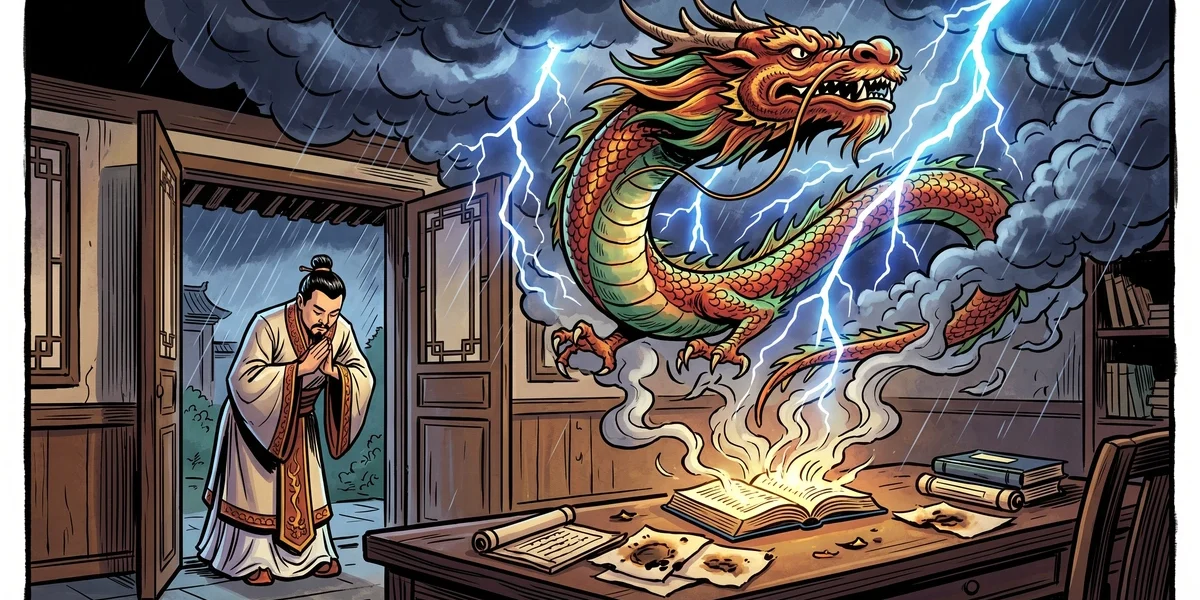
The Dragon After His Winter Sleep: Once there was a scholar who was reading in the upper story of his house. It was a rainy, cloudy day and the weather was
Origin and Tradition
The Dragon After His Winter Sleep draws on one of the most deeply embedded cycles in Chinese agricultural mythology: the belief that dragons — understood not merely as mythological creatures but as the living expressions of the earth’s vital energy — hibernate through the winter months and awaken in spring, and that this awakening is the fundamental driving force behind the seasonal renewal of agricultural life. This belief is embedded in the Chinese jieqi (節氣 — solar term) calendar, particularly in the third solar term Jingzhe (驚蟄 — literally “Awakening of Insects,” occurring around the 6th of March), which marks the moment when the first spring thunder rolls across the dormant earth, awakening the hibernating creatures — most importantly the dragon — who have been sleeping in the earth through the cold months.
The dragon in Chinese agricultural cosmology is fundamentally different from the spectacular supernatural beings of the court and maritime traditions: it is the long mai (龍脈 — dragon vein), the living energy that runs through the earth’s structure, surfaces in spring rains and summer storms, governs the movement of water through the landscape, and determines the fertility of the soil above it. The awakening of this dragon after winter is not a discrete event in the story of a particular supernatural being but a cosmic process — the re-energisation of the earth’s vital principle that makes agricultural life possible — and the stories told about it reflect the profound agrarian reverence for this annual renewal.
Dragon Veins, Agricultural Qi, and the Body of the Earth
The Chinese understanding of the dragon as the living energy of the earth is expressed most systematically in the tradition of fengshui (風水 — wind-water, geomancy), which identifies long mai (dragon veins) as the channels through which the earth’s vital energy (di qi, 地氣 — earth qi) flows. These dragon veins are not merely metaphorical: they are understood as real physiological structures of the landscape, following the ridgelines of mountains, the channels of rivers, and the contours of the terrain in patterns that directly influence the vitality, fertility, and health of the communities living above them. The dragon that wakes after winter is the earth’s own vitality reasserting itself after the compressive cold that drives it deep into the ground in autumn and winter.
The seasonal calendar reflects this understanding precisely. From the autumn equinox through the winter solstice, the traditional Chinese agricultural calendar tracks the progressive withdrawal of yang qi into the earth’s depths: the dragon goes underground, the insects burrow into the soil, the wells and springs slow to a trickle, and the earth’s surface becomes cold, hard, and temporarily barren. The winter solstice marks the nadir of this withdrawal — the darkest day — and from that point forward, the gradual return of yang qi begins. By the time of Jingzhe in early March, the first thunder signals that the dragon’s energy has returned close enough to the surface to be felt, and the awakening of hibernating creatures — including the earth dragon itself — marks the soil as ready to receive seed.
The Narrative: A Dragon Awakens, A Community Responds
The story centres on the moment of the dragon’s spring awakening and the community’s response to it. In the folk narrative tradition, this moment is not a private or invisible event but a cosmological announcement: the first spring thunder, the first significant rain after the dry cold months, the sudden movement of the soil in places where dragon veins run close to the surface. A protagonist — a farmer, a village elder, or a young person with unusual sensitivity to the earth’s rhythms — recognises the signs of the dragon’s awakening before others do, and must navigate the consequences of that early recognition.
In some variants, the story turns on the question of agricultural timing: the protagonist who plants in alignment with the dragon’s awakening — neither too early (before the earth’s vital energy has sufficiently returned) nor too late (after the optimal window) — harvests abundantly, while those who act on their own schedule rather than the earth’s find their efforts thwarted by late frost, insufficient rain, or soil that has not yet warmed to productive vitality. In others, the awakening dragon is a visible presence — a serpentine shape in the morning mist above the fields, a spiralling movement in the first spring rain — that the protagonist encounters directly and must respond to with the appropriate combination of reverence, practical knowledge, and moral readiness.
“When the dragon stirs beneath the field, the earth remembers what the winter made it forget; and the farmer who listened all winter for that stirring is ready when it comes.”
— Chinese agricultural folk tradition on the spring dragon awakening
The Second Day of the Second Month: Dragon Raising the Head
The most specific and widely celebrated expression of the spring dragon awakening tradition is the festival of Er Yue Er (二月二 — Second Day of the Second Month), also known as Long Taitou (龍抬頭 — Dragon Raises His Head). Celebrated on the second day of the second lunar month — typically falling in late February or early March, close to the Jingzhe solar term — this festival marks the dragon’s head emerging from underground after winter hibernation. The day is associated with a cluster of practices reflecting the agricultural cosmology of dragon-earth interaction: women avoid using scissors or needles (lest they harm the dragon whose energy runs through the earth near sewing implements), families eat foods shaped like dragon scales (spring pancakes) or other dragon-associated foods, and the head of the household performs a ritual sweeping of the floor toward the house’s entrance to “welcome the dragon in.”
The Er Yue Er festival encodes in ritual practice the same understanding that the story expresses in narrative: the dragon’s spring awakening is not merely a natural event to be observed but a cosmic process to be actively welcomed and facilitated by human participation. The relationship between human community and earth dragon is reciprocal — the dragon’s vitality sustains the agricultural life of the community, and the community’s ritual attention and proper behaviour maintain the conditions in which the dragon can fulfil its cosmic function effectively.
Why This Story Endured
The dragon’s winter sleep and spring awakening story endured because it gave personal, dramatic form to the experience that is most fundamental in any agricultural community: the annual uncertainty of whether spring will come in time, the relief when the first signs of earth’s re-energisation appear, and the gratitude toward whatever forces — cosmic, divine, or natural — have managed the seasonal transition successfully. In a world without meteorological science, the dragon’s awakening provided an explanatory narrative for the observable fact that the earth comes alive in spring: not through impersonal chemical processes but through the stirring of a living being whose vitality is the earth’s own vitality.
This understanding of seasonal renewal as a living process — the awakening of something that has been asleep rather than the mechanical operation of a clock — is not merely pre-scientific naivety but a form of ecological attentiveness that modern environmental thinking has begun to recover. The farmer who pays close attention to the signs of the dragon’s awakening — the quality of the soil, the movement of underground water, the behaviour of earthworms and insects, the character of the first spring rains — is practising a form of observation and response to the earth’s living rhythms that contemporary agriculture is only beginning to relearn.
You May Also Like
 Chinese Folk Tales
All Ages
Chinese Folk Tales
All Ages
The Disowned Princess
The Disowned Princess: At the time that the Tang dynasty was reigning there lived a man named Liu I, who had failed to pass his examinations for the doctorate.
 Chinese Folk Tales
Ages 6-8
Chinese Folk Tales
Ages 6-8
The Magic Cask
The Magic Cask: Once upon a time there was a man who dug up a big, earthenware cask in his field. So he took it home with him and told his wife to clean it out.
 Chinese Folk Tales
Ages 9-12
Chinese Folk Tales
Ages 9-12
King Mu Of Dschou
King Mu Of Dschou: In the days of King Mu of Dschou a magician came out of the uttermost West, who could walk through water and fire, and pass through metal