Sinbad the Sailor: The Third Voyage
Sinbad survives a ship seizure, a man-eating giant and a huge serpent before a familiar captain restores cargo from an earlier voyage.
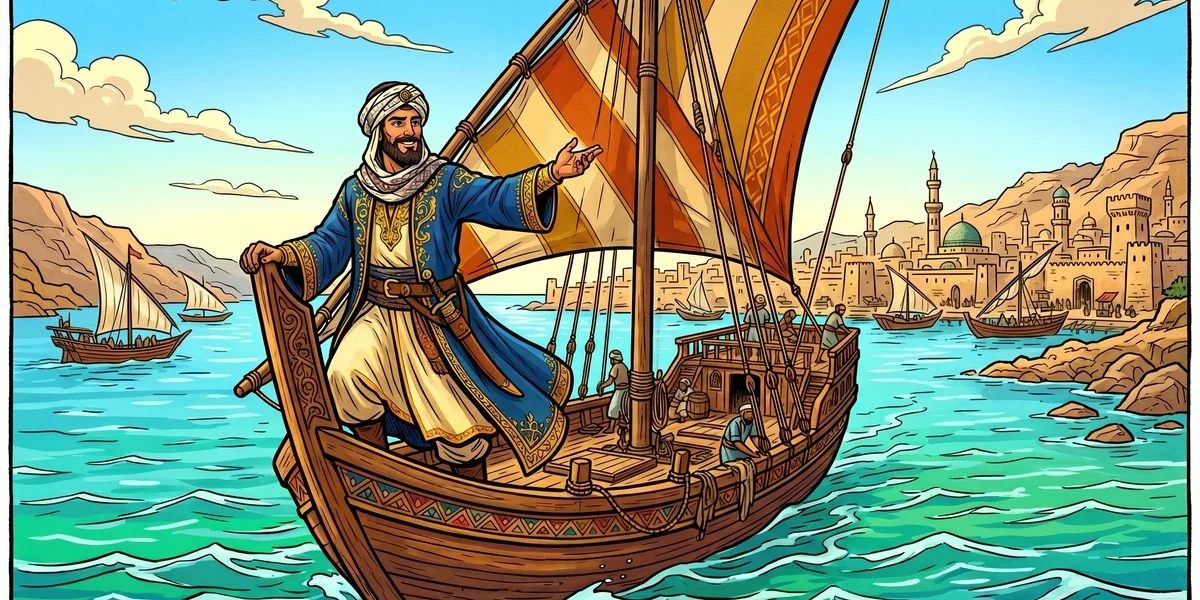
After a short time the easy life I led made me forget the perils of my first two voyages. Still in the prime of life, I liked being up and doing. Once more I took the rarest merchandise of Bagdad to Balsora and sailed with merchants I knew for distant lands. We had touched many ports and made much profit when a terrible wind blew us clean out of our reckoning for several days and drove us into harbour on a strange island.
“I would rather have anchored anywhere but here,” said our captain. “This island and all near it belong to small, fur-covered island creatures. They are certain to attack us, and whatever these creatures do we dare not resist—they swarm like locusts, and if one is killed the rest will make an end of us.”
His words caused great consternation, and too soon we found he spoke truly. A vast multitude of those fantastic creatures appeared—not more than two feet high, covered with reddish fur. Throwing themselves into the waves they surrounded our vessel, chattering in a tongue we did not know, clutching ropes and gangways, swarming up the side almost as if they flew. Rage and terror seized us; we dared neither hinder them nor speak. They hoisted the sails, cut the cable, and sailed our ship to an island a little further off, drove us ashore, took the vessel, and made off, leaving us helpless on a shore all mariners avoided with horror for a reason we soon learned.
We wandered inland, eating herbs and fruits, feeling we might as well live as long as possible though we had no hope of escape. In the distance we saw what seemed a splendid palace; when we reached it, it was a lofty, strongly built castle. We pushed back heavy ebony doors into the courtyard—and on the threshold of the great hall beyond we froze. On one side lay a huge pile of human bones; on the other, numberless roasting-spits. Overcome with despair we sank trembling to the ground without speech or motion.
The sun was setting when a loud noise aroused us. The hall door burst open and a horrible giant entered—tall as a palm tree, with one eye flaming like a burning coal in the middle of his forehead. His teeth were long and sharp; his lower lip hung down upon his chest; he had ears like an elephant’s covering his shoulders, and nails like the claws of a fierce bird. At that sight our senses left us and we lay like dead men. When we came to ourselves he sat examining us with his fearful eye. Then he came, took me by the back of the neck, turned me this way and that, felt I was mere skin and bone, and set me down. He treated the next the same way; at last he came to the captain, found him the fattest, stuck him on a spit, kindled a huge fire, and roasted him. After he had supper he lay down snoring like the loudest thunder while we shivered all night. At dawn he awoke and went out, leaving us in the castle.
Believing him gone we started up bemoaning our fate until the hall echoed. Though we were many and he alone, it did not occur to us to kill him—and we should have found that hard. We spent the day wandering the island eating fruit, and at night returned to the castle, having found no other shelter. At sunset he came back, suppered on another of our comrades, slept till dawn, and left as before. Several companions thought it better to leap from the cliffs at once than await so miserable an end; but I had a plan, and they agreed to try it.
“Listen,” I said. “Plenty of driftwood lies along the shore. Let us make several rafts and carry them to a suitable place. If our plot succeeds we can wait for a passing ship. If it fails we must take to the rafts; frail as they are, we have more chance on them than here.” We spent the day building rafts, each to carry three. At nightfall we returned; soon the giant came and one more was sacrificed. Then our vengeance was at hand. When he slept and snored, I and nine of the boldest rose softly, each took a spit, made it red-hot in the fire, and at a signal plunged it into his eye, completely blinding him. He sprang up uttering a terrible cry, clutching in all directions; we had fled different ways and thrown ourselves flat in corners where his feet were not likely to find us. After a vain search he fumbled to the door and fled howling. We left the fatal castle, stationed ourselves beside our rafts, and waited. If morning showed no giant and his howls died away, we might stay on the island; but alas, daylight showed him approaching, supported by two giants nearly as large, with a crowd of others at their heels.
We hesitated no longer—clambered on the rafts and rowed with all our might. The giants seized huge rocks, waded in, and hurled them with such aim that all the rafts but mine were swamped and their crews drowned. I and my two companions barely kept beyond reach; by hard rowing we gained the open sea. Wind and waves tossed us all that day and night; next morning we found ourselves near an island and gladly landed.
We found delicious fruits, ate our fill, and lay down on the shore. Suddenly a loud rustling woke us—an immense snake gliding over the sand. So swiftly it came that it seized one comrade before he could fly, crushed him in its coils despite his cries, and swallowed him. My other companion and I ran for our lives; seeing a tall tree we climbed it with a store of fruit from the bushes. At night I fell asleep, only to be wakened by the snake hissing round the tree; it reared up, found my sleeping comrade perched below me, swallowed him too, and crawled away, leaving me half dead with terror.
At sunrise I crept down with hardly a hope, yet life is sweet and I meant to save myself. All day I toiled collecting dry brushwood, reeds, and thorns, bound them in bundles, and piled a firm circle under my tree until I had a kind of tent in which I crouched like a mouse in a hole. That night the snake returned eager to devour me and glided round and round seeking entrance. Every moment I feared it would push the bundles aside, but they held; at daylight my enemy retired baffled and hungry. More dead than alive, shaking with fright and half suffocated by its poisonous breath, I crawled to the sea, ready to plunge from the cliffs rather than pass another such night—then to my joy I saw a ship. By shouting and waving my turban I attracted the crew.
A boat rescued me. Sailors and merchants crowded round, eager to know how I came to that desolate island. After I told my story they gave me the choicest food aboard, and the captain, seeing my rags, bestowed one of his own coats. We touched many ports and came at last to Salahat, where sandalwood grows in abundance. As I watched the merchants come ashore, the captain asked me to trade some merchandise belonging to a passenger of his who was dead, so that when he met the heirs he could give them the money—I should have a portion for my trouble. I consented gladly. He pointed out the bales and sent for the clerk who kept the ship’s list. When asked in what name to register the goods, the captain said, “In the name of Sindbad the Sailor.”
I was greatly surprised; looking carefully I recognised him as the captain of the ship of my second voyage, much altered. Believing me dead, he had not known me. I asked if the merchant who owned those bales was called Sindbad. “Yes,” he said—of Bagdad, joined at Balsora, left by mischance on a desert island where they filled water-casks, missed only hours later when the wind made it impossible to put back. “You suppose him perished?” “Alas, yes.” “Captain,” I cried, “look well at me. I am that Sindbad who fell asleep on the island and awoke abandoned!” He stared in amazement, then was convinced and rejoiced at my escape. He was glad to have that carelessness off his conscience; I should take my goods and the profit he had made on them. I took them gratefully. From island to island I laid in cloves, cinnamon, and other spices. In one place I saw a tortoise twenty cubits long and as broad, and a fish like a cow whose thick skin was used for shields, and another shaped and coloured like a camel. By degrees we came back to Balsora; I returned to Bagdad with so much money I could not count it, besides treasures without end. I gave largely to the poor, bought land to add to what I had, and thus ended my third voyage.
Where this story comes from
Sindbad’s third voyage is from The Arabian Nights Entertainments, a selection edited by Andrew Lang in 1898. Its translators worked from Antoine Galland’s French, and the preface says some pieces were left out. The tale is part of the Arabian Nights, not an Indian story.
Lang’s preface suggests Sindbad’s adventures may owe something to Homer’s Odyssey, and this voyage shows why: like Odysseus with the Cyclops, Sindbad and his men blind a man-eating one-eyed giant with red-hot spits and flee to the sea.
The giant’s eating of the crew is kept but told briefly.
Read the original: Andrew Lang, The Arabian Nights Entertainments (Project Gutenberg #128, The Seven Voyages of Sindbad the Sailor: Third Voyage)
For older readers: includes people roasted and eaten, violent blinding, drowning, a serpent swallowing people and thoughts of suicide under extreme fear.
The escape plan includes what might go wrong
Sinbad has the rafts built before attacking the giant. The group does not rely on blinding him to end every danger, and the arrival of other giants proves why an exit matters. Yet the rafts do not save everyone. His narration combines careful preparation with loss and chance, rather than promising that courage guarantees survival.
The recovered cargo later connects this voyage to the second. A captain’s duty to an absent owner helps restore Sinbad’s livelihood after strangers have restored his safety.
Separate plans from fortunate events
Place the prepared rafts, thorn barrier, passing ship and preserved cargo on a timeline. Mark which Sinbad controls and which depend on others or chance. Use the distinction to explain both his resourcefulness and the limits of it.
Talk about it
- How did Sindbad and his men escape from the giant?
- Why do you think the captain had kept Sindbad’s goods all that time, even believing him dead?
- Sindbad’s plan against the giant was very risky. Would you have tried it, or looked for another way out? Why?
Related stories
- Sinbad the Sailor: The Second Voyage — Sindbad’s earlier voyage, with the roc and the valley of diamonds
- The Fourth Voyage of Sinbad: Escape from the Cannibals — Sindbad’s next voyage, when he escapes from cannibals and a burial cave
- The Fisherman and the Genie — an Arabian Nights fisherman who tricks a giant genie back into a jar
Also known as: Sindbad the Seaman
Frequently Asked Questions
Who seizes the ship?
Why do the men build rafts first?
What cargo does Sinbad recover?
Why compare this with the Odyssey?
You May Also Like
 Arabian Nights
Scheherazade and the Sultan
To end the Sultan's deadly weddings, the vizier's daughter Scheherazade volunteers as his bride, with a plan that depends on one story.
 Arabian Nights
Ages 6-8
Arabian Nights
Ages 6-8
Sinbad the Sailor: The Second Voyage
Left behind on a desert isle, Sinbad ties himself to a roc, then escapes a serpent-filled diamond valley by strapping meat—and himself—for an eagle.
 Arabian Nights
The Tale of the Merchant and the Genie
A genie accuses a merchant of killing his son with a thrown date-stone; three travellers’ stories gradually win the merchant’s release.