King Joy and Secretary Splendor
A secretary shaves his head and a king neighs like a horse to win back their angry wives, and the secretary's rhyme gives the game away.
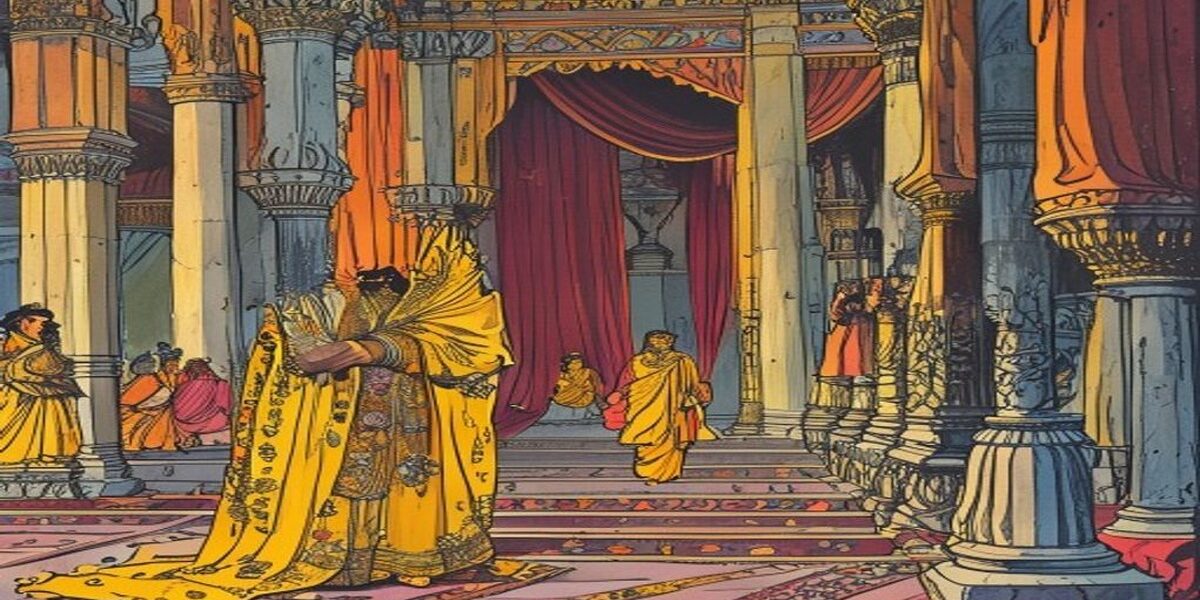
There was once a king called Joy, ruler of the whole earth from sea to sea. His power and courage were famous everywhere, so many princes knelt before him that the jewels on their crowns sparkled across his footstool, and his good name was as spotless as autumn moonlight.
King Joy had a secretary named Splendor, who had learned everything in every book of learning. One day Splendor’s wife had a lovers’ quarrel with him and would not stop sulking. “Darling,” said Splendor, “tell me what will make you forgive me, and I will do it, whatever it is.”
After a struggle she said, “If you shave your head and fall at my feet, I might think about forgiving you.” He did it, and she forgave him.
Now it happened that the king’s wife was angry with him in exactly the same way, and nothing he said would calm her down. “My love,” said King Joy, “I cannot live a single moment without you. I will throw myself at your feet and beg your pardon.”
“If you put a bit in your mouth like a horse,” said the queen, “and let me climb on your back and ride you, and if you neigh like a horse while I drive you, then I will forgive you.” And that is just what happened.
The next morning the king sat in his council hall, and in walked Splendor with a freshly shaved head. “Good Splendor,” asked the king, “why have you shaved your head at such a strange time?”
Splendor answered with a little rhyme: what will a man not do for a woman, when heads get shaved at odd times, and when people who are not horses neigh?
Where this story comes from
In Arthur W. Ryder’s 1925 Panchatantra this comic tale is “King Joy and Secretary Splendor,” from Book IV, “Loss of Gains.” The monkey tells it to the crocodile, who had tried to trick the monkey because his own wife asked him to, and Splendor’s rhyme is the point the monkey is making.
The secretary’s reply works because he knows the king’s secret: his reply implies that he knows about the queen’s horse ride, and his rhyme lets the king know it.
Read the original: Arthur W. Ryder, The Panchatantra (1925), Internet Archive
Best for ages 9–12 — a court comedy involving humiliating demands between spouses; discuss mutual respect and the assumptions behind the joke.
A closer reading
Joy’s public question seems to place Splendor in the weaker position, but the reply reveals that the king has an equally embarrassing secret. The rhyme turns a one-sided joke into a shared exposure. Political rank cannot protect the king from the comparison.
The story does not tell us what either quarrel was about. That omission matters: readers cannot decide who owed an apology simply from the punishments requested. Its generalizing joke about women reflects the speaker’s viewpoint, not evidence about all spouses. Reconciliation based on humiliation can be questioned even when the scene is written as comedy.
Try this with the story
Rewrite the exchange in the council hall as two plain sentences, then explain what the rhyme lets Splendor avoid saying directly. Discuss a way each couple could address a disagreement without demanding public or private humiliation.
Think about it
- How does Splendor’s answer change who is being laughed at?
- What important information about the original quarrels is missing?
- Why should the punchline not become a claim about all women or husbands?
Related stories
- The Monkey and the Crocodile — the frame story in which this tale is told
- The Camel, the Jackal and the Crow — more Panchatantra court cunning
- The Brahmin’s Dream — a Panchatantra joke at a dreamer’s expense
Also known as: King Joy and Secretary Splendour
Frequently Asked Questions
How does Splendor answer the king?
Do we know what caused the couples' quarrels?
You May Also Like
 Panchatantra Stories
Ages 6-8
The Lion and the Donkey Go Hunting
A lion hides a loud donkey in the woods to bray and scare the animals into his trap, and the donkey decides that he is the mighty hunter.
 Panchatantra Stories
Ages 9-12
The Elephant and the Sparrow
A careless elephant smashes a sparrow’s nest, and the grieving mother joins with a woodpecker, a gnat and a frog to bring the giant down.
 Panchatantra Stories
Ages 6-8
The Musical Donkey
A donkey and a jackal raid a cucumber field at night, but the donkey insists on singing, and the farmers wake up and give him a beating.