Deirdre
Deirdre: _Celtic Magazine_, xiii. I have abridged somewhat, made the sons of Fergus all faithful instead of two traitors, and omitted an incident in the house
Deirdre — known in Old Irish as Longes mac n-Uislenn, “The Exile of the Sons of Uisliu” — is the central tragedy of the Ulster Cycle and the most famous love story in the Gaelic world. It opens at Emain Macha, the royal seat of King Conchobar mac Nessa, with a prophecy that unmakes a kingdom; it ends on a windswept Ulster shore where three young men lie dead and a girl with raven hair walks willingly into the sea. Between those two moments lies a tale that has been continuously retold in the Irish and Scottish Gaelic tradition for more than a thousand years, copied into manuscripts, sung at firesides, and reworked by every major literary revival from James Macpherson’s eighteenth-century forgeries to W. B. Yeats and J. M. Synge. The version below is the one Joseph Jacobs printed in 1892, but the cultural deposit behind it is unusually deep, and we trace it carefully so the modern reader knows exactly what they are inheriting.
Origin and Canonical Sources
Old Irish original. The earliest written witness to the tale is the Old Irish saga Longes mac n-Uislenn (“The Exile of the Sons of Uisliu” or “Uisnech”), composed in roughly the eighth or ninth century and preserved in three medieval manuscripts: the twelfth-century Book of Leinster (Trinity College Dublin MS H.2.18, fol. 192–94, c. 1160), the Yellow Book of Lecan (TCD MS H.2.16, fourteenth century), and Edinburgh MS Adv. 53. The classic critical edition and English translation is Vernam Hull, Longes mac n-Uislenn: The Exile of the Sons of Uisliu (New York: Modern Language Association, 1949), which collates all three witnesses and prints Deirdre’s lament for Alba in parallel Old Irish and English. The Royal Irish Academy issued a photographic facsimile of the Book of Leinster page in Atlas of Ireland volume i (Dublin, 1880).
Late-medieval recension. A fuller and more sentimental fifteenth-century version, titled Oidheadh Chloinne hUisneach (“The Violent Death of the Children of Uisneach”), survives in Royal Irish Academy MS 23 N 10 and elsewhere. It was edited and translated by the Anglo-Irish Celticist Whitley Stokes as “Death of the Sons of Uisnech” in Ernst Windisch’s Irische Texte mit Übersetzungen und Wörterbuch, second series, part ii (Leipzig: S. Hirzel, 1887), pp. 109–84. Stokes’s edition is the version most often paraphrased in nineteenth- and twentieth-century retellings because it expands the Old Irish core into a fuller romance with named druids, a long Scottish exile, and Deirdre’s elegy for the glens of Alba.
Early Modern Irish prose. Geoffrey Keating (Seathrún Céitinn) included a careful Early Modern Irish summary in his Counter-Reformation history Foras Feasa ar Éirinn (“Foundation of Knowledge on Ireland”), composed about 1634. Keating’s version was translated by John O’Mahony (New York, 1857) and again by Patrick S. Dinneen for the Irish Texts Society (London, 1908, vol. ii, pp. 191–203). The Dublin Gaelic Society printed an eighteenth-century manuscript version in their Transactions for 1808, marking the first time the tale appeared in print in Irish.
Living Gaelic tradition. The Highland version which Joseph Jacobs translated for the present text was collected by the Scottish folklorist Alexander Carmichael (compiler of the Carmina Gadelica) from oral recitation in the Outer Hebrides and printed, with the original Scottish Gaelic, in the Transactions of the Gaelic Society of Inverness, volume xiii (1887), pp. 241–301. A separate English-language redaction appeared in the Celtic Magazine volume xiii in the same year. The remarkable point — first stressed by Eleanor Hull and later by James Carney in Studies in Irish Literature and History (Dublin: DIAS, 1955) — is that this nineteenth-century oral version preserves the structural core of the eighth-century manuscript, including Deirdre’s lament for Glen Etive, after roughly a thousand years of transmission outside any written tradition the reciter could read.
Joseph Jacobs’s 1892 retelling. Joseph Jacobs, the Australian-British folklorist who had already produced English Fairy Tales (1890), printed his English translation of Carmichael’s Hebridean text as no. xv of Celtic Fairy Tales (London: David Nutt, 1892), illustrated by John D. Batten. In his notes (pp. 254–55) Jacobs explicitly tells the reader that he abridged Carmichael, recombined the sons of Fergus into faithful messengers, and transposed Deirdre’s lament from the Book of Leinster manuscript into the close of the tale. This is the version that, with minor alterations, has stood at the head of the Indian Folk Tales Celtic-Irish collection.
Macpherson’s Darthula. James Macpherson included a free, heavily Romanticised version of the story under the name Dar-thula (“woman with beautiful eyes”) in his 1762 collection of pseudo-Ossianic poems. Although Macpherson’s claim of an unbroken Highland epic was rejected by Samuel Johnson and most modern Celticists, Darthula nonetheless poured the Deirdre material into European Romanticism and inspired translations by Goethe and the painter James Barry. Eleanor Hull and Douglas Hyde stressed in the 1890s that the genuine Gaelic recensions are tighter, sharper, and far less misty than Macpherson’s reverberating prose.
Twentieth-century literary afterlife. Lady Augusta Gregory adapted the saga as “Fate of the Sons of Usnach” in Cuchulain of Muirthemne (London: John Murray, 1902), pp. 100–28; W. B. Yeats wrote his verse play Deirdre in 1907; J. M. Synge his prose tragedy Deirdre of the Sorrows in 1910 (his final, unfinished work); and James Stephens his prose novel Deirdre in 1923. Vincent Woods’s A Cry from Heaven (Abbey Theatre, 2005) brought the saga back to the Irish national stage. The story is one of the canonical “Three Sorrows of Storytelling” of Ireland — Trí Truagha na Sgéalaíochta — alongside Oidheadh Chloinne Lir (“Fate of the Children of Lir”) and Oidheadh Chloinne Tuireann (“Fate of the Children of Tuireann”).
Folk-tale typology. The Deirdre saga sits awkwardly inside the Aarne-Thompson-Uther index because it is heroic literature rather than a household tale, but its component motifs are well classified in Tom Peete Cross’s Motif-Index of Early Irish Literature (Bloomington: Indiana University Press, 1952): M341 Death prophesied, M375.1 Doomed child reared in seclusion, T11.1 Love through hearing about description, K2247 Treacherous king/host, and F1041.1.1 Tragic love-death. Patrick K. Ford and Ann Dooley group the story with the Tristan and Iseult cycle as a Western European “love-death and royal betrayal” archetype.
Beat I — The Druid’s Word at Emain Macha
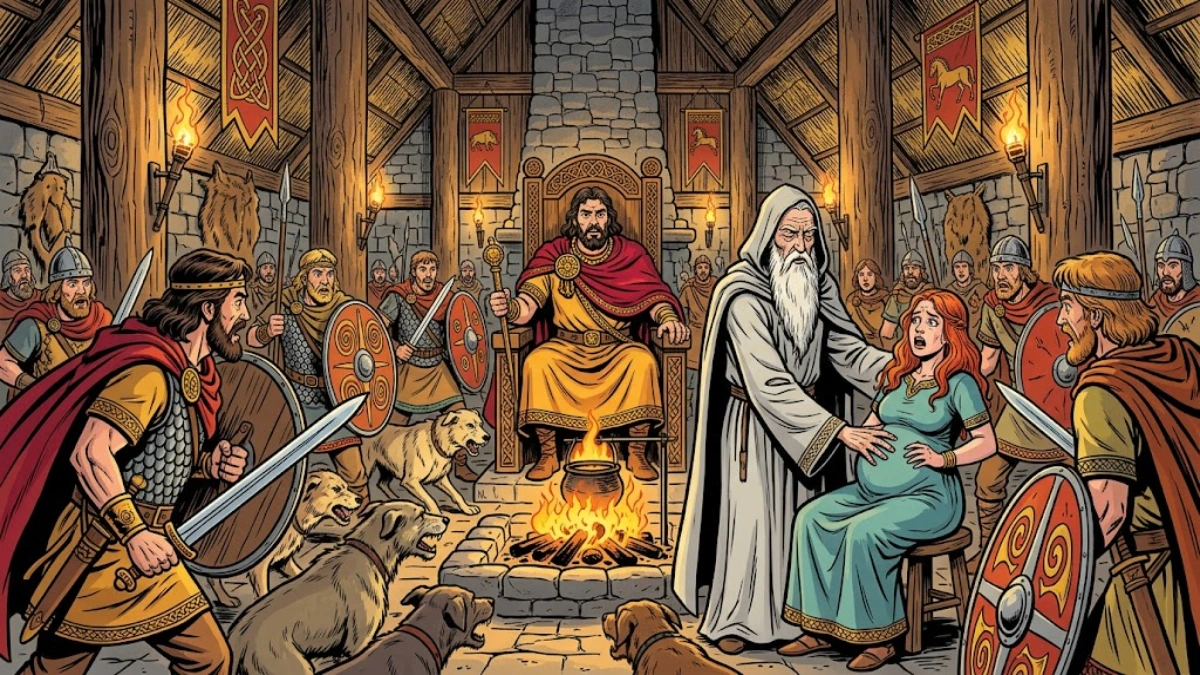
The saga opens not with the heroine but with her cry. King Conchobar mac Nessa is feasting in the great hall of Emain Macha — the royal capital of Ulster, on the hill of Navan Fort outside present-day Armagh — when the wife of his chief storyteller, Fedlimid mac Daill, suddenly screams in the womb. The sound is so piercing that the warriors leap up with their weapons. Conchobar calls for Cathbad the druid, the wisest counsellor of the court, who lays his hand on the woman’s belly and declares in stately Old Irish verse that the child within is a girl who will be the most beautiful woman ever born in Ireland, but for whose sake heroes will quarrel, kings will be diminished, and the great houses of Ulster will be split apart. He gives her her name — Derdriu, “the troubled one” — and the warriors clamour at once that she should be killed before she is born.
Conchobar refuses. The king takes the unborn child for himself: she is to be raised in secret, far from the eyes of any man, until she is old enough to become his queen. A hidden steading is built deep in the woods. Levarcham, a sharp-eyed nurse and conversation-woman trusted by the king, is set as her only companion, with a silent fosterer for hard work. The girl grows up untouched by the political world she was born into, schooled in stitching and harp-music and the names of birds, kept ignorant of the prophecy and of the king’s plan for her. The first beat of the story is therefore not yet a tragedy but a quiet act of state cruelty: a man in power has decided that a future will belong to him, and a child is paying the price of that decision in advance.
Beat II — The Calf in the Snow
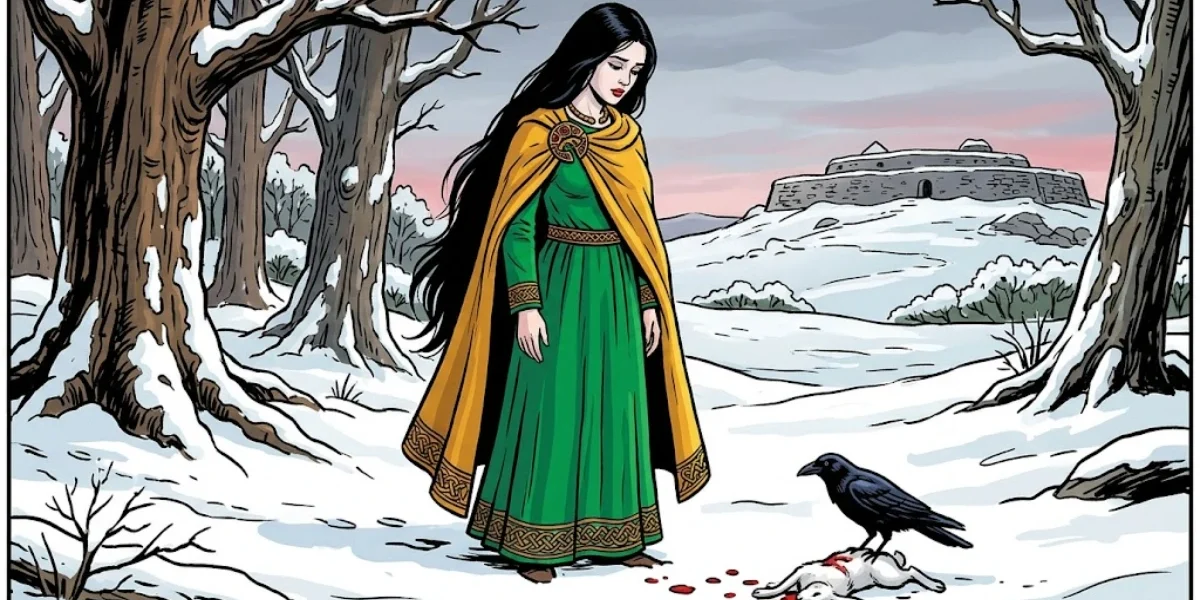
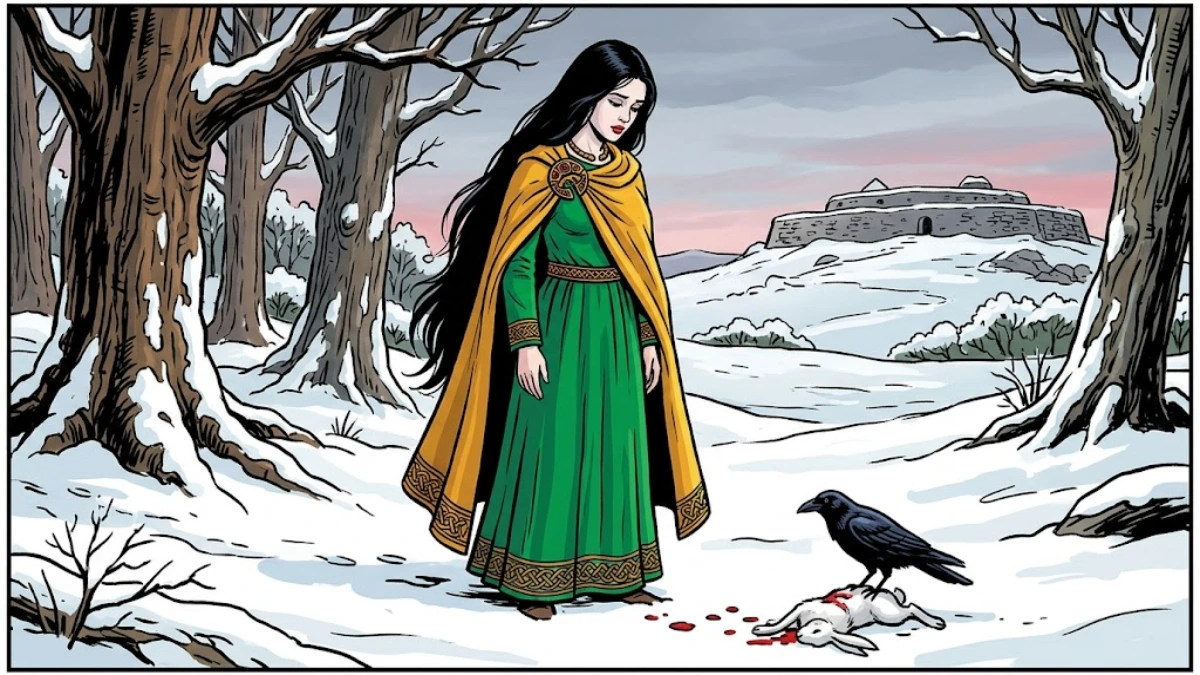
Years later, in deep winter, Deirdre stands at the edge of her hidden enclosure and watches her foster-father skinning a calf he has slaughtered for the household pot. A black raven flies down to drink the blood that pools on the snow. The young woman, who has known almost nothing but white walls and soft fabrics, is stopped by the sudden composition of three colours together — the white of the snow, the red of the blood, the black of the raven’s wing — and turns to Levarcham. “If there is a man in the world,” she says quietly, “with hair as black as that raven, with cheeks as red as that blood, and skin as white as that snow, that is the man I would love.”
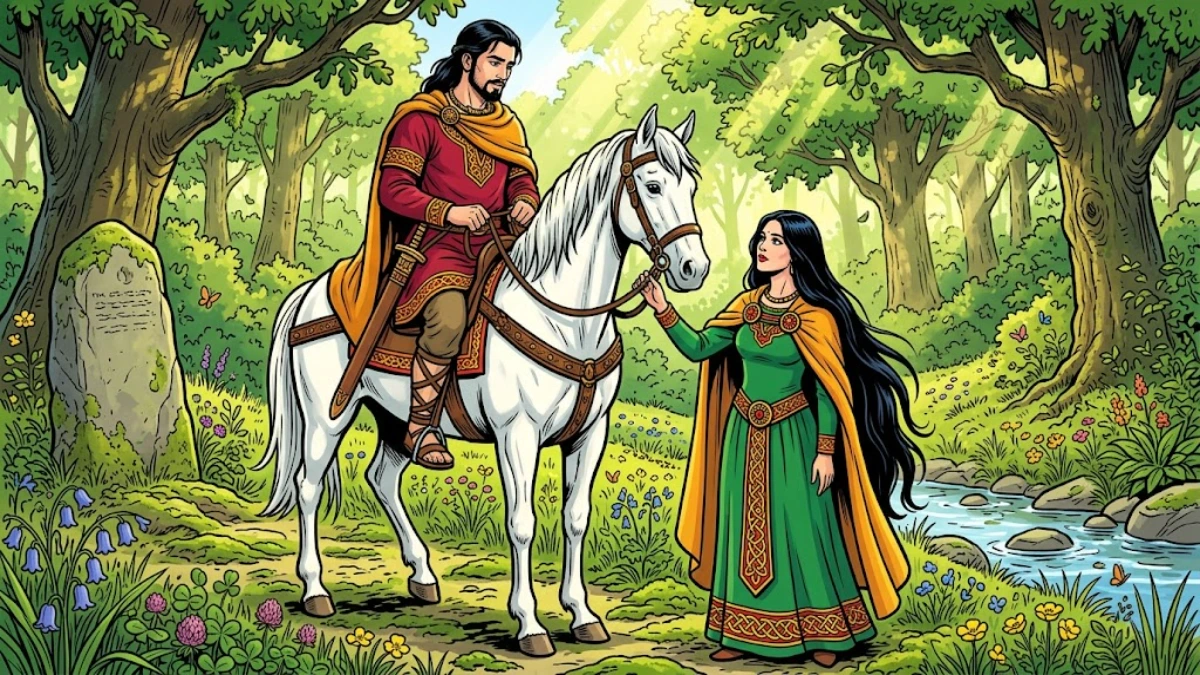
It is one of the most repeated images in Western literature — the same chromatic triad later appears in the German Schneewittchen (“Snow White”) of the Brothers Grimm (KHM 53, 1812) and in countless intermediate ballads — but in the Old Irish text it is almost certainly the older instance. Levarcham, against her instructions, names a man who matches the description: Naoise (Old Irish Noísiu), eldest son of Uisliu, one of the three “Sons of Usnach,” a young Ulster warrior of the king’s own war-band. Deirdre arranges to be in a clearing when Naoise rides past, calls to him directly, and refuses to let him leave until he has agreed to take her with him. Naoise tries to refuse — he knows the prophecy and the king’s claim — but cannot. With his brothers Ardan and Ainnle and a small company of one hundred and fifty followers, he takes Deirdre and flees Ireland for Alba — the Gaelic Scotland of Argyll, Lochaber, and the western glens. The second beat is the genuine love story at the heart of the saga: a girl who chooses for herself for the first time, and a young man who pays for that choice with his future.
Beat III — The Glen of the Two Voices
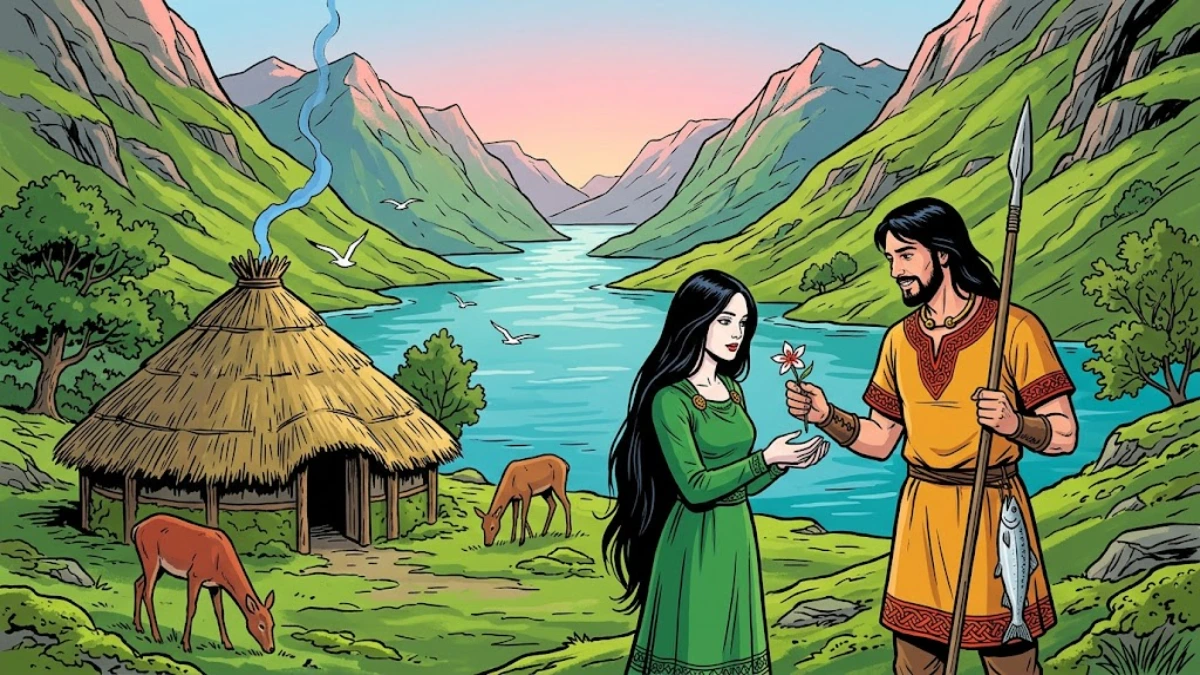
The exiled company spends a long time in Alba. They take service with the king of Alba as mercenaries, build a hunting-stead by the salmon-river of Glen Etive (Gleann Èite, off Loch Etive in Lorn, where the modern village of Glen Etive still stands), and live, the saga is at pains to say, in something like ordinary married happiness. Naoise hunts. Deirdre cooks the salmon and learns the names of the birds of Alba. Her elegy for these years, transposed from the Book of Leinster into the close of Jacobs’s text, is one of the loveliest short poems in the Gaelic canon and the reason later writers from Seán Ó Tuama to Seamus Heaney have returned to the story. “Glen Etive, O Glen Etive! There I built my first house. Beautiful was its wood at sunrise, when the sun struck Glen Etive.”
The peace cannot last. The king of Alba sees Deirdre and decides to take her for himself; the company has to flee further into the Hebridean islands. Word reaches Conchobar in Emain Macha that his lost girl and her warrior have been driven into a corner. The king summons his nobles and asks whether the Sons of Usnach should be brought home. The nobles, who remember Naoise from before the elopement and who have always loved the boy, beg the king to send pardon and to invite the exiles back to Ulster under safe-conduct. Conchobar agrees — and chooses as guarantors three of the most honourable men in his court: Fergus mac Róich, the former king of Ulster who has voluntarily ceded his throne; and Fergus’s two sons. The third beat sets up the catastrophe: Conchobar has decided privately to kill Naoise the moment he steps onto Ulster soil, and is willing to spend the honour of his three guarantors to do it.
Beat IV — The Red Branch and the Sea
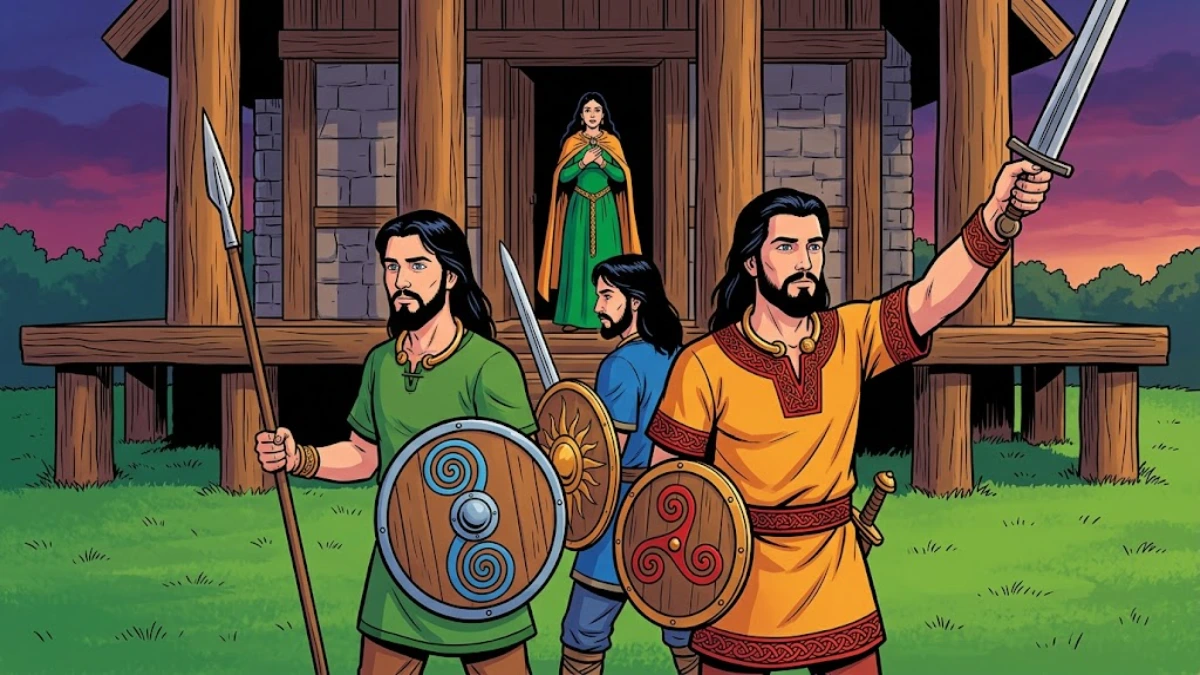
Deirdre dreams a warning: three black birds fly to her from Emain Macha carrying three drops of honey, and fly back carrying three drops of blood. She begs Naoise not to go. He goes anyway: a warrior who refuses a king’s safe-conduct under three sureties is a warrior with no future in Gaelic society, and Naoise has come to long for his own country. The company crosses the North Channel and lands on the Ulster shore. There Conchobar’s plan unfolds. Fergus is detained at a feast he cannot honourably refuse — a king’s invitation, and his under geis (a sacred Gaelic taboo) never to refuse one. Fergus’s sons escort the exiles forward to Emain Macha, but at the door of the king’s lawn the king’s mercenaries fall on the Sons of Usnach, and the brothers fight back to back. Naoise, Ardan, and Ainnle, the three of Usnach, are cut down on the green of the Red Branch — the warrior-house of Ulster — together with the son of Fergus who tried to defend them.
Deirdre is taken alive to Conchobar. The king keeps her for a year, but she will not smile, will not lift her head, will not eat at his table. He asks her at last whom she hates most in the world. Yourself, she says, and after you, Eógan mac Durthacht — the warrior who delivered the blow that killed Naoise. Conchobar, in a fit of cruelty, announces that since she has shared his bed for a year she will spend the next year with Eógan. As the chariot carries her away between her two enemies, she throws herself from it at full gallop onto a rock and dashes her head to pieces. In the older Old Irish text she dies on the rock; in the Hebridean recension Jacobs follows, she throws herself into the sea, and pine-trees grow from her grave and from the grave of Naoise and lean across the water until they touch — a final image that echoes the English ballad of Lord Lovel and the European motif of the trees of intertwined love (studied at length in the journal Mélusine, vol. iv, Paris 1888–89). Fergus, learning of the betrayal, burns Emain Macha and exiles himself to the court of Queen Medb of Connacht — and his exile is the political cause of the great Ulster war of Táin Bó Cúailnge, the “Cattle-Raid of Cooley.” The fourth beat is therefore not only the destruction of one family. It is the political wound from which the entire Ulster Cycle bleeds.
Moral
The Old Irish saga states the lesson of the tale not in the voice of a moralist but in the voice of Deirdre herself, in her last great elegy in the Book of Leinster:
Cid maith lat a Chonchobair
ind ferand-sa fil im chenn?
Domarfas in mac Uislenn
ní ragad m’anim ind.“What use to you, O Conchobar, this kingdom you wear like a crown? The son of Uisliu is dead — my soul is gone with him.”
The moral the early Irish reader is meant to take from this is not “obey the king” and not “beware of love.” It is the harder, older Gaelic teaching that fír flathemon, the “truth of the ruler,” is the one good upon which a kingdom rests, and a king who breaks his own sworn word for his own desire breaks his own house with it. Deirdre’s death is not the moral of the story. The burning of Emain Macha is the moral of the story.
Why This Tale Has Lasted
For more than a thousand years Longes mac n-Uislenn has refused to die. Eighth-century scribes wrote it down; fifteenth-century poets expanded it; seventeenth-century historians recapitulated it; eighteenth-century forgers repackaged it for European Romanticism; nineteenth-century folklorists found it living in the Outer Hebrides; the Irish Literary Revival made it the central native subject of the new Abbey Theatre; and twenty-first-century playwrights still return to it. The tale lasts because it does three things at once that very few stories do: it gives a young woman an interior life and a voice of her own at a moment when Western literature rarely did either; it shows political power being broken by its own dishonesty rather than by any outside enemy; and it gives the Gaelic world one of its most piercing love-songs in Deirdre’s farewell to the glens of Alba. Read carefully, the story is not really sad. It is honest. The girl who refuses to smile in Conchobar’s hall, who names her enemy out loud, and who decides her own death rather than be passed between two men, is one of the freest characters in the literature of medieval Europe — and the older the manuscript, the freer she sounds.
Frequently Asked Questions
Who wrote down the story of Deirdre, and when?
The earliest written form of the tale is the Old Irish saga Longes mac n-Uislenn (“The Exile of the Sons of Uisliu”), composed in roughly the eighth or ninth century and preserved in three medieval Irish manuscripts: the twelfth-century Book of Leinster (Trinity College Dublin MS H.2.18, c. 1160), the fourteenth-century Yellow Book of Lecan, and Edinburgh Adv. MS 53. A fuller fifteenth-century recension titled Oidheadh Chloinne hUisneach was edited and translated by Whitley Stokes in Ernst Windisch’s Irische Texte (Leipzig, 1887). Geoffrey Keating recapitulated the story in his Foras Feasa ar Éirinn (c. 1634), and Alexander Carmichael recorded a still-living oral version in the Outer Hebrides for the Transactions of the Gaelic Society of Inverness, vol. xiii (1887). Joseph Jacobs’s English translation of the Hebridean text appeared as no. xv of Celtic Fairy Tales (London: David Nutt, 1892).
Why are the colours raven-black, snow-white, and blood-red so important in this story?
The combination of black, white, and red as a description of an ideal beloved is one of the oldest poetic patterns in Western literature. In Longes mac n-Uislenn the young Deirdre sees her foster-father skinning a calf in the snow and a raven drinking the blood, and decides she will love only a man with hair as black as the raven, cheeks as red as the blood, and skin as white as the snow. The triad later reappears in the German Schneewittchen of the Brothers Grimm (KHM 53, 1812), where the Queen pricks her finger sewing by an ebony window-frame, and in many medieval ballads, but on the manuscript evidence the Old Irish text is the older instance. Tom Peete Cross indexes the motif as Z65.1 in his Motif-Index of Early Irish Literature (Bloomington, 1952).
Was the Sons of Usnach story really transmitted orally for a thousand years?
The continuity is unusually well-documented. The eighth- or ninth-century Old Irish saga, the fifteenth-century Oidheadh Chloinne hUisneach, Keating’s seventeenth-century summary, the Dublin Gaelic Society’s eighteenth-century manuscript (printed in their Transactions for 1808), and Carmichael’s nineteenth-century Hebridean oral transcription all preserve the same narrative skeleton: the prophecy at Emain Macha, the elopement to Alba (Scotland), Conchobar’s false safe-conduct, the death of the three brothers, and Deirdre’s elegy. James Carney, in Studies in Irish Literature and History (Dublin: DIAS, 1955), argued that the case is one of the strongest pieces of evidence in Europe for genuine long-term oral preservation of a complex literary text outside any continuous written tradition the reciter could read.
Where is Glen Etive, and is it the place named in Deirdre’s lament?
Glen Etive (Scottish Gaelic Gleann Èite) is a real glen in Lorn, in the western Highlands of Scotland, that runs south-west from the head of Glen Coe down to Loch Etive, an arm of the sea. Deirdre’s lament for Glen Etive in the Book of Leinster names specific local places — “Glen Lay,” “Glen Massan,” “Glen Etive,” and the salmon-river that runs through it — that match the geography of Argyll precisely. This is part of the reason Celticists treat the saga as describing real Scoto-Irish movement of warrior bands across the North Channel rather than as pure fantasy. The Gaelic poem has been translated by Vernam Hull (1949), Eleanor Hull, and most recently by Patrick K. Ford.
What did James Macpherson’s Darthula have to do with the real Deirdre saga?
James Macpherson, the Scottish poet who in the 1760s claimed to have discovered an unbroken Highland epic by the legendary bard Ossian, included a free Romantic version of the Deirdre material under the name Dar-thula in his 1762 Fingal collection. Although Samuel Johnson denounced Macpherson as a forger and most modern Celticists agree that the alleged Ossianic epic is largely Macpherson’s own composition, Darthula nevertheless poured a recognisable Deirdre story into European Romanticism. Goethe and the painter James Barry both responded to it. Eleanor Hull and Douglas Hyde later argued that the genuine Gaelic recensions in Carmichael, Stokes, and the Book of Leinster are tighter, sharper, and far less misty than Macpherson’s reverberating prose, and these are the texts on which all twentieth-century retellings — Lady Gregory’s 1902, Yeats’s 1907, Synge’s 1910 — were based.
You May Also Like
 Celtic Folk Tales
Ages 9-12
Celtic Folk Tales
Ages 9-12
The Wooing Of Olwen
The Wooing Of Olwen: Shortly after the birth of Kilhuch, the son of King Kilyth, his mother died. Before her death she charged the king that he should not take
 Celtic Folk Tales
Ages 9-12
Celtic Folk Tales
Ages 9-12
Guleesh
Guleesh: There was once a boy in the County Mayo; Guleesh was his name. There was the finest rath a little way off from the gable of the house, and he was
 Celtic Folk Tales
Ages 9-12
Celtic Folk Tales
Ages 9-12
The Farmer of Liddesdale
The Farmer of Liddesdale: here was in Liddesdale (in Morven) a Farmer who suffered great loss within the space of one year. In the first place, his wife and