The Monkey and the Crocodile: A Panchatantra Fable
A clever monkey and a crocodile become friends, but greed and betrayal test their bond in this Panchatantra tale.
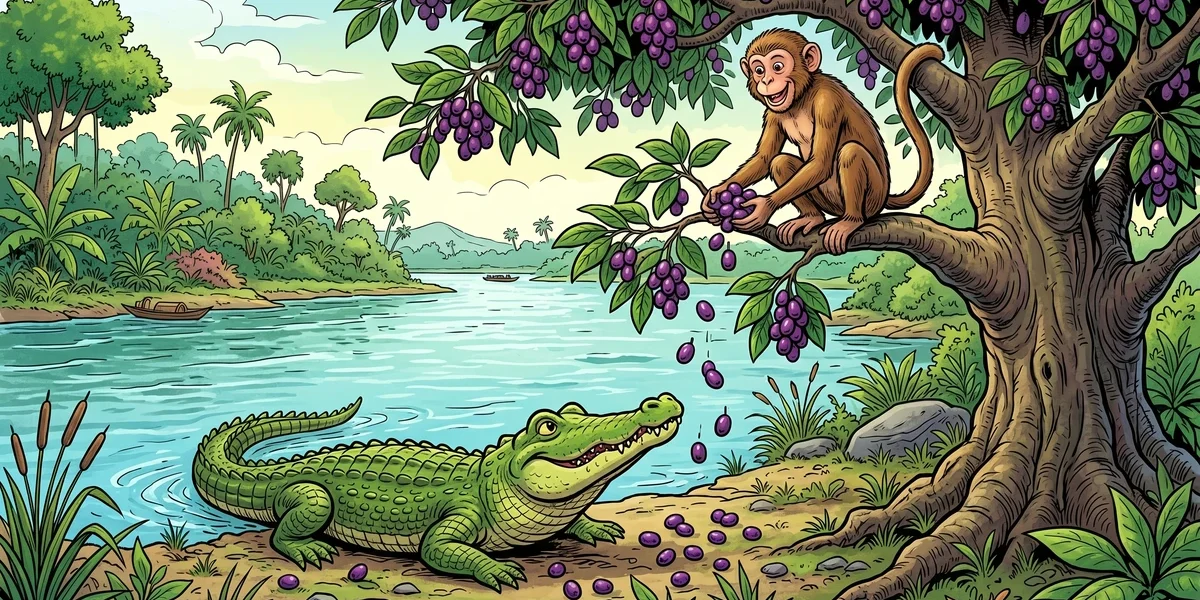
The Monkey and the Crocodile: Grihasthi, Mitra-Dharma, and the Domestic Triangle
The Panchatantra’s Recurring Domestic Triangle
A recurring structural pattern in the Panchatantra is what might be called the domestic triangle: a male protagonist with genuine relationships outside the home (friends, allies, partners in enterprise) whose external relationships are threatened or destroyed by the intervention of a spouse, typically a wife whose agenda is either suspicious, jealous, or simply narrow in its conception of the household’s interest. This pattern appears across multiple books of the Panchatantra and reaches one of its most memorable expressions in the Monkey and Crocodile tale.
The structural function of the crocodile’s wife in the tale is not simply to be a villain. She is the representative of a particular conception of household interest — a conception that is closed, possessive, and unmindful of the value of external relationships. In her logic, the crocodile’s friendship with the monkey produces fruits but not sufficiently satisfying fruits. The monkey’s heart, she reasons, would be more valuable than his shared rose-apples. This is a logic that treats friendship purely as a resource to be extracted maximally, rather than as a relationship to be maintained with care.
The Panchatantra is characteristically unsentimental about this dynamic: it does not present the wife as an unusual monster but as a recognisable type — the domestic partner who cannot perceive value beyond immediate material return, and whose demands, if followed, destroy the very relationships that produce the value she seeks. In this sense, the crocodile’s wife is the story’s true antagonist, not because she is evil but because she is radically short-sighted. She destroys a friendship that was producing ongoing benefit in order to obtain a one-time windfall that she cannot even ultimately collect.
Mitra-Dharma: The Sacred Obligation of Friendship
The Panchatantra’s second book, in which this tale appears, is specifically concerned with mitra-labha — the gaining of friends — and the principles of true friendship. The concept of mitra-dharma (the duty or rightness of friendship) is taken seriously in Indian ethical thought: a genuine friend (mitra) is one who speaks truth, helps in difficulty, and maintains the relationship even when it is costly to do so. The Sanskrit ethical tradition distinguishes sharply between the true friend and the false friend (mitra-bhasa, one who only appears to be a friend), and the Panchatantra is full of tales that illustrate this distinction through animal characters.
The crocodile’s failure is specifically a failure of mitra-dharma: he has a genuine friend in the monkey — one who gave freely of his resources, who offered company and warmth, who asked nothing in return. Rather than defend this friendship against his wife’s destructive demand, the crocodile attempts to convert the friendship into a murder plot. This is the deepest betrayal the Panchatantra recognises: not the betrayal by a known enemy, but the betrayal by a known friend who chooses domestic compliance over the obligations of friendship.
The tale asks, implicitly: what should the crocodile have done? The answer the Panchatantra provides elsewhere in its structure is clear: the true friend speaks truth to his wife, explains the value of the relationship, and refuses the demand. The crocodile lacks the moral courage to do this. He takes the path of least domestic resistance — and in doing so loses both the friendship and the windfall his wife desired. The tale is a study in the cost of moral cowardice in the domestic sphere.
“The fool who cannot say ‘no’ to his own household when it asks for what is wrong will find that he has lost both the wrong thing he refused to refuse and the right thing he had already earned.”
Niti vs. Bala: Why Intelligence Defeats Force in the Panchatantra
The Panchatantra’s overarching pedagogical framework is the training of young princes in the principles of niti (political and practical wisdom) as opposed to reliance on bala (brute force or raw power). The premise of the entire collection is that intelligence, applied strategically, consistently outperforms force applied directly. This principle is embedded in the structural logic of virtually every tale: the powerful character (lion, tiger, elephant, crocodile) is regularly defeated or outmanoeuvred by the clever character (jackal, monkey, mouse, crow).
In the Monkey-Crocodile tale, the physical power differential is stark: the crocodile is larger, stronger, in its natural element (water), and in a position of complete physical dominance over the monkey mid-river. By any analysis based on force, the monkey should have no chance. Yet the monkey escapes — not by becoming stronger, not by acquiring a weapon, not by receiving external help — but by thinking more clearly than the crocodile in a moment when clear thinking is the only resource available.
This is the Panchatantra’s central teaching in miniature: that the cultivation of intelligence — specifically the ability to rapidly assess a situation, identify available resources, understand the other party’s motivations, and construct a strategy that exploits those motivations — is a more reliable protection than physical strength or material wealth. The monkey’s only assets are a calm mind and a clear understanding of the crocodile’s character. They are sufficient.
The pedagogical implication for the princes who were the Panchatantra’s original audience is direct: the ruler who relies primarily on military power will be vulnerable to those who outthink him. The ruler who cultivates niti — who can read situations rapidly, understand motivations, construct strategic responses — will survive and succeed against physically superior opponents. The monkey is the model prince; the crocodile is the model of the powerful but mentally inflexible opponent.
The Aftermath: What the Severed Friendship Teaches
After the monkey escapes to the safety of his tree, he delivers a speech to the crocodile that is as important as the escape itself. He does not merely flee; he explains. He articulates what the crocodile has done wrong, not in anger but in the clear-eyed tone of a former friend who understands exactly what has occurred. He names the betrayal, explains why the friendship is over, and does so without cruelty or excessive reproach — but also without softening the truth.
This final act is pedagogically significant. The Panchatantra is training its audience not just in how to survive betrayal but in how to understand it — to analyse the structure of what went wrong, to name it correctly, and to take the appropriate relational consequence (severing the friendship) without either rage or false reconciliation. The monkey’s speech is a model of clear-headed post-mortem analysis: this is what happened, this is why it happened, this is what it means for the relationship going forward. No second chances; no pretence that the river can be crossed again with trust.
For the Panchatantra’s princely audience, this is a lesson in statecraft as well as in personal ethics: alliances that are revealed as treacherous must be treated as such. The ruler who continues to trust revealed traitors is not merciful but merely naive, and naivety in statecraft is a form of negligence. The monkey’s clear-eyed severance of the friendship is the correct political response — and the tale presents it as such.
Why This Story Lasted
The Panchatantra Monkey-Crocodile tale has been retold for more than two thousand years because it compresses several distinct but interlocking lessons into a single economical narrative: the danger of misplaced domestic compliance; the sacred and fragile nature of friendship; the reliable superiority of intelligence over force; and the proper handling of revealed betrayal. Each of these lessons is genuinely useful across the entire range of human social contexts — from family dynamics to political alliance to personal ethics. The tale has survived not because it is simple but because it is dense: every retelling yields another layer, another angle, another applicable insight. The monkey’s wit is only the beginning of what the story has to offer.
Frequently Asked Questions
What is “mitra-dharma” in Indian ethical thought?
Mitra-dharma (मित्र-धर्म) refers to the duties and obligations inherent in genuine friendship in Indian ethical tradition. The Sanskrit concept of mitra (friend) carries a strong sense of reciprocal obligation: a true friend speaks truth even when it is uncomfortable, helps in genuine need, maintains loyalty under pressure, and does not exploit the relationship for personal gain. The Panchatantra distinguishes extensively between the true friend (mitra) and the false friend (mitra-bhasa, one who merely appears to be a friend), and many of its tales dramatise the consequences of confusing the two. The crocodile’s failure in the Monkey-Crocodile tale is specifically a failure of mitra-dharma: he prioritises domestic compliance over the obligations of genuine friendship.
What is the role of the crocodile’s wife in the Panchatantra tale?
The crocodile’s wife serves as the story’s catalytic antagonist — the figure whose demand sets the plot in motion by creating an irresolvable conflict between the crocodile’s two relationships: his friendship with the monkey and his domestic obligations to his wife. She is not presented as unusually evil but as a recognisable type in the Panchatantra’s social taxonomy: the domestic partner who values household gain over external relationships, and whose immediate desires destroy the longer-term value that those external relationships produce. The Panchatantra uses this figure repeatedly across its tales to illustrate the danger of domestic short-sightedness and the importance of maintaining external alliances against domestic pressure.
What is “niti” in the Panchatantra’s educational framework?
Niti (नीति) is a Sanskrit term meaning policy, wisdom, prudence, or strategic conduct — the art of acting intelligently and effectively in the social and political world. The Panchatantra was composed as a manual of niti for young princes, teaching through animal fables the principles of strategic thinking, alliance formation, response to betrayal, and effective governance. Niti is consistently presented in the Panchatantra as superior to bala (force or raw power) — the stories repeatedly show clever but physically weaker characters (monkeys, jackals, crows, mice) defeating or outmanoeuvring powerful but strategically obtuse characters (lions, tigers, elephants, crocodiles). This is the collection’s central political argument: intelligence well applied is more powerful than any other resource.
Why does the Panchatantra use animal characters to teach human lessons?
The use of animal characters in instructional fables serves several pedagogical purposes. First, it creates sufficient distance from the real social world to allow the audience to recognise uncomfortable truths without defensive resistance — it is easier to laugh at a foolish crocodile than at a foolish nobleman. Second, animal characters carry pre-existing symbolic associations (the jackal as cunning, the lion as powerful but vain, the crow as clever) that do narrative work efficiently. Third, animal fables are memorable — the images of a monkey on a crocodile’s back, or a lion killed by a hare, are vivid and sticky in ways that abstract moral instructions are not. The Panchatantra’s compiler understood that wisdom delivered through story is both more palatable and more retainable than wisdom delivered through precept.
How is this version of the Monkey-Crocodile story different from other versions?
The Monkey-Crocodile tale exists in several versions across South Asian tradition, including the Panchatantra, the Jataka tales (where the monkey is identified as a Bodhisattva), and numerous regional folk retellings. The core narrative structure — friendship, wife’s demand, betrayal revealed mid-river, monkey’s wit, escape — is stable across versions. The differences typically involve emphasis: the Jataka version focuses on the Bodhisattva’s compassionate wisdom and may include a more elaborate dialogue; regional folk versions may add or subtract scenes and vary the tone. The Panchatantra version is the most structurally complete in its framing context (the book on gaining friends) and most explicit in its political and strategic lessons about niti and mitra-dharma.
Frequently Asked Questions
**Q: Why is this story important?**
You May Also Like
 Aesop's Fables
Ages 3-5
Aesop's Fables
Ages 3-5
The Story Of The King Who Would Be Stronger Than Fate
The Story Of The King Who Would Be Stronger Than Fate: Once upon a time, far away in the east country, there lived a king who loved hunting so much that, when
 Aesop's Fables
Ages 9-12
Aesop's Fables
Ages 9-12
The Talkative Tortoise
The dual-rooted Indian fable of Kambugrīva — "Conch-Necked," the tortoise of Phullotpala pond — and his two wild-goose friends Saṅkaṭa and Vikaṭa, who try to lift him out of a drought by carrying him on a stick. The story comes to us through two ancient traditions at once: the Buddhist Pali Canon as Kacchapa Jātaka No. 215, and the Hindu Panchatantra as Book I, Mitrabheda. It is not, as is often claimed, a tale of Aesop. T.W. Rhys Davids' 1880 translation is preserved in full alongside the Sanskrit retelling, with Sanskrit names restored, the dual-tradition origin explained, and the story's two-thousand-year journey through Pahlavi, Arabic, Persian, Hebrew, Latin, and finally La Fontaine's French traced.
 Aesop's Fables
Ages 3-5
Aesop's Fables
Ages 3-5
A Long Bow Story
A Long Bow Story: One day a bunniah, [1] or banker, was walking along a country road when he over took a farmer going in the same direction. Now the bunniah