Meet Arthi Anand of “Arts Tales with Arthi Anand”
Meet Arthi Anand of “Arts Tales with Arthi Anand”: Every once in a while, I come across a storyteller where one can feel the love for storytelling radiating

Arts Tales with Arthi Anand: Where Visual Art and Story Meet for Children
The intersection of visual art and storytelling for children is a territory that requires a particular combination of skills: the ability to see the story inside an image and to build the image from a story; patience with the pace at which children absorb beauty; and the conviction that aesthetic experience is not a luxury appended to education but one of its primary vehicles. Arthi Anand, creator of Arts Tales with Arthi Anand, works at precisely this intersection — using art as a doorway into narrative and narrative as a doorway into art, for children who might not otherwise have a guide to either.
The tradition she works in is ancient. Before literacy was widespread, images told stories — on cave walls, temple friezes, manuscript margins, and stained glass. The Aesopic tradition itself was accompanied from its earliest recorded forms by illustrations; the fables and their visual representations developed in parallel, each shaping the other. When Arthi Anand brings a painting into conversation with a story, she is restoring an original intimacy between these two forms of meaning-making that the specialisation of modern education has often sundered. The governing concept is chitra-katha—the picture-story—the oldest form of narrative in human experience.
“A child who learns to read a painting has learned something about how to read anything. A child who learns to see the story in an image has learned that stories are everywhere.”
Beat I — Art as a First Language for Children
Children encounter images before they encounter words. Their first acts of meaning-making are visual: recognising faces, interpreting expressions, reading the emotional tone of a room. Arts Tales with Arthi Anand works with this developmental sequence rather than against it — beginning with what the child can already do (see and respond to images) and using that capacity as a scaffold for what they are learning to do (read and respond to text). This approach reflects a well-established strand of educational philosophy: that the path to complex literacy runs through multiple modes of representation, not through text alone.
Beat II — The Narrative Inside the Image
Every painting that tells a story has a before and an after — a moment captured that implies what preceded and what will follow. Teaching children to ask “what happened just before this?” and “what will happen next?” is teaching them to think narratively, causally, sequentially — skills that transfer directly to reading comprehension, to understanding history, to scientific thinking about cause and effect. Arthi Anand’s work uses art as an occasion for exactly this kind of thinking: not “what do you see?” only, but “what is the story? Who are these people? What do they want? What will they do?”
Beat III — Bringing Art Within Reach
One of the persistent challenges of arts education is the assumption — absorbed from cultural context rather than explicit teaching — that art belongs to certain people and places: museums, galleries, the educated, the affluent. Arts education for children, especially in contexts where families have limited access to these institutions, must work against this assumption by demonstrating that the aesthetic encounter is available everywhere, that it does not require credentials or money, and that the child’s own response to what they see is valid and worth developing. Arthi Anand’s work carries this democratic conviction: the story in the image is available to anyone who is invited to look for it.
Programme: Arts Tales with Arthi Anand — combining visual art and storytelling for young audiences
Tradition invoked: Chitra-katha (picture-story) — the ancient intimacy between image and narrative in Indian and world tradition
Themes: Visual literacy, narrative thinking, arts education equity, the image as a doorway to story
Beat IV — The Story Weaver’s Role
Arthi Anand occupies a position that has existed in human communities across cultures and centuries: the person who stands between the art and the audience and helps the audience find what is in it. In museum traditions this is the docent; in oral traditions this is the storyteller; in the classroom this is the teacher who loves what they teach enough to transmit that love. What distinguishes the best practitioners of this role is that they do not substitute their interpretation for the child’s experience — they create the conditions in which the child’s own encounter with the work becomes possible. The story is not delivered; it is discovered, by the child, with a guide who knows where to look.
Why This Story Matters
Stories about people who dedicate themselves to bringing art and story to children are worth telling because they describe a form of generosity that is easy to overlook: the gift of attention, the gift of the frame that makes beauty visible, the gift of the question that opens a painting into a world. Arthi Anand’s work with Arts Tales is a contribution to a larger effort — pursued by teachers, librarians, storytellers, and museum educators around the world — to ensure that the encounter with beauty and narrative is not reserved for children who are already advantaged, but is available to every child who is willing to look and listen.
Frequently Asked Questions
What is Arts Tales with Arthi Anand?
Arts Tales with Arthi Anand is a programme that combines visual art and storytelling for children, using paintings and other artworks as starting points for narrative exploration. It works to develop visual literacy, narrative thinking, and aesthetic responsiveness in young audiences through guided encounters with art.
What is chitra-katha?
Chitra-katha (चित्रकथा) means “picture-story” in Sanskrit — the tradition of narrative told through images. It is one of India’s oldest narrative forms, found in painted scrolls, temple reliefs, manuscript illustrations, and the travelling storyteller traditions of communities across the subcontinent. The patua scroll painters of West Bengal, the phad painters of Rajasthan, and the Kalamkari artists of Andhra Pradesh all work within this tradition.
Why is visual literacy important?
Visual literacy — the ability to interpret, analyse, and create visual content — is increasingly recognised as a core component of twenty-first century literacy alongside reading, writing, and numeracy. In a world saturated with images, the ability to read them critically and creatively is a fundamental skill. Arts education that develops visual literacy also develops the narrative, causal, and analytical thinking that supports all forms of literacy.
How does arts education benefit children who have limited access to museums?
Digital reproduction has made it possible to bring high-quality images of artworks into any context with a screen. What remains necessary — and what programmes like Arthi Anand’s provide — is the human presence that helps the child find the encounter with the image meaningful rather than merely visual. The image without the conversation is wallpaper; the image with the right question becomes a story that the child enters.
How does storytelling enhance engagement with visual art?
Storytelling gives children a purposeful relationship with an image: instead of looking for what it “means” (an intimidating question with no obvious answer), they are looking for what happened, who is there, what they want, and what will happen next — questions they already know how to engage with from their experience of narrative. This makes the image approachable and the child’s own responses valid starting points for deeper exploration.
Frequently Asked Questions
**Q: Why is this story important?**
You May Also Like
 Aesop's Fables
Ages 3-5
Aesop's Fables
Ages 3-5
The Boy Who Cried Wolf: Loneliness and the Price of Deception
The Boy Who Cried Wolf: Loneliness and the Price of Deception: The village of Ashford clung to the edges of the Westwood Forest like a child reluctant to let
 Aesop's Fables
Ages 3-5
Aesop's Fables
Ages 3-5
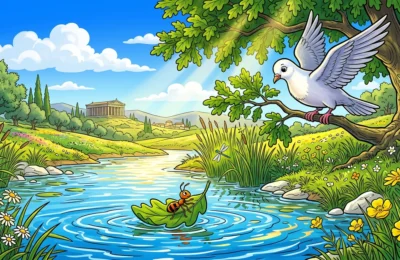
The Ant and the Dove
The Ant and the Dove: On a warm and sunny morning, a tiny ant was making her way through the tall grass near the bank of a wide, sparkling river. The day was
 Aesop's Fables
Ages 6-8
Aesop's Fables
Ages 6-8
Jackal Barber Brahmin
Jackal Barber Brahmin: A Barber and a Jackal once struck up a great friendship, which might have continued to this day, had not the Jackal been so clever that