Light Makes Prosperity
Light Makes Prosperity: There is a Tamil proverb dîpam lakshmîkaram, meaning, “light makes prosperity,” and the following story is related to explain it: The
Origin & Canonical Placement
“Light Makes Prosperity” is a South Indian Tamil household parable explaining the proverb dîpam lakshmîkaram — “light makes prosperity.” It belongs to the tradition of vīṭṭu kathai (household tales) from Tamil Nadu, Kerala, and Karnataka that animate the spiritual significance of daily domestic rituals, particularly the lighting of the kuthu vilakku — the standing brass lamp — at dusk. The story was first published in English in Tales of the Sun, or Folklore of Southern India (1890) by Mrs. Howard Kingscote and Pandit Natesa Sastri, collected from South Indian oral tradition where it had circulated for centuries.
“Dîpam lakshmîkaram — dîpam sarvaṅṇam param.”
“Light makes prosperity — light is the supreme auspiciousness.”
— Tamil devotional proverb, lamp-lighting tradition
The tale belongs to a recognised body of Indian stories about the goddess Lakshmî (prosperity, fortune, grace) and her elder sister Mûdêvî (adversity, ill-luck), which exist throughout Tamil, Telugu, Kannada, and Malayalam traditions. Together they personify the twin conditions of household fortune — prosperity enters where welcome is prepared; adversity departs when that welcome is sincere and sustained.
Beat I — The House of Fallen Fortune
In the town of Gôvindapâthî there lived a merchant named Paśupati Śeṭṭi, who had a son named Vinîta and a daughter named Garvî. As children, the brother and sister made a solemn vow: if they each grew up to have children who could be married to one another, they would fulfil such matches. Garvî in time married into a wealthy merchant family and gave birth to three daughters, the youngest of whom was named Suguṇî.
But then Paśupati Śeṭṭi died, and his creditors proved many and merciless. Every piece of property was sold to settle the debts, and within two months of his father’s death, Vinîta was left without a paisa — a penniless pauper. Garvî, seeing her brother’s fallen condition, allowed worldly calculation to overcome the vow of her childhood. She married her two eldest daughters to prosperous young merchants and allowed the childhood promise to quietly lapse. Only Suguṇî, her youngest, remained unmarried.
Vinîta bore this disappointment in silence — the mark of a genuinely sensible person. The community, however, did not forget. Neighbours spoke of Garvî’s broken vow to any who would listen. These conversations fell on the young ears of Suguṇî, who was not only beautiful but exceptionally learned and clear-minded. She could see that her uncle Vinîta was courteous, dignified, and virtuous; his sons were of excellent character. That her mother should judge them worthless because they were poor struck Suguṇî as a profound confusion of values.
Breaking with all Hindu social convention of the day, she went directly to her mother and said: “I have heard the story of your vow. I am ashamed to see it broken for my sisters. I will not marry anyone in the world except one of my cousins.” Her mother replied bitterly: “You wish to marry a beggar? Go, then — but we shall never see your face again.” Suguṇî accepted the consequence without flinching. The marriage with Vinîta’s youngest son was arranged.
Beat II — A Life of Dignified Poverty
Suguṇî entered her husband’s poor home not as a sacrificed daughter but as a full partner. Vinîta and his three sons rose each morning to gather dried leaves in the forest; the three daughters-in-law spent the day stitching the leaves into patrâvalî — disposable leaf-plates used at feasts — which the men sold in the market for a few paṇams each. The income was humble and irregular.
Suguṇî managed the household money with a skill that consistently stretched the small earnings to feed everyone well. Whatever remained after the family had eaten, she shared equally with her two sisters-in-law. She never mentioned her wealthy origins. She never contrasted her former comfort with her present circumstances. The family loved and respected her as a paragon of household virtue — griḥalakṣmî, the Lakshmî of the household — even before the events that were to follow.
Thus passed a couple of years. The family was poor, but not broken; honest, but not without hope.
Beat III — The Ring of the King
One afternoon, as the king of Gôvindapâthî took his oil bath in the palace courtyard, he removed a valuable ring from his finger and set it in a niche in the wall. A garuḍa — a Brahminî kite — was circling overhead and, mistaking the glittering rubies for flesh, swooped down and seized the ring in its talons. Finding it not to be food, the bird dropped it — and it fell, by a stroke of heaven’s arrangement, directly into the courtyard of Suguṇî’s home, where she was working alone.
She picked it up and kept it safely. Soon she heard the royal proclamation in the street: the king had lost a valuable ring and would reward generously whoever could restore it. Suguṇî called her husband and his two brothers and spoke to them quietly: “I have the king’s ring — a garuda brought it here at midday. We must all go to the palace. There, in your presence, I will explain how it came to me. When his majesty offers a reward, I will name what I want. I ask only one thing: whatever my choice seems to you, do not contradict or gainsay it.” They trusted her and agreed.
At the palace, the king received them. Suguṇî returned the ring with a full and truthful account of how it had arrived in her courtyard. The king was charmed by her modesty and directness and told her to name her reward.
“Most gracious sovereign,” she said, “I ask only this: on a Friday night, let all the lamps in every house in the town be extinguished — not a light in any street, not a flame in the palace itself. Only the house of your servant may be lit, with such lamps as she can afford.”
The king, puzzled but generous, agreed. Suguṇî returned home, pledged the last jewel she possessed, and with the proceeds began to prepare.
Beat IV — One Thousand Lamps
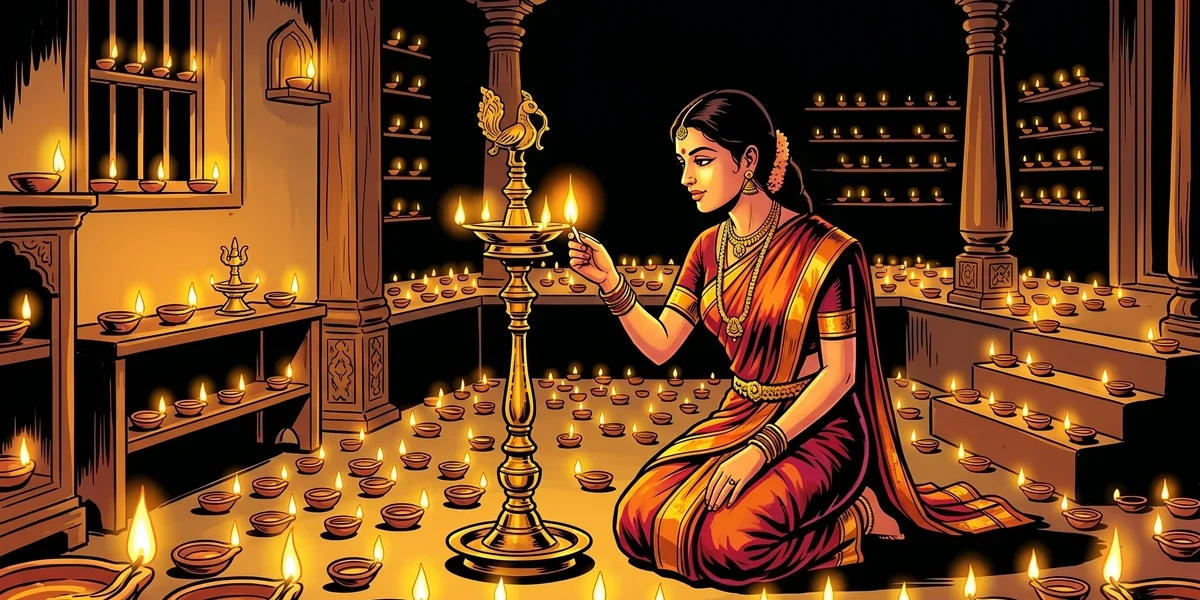
Friday came. Suguṇî fasted all day. As dusk approached, she set out one thousand oil lamps throughout the house — in every room, every corridor, every window, every doorstep. Then she called both of her brothers-in-law and gave them their instructions: one must stand at the front of the house all night without closing his eyes for a single moment; the other must guard the back. “If a woman of graceful appearance and feminine majesty seeks to enter, let her in — but first make her swear on everything sacred that she will never leave again. If a woman seeks to go out, let her go — but first make her swear that she will never in her life return.”
The brothers found her instructions peculiar, but they obeyed.
That night the entire town lay in darkness — every street, every palace window, every merchant’s shop — by royal command. Only one house blazed with light: Suguṇî’s home, a single constellation in a dark city.
The Aṣṭalakshmîs — the Eight Prosperities, the divine forms of abundance, grace, knowledge, strength, courage, victory, patience, and wealth — entered the town that night, as they do every Friday, seeking a worthy home to enter and dwell in. House by house they moved through the dark streets. Every door was dark. At last they came to Suguṇî’s door, blazing with a thousand flames.
The brother at the front stopped them and asked for their oath: they must swear never to leave. The Eight Prosperities, recognising the wisdom of the condition, took the oath solemnly and entered. When the brother understood who these luminous visitors were, he marvelled at the sagacity of his brother’s wife.
A moment later, from the back of the house, there emerged a hideous female — dark, dishevelled, dreadful in aspect — who asked the brother guarding the rear to let her out. He stopped her and required the oath: she must swear never to return. She agreed at once, for she could not remain where the Eight Prosperities had taken up residence. “My sisters have come,” she said. “I cannot stay here a moment longer. God bless you and your people. I swear by everything sacred never to come back.” And she ran away into the darkness.
She was Mûdêvî — Adversity, the elder sister of Prosperity — fleeing before the light.
Beat V — The Morning of Plenty
When morning dawned, the Eight Prosperities had already taken up their permanent abode with the family. The rice bag was full. The money chest overflowed. The pot held milk. Plenty had entered the house and sworn never to leave.
Vinîta and his sons were overjoyed. Even Garvî — Suguṇî’s mother, who had sworn never to see her daughter’s face again — was not too proud to come and beg her pardon. Suguṇî granted it without reservation and lived with all the members of her family, reconciled and prosperous, for a long and full life.
And it is for this reason that orthodox Hindus believe: dîpam lakshmîkaram — light makes prosperity, and darkness invites adversity.
Why This Story Has Lasted Across Centuries
The story of Suguṇî and the eight lights has endured because it fuses three things that rarely appear in the same tale: a brilliant strategic mind (the scheme with the lamps), a portrait of genuine household virtue (the years of dignified poverty before any miracle), and a cosmic explanation for an everyday ritual. The evening lamp is not merely a small ceremony — it is, the story insists, a signal sent into the dark that prosperity is welcome here. The story has travelled with the lamp-lighting ritual itself into Hindu diaspora communities in Singapore, South Africa, Fiji, Trinidad, the United Kingdom, and beyond, where families who light the kuthu vilakku at dusk still tell the tale of the woman who once lit a thousand.
Moral: Prosperity follows the light we prepare for it. Suguṇî did not wait for fortune to favour her — she lit a thousand lamps and made her home a place no blessing could refuse to enter.
Cultural & Ritual Context
The kuthu vilakku (also called nila vilakku or deepa) is a standing brass oil lamp, typically five-branched, that has been lit at dusk in Tamil, Kerala, and Kannada households for at least two thousand years. The ritual is described in the Grihyasûtras and in the Agamic texts associated with the domestic worship of Lakshmî. Lighting the lamp at dusk is simultaneously an act of welcoming the goddess, a practice of the household’s attention to order and cleanliness, and a moment of transition between the outward-facing busyness of the day and the inward, domestic quality of the evening. The lamp must be fed — it requires oil, a trimmed wick, a clean holder, and a moment of conscious attention. These requirements, the tradition teaches, are not incidental but purposeful: the discipline of maintaining the lamp is itself the discipline that makes a household worthy of prosperity’s presence.
The Eight Prosperities — Aṣṭalakshmî — represent the eight forms in which Lakshmî’s abundance manifests in human life: Âdilakshmî (primordial grace), Dhānyalakshmî (grain, food), Dhairyālakshmî (courage), Gajalakshmî (elephants, power), Santanalakshmî (progeny), Vijayālakshmî (victory), Vidyālakshmî (learning), and Dhanalakshmî (wealth). They arrive together in the story because genuine household prosperity is not one thing — it is eight things arriving at once when the conditions are right.
About This Story
“Light Makes Prosperity” is a Tamil South Indian folk parable from the oral tradition of Tamil Nadu, Kerala, and Karnataka. It explains the proverb dîpam lakshmîkaram and the significance of the evening lamp-lighting ritual (deepa puja). The story was first collected and published in English in Tales of the Sun, or Folklore of Southern India (1890) by Mrs. Howard Kingscote and Pandit Natesa Sastri (W. H. Allen & Co., London). It features the characters of Suguṇî, Vinîta, Garvî, and the divine Aṣṭalakshmîs (Eight Prosperities), and personifies Adversity as Mûdêvî, the elder sister of Lakshmî.
Frequently Asked Questions
**Q: Why is this story important?**
You May Also Like
 Panchatantra Stories
Ages 6-8
Panchatantra Stories
Ages 6-8
The Lion and The Foolish Donkey
The Lion and The Foolish Donkey: A lion named Karalakesara was living in a forest, loyally served by Dhoosaraka, a jackal that used to accompany the lion
 Panchatantra Stories
Ages 3-5
Panchatantra Stories
Ages 3-5
Tale of The Three Fish
Three fish brothers face a fisherman’s net: the wisest escapes by foresight, but the dullest perishes by delay.
 Panchatantra Stories
Ages 9-12
Panchatantra Stories
Ages 9-12
The Story of the Potter Called Yudhisthira
The Story of the Potter Called Yudhisthira: In a certain town, there lived a potter, by the nameof Yudhisthira. One day he was drunk, and, stumbling. on the