The Firewood Gatherer
A stick-gatherer’s son proves he is the king’s child by sitting in mid-air, then grows up to rule as the Firewood Gatherer king.
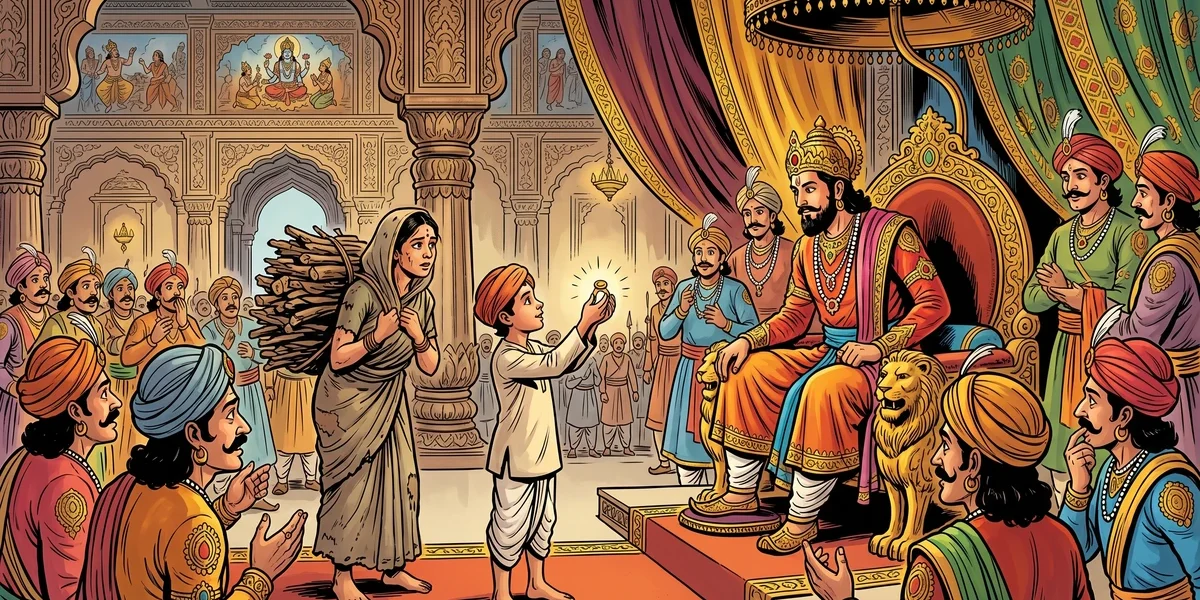
In the old days at Benares, King Brahmadatta rode out in state to his pleasure gardens. While he wandered among fruit and flowers he heard a woman singing as she gathered sticks in the grove. He fell in love the moment he saw her. They became lovers there among the trees, and the Bodhisatta was conceived that same day.
The woman felt a sudden weight within her, as heavy as if Sakka’s thunderbolt had settled in her body. She knew she would become a mother and told the king. He drew the signet-ring from his finger and pressed it into her hand. “If the child is a girl,” he said, “spend this ring on her care. If it is a boy, bring both the ring and the child to me.” Then he sent her away.
When her time came she bore a son—the Bodhisatta. As soon as he could run he played with other children in the open ground. Again and again a quarrel rose, and someone shouted, “No-father hit me!” The boy ran to his mother and asked who his father was.
“You are the son of the king of Benares,” she said.
“What proof is there?” he asked.
“When the king left me he gave me this signet-ring,” she answered, “and told me that if I bore a boy I must bring the ring and the child to him.”
“Then why have you not taken me to him?” said the boy. His mind was fixed. Seeing that he would not rest, she led him to the palace gate and asked that their coming be announced.
They were summoned in. She bowed before the king and said, “This is your son, sire.”
The king knew the truth well enough, yet shame before the court made him answer, “He is no son of mine.”
“Here is your signet-ring,” she said. “You will know it.”
“Nor is that my ring,” he replied.
Then the woman said, “Sire, I have no other witness left except the power of truth. If you are this child’s father, let him stay in mid-air. If you are not, let him fall and die.” She seized the boy by the foot and flung him upward.
He did not fall. Cross-legged in the air he spoke in a clear, sweet voice to the king below. He declared that he was the king’s own son, that a ruler who feeds strangers and keepers of elephants and horses ought also to feed his child, and he asked why the king supported others yet would not support him.
Hearing that teaching from the air, the king stretched out both hands and cried, “Come to me, my boy! No one but I shall rear and nurture you!” A thousand hands reached up from the court, yet the boy came down into the king’s arms alone and sat in his lap. The king made him viceroy and raised the mother to queen-consort. When the old king died, the son took the throne under the name Kaṭṭhavāhana—the Firewood Gatherer—remembering the sticks his mother had gathered. He ruled the realm justly, and when his days were done he passed on according to his deeds.
Where this story comes from
This page retells the past birth from the Kaṭṭhahāri Jātaka (Ja 7) in the English of the Ancient Buddhist Texts edition of Cowell’s Jātaka translation. A stick-gatherer’s child is proved by a mid-air appeal to truth and later crowned. In the present frame, the Buddha tells the story to the king of Kosala about a queen of low birth and her son.
The firewood-gatherer title remembers the mother’s wood-gathering. The mid-air test is a supernatural truth-act within the tale, resolving a denial that ordinary evidence has failed to overcome.
Read the original: Kaṭṭhahāri Jātaka (Ancient Buddhist Texts)
Reading guidance: Ages 9–12 with adult guidance; includes parental rejection, bullying and a mother throwing a child into the air under a threat of death. The supernatural scene must never be imitated.
A closer reading
The ring fails as proof because the person who gave it has the power to deny it. The king is not confused: the narrative says he knows the truth. This makes the palace scene about responsibility and status, rather than simply solving a mystery.
The child’s speech shifts attention from royal embarrassment to a parent’s duty of care. The different instructions for a son and daughter also expose unequal expectations in the story’s world. The mother’s dangerous throw works only because this is a miracle tale; neither family belonging nor truth should ever be tested by endangering a child.
Try this with the story
List the ring, the king’s knowledge and the boy’s speech as three different forms of evidence or argument. Explain which one addresses identity and which addresses the duty to provide care. Propose a safe, nonmagical way a court could hear the mother’s claim.
Talk about it
- Why does the ring fail when the king knows it is his?
- What duty does the boy ask the king to acknowledge?
- How do the king’s instructions treat a daughter differently from a son?
Related stories
- The Wise Hare — another Jātaka of courage and truth
- The Banyan Deer — a Jātaka king of deer who protects others
- King Shibi and the Dove — a ruler tested by compassion
Also known as: Katthahari Jataka
Frequently Asked Questions
How is the denial resolved in the tale?
Is the mid-air test a model to copy?
You May Also Like
 Jataka Tales
Ages 6-8
The Quarrel of the Quails
A flock of quails outwits a fowler by flying off together with his net, until a silly quarrel breaks out and they are all caught at once.
 Jataka Tales
Ages 6-8
The Ox Who Won the Forfeit
A boastful owner loses a bet when his strong Ox refuses to move for harsh words, then wins it back the next day with kindness and a garland of flowers.
 Jataka Tales
Ages 3-5
The Elephant and the Dog
When a farmer buys away the little dog who shares his meals, the king's elephant will not eat or bathe, and the king must find out why his elephant is so sad.