The Story of the Slave Kafur
An enslaved boy in the Arabian Nights tells one lie a year. The year his lie convinces a whole household their master is dead, and the master that his household is dead, a city is thrown into mourning over corpses that never existed - a comic, unsettling parable on the runaway speed of a falsehood.
Among the thousand nights and the one night there are tales of love, of magic and of kings — and then there is the small, dark, comic confession of a slave who could level a household with a single sentence. The old Arabic chapters give it the plain heading The Story of the Slave Káfúr, and it is told not by Shahrazád directly but by a character inside another story: one of three palace eunuchs, sitting in a graveyard at midnight, explaining how he came to lose both his freedom and his manhood. His answer is a masterpiece of gallows humour. He destroyed his master’s peace, his master’s house and his master’s good name — and he did it, he insists, with only half a lie.
It is one of the most quietly unsettling pieces in the whole collection, because it refuses to be simply funny. We laugh at the runaway panic Káfúr sets loose; then we notice the beating, the mutilation and the broken spirit that the laughter was hiding. The tale of Káfúr is the Nights at its sharpest: a joke with a wound inside it, a cautionary fable about the terrifying speed of a falsehood, and an unflinching glance at the cruelty of the slave markets that the storytellers’ own world took for granted.
Origin & Canonical Attribution
- Collection: Alf Layla wa-Layla (الف ليلة وليلة) — the Thousand and One Nights, known in English as the Arabian Nights.
- This tale: The Story of the Slave Káfúr (Edward William Lane); The Tale of the Second Eunuch, Káfúr (Sir Richard Burton).
- Frame & cycle: an inset tale within The Story of Ghánim bin Ayyúb, the Slave of Love, itself part of the Hárún al-Rashíd cycle; one of the confessions told by the three eunuchs who bury the chest in the cemetery.
- Arabic editions: Bulaq (Cairo, 1835); Calcutta II / Macnaghten (1839–42); Calcutta I (1814–18); Breslau / Habicht (1825–43).
- Translators: Antoine Galland (French, 1704–17); Edward William Lane (1838–40); John Payne (1882–84); Sir Richard Francis Burton (1885–88).
- Older roots: the lost Persian Hazár Afsána (“A Thousand Tales”), the seed-collection from which the Arabic Nights grew.
- Tale type & motifs: a trickster and “destructive lie” narrative; Stith Thompson motifs K2000 (the treacherous deceiver), J2350 (the calamity loosed by an unguarded tongue) and the wider folk family of the lie that races ahead of the truth.
- A note on the name: the fictional liar Káfúr should not be confused with the historical Abú al-Misk Káfúr al-Ikhshídí (d. 968 CE), the freed eunuch who rose to rule Egypt — the storytellers borrow only the common slave-name, not the man.
- Public-domain status: the Nights and all four named translations are long out of copyright and free to retell.
A Boy Sold “With His Fault”
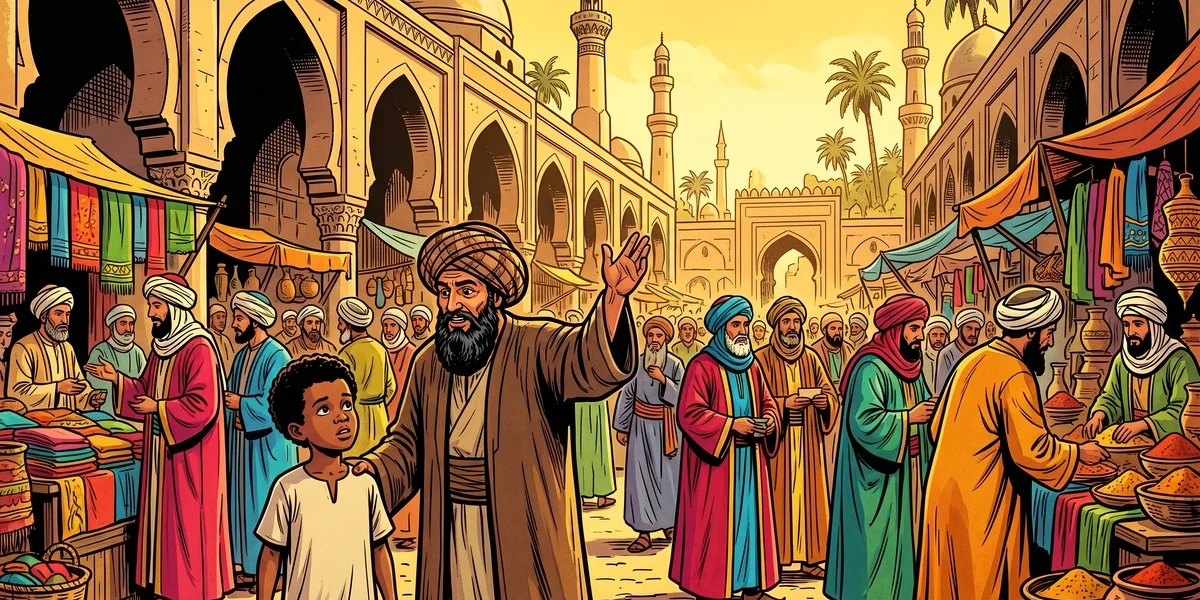
“Know, O my brothers,” the eunuch begins, “that at the commencement of my career I was a boy of eight years.” Even at eight, Káfúr had discovered the one talent that would shape his whole life: he could tell a lie so well, and so cruelly placed, that grown men quarrelled over it. Once each year — never more — he would loose a single falsehood into a slave-dealer’s household, and watch it do its work. The dealers fell out with one another. Reputations soured. At last his owner, worn down past patience, handed the boy to a broker in the market with a strange instruction: cry him for sale openly, and cry his defect along with him.
So the broker walked the rows of the bazaar calling, “Who will buy this slave with his fault?” When buyers asked what the fault was, the answer came plainly: “He tells one lie every year.” A merchant heard this, weighed it as a small thing, and bought the boy for six hundred pieces of silver — the sale witnessed, the defect named aloud, the bargain sealed in full knowledge. That detail matters more than it seems. In the law of the marketplace, Káfúr had been purchased knowingly faulty, and the boy filed the fact away. It would become, in time, the most dangerous weapon he owned.
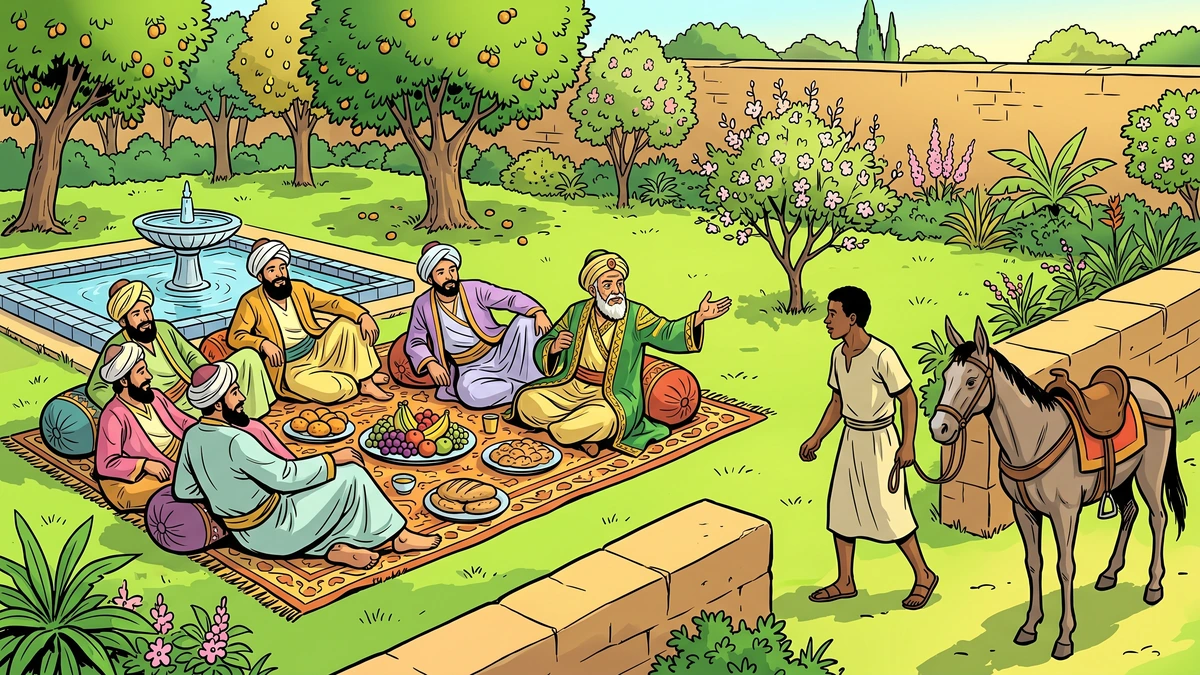
The new master was not unkind. He clothed the child decently and kept him through a prosperous, plentiful year — a year so good that the merchants of the city took turns hosting one another at feasts. The reader, knowing what is coming, feels the calendar turning like a fuse burning down. Káfúr owed the world one lie a year, and the year was nearly full.
The Errand and the First Cry
When it was Káfúr’s master’s turn to host the feast, he gathered the other merchants in a walled pleasure-garden inside the city. They ate and drank and made merry until noon, when the master found he wanted something fetched from home. “O slave,” he said, “mount the mule, ride to the house, bring such a thing from thy mistress, and return quickly.” It was the most ordinary errand imaginable. Káfúr mounted, rode — and somewhere on that short journey decided that the year’s lie had arrived.
He did not deliver it quietly. As he neared the house he began to shriek, and to weep, and to throw himself about, until the whole quarter — old and young — came running. His master’s wife and daughters flung open the door. What is the matter? And Káfúr gave them the lie, sized exactly to do the most harm: their master had been sitting beneath an old wall in the garden, he and all his friends, and the wall had fallen, and crushed them, and he alone had escaped to ride home with the news.
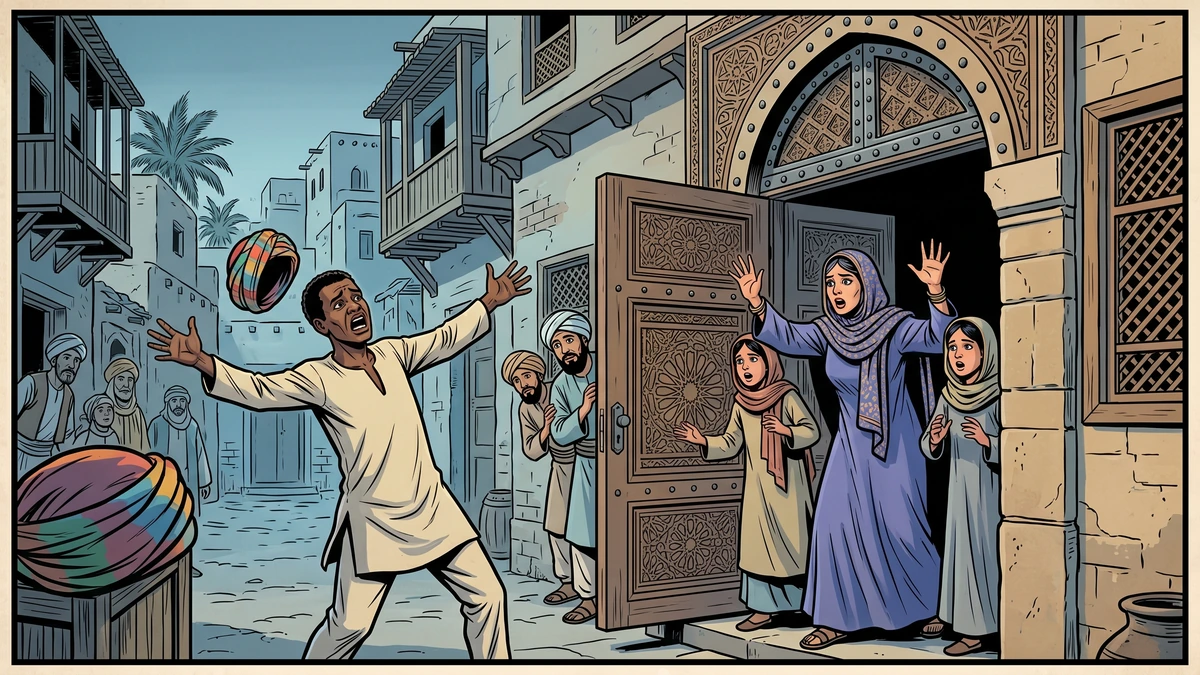
Here the tale shows its terrible understanding of how a lie travels. The women did not pause to doubt. They shrieked, tore their clothes, struck their own faces. The neighbours poured in. And then — this is the detail that turns comedy into something stranger — the grieving wife began, in her frenzy, to wreck her own home: overturning the furniture, pulling down the shelves, breaking the shutters, smearing the walls. “Woe to thee, O Káfúr!” she cried. “Come, help me — smash these cupboards, shatter this china!” And Káfúr, weeping loudly all the while and crying “Oh, my master!”, helpfully went room to room laying the house to ruin. The lie had now recruited its own victims as its labourers.
A City Dressed in Mourning
The falsehood did not stop at the threshold. The widow — for so she believed herself — went out into the street with her face unveiled and her household streaming behind her, ordering Káfúr to lead them to the spot where their master lay dead so the body might be carried home with honour. He walked ahead, crying out, and the procession swelled. Every passer-by who asked the news was told the news, and joined; soon there was scarcely a man, woman or child of the quarter not following, all of them beating their breasts in lamentation.
The story now does something a careful reader should pause over. A single sentence, spoken by an eight-year-old slave at a doorway, has become a public event. Word reached the Wálí — the city governor — who did not dismiss it but acted on it: he mounted, summoned labourers with axes and baskets to dig the bodies from the rubble, and rode out at the head of yet another crowd. Two great tides of people were now converging on the garden, one grieving a master, the other grieving a household, and not one soul among the hundreds had thought to check whether anyone had died at all. That is the engine of the tale: a lie, once it puts on the costume of grief, is almost never questioned.
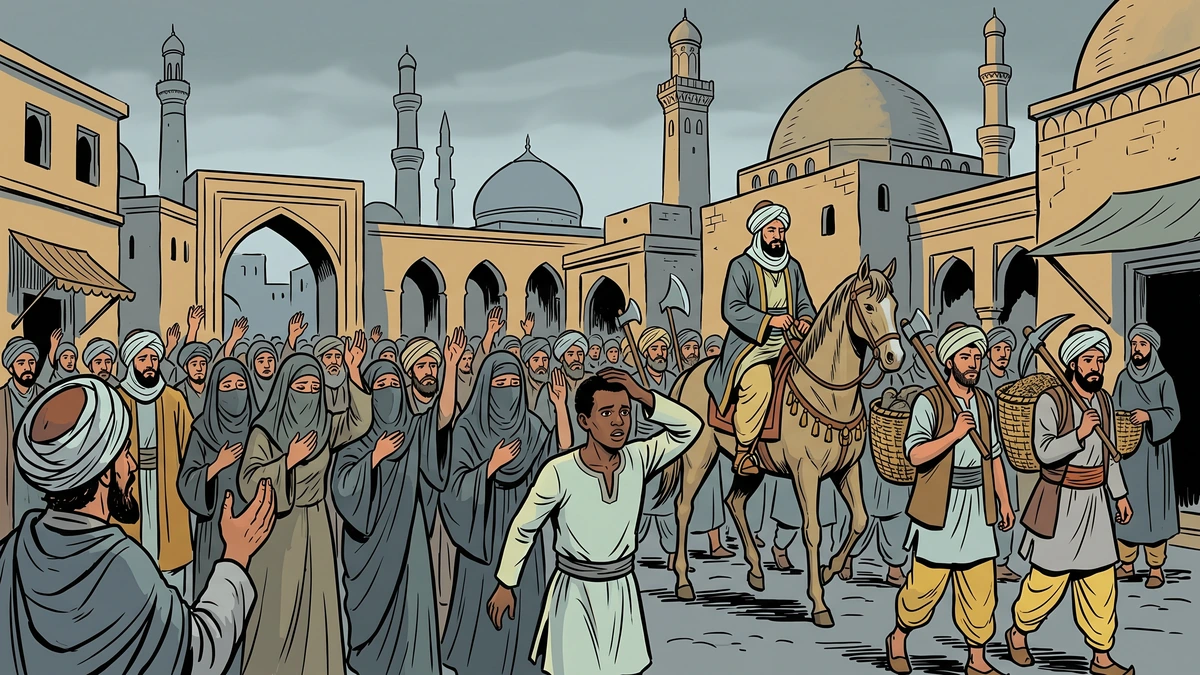
Káfúr kept his place at the front, weeping, throwing dust on his head, slapping his own face — a small dark figure conducting an entire city’s sorrow like an orchestra. When at last he came within sight of his master, alive and at ease among the feasting merchants in the garden, he did not falter. He slapped his face harder and wailed a fresh grief: Oh my mistress! Who will pity me now that my mistress is gone?
“Only Half a Lie”
The master, bewildered, asked what had happened. Káfúr delivered the mirror image of his first lie: the saloon wall had fallen at home and crushed the mistress and all her children; not one had escaped; the mule was dead, the sheep and geese and hens were dead, the cats and dogs were already at the carcasses. The man’s face went dark. He could not stand. He tore his clothes, plucked his beard, struck himself until blood ran, and stumbled out of the garden gate beating his face like a drunkard — and the merchants, weeping in sympathy, came with him.
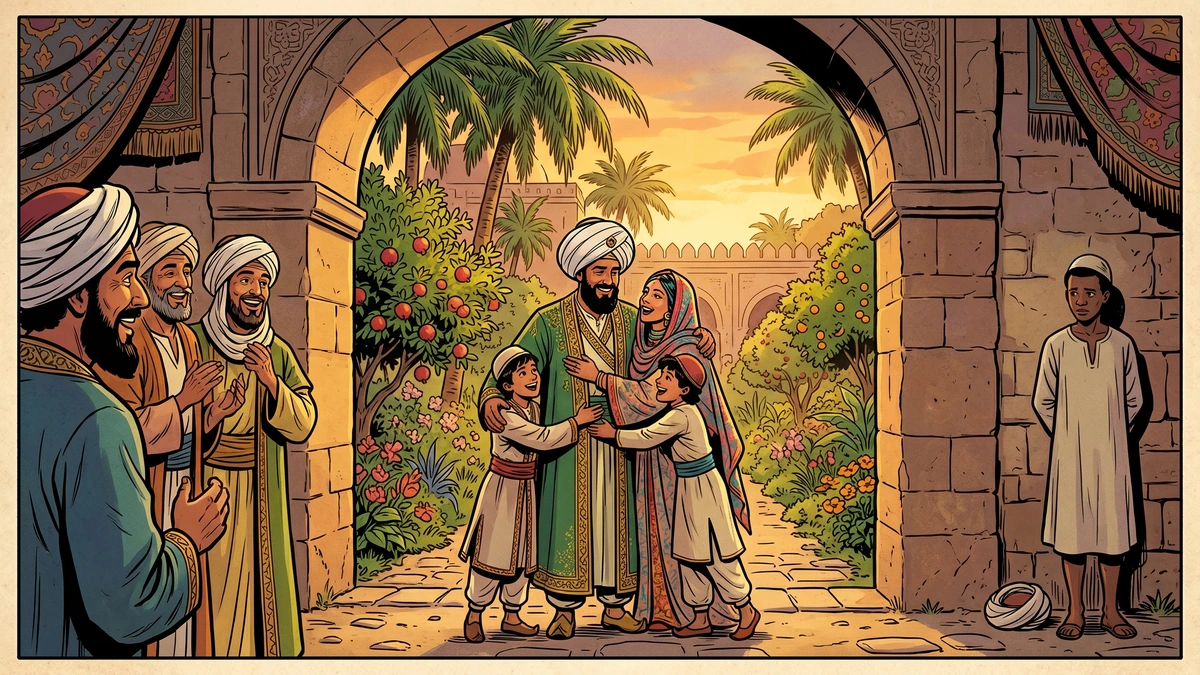
And so the two processions met at the gate: the husband mourning his family, the family mourning the husband, each crowd certain of its corpse. For one suspended moment everyone stared. Then the wife saw her living husband, and the husband saw his living wife, and the children flung themselves upon their father — Praise be to God for thy safety! The grief collapsed into stunned, comic relief. Only slowly, comparing notes, did the two halves of the household realise that a single slave had told each of them that the other was dead.
The master rounded on Káfúr — “O malevolent slave! By Allah, I will strip the skin from thy flesh!” — and Káfúr answered with the breathtaking legal argument he had been saving since the day of his sale. His master had bought him with his fault, before witnesses, knowing the defect was one lie a year. “And this,” the slave said calmly, surveying the wrecked house, the mourning city and the exhausted governor, “is but half a lie. When the year is complete I shall tell the other half — and then it will be a whole one.” The master, appalled, shouted that half a lie was already an entire calamity, and that Káfúr was free, this instant, and gone from him. But the boy would not even accept freedom on those terms: a freed slave with no trade, he said, would only starve; the law of emancipation required the bargain be honoured. The Wálí settled the matter the way that world settled most things — with a beating so severe the child fainted. He was nursed back to value, sold on, and passed from emir to emir and grandee to grandee, sowing ruin wherever he went, until at last he entered the palace of the Commander of the Faithful. “And now,” the eunuch ends his confession, “my spirit is broken, and my strength has failed.”
The Moral of the Tale
On its laughing surface the tale of Káfúr is a comic warning about the speed and reach of a lie. A falsehood does not stay the size it was spoken. Káfúr releases one sentence and within hours it has emptied a home, mobilised a quarter, fooled a governor and gathered hundreds of mourners around two corpses that never existed. The truth, when it finally arrives, has to fight its way upstream against a current the lie set running. This is why the storytellers let Káfúr call his catastrophe “half a lie”: the joke is also the lesson. There is no such thing as a small lie once it is loose in a crowd. The Arabic moral tradition states the principle without a smile:
الكذب داء والصدق دواء
“Falsehood is a sickness, and truthfulness is its cure.”
But there is a second, graver moral that the comedy is built to make us miss, and a thoughtful reader should not let it pass. Káfúr is not a free agent playing pranks; he is a child of eight, sold like livestock, defined publicly by a “fault,” beaten, mutilated and traded from hand to hand until his spirit breaks. His lies are the only power a powerless person was ever permitted, and he wields that power against the only people within his reach. The tale invites us to laugh, and then quietly shows us the cost of the laughter. It is, in the end, as much an indictment of a system that manufactured a Káfúr as it is a scolding of the boy himself — and that double vision is exactly what raises it above a simple jest.
Why the Tale Has Lasted
The story of Káfúr has survived because it does something most cautionary tales cannot: it makes the danger genuinely entertaining. A flat warning against lying is forgotten by morning. A lie that knocks down a house, drags the city governor out with picks and shovels, and ends with two funeral processions colliding at a garden gate is remembered for life. The Nights understood that a lesson rides furthest when it is carried by a good joke, and the “half a lie” defence — absurd, brazen, and horribly logical — is one of the finest comic strokes in the whole collection.
It has lasted, too, because its central observation has only grown truer. Káfúr’s lie spreads exactly the way a rumour spreads in any age: each new hearer repeats it in good faith, the crowd’s size becomes its own proof, and grief or outrage makes people far less likely to stop and ask whether the thing is real. A medieval listener heard a fable about a graveyard quarter and a galloping rumour. A modern reader recognises something uncomfortably close to a story moving through a feed — shared, amplified, mourned over, and acted upon, all before anyone checks. The technology is new; the human machinery the tale describes is a thousand years old.
And it endures because it refuses the easy ending. Káfúr is never reformed, never punished into a neat lesson; he is simply ground down, his mischief outliving his hope. That bleak honesty — comedy that knows it is standing on something painful — is the particular genius of the Arabian Nights, and the reason a small inset tale about a lying slave-boy still holds a reader’s attention all these centuries on.
Frequently Asked Questions
Who is Káfúr in the Arabian Nights?
Káfúr is an enslaved boy, and later a palace eunuch, in the Thousand and One Nights. His story is told as a confession: he is one of three eunuchs who appear in The Story of Ghánim bin Ayyúb, the Slave of Love, and he explains how a lifelong habit of lying led to his beating, mutilation and endless resale. He is famous for telling exactly one elaborate lie each year.
What is Káfúr’s “one lie a year”?
Káfúr’s defect, named openly when he was sold, was that he told a single deliberate falsehood every year. The tale’s great example is the lie he tells on his master’s feast day: he convinces the household that the master has been killed by a falling wall, and separately convinces the master that the whole household has died the same way — setting two false funerals in motion at once.
Why does Káfúr call it “half a lie”?
When his furious master threatens to kill him, Káfúr argues that he was bought “with his fault” — lawfully, before witnesses, who all knew he told one lie a year. Since the year is not yet over, he claims this enormous deception is only half of that year’s allowance, with the other half still to come. The absurd defence is the tale’s sharpest joke and its clearest warning: there is no such thing as a small lie.
Is the Káfúr of the tale the same as the historical ruler Káfúr?
No. The fictional liar shares only a common slave-name with Abú al-Misk Káfúr al-Ikhshídí (died 968 CE), a freed African eunuch who rose to govern Egypt and was praised — and satirised — by the poet al-Mutanabbí. The Nights borrows the name, which was common among enslaved men of the period, but the character and his story are entirely the storytellers’ invention.
Where does the tale appear, and is it public domain?
It is an inset story within the Hárún al-Rashíd cycle of the Arabian Nights, embedded in the tale of Ghánim bin Ayyúb. It survives in the major Arabic editions (Bulaq 1835, Calcutta II 1839–42, Calcutta I and Breslau) and in the English versions of Galland, Lane, Payne and Burton. The Thousand and One Nights and all of these classic translations are long out of copyright and firmly in the public domain.
You May Also Like
 Arabian Nights
All Ages
Arabian Nights
All Ages
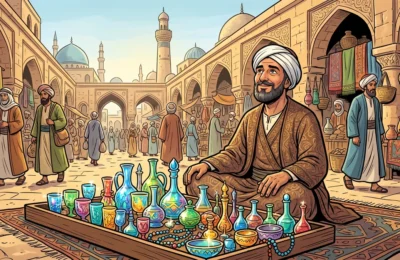
The Barber’s Story of His Fifth Brother
The barber's fifth brother, Al-Nashshar, invested his whole inheritance in glassware and, lost in a daydream of the fortune it would bring, kicked over the tray and shattered everything - the Arabian Nights tale that gave English the word 'Alnaschar'.
 Arabian Nights
Ages 9-12
Arabian Nights
Ages 9-12
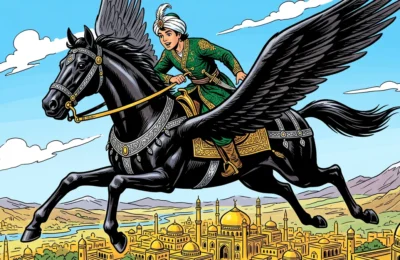
The Enchanted Horse
The Enchanted Horse, or Ebony Horse, from the Thousand and One Nights - a Persian prince masters a flying mechanical horse, wins a princess, and outwits the inventor who steals her away.
 Arabian Nights
Ages 9-12
Arabian Nights
Ages 9-12
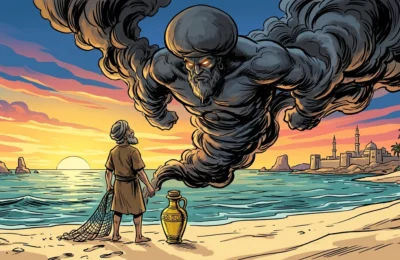
The Fisherman and the Genie
A poor old fisherman draws a sealed copper jar from the sea and frees a furious ifrit who vows to kill him - then must use his wits alone to survive. A classic tale of the Thousand and One Nights, retold with full scholarly attribution.