The Story of the Sandy Road
The Story of the Sandy Road: Source: Jataka Tales Ellen C. Babbit | Type: Jataka | Country: India | Language: English Once upon a time a merchant and his men
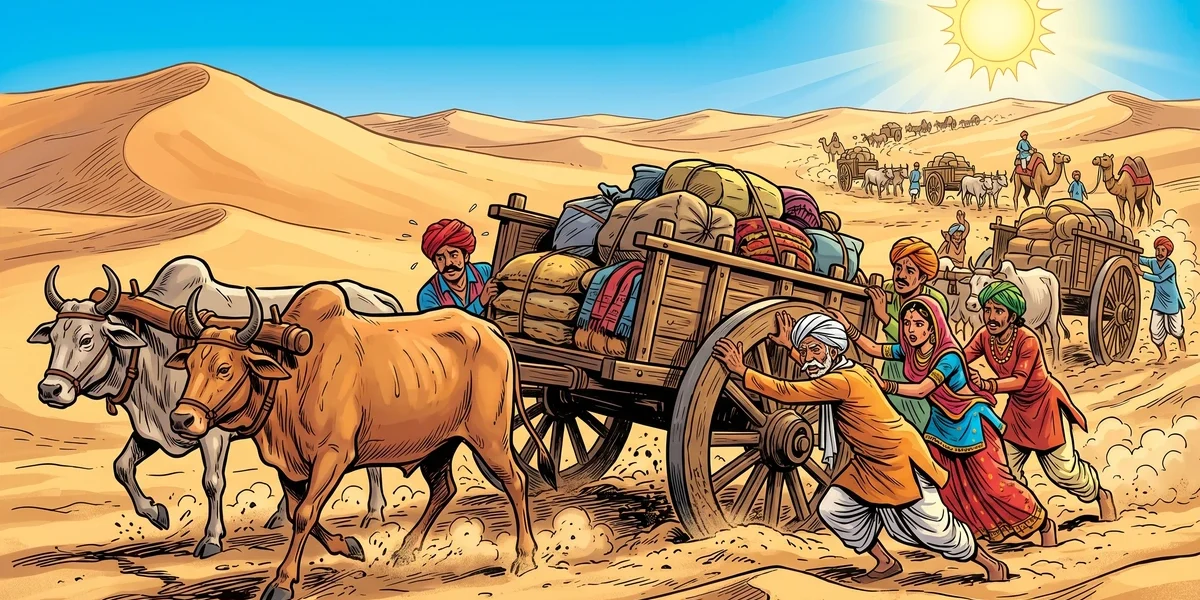
Origin and Attribution
The Story of the Sandy Road belongs to the Jataka tradition’s rich body of caravan narratives — tales set along the great trade routes of ancient India that used the specific dangers and disciplines of long-distance commercial travel as vehicles for teaching leadership, resource management, and the psychology of groups under pressure. Desert crossings were among the most feared events in ancient Indian commercial life: the Thar Desert, the salt flats of Gujarat, the parched stretches of the central Deccan all presented real lethal risks to caravans that miscalculated water, direction, or timing.
The tale’s Pali title references the specific challenge of the sandy desert road — a route where landmarks disappear, where the surface underfoot gives way, where the sense of progress becomes uncertain and the mind begins to generate the phantom certainties that are the first symptoms of disorientation. The Bodhisatta appears as the caravan leader who, by virtue of steadiness and clear perception, navigates the group through a crisis that would have destroyed them if they had followed either their initial guide’s false reading or the general panic that followed its exposure.
Beat I — Into the Desert
A great merchant caravan set out to cross a large desert, carrying goods between two prosperous cities separated by several days of featureless sand. The caravan was well-organised: water for the journey, food for the people and animals, a hired guide who knew the route, and experienced merchants who had made the crossing before under easier conditions. The Bodhisatta served as the caravan’s senior leader — not its owner but its directing intelligence, the man the other merchants deferred to when decisions needed making.
The desert crossing began without incident. For the first day and night, the guide navigated by the stars, the caravan moved steadily, and the mood was confident. On the second night the guide made a catastrophic error: he fell asleep at his post and the oxen — following their natural inclination when unguided — turned gradually and imperceptibly around. By the time the guide woke and took his bearings, the caravan had been moving in the wrong direction for several hours and had nearly completed a circle back toward its starting point.
The guide recognised what had happened and said nothing. He corrected the direction as quietly as he could, hoping the error would go unnoticed. But experienced merchants notice when the progress they expect is not materialising, and by morning it was clear to several of them that the landscape was wrong — the dunes were in positions they should not have been in if the night had been spent moving forward. When the truth emerged — that they had lost hours of travel and consumed a night’s water supply going in circles — the reaction was immediate and severe.
Beat II — The Crisis of Confidence
The merchants turned on the guide with the concentrated fury of people who have discovered that the person responsible for their safety had concealed a dangerous mistake. Several called for turning back immediately. Others argued that the water they had already consumed made return as risky as continuing. A third group insisted on waiting in place until someone came to find them. The oxen were exhausted; the water was significantly depleted; the sun was rising to full heat; and the five hundred merchants and their servants were arguing in five different directions with equal conviction and equal ignorance.
The Jataka text describes this moment with precise psychological accuracy: the caravan had become a mob of individuals each generating their own theory of survival and defending it against every other theory. This is the specific danger that desert survival experts in any culture identify as the second cause of death after actual water depletion: the dissipation of collective decision-making capacity into competing individual panic responses. A group that cannot agree on a direction — any direction — is a group that will not move, and a group that does not move in a desert dies.
The Bodhisatta did not join the debate. He did not argue for his own theory against the others or try to establish his authority by overriding the other merchants. Instead he walked away from the group, found the highest point of nearby ground, climbed it, and spent time in deliberate observation: the angle of the sun, the set of the wind, the tracks left by the oxen during the night’s circular detour, the vegetation patterns that indicated subsurface moisture. He assembled what he could observe into a direction and returned to the caravan with a specific, actionable instruction rather than another theory.
Beat III — The Leader’s Calm
The Bodhisatta addressed the caravan not with anger at the guide or reassurance that everything would be fine but with the specific practical information that the situation required: this is the direction, this is why I believe it is correct, this is what we will do for the next hour, and this is what we will do after that. The Pali text notes that his voice was steady — not performed steadiness that people recognise as false reassurance, but the actual steadiness of someone who has assessed the situation and found a workable path through it.
Several merchants objected. The Bodhisatta did not argue with the objections; he acknowledged them and maintained his assessment. The difference between him and the others was not that he was certain — in the circumstances certainty was unavailable to anyone — but that he had committed to a course of action based on the best available evidence and was prepared to act on it consistently while remaining genuinely open to correction if better evidence appeared. This is the posture the Jataka tradition identifies as the proper response to genuine uncertainty: not false confidence, not paralysis, but evidence-based commitment with genuine openness.
The caravan moved. By mid-afternoon they encountered signs of the correct route — the tracks of another recent caravan, a marker stone, eventually a water source. They had lost time and water but they had not lost the crossing. They reached their destination later than planned but intact. The guide’s error had been salvageable precisely because the Bodhisatta’s response to the crisis was calibrated to what the crisis actually required: a calm voice, a specific direction, and the authority that comes not from position but from the visible quality of clear thinking under pressure.
Beat IV — The Moral and Its Living Relevance
The Sandy Road story encodes a leadership principle that the Jataka tradition develops across multiple caravan narratives: the most valuable quality a leader possesses in a genuine crisis is not superior knowledge — the Bodhisatta did not know with certainty which direction was correct — but the capacity to maintain clear thinking and deliberate action when those around them have been reduced by fear to competing impulses. This capacity is not courage in the physical sense but what the Pali text calls dhiti — steadiness of resolve, the ability to hold a considered position under pressure without rigidifying into false certainty on one side or collapsing into paralysis on the other.
“The desert does not kill the caravan that loses its way; it kills the caravan that loses its mind. The leader’s first task is to keep the mind of the group functioning when fear has dissolved the mind of every individual in it.”
The political and organisational application of this teaching is immediate. Every institution faces moments of collective disorientation — when the assumptions on which normal operations are based turn out to be false, when the trusted guide has been navigating in circles, when the options before the group are all uncertain and the debate between them is generating more heat than light. In these moments the leader who can do what the Bodhisatta did — separate themselves from the debate, observe what can actually be observed, return with a specific direction rather than another theory, and maintain that direction calmly through objections — provides something that cannot be provided by any amount of institutional process or planning: the steady mind that stops the group from dissolving into its component panics.
The Sandy Road story is also one of the Jataka tradition’s clearest teachings about the relationship between leadership and information. The Bodhisatta does not pretend to know more than he does. He observes what he can observe, reasons from what he has observed, states his conclusion with appropriate confidence — neither false certainty nor debilitating hedging — and acts. This is the epistemological posture of the effective leader under genuine uncertainty, and it is as relevant to a board meeting during a financial crisis as it was to a caravan in a desert two and a half millennia ago.
Why This Story Lasted
The Sandy Road story survived because it addresses the specific problem of collective panic — the dissolution of a group’s decision-making capacity under stress — with a concrete and replicable response. The Bodhisatta’s actions are not mysterious or dependent on exceptional gifts: he observes, he reasons, he decides, he communicates specifically, he maintains his assessment calmly. These are learnable behaviours, and the story is essentially a teaching case for practising them. Stories that encode learnable responses to universal crisis patterns — rather than simply celebrating exceptional individuals who possessed qualities the listener cannot acquire — are the ones that survive as working tools rather than merely as inspiring examples. The Sandy Road story has been both for more than two thousand years.
You May Also Like
 Jataka Tales
Ages 3-5
Jataka Tales
Ages 3-5
The Monkey King’s Sacrifice: A Tale of Selfless Love
The Monkey King's Sacrifice: A Tale of Selfless Love: The Monkey King’s Sacrifice A Jataka Tale of Selfless Courage and Transformation In the ancient times
 Jataka Tales
Ages 3-5
Jataka Tales
Ages 3-5
The Reluctant Tortoise
The Reluctant Tortoise: There was a time when the city of Benaras was ruled by King Brahmadatta. In the same city, lived Bodhisatta, the son of a potter.
 Jataka Tales
Ages 6-8
Jataka Tales
Ages 6-8
The Banyan Deer
The Banyan Deer: Source: Jataka Tales Ellen C. Babbit | Type: Jataka | Country: India | Language: English ONCE upon a time there was a deer named Banyan. A