The Reluctant Tortoise
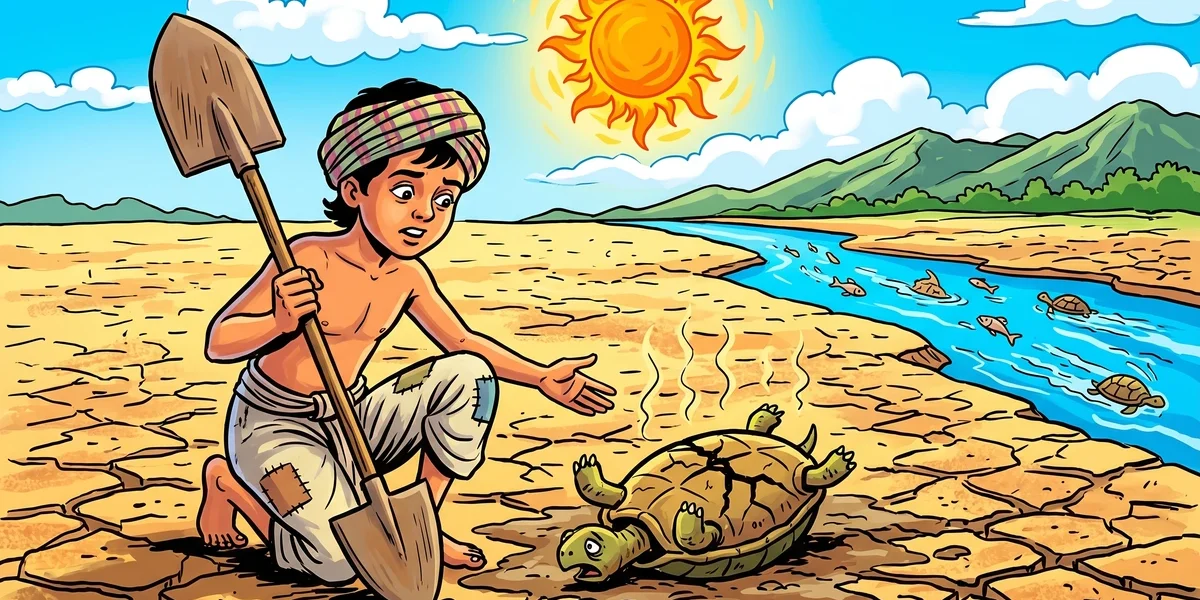
The Reluctant Tortoise: There was a time when the city of Benaras was ruled by King Brahmadatta. In the same city, lived Bodhisatta, the son of a potter.
Origin and Attribution
The Reluctant Tortoise belongs to the cluster of Jataka tales centred on the tortoise as a figure of philosophical significance in the Indian tradition. Where the more famous talking-tortoise stories (Kacchapa Jataka No. 215, Cullakacchapa) focus on the failure of speech restraint, the Reluctant Tortoise tradition draws on a different but equally ancient use of the tortoise in Indian thought: as the embodiment of pratyahara — the withdrawal of the senses from external stimulation — which Patanjali’s Yoga Sutras (c. 4th century CE, codifying a much older tradition) famously compares to the tortoise pulling its limbs inside its shell.
The Jataka tale takes this philosophical image and translates it into a narrative about discernment — the capacity to know when to extend into the world and when to withdraw, and to make that distinction quickly and accurately in response to what the situation actually requires. The tortoise who is “reluctant” in this tale is not lazy or fearful; it is a being of refined perception who has learned to read the signs of danger before they become inescapable, and whose withdrawal is the active expression of a lifetime of attentive practice.
Beat I — The Wise Tortoise of the Lake
In a former life in a great lake of the Gangetic plain, the Bodhisatta was born as a tortoise of exceptional age and wisdom — a creature who had survived many seasons precisely because his reading of his environment was accurate and his responses were calibrated rather than automatic. The lake was home to many animals and was also the water source for a human village at its edge. The relationship between the lake’s creatures and the village was generally peaceful; the villagers respected the lake as a resource and did not habitually harm its inhabitants.
The tortoise had observed, over many years, that the danger to lake creatures almost never came from the village in its normal state. It came from specific conditions: drought that concentrated both humans and animals at shrinking water sources, festivals that brought large crowds whose behaviour became unpredictable, or the arrival of strangers whose relationship to the lake was not governed by the village’s existing norms. He had learned to read the signs of these conditions early — changes in the water level, changes in the pattern of foot traffic at the lake’s edge, the arrival of boats or nets that had not been there before.
His younger companions — other tortoises, fish, and birds who shared the lake — had not yet developed this attentiveness. They approached the lake’s edge freely, warmed themselves on the banks without attention to what was happening beyond the immediate view, and trusted that conditions would remain as they had been. The Bodhisatta watched them with the mild concern of an elder who knows something the young do not yet know: that survival requires the accurate reading of change, not the optimistic assumption of continuity.
Beat II — The Signs and the Withdrawal
One spring, the signs appeared. The water level dropped slightly — normal for the season, but accompanied by an unusual increase in the number of men visiting the lake’s edge with measuring rods and discussing something in low voices. New nets appeared, spread to dry on the bank in arrangements the tortoise had not seen in the village’s normal fishing. A large flat-bottomed boat arrived that had not been there before. None of these signs was individually conclusive; together they formed a pattern the old tortoise recognised.
He called his companions together — or rather, he moved among them in his deliberate way and communicated what he had observed. Several dismissed his reading: the water drops every spring, the nets are ordinary, the boat belongs to a trader. The tortoise did not argue. He had observed what he had observed; he stated it plainly; and then he withdrew. He moved away from the open bank into the deeper part of the lake, where the reeds grew thick and the bottom offered concealment, and he settled in to wait.
Two days later, a large fishing operation arrived at the lake — not the village fishermen with their familiar small nets but a commercial party from a distant city who had obtained rights to the lake for a seasonal harvest. They drew their nets through the open water, caught several of the tortoise’s companions who had remained near the surface, and departed with a substantial catch. The reeds where the Bodhisatta had withdrawn were not searched; the water was too shallow for the large nets; and the tortoise remained undisturbed.
Beat III — Pratyahara as Practical Wisdom
The Jataka commentary uses this story to elaborate the concept of pratyahara in its practical rather than its meditative dimension. In Patanjali’s Yoga Sutras (II.54–55), pratyahara is defined as the state in which the sense organs follow the nature of the mind rather than pursuing their objects — the famous comparison being the tortoise that draws its limbs within its shell. This is presented in the Yoga tradition as a meditative attainment: the preliminary to the deeper concentrations of dharana (concentration) and dhyana (meditation).
The Jataka tradition’s use of the same metaphor is more immediately practical: pratyahara is the capacity to withdraw from engagement when engagement is dangerous, not as a permanent posture but as a contextually appropriate response. The Bodhisatta tortoise is not permanently withdrawn; he extends into the world, observes it attentively, gathers information, communicates what he has observed. His withdrawal is temporary, specific, and based on evidence. When the commercial fishing party departs, he returns to his normal range of activity. This alternation — engaged when safe, withdrawn when dangerous, the reading of when each applies — is what the Jataka identifies as the practical expression of the tortoise’s wisdom.
The Arthashastra parallel is in Kautilya’s teaching on the mandala of circumstance: the wise person acts boldly when conditions are favourable, withdraws and waits when conditions are unfavourable, and correctly identifies which situation obtains at any given moment. The failure mode the Arthashastra identifies is identical to the failure of the Bodhisatta’s companions: the assumption that conditions are as they were, when the evidence indicates they have changed.
Beat IV — The Moral and Its Living Relevance
The Reluctant Tortoise story encodes a teaching about discernment that the Indian philosophical tradition found important enough to encode in both its contemplative and its narrative streams. The moral is precise: withdrawal is not the same as retreat, and reluctance is not the same as cowardice. The tortoise who retreats from an approaching army is a coward; the tortoise who reads the pattern of new nets, falling water, and unfamiliar boats and moves into the reeds before the nets arrive is a strategist. The difference is in the quality of the reading that precedes the withdrawal.
“The tortoise does not fear the water; it reads the water. When the water brings danger, the shell is not hiding — it is waiting. The legs will extend again when the water is clear.”
The contemporary relevance of this teaching is in the distinction it draws between reactive withdrawal (driven by fear) and strategic withdrawal (driven by accurate assessment). In every domain of human activity — professional, political, personal — there are moments when the correct response to an unfavourable situation is not to push through or to fight but to disengage temporarily and wait for conditions to improve. The capacity to make this choice accurately — to read the signs early enough that withdrawal is clean and timely rather than panicked and late — is one of the practical skills the tortoise tradition in Indian literature was specifically trying to cultivate in its listeners.
The story also encodes a teaching about the relationship between elder wisdom and the confidence of the young. The Bodhisatta’s companions were not foolish; their reading of each individual sign was defensible. What they lacked was the accumulated pattern recognition that comes from having observed the lake across many seasons. The elder’s reluctance — his withdrawal when the young remained — is not pessimism but the fruit of experience. The tradition is suggesting that the appropriate response to this kind of elder caution is not dismissal but inquiry: what has he seen that we have not?
Why This Story Lasted
The Reluctant Tortoise story survived because it addresses a form of practical wisdom that every culture values but few explicitly teach: the capacity to withdraw before danger becomes inescapable rather than after it has already arrived. The image of the tortoise — ancient, deliberate, encased in a shell that is simultaneously its protection and its limitation — is the Indian tradition’s most economical symbol for this capacity. Stories that attach important teachings to vivid and memorable images survive; the tortoise’s shell has been carrying this teaching for more than two thousand years, which is precisely the kind of patience the teaching itself commends.
Frequently Asked Questions
**Q: Why is this story important?**
You May Also Like
 Jataka Tales
Ages 6-8
Jataka Tales
Ages 6-8
The Foolish Valuer
The Foolish Valuer: Source: Jataka Tales Sacred Texts | Type: Jataka | Country: India | Language: English Once on a time Brahmadatta was reigning in Benares in
 Jataka Tales
Ages 3-5
Jataka Tales
Ages 3-5
The Brave Little Quail: Small Courage Defeats Great Pride
The Brave Little Quail: Small Courage Defeats Great Pride: The Brave Little Quail A Jataka Tale of Wisdom and Unlikely Alliance In the days when animals could
 Jataka Tales
Ages 3-5
Jataka Tales
Ages 3-5
The Turtle Who Couldn’t Stop Talking
The Turtle Who Couldn't Stop Talking: Source: Jataka Tales Ellen C. Babbit | Type: Jataka | Country: India | Language: English A TURTLE lived in a pond at the