The Foolish Valuer
The Foolish Valuer: Source: Jataka Tales Sacred Texts | Type: Jataka | Country: India | Language: English Once on a time Brahmadatta was reigning in Benares in
Source: Jataka Tales Sacred Texts | Type: Jataka | Country: India | Language: English
Once on a time Brahmadatta was reigning in Benares in Kasi. In those days our Bodhisatta was his valuer. He used to value horses, elephants, and the like; and jewels, gold, and the like; and he used to pay over to the owners of the goods the proper price, as he fixed it.
But the king was greedy and his greed suggested to him this thought: ‘This valuer with his style of valuing will soon exhaust all the riches in my house; I must get another valuer.’ Opening his window and looking out into his courtyard, he espied walking across a stupid, greedy hind in whom he saw a likely can didate for the post. So the king had the man sent for, and asked him whe ther he could do the work. ‘Oh yes,’ said the man; and so, to safeguard the royal treasure, this stupid fellow was appointed valuer. After this the fool, in valuing elephants and horses and the like, used to fix a price dictated by his own fancy, neglecting their true worth; but, as he was valuer, the price was what he said and no other.
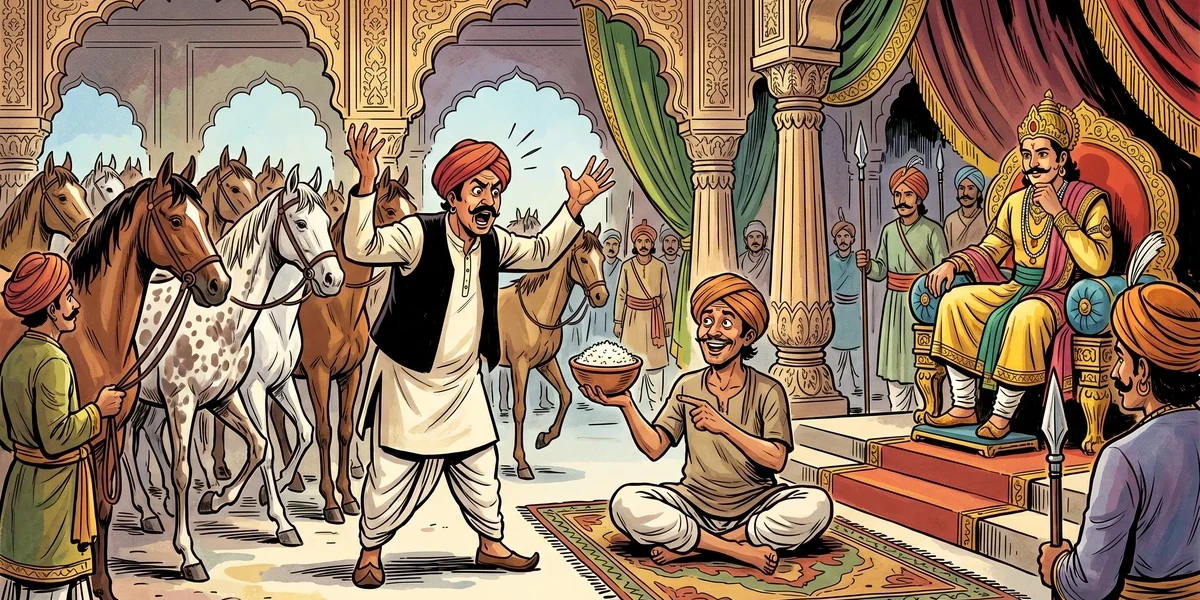
At that time there arrived from the north country a horse-dealer with 500 horses. The king sent for his new valuer and bade him value the horses. And the price he set on the whole 500 horses was just one measure of rice, which he ordered to be paid over to the dealer, directing the horses to be led off to the stable. Away went the horse-dealer to the old valuer, to whom he told what had happened, and asked what was to be done. ‘Give him a bribe,’ said the ex-valuer, ‘and put this point to him: Knowing as we do that our horses are worth just a single measure of rice, we are curious to learn from you what the precise value of a measure of rice is; could you state its value in the king’s presence?’
Readily following the Bodhisatta’s advice, the horse-dealer bribed the man and put the question to him. The other, having expressed his ability to value a measure of rice, was promptly taken to the palace. With due obeisance the horse-dealer said, ‘Sire, I do not dis pute it that the price of 500 horses is a single measure of rice; but I would ask your majesty to question your valuer as to the value of that measure of rice.’ Ignorant of what had passed, the king said to the fellow, ‘Valuer, what are 500 horses worth?’ ‘A measure of rice, sire,’ was the reply. ‘Very good, my friend; if 500 horses then are worth one measure of rice, what is that measure of rice worth?’ ‘It is worth all Benares and its suburbs,’ was the fool’s reply.
Hereupon the ministers clapped their hands and laughed merrily. ‘We used to think,’ they said in scorn, ‘that the earth and the realm were beyond price; but now we learn that the kingdom of Benares together with its king is only worth a single measure of rice! What talents the valuer has! How has he retained his post so long? But truly the valuer suits our king admirably.’
Then the Bodhisatta repeated this stanza:
‘Dost ask how much a peck of rice is worth? Why, all Benares, both within and out. Yet, strange to tell, five hundred horses too are worth precisely this same peck of rice!’
Thus put to open shame, the king sent the fool packing, and gave the Bodhisatta the office again. And when his life closed, the Bodhisatta passed away to fare according to his deserts.

Moral
Foolishness invites exploitation. Lacking discernment, the rice-valuer became prey to trickery. Paññā (wisdom) requires asking questions and verifying facts. Those who do not think critically are easily deceived.
Historical & Cultural Context
The Jataka Tales are an ancient Buddhist collection from the Pali Canon recounting the previous lives of the Bodhisatta. Each tale demonstrates a moral virtue (parami) such as generosity, patience or wisdom – qualities that ripened into Buddhahood.
This tale appears in the Jataka collection set in Benares under King Brahmadatta. It reflects the Pali Canon’s concern with morality (sīla) and wisdom (paññā) as shields against deception. The ‘foolish valuer’ motif teaches the necessity of applying intelligence to professional responsibility.
Reflection & Discussion
- Why was the valuer’s confidence without checking more dangerous than simple ignorance?
- Describe a modern equivalent of someone trusted in their role being fooled.
- How might the story differ if the valuer had asked for a second opinion?

Did You Know?
- Jataka Tales are believed to describe the previous lives of Gautama Buddha.
- There are 547 Jataka Tales in the traditional collection, each teaching a different virtue.
- The Jataka Tales are among the oldest collections of folklore in the world, dating back to the 4th century BCE.
What This Tale Teaches Us Today
Old stories keep their power because their lessons never stop being useful. Here is how this one still applies:
- Flattery is usually a warning sign. Powerful people should suspect, not welcome, the voices that agree with them too quickly.
- Generosity, when offered to the right creature, returns in forms you could not have predicted.
- Humility is a survival skill. Proud characters in Panchatantra tales almost always lose.
Why This Story Still Matters
This folk story from the Panchatantra preserves wisdom that Indian teachers have used for over two thousand years to teach practical ethics. The Foolish Valuer is a small but finished piece of moral engineering – each character represents a recognizable human type, each decision is a lesson in how people actually behave. Indian grandparents still tell these stories to grandchildren for the same reason ancient royal tutors told them to young princes: because the patterns described in the Panchatantra are eternal. Those who listen early in life make better decisions for the rest of it.
Cultural Context and Continuing Influence
Folk tales like this one survived for hundreds of years through oral storytelling before any scholar thought to write them down. Grandparents told them to grandchildren, travelers traded them along roads and rivers, and mothers repeated them to babies who would one day repeat them to their own children. Each small retelling sharpened the story, discarded unnecessary parts, and polished the essential lesson. That long process of refinement is why a good folk tale feels so weighty – it has been shaped by thousands of listeners across generations, each contributing something small to the story we read today.
Modern readers sometimes wonder whether folk tales are still relevant in an age of apps and smartphones. The answer is yes, perhaps more than ever. The technology changes, but the underlying questions – about kindness, courage, loyalty, greed, family, fear, love – do not. These are the same questions that children asked around a fire in ancient India, around a hearth in medieval Ireland, around a campfire in 19th-century Korea. And they are the same questions children ask their parents today, just phrased differently. That is why a family that reads folk tales together is doing real cultural and emotional work, not simply entertaining itself.
Reading Folk Tales With Children
Reading folk tales aloud to children is one of the oldest and most effective forms of moral education. Unlike a lecture or a rule, a story slides past a child’s natural resistance and plants its lesson in the imagination, where it quietly grows. Years later, when the child meets a real situation that resembles the story – a bully at school, a dishonest coworker, a moment of temptation – the old tale rises to the surface of memory and offers guidance. That is why parents and teachers across every culture have trusted stories to do the work of raising good humans, long before formal schools or textbooks existed.
When reading this story with a young listener, try pausing at key moments and asking what the child thinks will happen next. Let them guess, even if they are wrong. That small act of prediction turns a passive listener into an active thinker. After the story ends, a simple open question – “What would you have done?” or “Who do you think was the smartest character?” – invites the child to connect the tale to their own life. Those conversations are where real learning happens, not during the reading itself but in the quiet moments that follow.
Older children and teenagers sometimes think they have outgrown folk tales. In reality, the best tales only deepen with age. A ten-year-old hears the surface plot; a fifteen-year-old notices the irony; a twenty-year-old sees the economic and political pressures on the characters; a forty-year-old understands the parents in the story for the first time. A good folk tale is a gift that keeps unfolding for decades. Families who read and reread the same stories across the years discover this naturally, and pass the discovery down.
A Final Word
Every folk tale carries within it the accumulated judgment of thousands of listeners across many generations. When a story has been told for a thousand years and still moves children today, that is not an accident. It is proof that the story is saying something true about the human condition. The wiser the listener, the more they see in a tale they have heard a hundred times before. Reading these stories slowly, out loud, with children beside us, we are joining the longest conversation our species has ever had with itself. Every tale we share is a quiet vote for patience, for meaning, and for the old idea that a good story is one of the finest things one generation can hand down to the next.
We hope this telling gave you something worth carrying into your day – a small lesson, a useful image, a question to ask your child at dinner. Folk tales do their best work in the hours and years after the reading ends, quietly shaping how we see the world and each other. Thank you for spending time with this story, and for keeping the old tradition of careful listening and thoughtful retelling alive.
You May Also Like
 Jataka Tales
Ages 6-8
Jataka Tales
Ages 6-8
The Faggot-Bearer
The Faggot-Bearer: Source: Jataka Tales Sacred Texts | Type: Jataka | Country: India | Language: English Once on a time in Benares Brahmadatta the king, having
 Jataka Tales
Ages 9-12
Jataka Tales
Ages 9-12
The Hawks And Their Friends
Hawks and animal friends learn that loving-kindness, not kinship, binds hearts together across difference.
 Jataka Tales
Ages 6-8
Jataka Tales
Ages 6-8
The Quarrel of the Quails
The Quarrel of the Quails: Source: Jataka Tales Ellen C. Babbit | Type: Jataka | Country: India | Language: English ONCE upon a time many quails lived together