The Lady Of The Moon
The Lady Of The Moon: In the days of the Emperor Yau lived a prince by the name of Hou I, who was a mighty hero and a good archer. Once ten suns rose together
Origin & Tradition
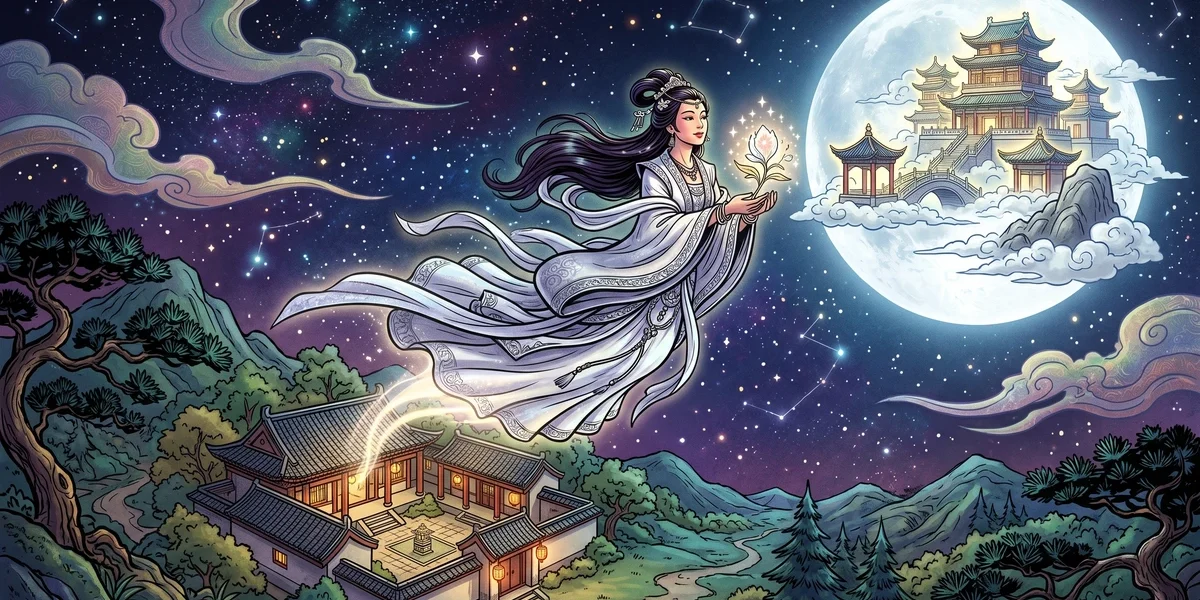
“The Lady of the Moon” concerns Chang’e (嬙娥) — the Moon Goddess, one of the most beloved and melancholy figures in the entire Chinese mythological tradition. Her story is among the oldest in Chinese literature, referenced in texts as early as the Gui Cang (幸藏, a divination manual of the late Shang dynasty, c. 1200 BCE) and reaching its fully elaborated form in Han dynasty texts and poetry. Chang’e is the wife of Hou Yi (后罿), the divine archer who saved the world by shooting down nine of the ten suns — a heroic deed that earned him an elixir of immortality from the Queen Mother of the West (西王母, Xiwangmu). Chang’e took the elixir — whether by theft, by fear of its theft by another, or by an impulse she could not afterwards explain — and fled to the moon, where she has lived alone ever since in the cold and magnificent Moon Palace (広寒宮, Guanghan Gong, “Palace of Vast Cold”) with only the Jade Rabbit (玉兔, Yu Tu) for company. Her story is the founding myth of the Mid-Autumn Festival (中秋節, Zhongqiu Jie), celebrated on the fifteenth day of the eighth lunar month, when the moon is fullest and brightest, and families gather to share mooncakes and look up at the sky where Chang’e still resides.
Part I — Hou Yi and the Elixir
In the mythological time when the world was new and the cosmic order not yet settled, ten suns — divine birds who took turns crossing the sky — decided one day to travel together. The combined heat of ten suns simultaneously in the sky was catastrophic: crops burned, oceans began to boil, people and animals died in the scorching heat that covered the earth without relief. The divine archer Hou Yi (后罿), husband of Chang’e and commander of the divine bow, was sent by the Jade Emperor to resolve the crisis. He shot down nine of the ten suns — sparing one, which has been our single sun ever since — with arrows of astonishing accuracy, restoring the world to habitable conditions.
The Jade Emperor, however, was displeased: the nine suns were his sons, and Hou Yi’s decisive action, while it saved the world, was not strictly within the authority he had been given. Hou Yi and Chang’e were stripped of their divine status and exiled to the mortal realm, condemned to live and die as ordinary humans. In this diminished condition, Hou Yi journeyed to the Queen Mother of the West — the Taoist goddess who possessed the elixir of immortality — and obtained from her one dose of the medicine: enough for two people to become immortal together, or for one person alone to ascend immediately to heaven.
Hou Yi brought the elixir home and told Chang’e: they would take it together on an auspicious date, recovering their divine status simultaneously. He left it in the house for safekeeping and went out.
Part II — The Theft, the Flight, and the Eternal Cold
What happened next is the pivot on which the entire myth turns, and on which Chinese culture has never reached a fully settled verdict. Chang’e took the elixir. Accounts differ on her motivation: in the most sympathetic versions, she discovered that a villainous disciple of Hou Yi intended to steal it by force, and drank it herself to prevent its theft, preferring her own ascension to allowing a corrupt person to obtain immortality. In less sympathetic versions, she was unable to resist the temptation of the immortality she had once possessed and lost, taking the dose that was meant for both of them without waiting for her husband. In the most ambiguous versions — the ones that have generated the most poetry — her motivation is simply not stated, and the reader is left with the image of a woman and a vial of elixir and an empty house, and whatever understanding of human nature they bring to that combination.
She drank the elixir and rose immediately to heaven — rising past the stars, past the celestial realms she had once inhabited, drawn by the concentrated power of the full dose toward the highest and coldest place: the moon. The Moon Palace (Guanghan Gong, literally “Palace of Vast Cold”) received her in its magnificent desolation — crystal walls, cold light, silence broken only by the rhythmic pounding of the Jade Rabbit, who grinds immortality herbs with a pestle under the osmanthus tree. It was beautiful. It was immortal. It was completely alone.
Hou Yi, returning home to find Chang’e gone and the elixir consumed, could not follow. He lived and died as a mortal, shooting the sun each day as legend assigned him, while Chang’e looked down from the moon at the world where they had been exiled together, and where he now remained without her. Chinese poets have returned to this image for three thousand years. The Tang dynasty poet Li Shangyin (李商隠, 813–858 CE) wrote the lines most often quoted in this context: “Chang’e must be regretting having stolen the elixir / In the blue sea and green sky, she mourns through the night.”
Part III — The Mid-Autumn Festival and Communal Response
The Mid-Autumn Festival (中秋節, Zhongqiu Jie) that Chang’e’s story grounds is celebrated on the fifteenth day of the eighth lunar month — the night of the year’s most perfectly full and bright moon. The festival’s ritual core is communal: families gather together, share mooncakes (月餅, yue bing) — round pastries whose shape mirrors the full moon — and look up at the sky together. In some traditions, offerings of mooncakes, pomelos, and osmanthus wine are made to Chang’e at outdoor altars; in others, the gathering is simply a family meal conducted under the full moon’s light.
The ritual structure of the festival constitutes, implicitly, a collective response to the myth it commemorates. Chang’e is alone in her immortal palace; the Mid-Autumn Festival is a celebration of togetherness. Chang’e ascended beyond the human world; the festival gathers human families back to the same table. Chang’e has the moon to herself; the festival shares the sight of the moon among all who look up at it simultaneously. The round mooncake, divided and distributed, is the literal enactment of the anti-Chang’e principle: the elixir that was not divided becomes, in the festival’s symbolism, the cake that is. What Chang’e chose not to share, the festival chooses to share over and over again, as if in annual correction of the original choice.
This reading makes the Mid-Autumn Festival not merely a celebration of Chang’e but an implicit gentle critique of her choice — or rather, a collective statement of preference for the value she chose against. The festival says: we looked at the story of solitary immortality in the cold palace and we chose the family table instead. We would rather share the mooncake and be mortal than ascend alone to the palace of vast cold and be immortal forever.
Part IV — The Paradox of Solitary Transcendence
The deepest question the Chang’e myth raises is whether transcendence that must be purchased at the price of human connection is genuinely transcendence or simply a different kind of limitation — an exchange of one form of finitude (mortality) for another (eternal solitude). This question has been at the heart of Chinese philosophical and religious debate for millennia, surfacing most explicitly in the tension between Buddhist individual liberation and Mahayana’s bodhisattva ideal.
In the Theravada Buddhist tradition, the highest aspiration is the individual’s liberation from the cycle of rebirth through personal practice and attainment — an achievement that is, by its nature, individual. In the Mahayana tradition that dominated Chinese Buddhism, the bodhisattva ideal offers a counterweight: the most spiritually advanced being is not the one who exits the world but the one who remains in it, returning life after life until all sentient beings have been liberated. The bodhisattva’s compassion — the deliberate choice to remain connected rather than to transcend — is presented as a higher attainment than individual liberation.
Chang’e, in this light, is not a bodhisattva. She chose individual ascension over shared transcendence, and the myth’s emotional register — the palace of vast cold, the eternal loneliness, the moonlit mourning — suggests that this choice cost her something that immortality cannot restore. She is free from death; she is not free from regret. The Jade Rabbit pounds his herbs; the osmanthus blooms in cold light; and the lady of the moon looks down at the world she left behind, where families gather under her light to share what she chose not to share — which is, the myth quietly suggests, the better part of what makes existence worth having.
“She rose to the cold palace and the cold light and the cold silence, and she has never regretted it, and she has never stopped regretting it, and both of these things are true every night that she looks down at the families sharing their round cakes under the moon she lives in.”
Why This Story Lasted
The Chang’e myth has lasted for three thousand years because it holds its central question permanently open. Did she do the right thing? Every generation answers differently: the moralists say no, she betrayed her husband; the romantics say perhaps, given the circumstances; the philosophers say the question itself is the lesson — that there is no answer, only the choice and its irreversible consequences. A story that can hold a genuine question open for three millennia, still generating poems and operas and debates about what a woman did with an elixir on a night when her husband was away, has achieved something that few stories achieve: it has found the particular pressure point where human experience is permanently unresolved.
The Mid-Autumn Festival’s annual renewal of the story also sustains it. Each year, the full moon appears; each year, families gather; each year, the mooncakes are divided and shared; and each year, looking up at the moon’s cold light, someone thinks of Chang’e looking down, and the ancient question surfaces again: was the elixir worth it? The festival does not answer the question; it simply creates the conditions under which the question arises, year after year, and trusts that the act of gathering under the moon together, sharing what is divisible and looking at what is not, is itself a sufficient answer for those who experience it.
You May Also Like
 Chinese Folk Tales
Ages 9-12
Chinese Folk Tales
Ages 9-12
The Sorcerer Of The White Lotus Lodge
The Sorcerer Of The White Lotus Lodge: Once upon a time there was a sorcerer who belonged to the White Lotus Lodge. He knew how to deceive the multitude with
 Chinese Folk Tales
Ages 6-8
Chinese Folk Tales
Ages 6-8
A Legend Of Confucius
A Legend Of Confucius: When Confucius came to the earth, the Kilin, that strange beast which is the prince of all four-footed animals, and only appears when
 Chinese Folk Tales
Ages 6-8
Chinese Folk Tales
Ages 6-8
The Spirit Of The Wu-Lian Mountain
The Spirit Of The Wu-Lian Mountain - a folk tale retold for young readers with a clear moral, simple words, and the warmth of a bedtime story from long ago.