Hudden And Dudden
Hudden and Dudden and Donald O'Neary: An Irish Tale of Wit Over Greed In Ireland long ago, in a time when magic still seemed possible and cleverness was often
Hudden and Dudden and Donald O’Neary: A Celtic-Irish Tale of Wit Outwitting Greed
This is the tale Irish storytellers carried by hearth-light through three centuries of the long winter nights, the story of two prosperous neighbours whose envy ate at them like rust, and one poor man whose only weapon was the sharp edge of his thinking. The narrative is preserved most faithfully by the Wexford folklorist Patrick Kennedy in Legendary Fictions of the Irish Celts (London: Macmillan and Co., 1866), where it appears as “Hudden, Dudden, and Donal O’Leary”, gathered from oral tellings in southeastern Ireland during the post-Famine generation. It was given its more familiar shape in 1892 by Joseph Jacobs in Celtic Fairy Tales (London: David Nutt, 1892, pages 47–55), where Jacobs softened the dialect for English nursery readers and standardised the protagonist’s surname to “O’Neary.” Folklorists classify the tale as ATU 1535, “The Rich and the Poor Peasant”, the same international tale-type that produces Hans Christian Andersen’s “Little Claus and Big Claus” (1835), the Brothers Grimm “The Little Peasant” (KHM 61), and the Norwegian “Big Peter and Little Peter”. In Stith Thompson’s Motif-Index of Folk-Literature the story braids together motif K335.1.4 (the worthless object sold for treasure) and K1051 (the dupes drowned in their own sack), making it one of the most widely told trickster comedies in European peasant tradition. Yet only the Irish version names its hero with the gentle music of O’Neary and lets him answer cruelty not with revenge, but with mischief sweet enough to teach without poisoning.
The Two Wealthy Brothers and the Cow Named Daisy
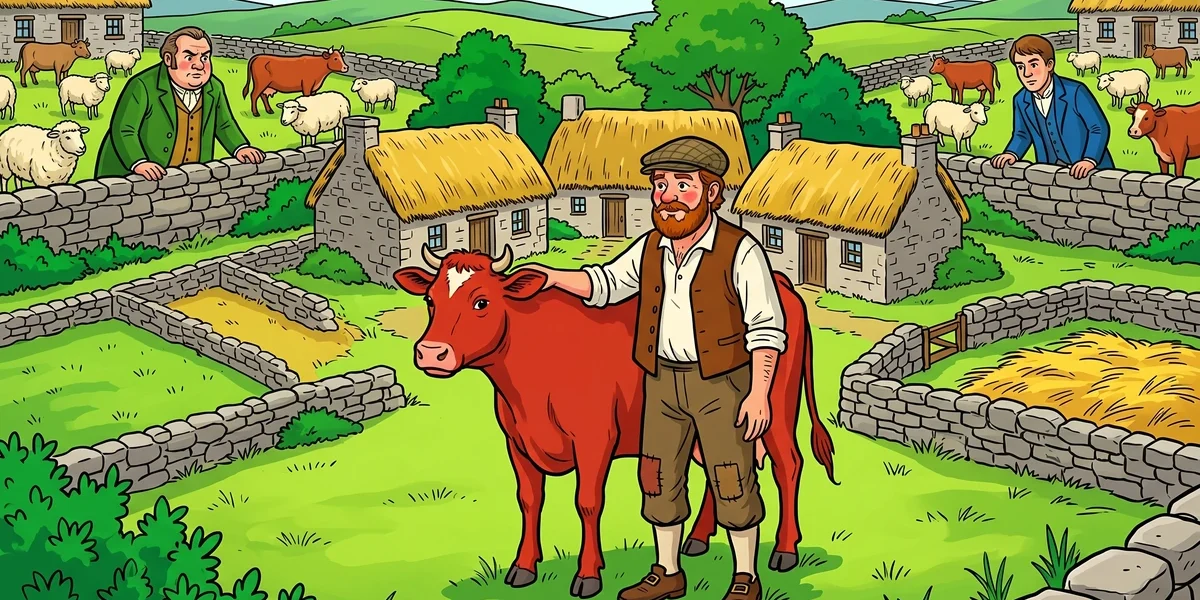
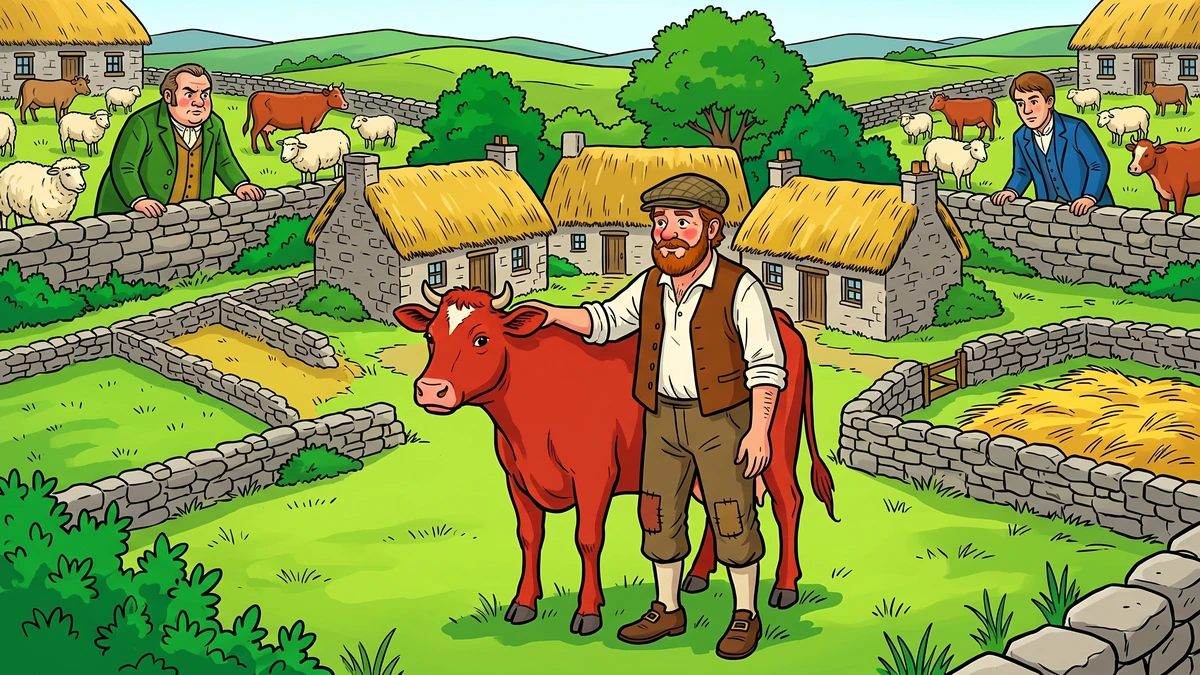
In the green hills of County Wexford, where the stone walls curl like sleeping serpents across the fields and the smoke of turf fires rises straight up on a still morning, three small farms stood side by side. Two of these farms belonged to a pair of stout brothers known to everyone as Hudden and Dudden. Their barns groaned with hay, their byres held cattle of every colour, their flocks of speckled sheep covered the hillside like clouds at sunrise, and their houses had real glass in the windows and slate on the roof, which in those days was a sign of fortune. Hudden was the older, with a face like a closed fist; Dudden was the younger, with a smile that never reached his eyes. They were not unkind to strangers, only to anyone who lived close enough to remind them, by simply existing, that the wealth they hoarded could have been shared.
Between the two brothers’ grand farms lay a strip of land no wider than a long throw, and on that strip lived a poor man named Donald O’Neary. His cottage was thatch with a hole patched by an old creel, his fields grew more rushes than barley, and the wind came in under the half-door and sat at his hearth like an unwelcome guest. Yet Donald was rich in one thing: he was the master of a fine red cow named Daisy, who gave milk so creamy that the butter from it sold better at the Wexford market than any other in the parish. Daisy was Donald’s livelihood and his friend; he spoke to her in the Irish his grandmother had taught him, and she answered with the patient blink that only cows can manage.
Hudden and Dudden hated to look across their walls and see Donald’s poor patch of ground. “If we had his three acres,” said Hudden one evening over their bowls of thick stew, “we could put the white cattle on them and never know how much richer we were getting.” “And if we were rid of Donald himself,” said Dudden, “the priest would soon stop scolding us for keeping our charity for the poor box.” Their plan was as plain as it was wicked: kill the cow, ruin the man, and the land would fall to them like a ripe sloe. That very night, when Donald was at the wake of an old neighbour two glens away, the brothers slipped into his byre with a heavy stick and struck Daisy down. They went home and slept the heavy sleep of those who think they have not been seen.
The Hide That Walked to Market
Donald came home in the grey hour before dawn and found his Daisy cold in the straw. He sat down on the milking-stool and cried until the cock crew. But there is a quality the Irish have given many names — cleas na gciontacha, the trick of those who have nothing left to lose — and it stirred in Donald before the second crow. “She is gone,” he said aloud, “and weeping will not bring her back. But Daisy has one last gift in her, and I’ll not waste it.” He skinned the cow with a careful hand and stretched her hide to dry in the wind. Then he did a curious thing: he went to the stone under the hearth where he kept the few silver shillings saved over many years, and he tucked the coins one by one into the folds of the hide, knotting it shut so that the metal could be felt but not seen.
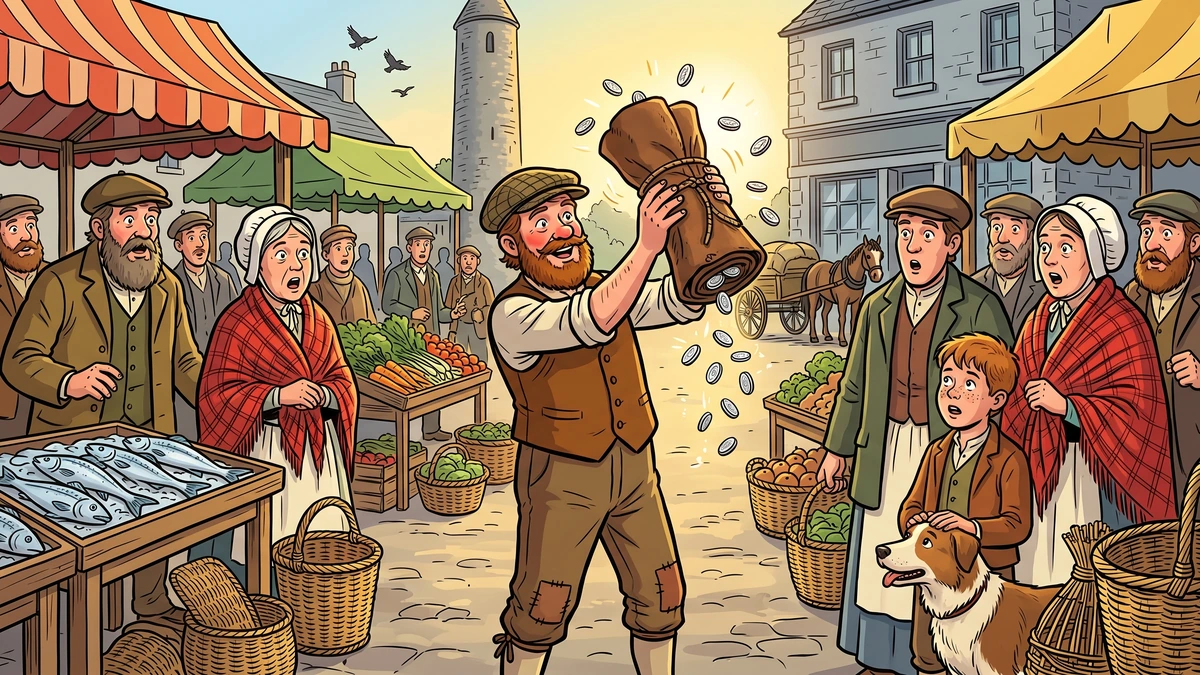
With the hide on his back and a song between his teeth, Donald walked the eight long miles to the Wexford fair. He set himself down at the corner where the cattle-jobbers gathered, and when a buyer asked what he had in the bundle he answered, with a face as innocent as a christening child, “Only the hide of a cow, sir, but a hide that has the grace to give a man money when he asks for it.” He gave the bundle a clever little shake and the silver inside it gave back the unmistakable music of coin. Word ran around the fair the way fire runs in dry heather. Other men came up, jingled the bundle for themselves, and went home that night swearing they had heard it speak. Donald was offered first one price, then another, and at last he sold the hide for a sum that would have bought three cows like Daisy with change for a new roof and a new pipe besides.
When Donald walked home along the white lanes that evening with his pockets weighed down like a smuggler’s, Hudden and Dudden saw him from their front door and could not believe their eyes. “Where did you come by such gold?” they shouted across the wall, half-furious already. Donald only smiled. “It was the hide of my poor Daisy,” he said, gentle as the rain. “There is a great hunger for cow-hides at the Wexford market just now, and a man with one to sell is as good as set up for the year.”
The Brothers’ Folly and the Trick at the Funeral
Now Hudden and Dudden had a great quantity of cattle and they were never men to let a chance of profit go past their door. That very night they ran to their byres, and with the same sticks that had killed Daisy they struck down a dozen of their own beasts — fat heifers, young bullocks, a milch-cow in calf, all of them piled bloody and sorry in the yard before the sun was up. They skinned them in a great hurry, and the next morning they marched into Wexford with a wagon-load of hides, sure that they were about to become twice as rich as before.
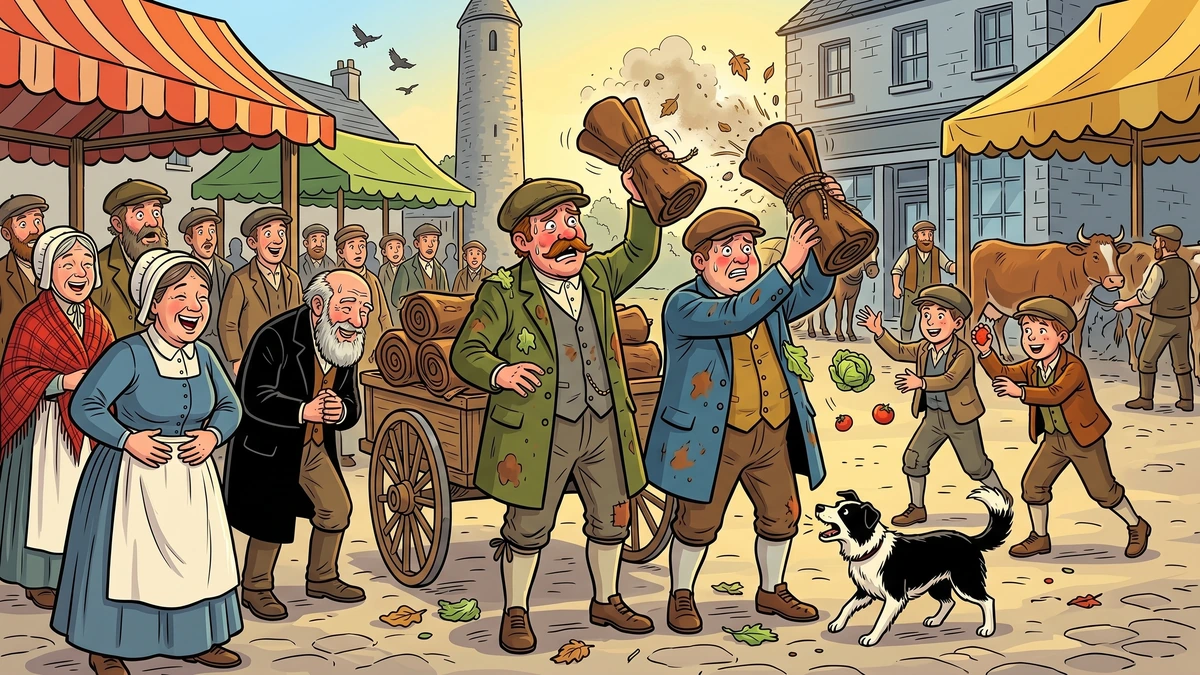
The fair-day buyers stared at the brothers as if they had brought in a load of stones. The price of cow-hide that day was the fair price of cow-hide, no more, no less, and when Hudden and Dudden swore that the hides could speak and gave the bundles a shake, the only sound was their own foolishness rattling. They were laughed out of the market, pelted with rotten cabbages by the boys, and chased home along the road by a pack of yapping dogs. By the time they reached their own gate they had worked themselves into a black fury. “He has tricked us,” said Hudden. “We will pay him back in his own coin,” said Dudden. They burst into Donald’s house with murder in their eyes, but Donald was not there — he had gone to the chapel to light a candle for Daisy.
The brothers did not wait. They tied a sack closed at the mouth of his sleeping-loft so that he must walk into it when he came in, and they went home to sharpen their knives. But Donald’s old mother was visiting that hour from the next townland, a woman bent with age who had buried two husbands and feared nothing. When she stepped into the cottage and felt the sack drop over her, she made not a sound; she had heard the brothers’ footsteps fade down the lane and she knew, with the long knowledge of the country, that something was very wrong. Donald came home a quarter-hour later, opened the sack, and his mother whispered her tale into his ear. The two of them sat by the fire and worked out a plan as careful as the braiding of a sally-rope.
The Sack at the River and the Fairies’ Cattle
That very night Hudden and Dudden returned with a great wide-mouthed sack of their own. They bundled what they thought was Donald into it, slung it on a stout pole between them, and set off for the dark river that ran behind the chapel — for in their wickedness they meant to drown the man and let the salmon make a quiet end of the business. But Donald had slipped his mother out the back door and slipped himself into the sack instead, and as the brothers staggered along the slippery path they grew thirsty, as wicked men so often do at the worst moment. They set the sack down by the door of Sheehan’s shebeen — a low-roofed alehouse where a fiddle could be heard tuning — and they went inside for one quick drop of porter to keep their courage up.
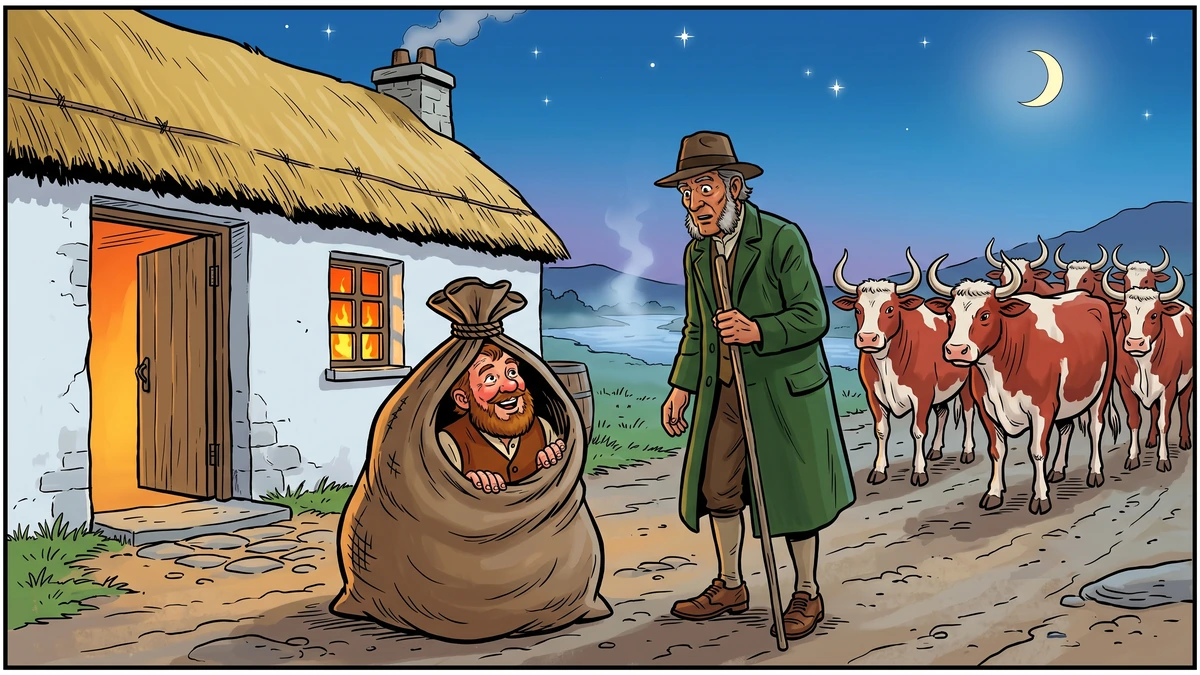
While they were inside arguing over who would pay, Donald began a great cheerful song from inside his sack: “I will not have her, I will not have her, the king’s own daughter and all her gold, I will not marry against my will!” A passing drover called Conn the Cattle-Man, who was driving a herd of fine red bullocks home along the road, stopped at the strange sound. “And what ails you, friend?” said Conn through the cloth. “Sure they are forcing me to wed the king’s daughter,” cried Donald, “and I have no taste at all for crowns or palaces. Any honest man with a herd of cattle would be welcome to take my place.” Conn was a widower with no princess of his own and a great love of comfort; he had the sack untied in the wink of an eye, climbed in himself, and gave Donald the rope to his red bullocks and the blessing of God. Donald drove the cattle home along the back-lane and into his own field before the moon had moved a hand’s breadth in the sky.
When the brothers came stumbling out of Sheehan’s, they hoisted up the sack — heavier than they remembered, but porter has a way of confusing the shoulders — and tipped it into the deepest pool of the river. Conn, poor man, never had the chance to sing his way out. The brothers went home to sleep the sleep of the wicked, who never sleep as well as they think they do.
The Last Trick: Donald’s Cattle from the Bottom of the River
The next morning the brothers were at their breakfast when they saw, through the window, a thing that made the spoons drop out of their hands: Donald O’Neary was walking down the boreen at the head of a great herd of fine red cattle, the like of which had not been seen in the parish since the Norman lords kept their pleasure-stock at Ferns. They ran out into the road, trembling. “Donald,” said Hudden, in a voice as soft as buttermilk, “where did you come upon such cattle?” “Where you sent me,” said Donald, calm as a stone. “At the bottom of the river. Did you not know the fairy-folk keep their finest herds on the green meadows under the water? I had only to step out of the sack and walk a little, and they begged me to take a herd up with me, for they have more than they can mind. There were a thousand more I had to leave behind, and it nearly broke my heart.”
Hudden and Dudden looked at one another. Their greed, which had been their tutor all their lives, sat them down at the kitchen table and would not let them rise until they had begged Donald for the favour of being put in sacks themselves and carried to the river-pool. Donald, for the look of the thing, said he would oblige a neighbour. He fetched the strongest sack from his shed, tied each brother in tight, and with the help of two passing tinkers he carried them down to the same dark pool and rolled them in. The river took them as quietly as it had taken Conn the night before. Donald walked home, lit his pipe, and gave Daisy’s old halter a kindly look where it hung above the door.
The Moral: Cleverness Is the Sword of the Poor
The Irish say of this tale, in the old Gaelic that hangs on among the storytellers of the Wexford glens:
“Is fearr ciall ná saibhreas, agus is fearr cleasaíocht ghreannmhar ná díoltas dorcha.”
“Wit is better than wealth, and a laughing trick is better than a dark revenge.”
Donald O’Neary takes nothing back from his cruel neighbours that they did not give him first. He does not lift a hand to strike them. He does not lay an information with the magistrate. He simply allows their own greed to be the rope they hang upon, the sack they drown in, the fair-day cabbages that pelt them on the road home. The moral the seanchaí of Wexford pressed on every child who heard the tale was a double one: first, that the sharpest weapon a poor man owns is between his ears and not at his belt; second, that envy has a perfect appetite for its own destruction, and the wise man has only to step aside and let it eat. There is no cruelty in Donald — when his neighbours killed his only cow he wept first, and only afterwards turned his mind to the trick. The story rebukes greed without preaching, and rewards cleverness without making a hero of the cheat. It is, in this measured balance, one of the loveliest of all Celtic moral tales.
Why This Tale Has Lasted
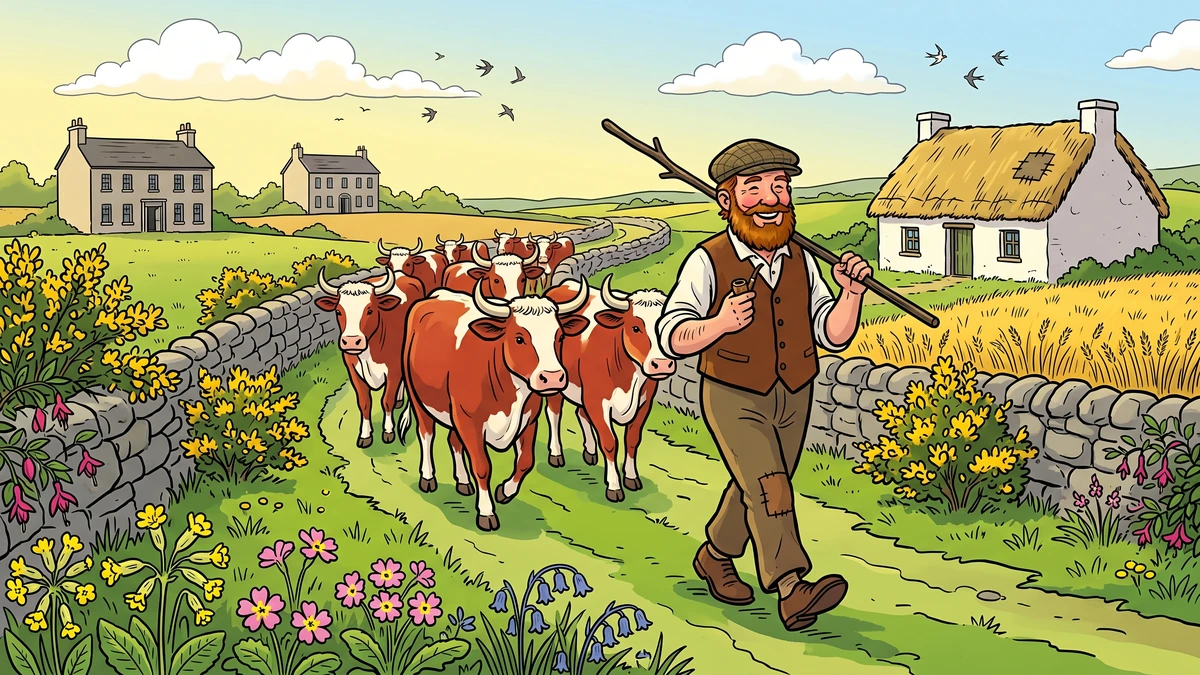
The Hudden and Dudden story has travelled the longest road in folklore: it has been told for at least eight centuries across Europe, from the medieval Latin Unibos of the eleventh-century Cambridge Songs through the German “Little Peasant” of the Brothers Grimm, the Danish “Little Claus and Big Claus” of Andersen, the Norwegian “Big Peter and Little Peter” of Asbjørnsen and Moe, and the Irish version preserved by Patrick Kennedy and Joseph Jacobs that you have just read. Each culture takes the bones of the story — two rich oppressors, one poor trickster, a dead beast turned to gold, a sack that drowns the wicked in their own wickedness — and dresses them in the local cloth. In Ireland, the local cloth is the small farm of the post-Famine generation, the fairs of Wexford and Enniscorthy, the shebeen on the river road, and the easy belief that the underworld of the fairy-folk lies just below the surface of the everyday water. The tale has lasted because in every age the listener has known a Hudden and a Dudden, has felt the smallness of standing between their two great farms with one cow to keep him alive, and has needed the comfort of believing that the wits God gave the small man are enough to keep him on his feet. It has lasted, too, because it is funny — and a moral that is laughed at is better remembered than a moral that is preached. The seanchaí understood that, and so does every child who has ever giggled at the picture of two stout brothers being tipped into a river by their own greed.
Frequently Asked Questions
Who originally collected the Irish folktale of Hudden and Dudden?
The story was first preserved in print by the Wexford folklorist Patrick Kennedy in his collection ‘Legendary Fictions of the Irish Celts’, published in London by Macmillan and Co. in 1866, where it appears as ‘Hudden, Dudden, and Donal O’Leary’. Kennedy gathered it from oral tellings in southeastern Ireland during the post-Famine generation. The English folklorist Joseph Jacobs later included a softened, English-friendly version titled ‘Hudden and Dudden and Donald O’Neary’ in ‘Celtic Fairy Tales’ (London: David Nutt, 1892), which became the standard nursery retelling and the source most modern English readers know.
What is the ATU folktale-type classification of Hudden and Dudden?
Folklorists classify the tale as ATU 1535, ‘The Rich and the Poor Peasant’, in the Aarne–Thompson–Uther index. This is the same international tale-type that produced Hans Christian Andersen’s ‘Little Claus and Big Claus’ (1835), the Brothers Grimm’s ‘The Little Peasant’ (KHM 61), and the Norwegian ‘Big Peter and Little Peter’ collected by Asbjørnsen and Moe. In Stith Thompson’s ‘Motif-Index of Folk-Literature’ the story combines motif K335.1.4 (the worthless object sold for treasure) and K1051 (the dupes drowned in their own sack), making it one of the most widely told trickster comedies in European peasant tradition.
What is the moral of Donald O’Neary’s story?
The moral, summarised in the Wexford Gaelic, is ‘Is fearr ciall ná saibhreas, agus is fearr cleasaíocht ghreannmhar ná díoltas dorcha’ — ‘Wit is better than wealth, and a laughing trick is better than a dark revenge.’ Donald never raises a hand against Hudden and Dudden; he simply allows their own greed to become the rope they hang upon. The seanchaí pressed two lessons on every listener: that the sharpest weapon a poor man owns is between his ears, and that envy has a perfect appetite for its own destruction — the wise man has only to step aside and let it eat.
Why did Donald put silver coins inside the cow’s hide?
After Hudden and Dudden killed his cow Daisy, Donald skinned her and hid every shilling he owned inside the folds of the dried hide, knotting it shut so that the metal could be felt but not seen. At the Wexford fair he gave the bundle a clever shake; the silver inside rang with the unmistakable music of coin, and word spread that the hide could ‘speak money’. Buyers competed for it and Donald sold it for a small fortune — far more than three live cows would have fetched. The trick depends on showmanship rather than magic: he turned the only thing his cruel neighbours had left him into bait for their own greed.
How does the Irish version of ATU 1535 differ from Andersen’s Little Claus and Big Claus?
The bones of the story — two rich oppressors, one poor trickster, a dead animal turned to gold, a sack that drowns the wicked in their own wickedness — are identical across the European variants. The Irish version is distinguished by its setting in a small post-Famine Wexford farm, by the role of the shebeen (the country alehouse), and especially by its easy belief that the fairy-folk keep their finest cattle on green meadows under the surface of the river — a detail rooted in Irish belief in the Tuatha Dé Danann and the otherworld below the water. Andersen’s Danish ‘Little Claus and Big Claus’ (1835) replaces the fairy cattle with a journey to a river-bottom mermaid, while the Grimms’ ‘The Little Peasant’ (KHM 61) emphasises the village and the parish priest. Donald O’Neary is also gentler than his European cousins: he weeps for his cow before he sets his trick, and never strikes a blow himself.
You May Also Like
 Celtic Folk Tales
Ages 3-5
Celtic Folk Tales
Ages 3-5
The Glass Mountain: A Polish Tale of Cleverness Over Strength
The Glass Mountain: A Polish Tale of Cleverness Over Strength: In a distant kingdom of Poland, there stood a mountain unlike any other in all the world.
 Celtic Folk Tales
Ages 9-12
Celtic Folk Tales
Ages 9-12
The Sea-Maiden
The Sea-Maiden: There was once a poor old fisherman, and one year he was not getting much fish. On a day of days, while he was fishing, there rose a sea-maiden
 Celtic Folk Tales
Ages 9-12
Celtic Folk Tales
Ages 9-12
The Vision of MacConglinney
The Vision of MacConglinney: athal, King of Munster, was a good king and a great warrior. But there came to dwell within him a lawless evil beast, that