Yun Se-Pyong, The Wizard
Yun Se-Pyong, The Wizard: [Yun Se-pyong was a man of Seoul who lived to the age of over ninety. When he was young he loved archery, and went as military
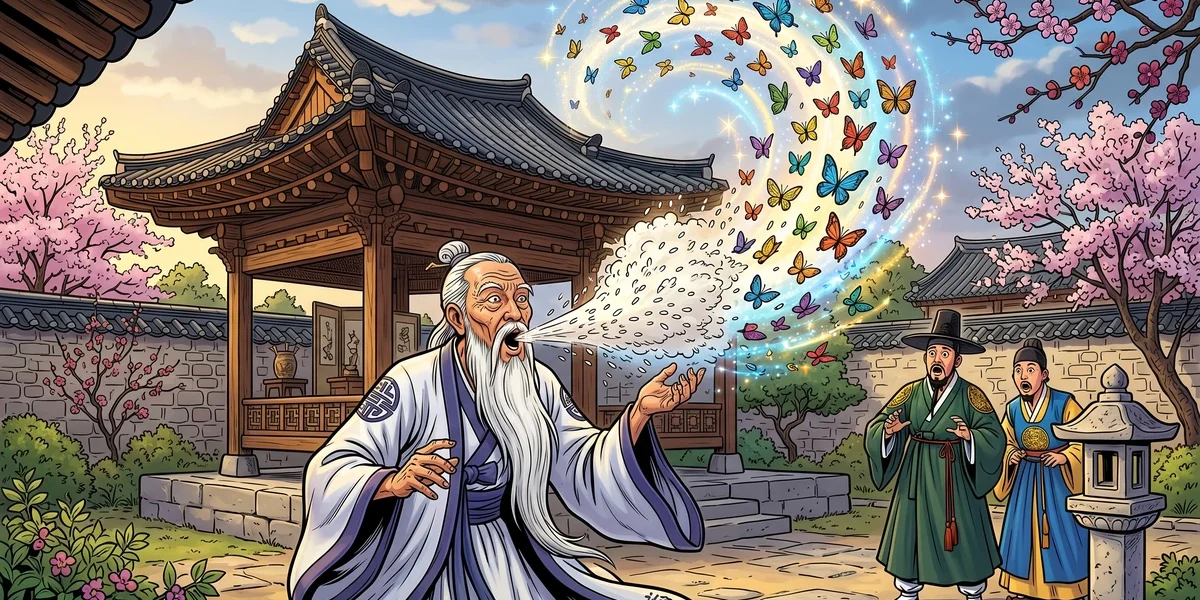
Origin & Tradition
Yun Se-Pyong belongs to the Korean folk tradition of the dosa (도사, 道士) — the Taoist-inflected sage-practitioner whose cultivated attunement to cosmic principles gives him capacities beyond those of ordinary human beings. Unlike the shamanic mudang, whose power derives from mediation of specific spirit beings, or the Buddhist monk, whose power derives from meditative concentration, the dosa operates through alignment of his own nature with the deep principles articulated in Chinese classical Taoism and geomantic theory. The specifically Korean dimension of this tradition added the concept of unsu (운수, 運數) — the flow of fortune, the movement of cosmic potential through time that affects households, communities, and kingdoms as well as individuals. A wizard of Yun Se-Pyong’s caliber is primarily a practitioner of unsu perception and navigation: someone who can read the flow of fortune at scales beyond the individual, and who helps those he assists to move with that flow rather than against it. This story, preserved in multiple variants across the central Korean highland traditions, examines what this kind of wisdom costs and what it requires.
Beat I — The Wizard’s Reputation
Yun Se-Pyong’s reputation had preceded him through several provinces by the time the story’s central situation developed — not the reputation of a man who performed dramatic supernatural feats, but of a man whose advice, when followed, consistently resulted in outcomes that those who had ignored it consistently came to regret. This is a more durable and more interesting kind of reputation, because it accumulates through the testimony of people who had personal experience of the advice’s accuracy rather than through secondhand transmission of impressive stories.
The specific instances the reputation rested on shared a common pattern: Yun Se-Pyong had consistently counseled people to work with movements already in progress rather than to initiate counter-movements against what was already flowing. The family he had advised not to relocate during a period when the movement of fortune was running against such relocation, and who had watched their neighbors lose investment in a similar relocation during the same period, had spoken of his advice extensively. The merchant he had counseled not to extend credit during a specific seasonal period, and who had watched his competitors’ credit arrangements unravel precisely during that period, had spoken of his advice extensively. None of these people had experienced dramatic supernatural intervention; they had experienced the precise perception of which way the current was running, and advice to swim with it rather than against it.
Beat II — The Request and Its Complications
The request that the story centers on came from a household whose unsu was in a particularly difficult passage: three consecutive poor harvests, a two-year legal dispute consuming resources and attention, a broken marriage negotiation, and a sequence of minor misfortunes — a roof leak, a sick ox, a fire in the storage building — that individually were manageable but collectively had acquired the quality of an accumulating pattern.
The household head came to Yun Se-Pyong with a list of specific interventions: geomantic adjustment of the household’s orientation, talismans for each problem area, an auspicious date for the legal dispute’s next hearing, guidance on the next marriage negotiation. He presented these as separate technical problems, each with a specific solution available to a practitioner of Yun Se-Pyong’s caliber.
Yun Se-Pyong listened to the entire list with complete attention, asking clarifying questions — not about the specific problems but about the timeline of their occurrence, the sequence in which they had developed, and the relationship between the household’s situation and the broader situations of the neighboring families and the regional community. When the household head had finished, Yun Se-Pyong sat with what he had been told for a time the household head later described as unnervingly long.
Then he declined to perform most of what had been requested. Not because the problems were beyond his competence, and not because the specific interventions were technically impossible, but because his reading of the household’s unsu indicated that the problems were not separate technical malfunctions — they were expressions of a single larger movement currently running against the household, and piecemeal technical interventions would at best defer the problems’ resolution without addressing their source, and at worst would expend the household’s resources in interventions whose effects would be absorbed by the larger flow without significantly altering it.
Beat III — Unsu and the Ethics of the Wizard’s Practice
Unsu (운수, 運數) in Korean cosmological tradition operates at multiple scales simultaneously. At the individual scale it describes the movement of fortune through a specific person’s life — related to the palja (八字, the eight characters of birth time) but more dynamic and responsive to temporal cycles. At the household scale it describes the movement of collective fortune through a family unit. At the community and regional scale it describes the broader movement of fortune through the shared landscape, influenced by geomantic factors — the relationship between the landscape’s physical characteristics and the flow of cosmic energy through it.
Yun Se-Pyong’s specific competence was the perception of unsu at all three scales simultaneously and the ability to identify which scale’s movement was the primary driver of a household’s current situation. His reading of the household head’s situation indicated that the household’s difficulties were primarily driven by a regional unsu cycle — a broader movement affecting multiple households in the district — and that the family’s specific vulnerabilities were amplifying effects of this broader movement rather than independent problems with independent solutions.
This diagnosis had significant ethical implications. A wizard less committed to accurate perception might have performed the requested interventions — each was technically within standard practice, each would have demonstrated his skill, each would have been paid for — and allowed the household to discover over subsequent seasons that the interventions had not produced the expected results, attributing the failure to some additional factor requiring further intervention. This is, in fact, what many practitioners did, as the folk satirical tradition around the dosa practice made clear. Yun Se-Pyong’s reputation rested precisely on his refusal to do this: on his consistent practice of telling clients what his perception actually revealed rather than what the payment schedule encouraged him to reveal.
The wizard’s ethic, in the Korean folk understanding of Yun Se-Pyong’s tradition, was therefore a form of the same principle that appeared in the political domain as jeongyeong (right-naming): the obligation to call what one perceives by its correct name, even when the correct name is less commercially convenient than an alternative. A wizard who perceives that a client’s problems are expressions of a regional unsu movement and tells him this, declining to perform interventions that would generate payment without addressing the actual source, is practicing a form of integrity that the professional pressure of the dosa practice environment consistently worked against.
Beat IV — The Moral and Its Endurance
What Yun Se-Pyong did perform was considerably less dramatic than what had been requested: he identified two specific areas where the household’s situation could be genuinely improved through aligned rather than counter-movement action — the timing of the legal dispute’s engagement, and a specific aspect of the storage building’s reconstruction that would improve rather than merely restore the building’s contribution to the household’s overall geomantic situation. He declined the talismans, the marriage guidance, and the orientation adjustment, explaining that these interventions would be absorbed by the regional flow without benefit at this point in the cycle.
The household head received this guidance with the displeasure of a man who had expected more and received less. He did not follow all of the advice he was given. The portion he followed produced the outcomes Yun Se-Pyong had described. The portions he ignored produced the outcomes that the broader unsu movement was already producing in the district — neither dramatically worse nor dramatically better than what the wizard had said would happen without intervention.
The moral that circulated in the folk tradition through the memory of this encounter was not about Yun Se-Pyong’s accuracy. It was about the quality of practice that his accuracy represented: the specific courage required to tell a paying client that most of what he wants cannot usefully be done, and the specific honesty required to perceive the limits of one’s own practice accurately enough to know when those limits have been reached. These are the qualities that separate a wizard who has cultivated genuine alignment with unsu from one who has merely learned the techniques of performing that alignment for an audience that cannot distinguish the genuine from the performed.
“The wizard who tells you what you cannot change has served you better than the wizard who tells you what you want to hear. The first has given you time to work with what can be changed.”
— Korean proverb associated with the dosa tradition
Why This Story Lasted
Tales of Yun Se-Pyong persisted because they articulated a standard for the practice of specialized knowledge that was universally applicable: the obligation to tell clients what one’s expertise actually perceives rather than what the client wants to hear or what the payment structure incentivizes. Every specialized practice — medicine, law, agriculture, divination — contained within it the same pressure that Yun Se-Pyong resisted, and every community valued the practitioner who resisted that pressure and paid the commercial cost of the resistance. The dosa tradition gave this standard its most dramatic form, but the principle it embodied was recognizable far beyond the specific practice of fortune-flow perception.
Unsu (운수) and the Korean Cosmological Tradition
Unsu (運數) in Korean cosmological thought describes the movement of fortune through time at multiple scales — individual, household, community, and regional. Unlike the palja (八字, the eight characters of birth time) that determines an individual’s fate configuration at birth, unsu is understood as dynamic and cyclical, responsive to temporal patterns and geomantic factors. Practitioners who specialized in unsu perception — including dosa wizards, geomancers (풍수사, pungsu-sa), and certain mudang — developed elaborated systems for reading these multi-scale fortune movements and advising households and communities on alignment. The folk tradition gave unsu perception its most enduring narrative expression through stories of practitioners whose accuracy was measured not by their fees but by the honesty with which they reported what they perceived.
Frequently Asked Questions
What is the central moral of “Yun Se-Pyong, the Wizard”?
The tale teaches that genuine mastery of fortune-flow perception (unsu) requires the courage to tell clients what one’s expertise actually reveals rather than what payment incentivizes — and that this specific honesty is more valuable than the most impressive technical interventions, because only accurate diagnosis enables the alignment with fortune’s actual movement that produces genuine benefit.
What happens in the story?
A household head brings Yun Se-Pyong a list of specific magical interventions he wants performed to address a sequence of misfortunes. After careful inquiry, Yun Se-Pyong declines most of what was requested, explaining that the household’s difficulties are primarily expressions of a broader regional unsu cycle rather than separate technical problems with technical solutions. He performs only two specific interventions where aligned action can genuinely help. The household head’s partial compliance and partial resistance produce exactly the outcomes the wizard described.
What is unsu and how does it differ from palja (individual fate)?
Unsu (운수, 運數) describes the movement of fortune through time at multiple scales — individual, household, community, and regional — and is understood as dynamic and cyclical rather than fixed. Palja (팔자, 八字) — the eight characters of birth time — determines an individual’s fate configuration at birth and remains relatively fixed. Unsu flows through and interacts with palja but operates at scales beyond the individual, describing the broader fortune-movements that affect households and communities as collectives.
Why does Yun Se-Pyong decline most of the requested interventions?
His reading of the household’s unsu indicates that the problems are expressions of a regional cycle affecting multiple households — a broader movement that piecemeal technical interventions cannot significantly alter. Performing the requested interventions would generate payment but would not address the actual source of the difficulty. Yun Se-Pyong’s practice ethic requires him to decline, even at commercial cost, because his reputation rests on telling clients what his perception actually reveals rather than what the payment structure incentivizes.
How does the dosa wizard tradition differ from the mudang shamanic tradition?
The mudang derives power from direct possession by and mediation of specific spirit beings — her ritual efficacy comes from her role as intermediary between the human and spirit worlds. The dosa practitioner operates through alignment with cosmic principles (Taoist and geomantic) rather than through spirit mediation — his power derives from cultivated understanding of the deep patterns that govern how fortune moves through time and space. Both traditions served overlapping functions in Korean religious life and were often consulted in sequence or simultaneously for different aspects of a household’s spiritual situation.
You May Also Like
 Korean Folk Tales
All Ages
Korean Folk Tales
All Ages
Pigling And Her Proud Sister
Pigling And Her Proud Sister: Pear Blossom had been the name of a little Korean maid who was suddenly left motherless. When her father, Kang Wa, who was a
 Korean Folk Tales
Ages 9-12
Korean Folk Tales
Ages 9-12
The Man Who Lost His Legs
The Man Who Lost His Legs: There was a merchant in Chong-ju who used to go to Quelpart to buy seaweed. One time when he drew upon the shore he saw a man
 Korean Folk Tales
Ages 9-12
Korean Folk Tales
Ages 9-12
The King Of Yom-Na (Hell)
The King Of Yom-Na (Hell): [Pak Chom was one of the Royal Censors, and died in the Japanese War of 1592.] In Yon-nan County, Whang-hai Province, there was a