East Light And The Bridge Of Fishes
Long ago, beyond the Everlasting White Mountains, East Light shows unexpected kindness to a bridge of fishes, discovering that compassion opens a path to grace.
Origin & Tradition
East Light and the Bridge of Fishes belongs to the richly layered tradition of Korean cosmological folk narrative — stories that locate human experience within a universe of permeable boundaries between realms. The east light (동녘, dongnyeok, the specific quality of light that arrives before the sun fully rises, the eastern sky at its most luminous before dawn becomes day) is recognised in Korean shamanic tradition as a liminal moment: the threshold between the night-world, when spirits move freely and the boundaries between the living and the dead are thin, and the day-world, when ordinary human life reasserts its opacity. The bridge of fishes is a cosmological structure specific to Korean narrative — a bridge formed from living fish that rise from the water to create a crossing, connecting two points that ordinary geography places on opposite shores of an unbridgeable river. Together, east light and the fish bridge mark a moment and a place where crossing between realms is briefly possible for those who are prepared to use it.
Beat I — The World Before the Bridge
The protagonist of this story is a young man named East Light — so called because he was born at the precise moment of the eastern sky’s first luminescence, before sunrise, in the threshold-time that the Korean tradition holds as auspicious for those who will have dealings with the world beyond ordinary sight. East Light has grown up with the specific quality of attention that threshold-born people develop: he notices what others miss, he is awake at hours when the world is unguarded, he has from childhood had dreams that turned out to be accurate about things he had not consciously known.
He lives near a river that divides two territories — one ordinary, one not. On the far bank, visible in the water’s reflections at certain hours but not accessible by any boat or ford, is the place where his mother went when she died: not the Korean underworld in any formal sense, but the specific place that in Korean shamanic geography lies just across the river of separation, where the recently dead spend time before moving further into jeoseung (저승). He has been told she is there; he can sometimes almost see the light from the far shore. He needs to reach her — not to bring her back, which is not possible, but to complete something that was left incomplete at her death. A word not spoken; a question she died without answering; a recognition he needs to give and she needs to receive.
The river cannot be crossed by any ordinary means. He has tried boats; they reach the middle and stop, held by a current that no oar can overcome. He has tried swimming; the cold deepens before the far bank is reached, in a way that has nothing to do with weather. The river is not an ordinary river at the point where it separates the living from the nearly-dead; it operates according to cosmological rather than physical rules.
Beat II — The Bridge of Fishes
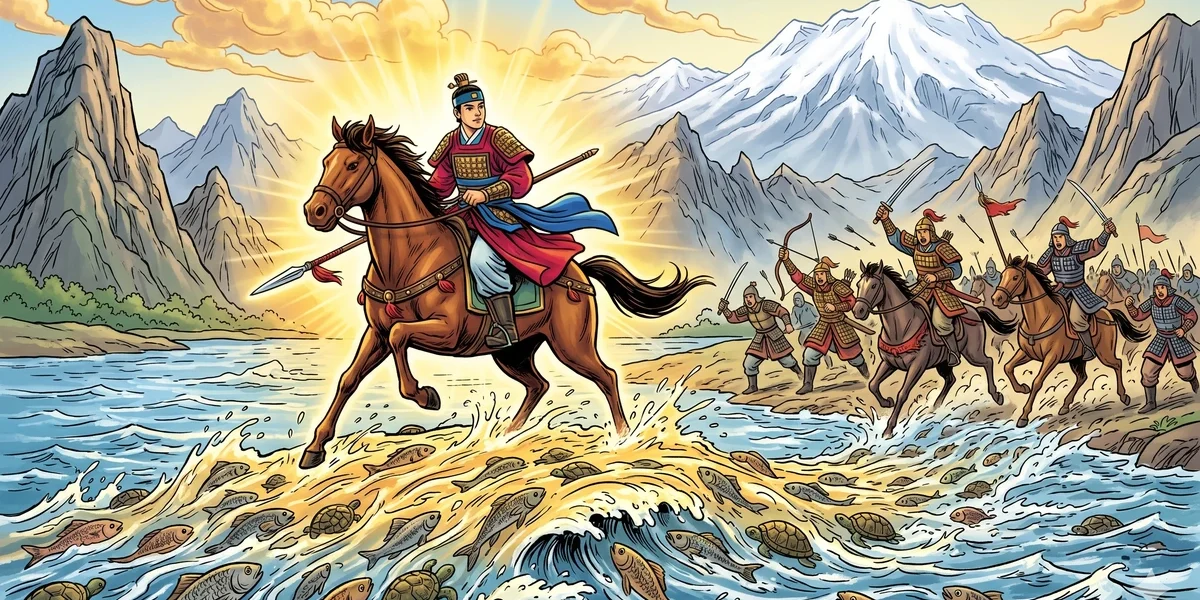
An old shaman — mudang (무당) — who has been watching his efforts tells him what he has not known: the bridge forms only at east light, on the morning of the seventh day of the seventh lunar month (the same astronomical occasion that forms the magpie bridge for Gyeonwu and Jiknyeo in the celestial register). At that precise moment, the fish of the river — not all fish, but the ancient ones, the ones whose own accumulated years have given them spiritual status — rise to the surface and form themselves into a bridge. The bridge lasts exactly as long as the east light lasts: long enough for a determined person to cross and complete their business and return, if they do not delay and do not look back.
The shaman’s instructions have the precise, conditional quality of Korean ritual directions: the right moment, the right orientation, the right inner state. East Light must stand at the river’s edge at the first appearance of eastern luminescence, before the sun itself has risen. He must step onto the first fish with his right foot. He must not speak during the crossing. He must not look downstream. On the far bank he will have until the sun’s disk fully clears the horizon — the duration of east light — before the bridge dissolves and he must cross back on whatever remains of it.
He follows the instructions. The bridge forms: fish upon fish, ancient and silver in the pre-dawn light, bodies flat and still as bridge-planks in a phenomenon that is clearly not natural and is not pretending to be. He crosses. He finds his mother in the form of a light at the far shore — not her body, which has been buried, but the specific quality of her presence, her characteristic luminescence, which he recognises immediately.
Beat III — The Liminal Moment and Korean Cosmological Architecture
The east light — dongnyeok (동녘) — holds a specific place in Korean shamanic cosmology that is more precise than the general association of dawn with new beginnings. In Korean ritual poetry (무가, muga, shaman songs), the east light is the moment at which the samshin (삼신, the three birth spirits) are most present and accessible; it is the time at which newly dead spirits are closest to the living world before they begin their journey into jeoseung; it is the threshold at which prayers addressed to the divine have the shortest distance to travel.
This cosmological specificity reflects a broader feature of Korean shamanic thought: its precise temporal mapping of the universe’s permeability. Not all times are equally accessible to communication between worlds; the universe has temporal architecture as well as spatial architecture, and certain moments are structurally different from others. The east light is one such moment; the seventh day of the seventh month is another (it is when the celestial river — the Milky Way — is at its most accessible for the star-crossed lovers’ crossing); the liminal periods of the four annual solstices and equinoxes are others.
The bridge of fishes adds a spatial dimension to the temporal one. Fish in Korean folk cosmology occupy a distinctive position: they live between two registers — the surface world visible to ordinary perception and the depths that ordinary perception cannot penetrate. They move freely between these registers in a way that birds move between earth and sky. The fish that form the bridge are the oldest, most spirit-saturated ones — they have accumulated enough yeongnyeok (영력, spiritual power) through long life to participate in the cosmological architecture of the threshold moment. They do not form the bridge by being compelled; they form it because the east light of the seventh-month seventh day is the moment at which this is what ancient fish do, in the Korean universe’s regular cosmological operation.
Beat IV — The Crossing and Its Completion
The encounter on the far shore is brief and precisely what it needed to be. East Light speaks the word that was not spoken at his mother’s death; he receives the answer she had been holding across the boundary between the worlds. The recognition is given and received. The quality of his mother’s light changes — releases something it had been holding — and then, as the sun’s disk clears the horizon and the east light ends, he crosses back. The fish bridge dissolves behind him, fish by fish, as the last of the light that sustained it disperses into ordinary daylight.
The story’s moral economy is precise: the crossing was not for reunion but for completion. East Light did not attempt to bring his mother back (which the tradition consistently marks as a transgression — the story of Orysa, the Korean Orpheus figure, demonstrates what happens to those who try). He went to complete what was incomplete: the unspoken word, the unanswered question, the withheld recognition. The brevity of the east light — just long enough — is calibrated to this: it permits completion but not extension, crossing but not permanent residence.
This calibration is one of the Korean shamanic tradition’s most consistent features in threshold narratives: the boundary between the living and the dead can be crossed for specific, legitimate purposes (completing han, delivering a message, receiving a recognition) but not for the purpose of reversing death or permanently extending what has been ended. The boundary is permeable by design — the universe provides the fish bridge and the east light — but the permeability is purposeful, not unlimited. Those who use it correctly find completion; those who try to exceed its terms find the bridge dissolving under their feet at midstream.
“The bridge of fishes forms at east light — ancient fish rising for a crossing that has always been possible at this moment, on this morning, for those who stand ready. The universe provides the architecture; you must provide the readiness.”
— Distilled from the Korean shamanic cosmological tradition
Why This Story Has Lasted
East Light and the Bridge of Fishes has persisted because it addresses one of the most universal human needs: the need to complete what was left incomplete at a death. The specific thing East Light needs to say to his mother — the word not spoken, the question unanswered, the recognition withheld — is a version of what almost everyone carries after the death of someone they loved. The Korean tradition’s answer is not merely therapeutic consolation but cosmological instruction: the universe provides, at specific moments in its temporal architecture, the means for such completion. The fish bridge is not wishful thinking; it is the universe operating as it is designed to operate. The human task is readiness — to know when the east light comes, to stand at the right place, and to be prepared to cross.
Frequently Asked Questions
What is the east light (dongnyeok) in Korean shamanic tradition?
The east light (동녘, dongnyeok) is the specific quality of luminescence that fills the eastern sky before the sun’s disk rises — the pre-dawn threshold between the night-world, when spirits move freely, and the day-world, when ordinary human life reasserts its opacity. In Korean shamanic cosmology, the east light is one of several temporally specific moments of maximum permeability between worlds: it is when the samshin (birth spirits) are most present, when recently dead spirits are closest to the living world, and when prayers have the shortest distance to travel to the divine. It is a moment of cosmological architecture, not merely atmospheric description.
What is the bridge of fishes and how does it form?
The bridge of fishes forms from the oldest, most spirit-saturated fish in the river — those who have accumulated sufficient yeongnyeok (영력, spiritual power) through long life to participate in cosmological architecture. They rise to the surface at east light on the seventh day of the seventh lunar month and form themselves into a bridge connecting the living shore to the shore where the recently dead dwell. The bridge lasts exactly as long as the east light: from the first eastern luminescence until the sun’s disk fully clears the horizon. Fish in Korean folk cosmology move between the visible surface world and the inaccessible depths, making them natural cosmological intermediaries between ordinary and extraordinary registers of existence.
Why is East Light able to cross the bridge when others cannot?
East Light was born at the threshold moment (the east light) and has developed a characteristic quality of attentiveness to what that threshold reveals. Beyond this native quality, his crossing depends on specific preparation: the shaman’s instructions (right foot first, no speaking, no looking downstream), the right moment (the seventh-month seventh-day east light), and the right purpose (completing what was left incomplete at his mother’s death, not reversing her death or extending the crossing beyond its permitted scope). The fish bridge is available to those who meet all these conditions — it is a cosmological structure provided by the universe’s regular operation, not a supernatural exception requiring extraordinary power.
What is the Korean shamanic concept of jeoseung (저승)?
Jeoseung (저승) is the Korean realm of the dead — not a fixed underworld in the Christian or Greek sense but a dynamic spiritual territory adjacent to the living world, accessible through specific temporal and spatial thresholds. In Korean shamanic cosmology, the recently dead spend time in proximity to the living world (the forty-nine-day liminal period) before moving further into jeoseung. Shamans can communicate with those in jeoseung through ritual (gut, 굿); specific cosmological moments (east light, the seventh-month seventh day) allow direct crossing under constrained conditions. Jeoseung’s boundaries are permeable by design — the universe provides the fish bridge — but the permeability is purposeful, permitting completion and communication but not reversal of death.
What is the significance of the seventh-month seventh-day in Korean tradition?
The seventh night of the seventh lunar month (칠석, Chilseok) is the date in Korean astronomical tradition when Gyeonwu (the Cowherd, Altair) and Jiknyeo (the Weaver Girl, Vega) are reunited across the Milky Way via the magpie or fish bridge — the Korean equivalent of the Chinese Qixi festival. It is also, in shamanic cosmological mapping, one of the moments of maximum boundary permeability between realms — the moment when the universe’s architecture most fully supports crossing. The fish bridge of East Light’s story forms on this date precisely because the seventh-month seventh-day is already the occasion when the universe provides bridge architecture between separated worlds, whether for celestial lovers or for living people with legitimate business on the far shore.
You May Also Like
 Korean Folk Tales
All Ages
Korean Folk Tales
All Ages
The Sky Bridge Of Birds
The Sky Bridge Of Birds: No bird is more common in Korea than the magpie. They are numbered by millions. Every day in the year, except the seventh day of the
 Korean Folk Tales
All Ages
Korean Folk Tales
All Ages
Cheung Puk-Chang, The Seer
Cheung Puk-Chang, The Seer: The Yol-ryok Keui-sul, one of Korea’s noted histories, says of Cheung Puk-chang that he was pure in purpose and without selfish
 Korean Folk Tales
Ages 9-12
Korean Folk Tales
Ages 9-12
The Geomancer
The Geomancer: [Yi Eui-sin was a specialist in Geomancy. His craft came into being evidently as a by-product of Taoism, but has had mixed in it elements of