The Story of the Dog in a Foreign Country
Read 'The Story of the Dog in a Foreign Country' — a classic Panchatantra story about friendship. of the Dog in a Foreign Country is part of the Panchat...

Origin & Canonical Placement
“The Story of the Dog in a Foreign Country” is a pithy fable of appetite, delusion, and the gap between the glamour of the unfamiliar and the reality of returning home. It belongs to the broader narrative tradition of the Panchatantra, attributed to Vishnu Sharma (c. 300 BCE–300 CE), and appears in related collections including the Hitopadesha. Thematically it belongs to Book V: Aparikshitakaraka (“Ill-considered Action”), which collects stories about the consequences of acting without reflection, surrendering to desire, and mistaking novelty for wisdom.
“Paradeshagato moho svadeshagamane nashyati.”
“The delusion gained in a foreign land dissolves upon return home.”
— Panchatantra maxim, Book V tradition
Beat I — Departure: The Grass Is Greener
A dog lived in a town where food had become increasingly scarce. Competition among the street dogs was fierce, and even an energetic and clever dog found himself going hungry more often than not. Word reached him — through the mysterious channels by which dogs exchange information — that in a distant city the streets were genuinely rich with food: wealthy households discarded extraordinary quantities of meat and grain, doorstep offerings were left by pious families at every hour, and the dogs there were sleek, well-fed, and lived without the grinding anxiety of constant competition.
The dog resolved to travel to this city of abundance. The journey was long and difficult — he crossed dry plains, forded rivers, and traversed forests — but he arrived at last and found that the reports had not exaggerated. Food was everywhere: scraps of roasted meat outside cook-shops, grain spilled from the wheels of merchant-carts, milk left in clay bowls at temple doorways. For the first weeks, the dog ate magnificently and thought he had found paradise. He grew fat. He slept long hours in the sun. He congratulated himself on the wisdom of his decision to leave.
Beat II — The Reality: A Stranger Among Dogs
The city’s paradise, it emerged, had terms and conditions that the reports had omitted. The city’s resident dogs were not merely well-fed — they were also numerous, territorial, and deeply organised. They had divided the city into precise zones of influence and patrolled their territories with systematic aggression toward outsiders. The newcomer dog, growing fat on “their” food, attracted mounting hostility. At first the attacks were exploratory — snapping warnings, chases of a few hundred yards. Then they became coordinated and serious. Packs of local dogs would converge on him simultaneously from multiple directions, blocking his access to food sources and driving him from the city’s richest districts.
The dog fought, retreated, and attempted diplomatic overtures (the canine equivalent: low-bodied approach, averted gaze, submissive gestures). Nothing worked. He was not of this place; he had no history here, no established relationships, no standing. The food remained abundant, but he could not access it without enduring constant, escalating violence from animals who had prior claim. He was, in every meaningful sense, a stranger — and no amount of hunger or intelligence could change that fundamental fact quickly enough to make his position tenable.
Beat III — The Analysis: The Hidden Costs of Migration
Vishnu Sharma uses this tale to make a sophisticated argument about the difference between resources and access to resources. The dog’s original assessment was technically accurate: the foreign city did have more food. What he failed to evaluate was the social infrastructure that determined who could benefit from that food. Abundant resources in a closed social system may be less accessible to a newcomer than scarce resources in an open, familiar one where the newcomer has established reputation, relationships, and standing.
The Panchatantra’s political reading of this insight concerns diplomatic and military adventurism. A state that invades or occupies a wealthy territory may find that the wealth it sought is controlled by social networks, local knowledge, and customary arrangements that entirely exclude outsiders. Kautilya’s Arthashastra is explicit on this point: a conqueror who fails to win the loyalty of the conquered population will find that the territory’s wealth continues to flow to local insiders while the occupying power bears all the costs of administration and none of the benefits it anticipated.
At the individual level, the story addresses a universal human experience: the seductive power of the unfamiliar and the underestimation of social capital. What one has built over years in a familiar environment — reputation, relationships, knowledge of local customs and power structures — is invisible precisely because it is so thoroughly integrated into daily life. It only becomes visible when one gives it up and attempts to start from zero in a new environment, where the absence of this social infrastructure makes every task harder, every negotiation more fraught, and every resource less accessible.
Beat IV — Moral Dimension & Enduring Relevance
The dog returns home. The journey back is as long and difficult as the journey out, and he arrives thinner than when he left — thinner even than the near-starvation that prompted his original departure. But the familiar pack, the familiar streets, the familiar hierarchy of access: these are worth more now than they were when he left them. He understands, experientially rather than theoretically, that his social capital was a real form of wealth that he had been accounting at zero because it was invisible.
The fable’s insight is not an argument against travel, ambition, or seeking better conditions. It is an argument for honest accounting. When evaluating the apparent advantages of a different situation, one must also evaluate what one would leave behind — including the intangible assets of established relationships, local knowledge, and social standing that are genuinely wealth-creating even when they cannot be monetised directly. The dog’s error was not that he wanted more food; it was that he counted only the food and not the social architecture through which food was distributed.
In contemporary terms, the story addresses anyone contemplating a major transition — a new city, a new employer, a new country — under the influence of compelling information about the destination’s advantages. The Panchatantra’s counsel is to investigate not just the resource abundance of the destination but the social infrastructure that determines who benefits from those resources, and to honestly value what one is giving up in making the move.
Moral: Abundance in a new place may be inaccessible without the social capital that only time and belonging can build; what we have is often invisible until we give it up.
Why This Story Has Lasted 2,000 Years
The dog’s story endures because it captures, in a single precise image, an experience that every culture in every era has lived through: the gap between the promise of the unfamiliar and the reality of arriving as an outsider. It travelled through the Panchatantra’s translation networks into Arabic, Persian, and European traditions where it resonated immediately with populations familiar with migration, trade, and the ambiguous outcomes of seeking fortune abroad. The tale is funny in the way that only truly wise fables can be — the dog’s pompous self-congratulation in the first weeks gives way to an increasingly undignified retreat, and the reader recognises both the comedy and the genuine pathos of a creature who wanted something real and simply failed to account for everything the wanting required. Vishnu Sharma’s genius was to teach this lesson without cruelty: the dog is not stupid, he is merely incomplete in his analysis, and the story invites recognition rather than condescension.
About the Panchatantra
The Panchatantra (“Five Treatises”) was composed in Sanskrit by the scholar Vishnu Sharma around 300 BCE–300 CE as a niti-shastra — a guide to wise conduct and statecraft — framed as animal fables for the instruction of young princes. Its five books cover the dissolution of allies, the winning of allies, war and peace, the dangers of naivety, and the hazards of rashness. The text spread westward through Pahlavi and Arabic translations to become the most widely translated secular book of the ancient world after the Bible.
You May Also Like
 Panchatantra Stories
Ages 9-12
Panchatantra Stories
Ages 9-12
Four Friends Hunter
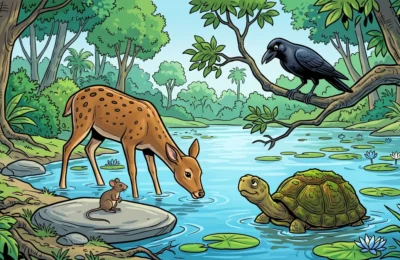
The framing tale of Book II of the Panchatantra — a mouse, a crow, a tortoise, and a deer combine their gifts to outwit a hunter. A two-thousand-year-old story about friendship across difference, complementary strengths, and the quiet machinery of survival.
 Panchatantra Stories
Ages 6-8
Panchatantra Stories
Ages 6-8
The Cunning Mediator
The Cunning Mediator: Beware of a rascal who pretends to be holy.” Two partridges (quail-like birds) lived in a certain tree in the jungle. While one of them
 Panchatantra Stories
Ages 9-12
Panchatantra Stories
Ages 9-12
The Crane and the Crab
The Crane and the Crab: When things go wrong, use your wit to overcome the situation.” A heron lived near a big lake, which was full of fishes and other water