A Story Weaver By Chance Meet Vani Balaraman Of Cuddles And Reads
A Story Weaver By Chance Meet Vani Balaraman Of Cuddles And Reads: Somethings happen by chance. For Vani Balaraman, it was storytelling. Founder of Cuddles and
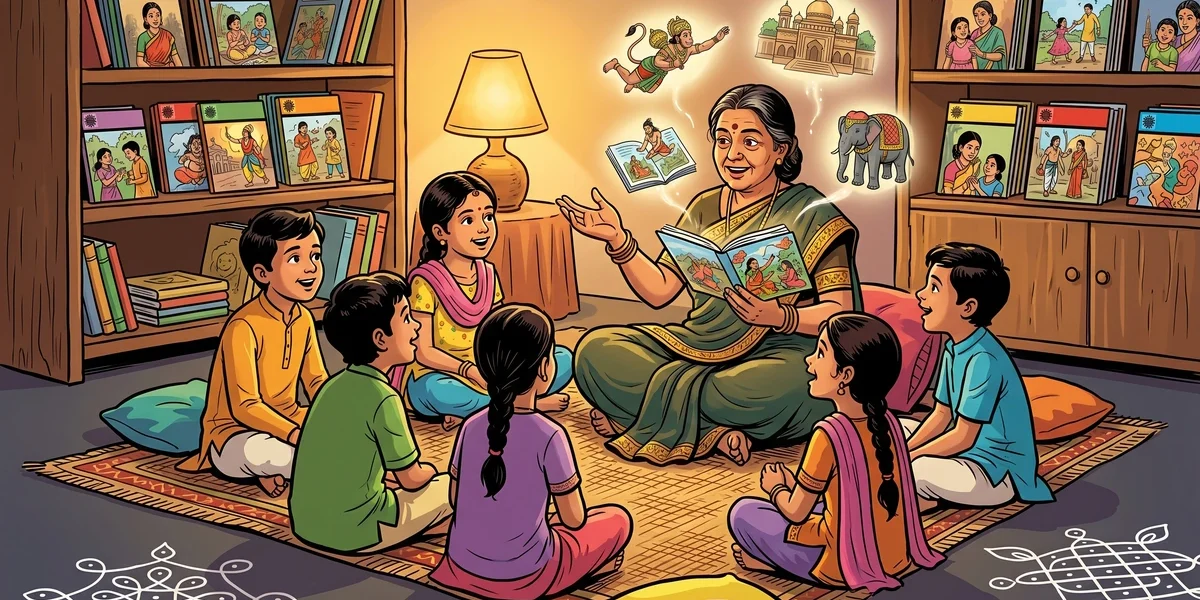
A Story Weaver by Chance: On the Accidental Vocation and the Power of Reading Aloud to Children
Not all paths to storytelling are planned. Vani Balaraman, founder of Cuddles and Reads, came to her vocation through the same route that many of the world’s most committed advocates for children’s literature have taken: necessity, love, and the discovery that reading aloud to a child is not a simple act of transmission but a complex, mutual, and irreversible experience. When a child asks to hear a story again, something has happened that cannot be undone; a relationship with narrative has been established that will shape how that child makes sense of the world for the rest of their life.
The encounter between a story weaver and a reader-of-children is not accidental in the deep sense — it has the quality of inevitability that characterises meetings between people whose concerns have been converging without their knowledge. Vani Balaraman’s work with Cuddles and Reads represents a strand of advocacy grounded in the insight that access to books and the practice of reading together is not a luxury for children who already have much, but a foundational equity concern for children who have little. The governing concept is prathamik pathya — the primary text — the idea that the first stories a child hears shape the cognitive and emotional templates through which all subsequent experience is organised.
“The child who has been read to knows something that the child who has not been read to does not know — not the content of specific stories, but that stories exist, and that they are for them.”
Beat I — The Accidental Beginning
Vani Balaraman did not set out to found a reading advocacy organisation. Like many such ventures, Cuddles and Reads began in the particular — a specific child, a specific stack of books, a specific discovery about what happened when the two came together. The “by chance” in the title of this encounter is not false modesty but an accurate description of how most genuine vocations begin: not with a strategic plan but with a moment of recognition, a discovery that one is already doing the thing one was going to do, and that it matters more than expected.
Beat II — Reading Aloud as a Practice of Presence
The core of Cuddles and Reads is a deceptively simple act: an adult reading aloud to a child. The research literature on early literacy is unambiguous about the benefits — vocabulary acquisition, phonological awareness, comprehension, attention span, emotional regulation. But the advocates for read-aloud practice, Vani Balaraman among them, point to something beyond the measurable: the quality of shared attention, the experience of both adult and child being inside the same story at the same time, the specific warmth of the cuddling that the organisation’s name makes central. Reading together is not just information transfer; it is a form of intimacy that builds the relationship between adult and child while simultaneously building the child’s relationship with narrative itself.
Beat III — Access and Equity in Children’s Literature
The organisations working in children’s literacy in India face a structural challenge: books in regional languages for young children are scarce; books that represent the range of India’s communities are scarcer still; books that find their way into the hands of children without access to bookshops or libraries are the scarcest of all. Cuddles and Reads addresses this challenge through a combination of resource sharing, community building among parents and caregivers, and advocacy for the systemic conditions — library networks, school reading programmes, publisher incentives — that would make the read-aloud experience available to every child rather than those already advantaged.
Organisation: Cuddles and Reads — dedicated to promoting read-aloud culture and early literacy in India
Themes: Prathamik pathya (the primary text), read-aloud as intimacy and learning, equity in access to children’s literature, the accidental vocation
Related tradition: The encounter between storytellers is itself an Aesopic motif — the transmission of narrative wisdom through unexpected meeting
Beat IV — Why Chance Encounters Between Story Weavers Matter
The Aesopic tradition was itself transmitted through encounter — teachers and students, travellers and inn-keepers, the slave Aesop and the people who recorded what he said. Stories survive because people who care about them find each other, often by accident, and pass on not just the stories but the conviction that the stories matter. The meeting between a story weaver and Vani Balaraman of Cuddles and Reads belongs to this tradition: two people who have independently arrived at the same understanding — that stories are essential, that children need them, that the work of getting them together is urgent — discovering each other and the conversation that their shared conviction makes possible. Such meetings are not accidents. They are the mechanism by which traditions are sustained.
Why This Story Matters
The story of how one person comes to dedicate themselves to children’s reading is worth telling because it is, in miniature, the story of how children’s literature itself has survived and flourished: through the accumulated devotion of people who found the work more important than they had expected, who built organisations and networks and reading groups and library programmes because the alternative — a childhood without stories — seemed to them an impoverishment too serious to accept. Vani Balaraman’s Cuddles and Reads is a node in a network of such devotions, and the chance encounter that produced this piece is one more moment in that ongoing transmission.
Frequently Asked Questions
What is Cuddles and Reads?
Cuddles and Reads is an Indian initiative focused on promoting read-aloud culture, early literacy, and access to children’s books. It works with parents, caregivers, educators, and communities to establish reading as a shared practice rather than a solitary or purely academic activity.
Why is reading aloud specifically valuable?
Research consistently shows that read-aloud experiences accelerate vocabulary development, comprehension, attention, and emotional literacy in ways that silent reading (especially in early childhood, before independent reading is established) cannot fully replicate. The adult voice, the physical proximity, the ability to pause and discuss — all contribute to a richer language experience than text alone provides.
What is the challenge of children’s literature access in India?
India’s linguistic diversity and the concentration of quality children’s publishing in English and a few major languages means that children in many regional language communities have limited access to books that reflect their own experience. Additionally, the infrastructure of public libraries and school reading programmes that makes books accessible in many countries is less developed in much of India, creating a significant equity gap.
What does “story weaver” mean in this context?
A story weaver is someone who works with the raw material of narrative — collecting, retelling, adapting, transmitting stories — in the way that a weaver works with thread. The term emphasises the craft and the making involved in storytelling, as distinct from mere reporting or recitation. Meeting another story weaver, whatever the occasion, is a recognition of shared vocation.
How can families start a read-aloud practice?
The simplest beginning is also the best: pick any book the child shows curiosity about, find a comfortable position that allows both of you to see the pages, and read it together. Regularity matters more than duration — ten minutes daily outperforms an hour weekly. Stopping to ask questions, following tangents the child raises, re-reading the same book many times — all of these are features of the practice rather than departures from it. The goal is shared attention and the pleasure of being inside a story together.
Frequently Asked Questions
**Q: Why is this story important?**
You May Also Like
 Aesop's Fables
Ages 3-5
Aesop's Fables
Ages 3-5
Good Luck To The Lucky One Or Shall I Fall Down
Good Luck To The Lucky One Or Shall I Fall Down: In a certain town there lived a wealthy Brâhmiṇ. He wished to build a house - pretty large and spacious - as
 Aesop's Fables
All Ages
Aesop's Fables
All Ages
The Boy Who Cried Wolf
The Boy Who Cried Wolf: Age Group: 0-5 years. Aesop’s fables are ideal for bedtime stories and moral stories to teach kids simple lessons. Once there was a boy
 Aesop's Fables
Ages 6-8
Aesop's Fables
Ages 6-8
Cinderella For Our Era
Cinderella For Our Era: Once upon a time, there were two sisters who lived with their mother. All three of them were cranky and selfish and cruel. It didn’t