The Willow-Wren And The Bear
The Willow-Wren And The Bear: Once in summer-time the bear and the wolf were walking in the forest, and the bear heard a bird singing so beautifully that he
Origin: Germany — Kinder- und Hausmärchen, Brothers Grimm, KHM 102 (“Der Zaunkönig und der Bär”), first published 1815 in the first edition of the second volume (Berlin: Realschulbuchhandlung) and retained without major revision through the seventh and final edition of 1857. Tale type: ATU 222 “War of Birds and Quadrupeds.” Oral source: “Aus Zwehrn” — the great Hessian informant Dorothea Viehmann (1755–1816) of Niederzwehren, near Cassel, who supplied roughly forty of the most polished tales in the Grimms’ collection. Translators: Edgar Taylor (London, 1826, in the second volume of German Popular Stories) and Margaret Hunt (London, 1884, Grimm’s Household Tales) — the prose used here follows Hunt. Read time: 10 minutes.
The Story Behind the Story: An Animal-War Older Than the Grimms
“The Willow-Wren and the Bear” is one of the oldest comic plots in European folklore. Within the Aarne–Thompson–Uther index of international tale types it is registered as ATU 222, “The War of Birds and Quadrupeds,” a category that catalogues stories in which the winged and the four-footed declare hostilities and the smallest creature on either side decides the outcome by stratagem. The Grimms collected their German version in Zwehrn, a small Hessian village outside Cassel, from Dorothea Viehmann — their most accurate and most rhythmic narrator — and they printed it in 1815 in the first edition of the second volume of the Kinder- und Hausmärchen, where it sat as number 102. Wilhelm Grimm later cross-referenced his transcript with a printed German variant by Johann Karl August Musäus and a manuscript version by the Göttingen scholar Karl Goedeke, but the bones of the tale — the bear’s careless insult, the wren’s declaration of war, the gnat hidden under the leaf, the cat’s tail signal turned upside-down by a sting under it — were already standing as Viehmann told them.
The tale is far older than 1815. Pliny the Elder, in book ten of his Naturalis Historia (c. 77 AD, chapters 73–74), already records the European folk-belief that the wren is the king of birds — regulus in Latin, “the little king” — on account of an ancient flying contest in which the smallest bird hid in the eagle’s plumage, rode aloft on the eagle’s wings, and slipped out at the highest moment to claim the throne. Aristotle had named the same bird basileus, “king,” in his Historia Animalium. The wren’s diminutive royalty crossed Europe with Latin learning: in German the bird remained Zaunkönig (“hedge-king” or “fence-king”), in Dutch winterkoning, in Welsh dryw (with the same root as derwydd, druid or sage), in French roitelet (“little king”). Jacob Grimm, in his Reinhart Fuchs (Berlin, 1834) and in his Deutsche Mythologie (1835), traced the wren’s kingship through German, Greek, Latin and Old Norse sources and concluded that it preserved a pre-Christian totem — a small migratory bird whose December song made it, for early Indo-European populations, a winter solstice emblem of survival.
The animal-war motif itself runs even further back. A late-Aesopic Greek fable preserved in the Augustana manuscripts (Perry 480) tells of a war between birds and beasts decided by a single bat who switches sides; the medieval Latin Reinhart-cycle preserves a German variant; and the Old French Roman de Renart branches several times into the same plot. The Brothers Grimm’s footnote to KHM 102, in their Anmerkungen volume of 1822, lists no fewer than eight European cousins: a Swiss version from Aargau, a Mecklenburg version from Mussaüs, a Tyrolean version, a Bohemian version, a Wallachian version, and three Westphalian variants. Johannes Bolte and Georg Polívka, in their five-volume scholarly redaction of the Grimms’ notes (Leipzig, 1913–1932), volume two, §102, expanded the list to more than thirty European and Caucasian parallels. Whatever village hearth the Grimms heard the story at, the audience already knew it.
The Bear’s Careless Insult and the Wrens’ Reply
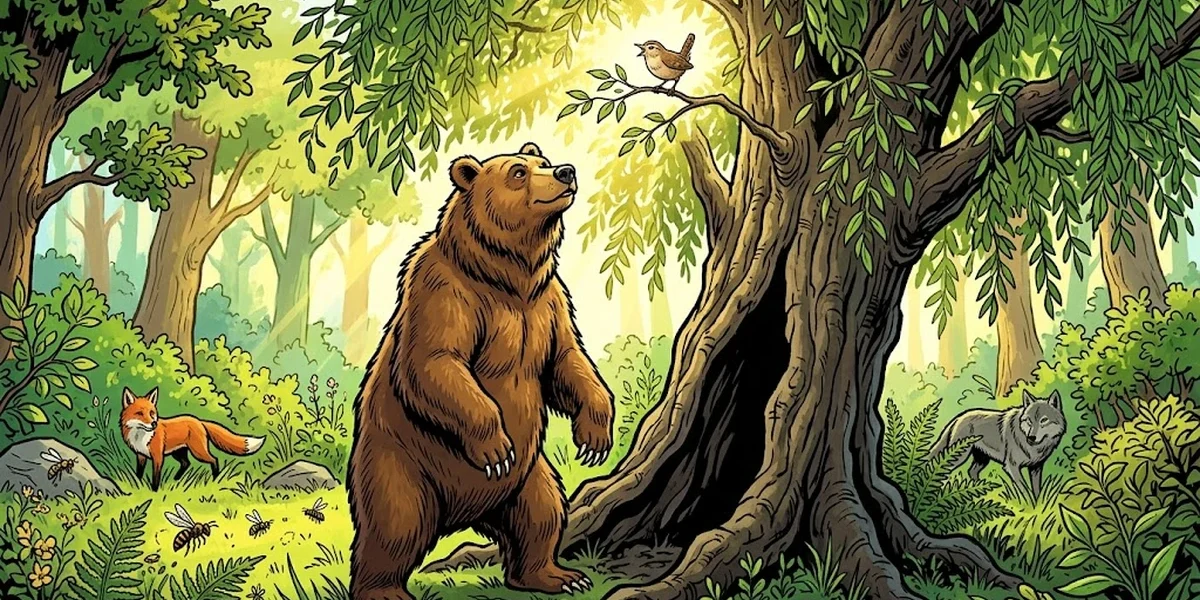
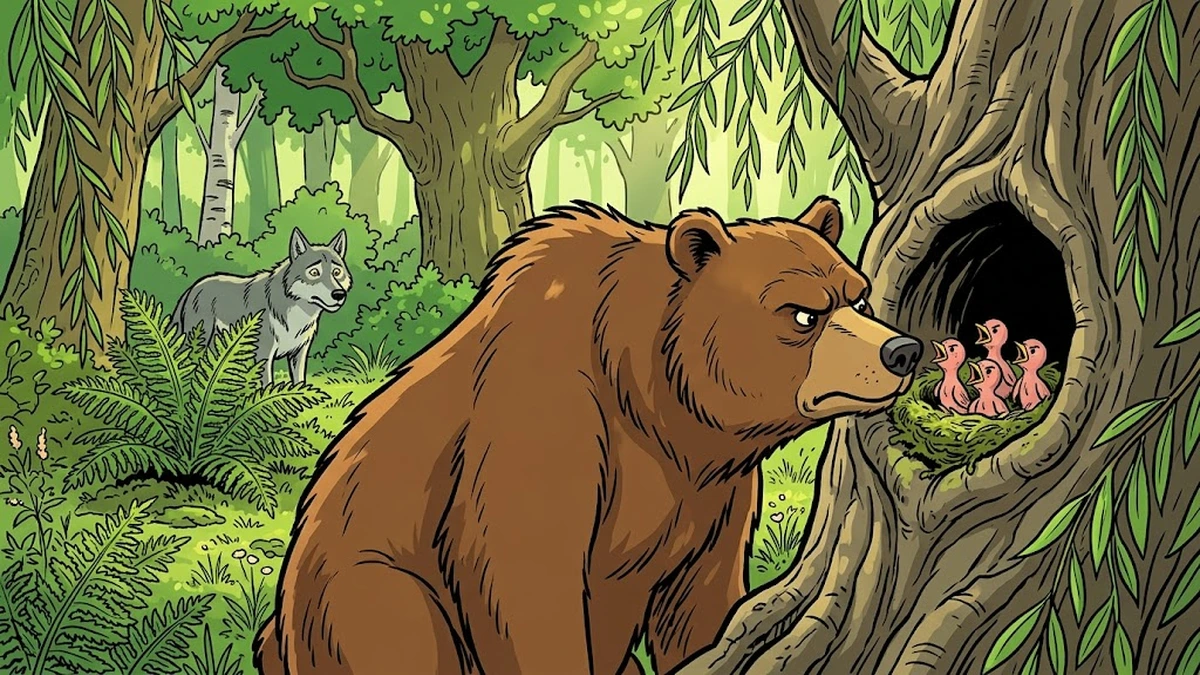
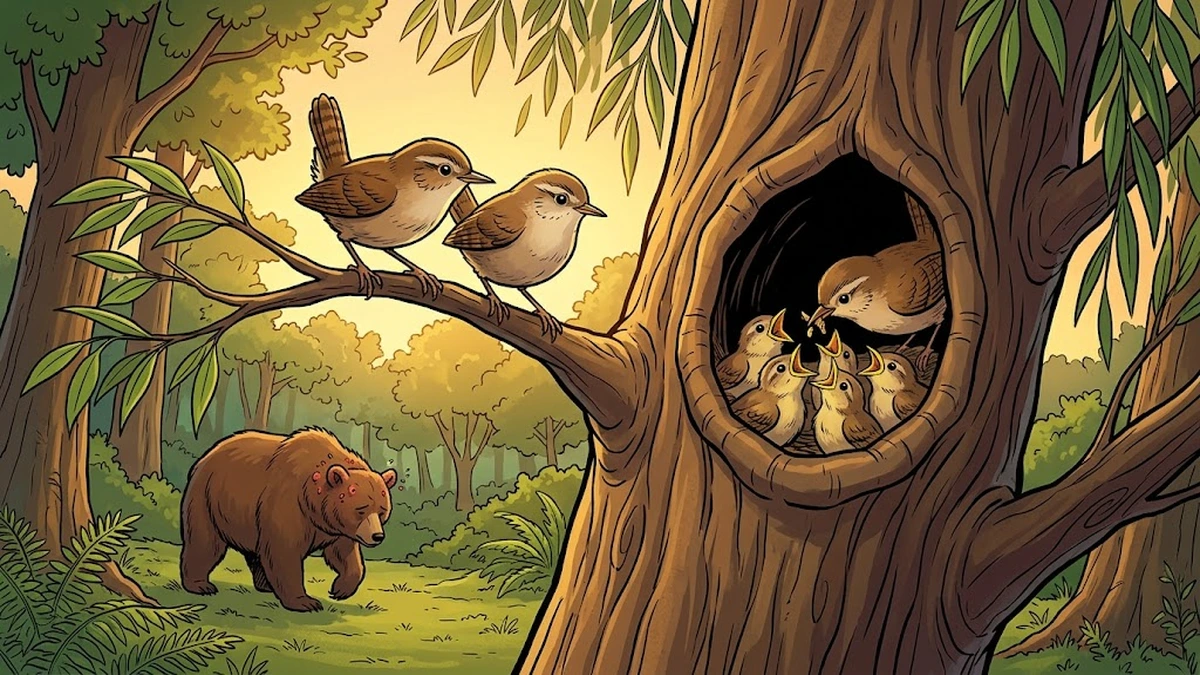
The tale opens in a German summer wood. A bear and a wolf are walking together through the trees, and from somewhere among the leaves comes a song so clear that the bear stops in his tracks and asks his companion what bird is making it. The wolf, who knows his forest, answers gravely: “That is the King of the birds, before whom we must bow down.” The singer is in fact the willow-wren — der Zaunkönig, the smallest bird of the German hedgerow, scarcely as long as a man’s thumb. The bear, who has never thought about it before, is suddenly seized with the desire to see the King’s palace. The wolf cautions him to wait: nothing can be inspected until both King and Queen are absent. The two animals creep closer, mark the hole in the willow tree where the wrens nest, and watch the parents come and go with food in their beaks. They trot off into the wood again. But the bear, like all bears in old German tales, has no patience for patience. He returns alone, the next moment the parents are gone, and pokes his great snout into the hollow.
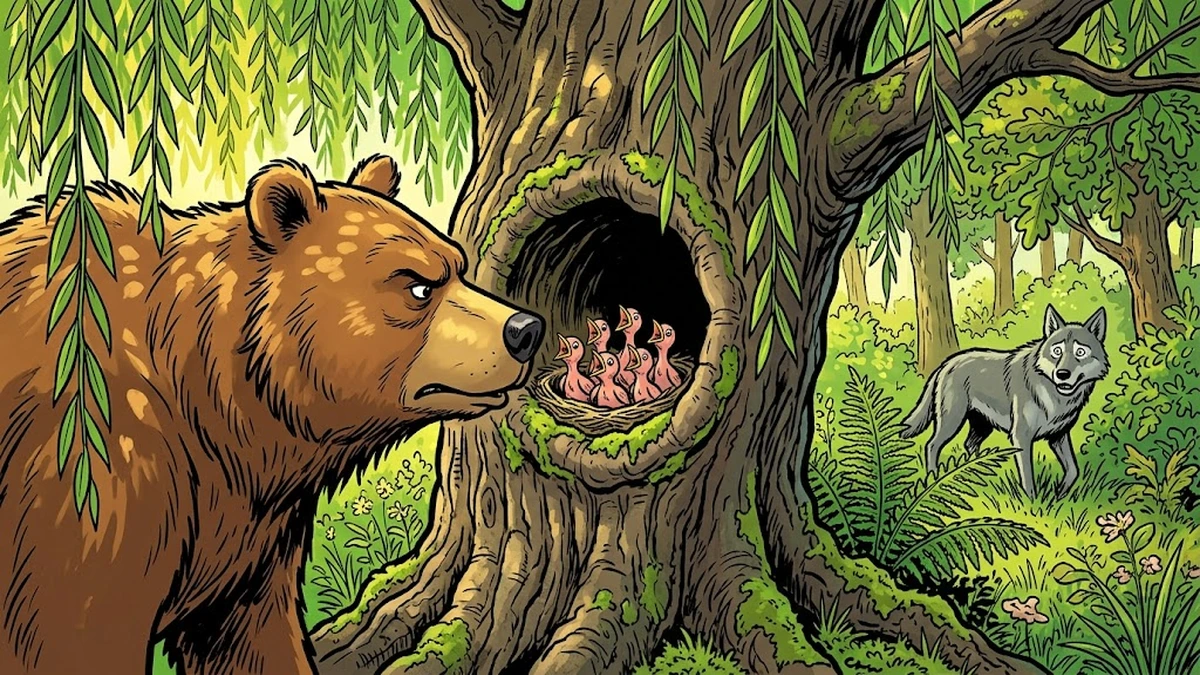
What he finds inside is unimpressive. Five or six naked nestlings lie blind and pink at the bottom of a moss-lined cup, indistinguishable from any other young birds in any other tree. The bear, who had imagined gilded halls, flies into a contempt the size of his appetite. “Is that the royal palace?” he booms. “It is a wretched palace, and you are not King’s children — you are disreputable children!” The word in Viehmann’s Hessian dialect is harder to render in English than the Grimms admit; it is closer to “low-born brats” than to anything more polite. He withdraws his snout and ambles off in self-satisfaction, as if a passing remark of his could leave the tree without consequence. He has misjudged the politics of small birds.
The nestlings are furious. When their parents return with insects in their beaks, the chicks refuse to swallow a single fly’s leg. “We will not eat,” they cry, “not though we were dying of hunger, until you have settled whether we are respectable children or not. The bear has been here, and has insulted us!” Their mother, who knows that the dignity of a household depends on its replies, lifts her head from the nest and answers as the queens of small kingdoms have always answered: “Be easy. He shall be punished.” Within the hour the King wren has flown to the mouth of the bear’s cave and shouted in: “Old Growler, why have you insulted my children? You shall suffer for it — we will punish you by a bloody war.” War is declared. From the willow tree the wrens summon every flying creature in the German air — not only the larger birds but the midges, hornets, bees, and ordinary biting flies. From the cave the bear summons every quadruped on the German earth — oxen, asses, cows, deer, foxes, every animal that walks. The forest fills with hooves and wings.
The Gnat Beneath the Leaf, and the Fox’s Tail
The willow-wren, who is a tactical king for all his small size, sends spies to learn which beast the four-footed army has chosen as its commander. The cleverest of these spies is a gnat, light enough to ride a breeze and small enough to vanish into a fold of bark. She flies into the part of the forest where the quadrupeds are mustering and slips beneath a leaf of the very tree where the war-council is being held. There stands the bear, in the centre of a ring of larger animals, calling the fox forward. “Fox,” the bear says, “you are the most cunning of all the animals; you shall be our general and lead us in the field.” The fox bows his red shoulders. “Good,” he answers, “but what signal shall we agree upon?” No one has thought of this; the four-footed army has not fought a battle in a hundred summers. The fox lifts his tail. “I have a fine long bushy tail, almost like a plume of red feathers. When I lift it high in the air, you will know the fight is going well, and you must press forward. When I let it drop, you will know we are losing, and every man must run for his life.” The animals murmur their approval. The gnat, hidden under the leaf, turns slowly in her hiding-place to make sure she has it all by heart, and flies back to the willow tree at full speed.
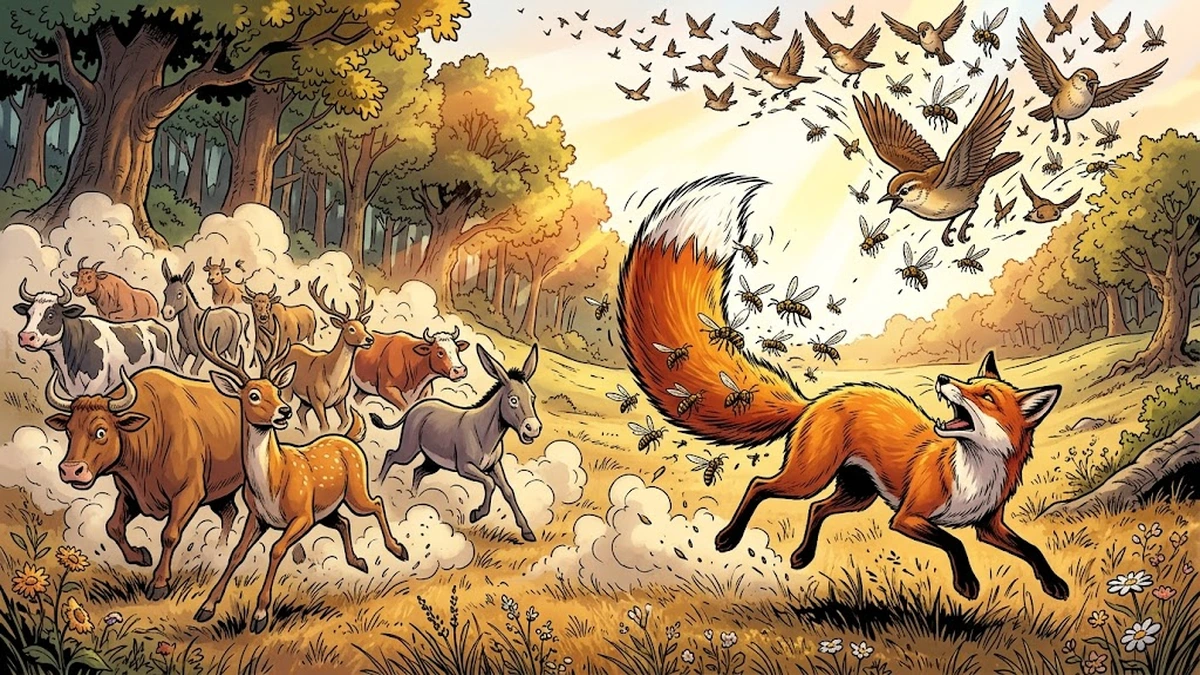
The day of battle dawns. The four-footed army comes thundering through the trees with the bear in the centre and the fox at the right, his tail held high as a banner of red flame. Behind them the dust rises in clouds. From the air comes the willow-wren’s army, a moving shadow of feather and wing, with the smaller birds out front and the stinging insects behind. The wren, however, has done his planning. He has sent the hornet, the wasp, and a small detachment of biting flies to the fox’s tail with one quiet instruction: get under the white tip and sting. The hornet leads the way. As the two armies meet, the four-footed creatures look up to their general’s signal. The fox’s tail still flames red above the front rank. The animals press forward, hooves drumming, antlers lowered. Then, abruptly, the tail twitches; it droops half a foot; it droops a foot more; it sinks until its tip drags on the ground. The fox, stung again and again under his beautiful brush, cannot hold it up to save his life. He squirms; he yelps; he whips his hindquarters from side to side; he runs in circles trying to bite the place that hurts him most. To the watching army it looks as though their commander has lost heart. The signal has fallen. The retreat has begun.
The Rout and the Bear’s Apology
The four-footed army has practised one signal and one alone. When the tail drops, every man runs for his life. The deer wheel and crash through the undergrowth. The oxen turn so violently that they trip the cows behind them. The asses bolt. The bear, in the centre, looks left and right and sees nothing but tails and rumps disappearing into the trees, and is carried off by his own panicked army before he can shout an order. The hornets, the wasps and the flies follow them all the way home. The forest, which had been thick with hooves a moment before, is empty by mid-afternoon, except for the laughter of the small birds and the soft whirr of insect wings. The willow-wren and his army have not lost a single soldier.
The willow-wren, like a true king of a small kingdom, does not press the victory beyond what is needed. He flies straight to the bear’s cave. The bear, exhausted, ashamed, and thoroughly stung about the ears, is sitting at the mouth of his hole, lapping at his bruises and scratches. The wren alights on a rock above him and asks him whether he is now ready to apologize. The bear, who has just spent an afternoon learning that ten thousand bees and one good gnat are heavier than ten thousand quadrupeds, lifts his great head and says, in Hunt’s translation, “that he indeed and most humbly begged pardon, for he had spoken thoughtless words and had insulted the King’s children.” The willow-wren accepts the apology as gracefully as a king should. He flies back to the willow tree; he lights on the rim of the nest; and he tells the nestlings that the bear has paid for his words. “Now then, eat your supper,” he says, in the line that Viehmann gave the Grimms in Hessian and which Hunt translated into the kitchen-table English of Victorian London. The nestlings open their beaks. The willow-wren and his Queen sit on the branch and watch them feed. The story is over.
The Moral the Grimms Set Down
“Da bekommt der Hochmuth seinen Lohn: das kleinste Volk weiß, wenn es klug ist, das größte zu schlagen.“
(“Thus does pride receive its wages: the smallest folk, if they are clever, know how to beat the largest.”) — concluding line, KHM 102, in the spirit of Dorothea Viehmann’s oral close, as paraphrased by the Grimms in their Anmerkungen of 1822.
The Grimms’ moral here is not in the body of the printed tale but in the marginalia. They were collectors first and editors second, and they were uneasy about pasting morals onto stories that already contained them in their gestures. The moral of “Der Zaunkönig und der Bär” is in the way the bear is brought low: not by another bear, not by a stronger animal, but by a gnat under a leaf and a hornet under a tail. The story’s quiet point is that bigness is not a defence. The bear, who is so confident of his strength that he insults a king he has never bothered to look at properly, ends the day with welts on his ears, while the willow-wren, who is the size of a man’s thumb, finishes his supper in peace. The moral of the German tale is the moral of all ATU 222 tales the world over: the small, when they are organized and clever, can outfight the large, and the large, when they are careless about their tongues, are easier to beat than they imagine.
There is a second moral, gentler and harder to see. The willow-wren goes to war for the dignity of his children. The story is, on its surface, an animal-fable; underneath, it is a story about how a parent answers an insult to a child. The bear’s offence was not against the wren’s army or the wren’s territory. It was against five or six naked nestlings whom no one but their parents could possibly have defended. The wren’s response is exact: he summons every fly in the air, he routs an entire forest, and he requires a single sentence of apology before he allows his children to eat their supper. The dignity of small households, the German story is saying, is worth a war. That is a moral Viehmann understood from the inside — she was the widow of a tailor, and she was raising her grandchildren in a small house in Niederzwehren when the Grimms came calling with their notebooks.
Why “The Willow-Wren and the Bear” Has Lasted
Two hundred and ten years after Dorothea Viehmann told it to the Grimms in her kitchen at Niederzwehren, “Der Zaunkönig und der Bär” is still in print in roughly forty languages. It survives as a children’s story, as a school-reader, as the libretto of a 1929 chamber opera by Hans Steinkopf, as an episode in animated television series in Germany (Sim-Sala-Grimm), Czechia and Slovakia, and as a favourite of cartoon illustrators from Walter Crane (Household Stories, 1882) to Wanda Gág (Tales from Grimm, 1936) to the modern German illustrator Anastassija Archipowa. It is one of the few KHM tales that the German educational ministry includes by name in early-primary syllabi for ecology and natural history, because its biology is mostly correct: the wren (Troglodytes troglodytes) is the Latin regulus, it does build domed nests in willow holes, and it does shriek loud enough at perceived threats to warn every bird in the wood.
The tale’s psychological gravity has attracted adult readers as well. In The Uses of Enchantment (1976), Bruno Bettelheim noted that ATU 222 narratives give children essential reassurance about their own size: in a world where adults are large and loud and sometimes careless, children need stories in which the smallest creature in the field can humiliate a bear by clever planning and the cooperation of friends. The Swiss analyst Marie-Louise von Franz, lecturing on Grimm tales in her Zurich seminars (collected in The Interpretation of Fairy Tales, 1970), used “Der Zaunkönig und der Bär” as her standard example of the puer-aeternus-versus-senex dynamic in folk literature: the bear stands in for the heavy, opinionated, stuck adult; the wren stands in for the alert, light-footed, allied young consciousness. Jack Zipes, in his standard English critical edition of the Grimms (The Original Folk and Fairy Tales of the Brothers Grimm, Princeton, 2014), translates the moral as a workers’ rights gloss: the small folk, if they organize, can defeat the large folk who own the cave.
The story is also a bird-watcher’s gift. Across northern Europe, the wren’s December song was once thought to call back the sun at the winter solstice, and the bird is still hunted symbolically in the “Wren Day” processions of rural Ireland (Lá an Dreoilín, December 26th), Wales, the Isle of Man and parts of southern France. The Grimms knew none of this in detail when they collected the tale — that comparative folklore was assembled later by James Frazer, by Edward Anwyl, and by the German ornithologist Bernhard Hoffmann — but every line of “Der Zaunkönig und der Bär” assumes a listener who has heard a wren sing in a hedgerow and has wondered why so small a bird makes so loud a noise. The German answer, after Pliny and the Aesopic fabulists and Dorothea Viehmann, is that the wren makes that much noise because he is, in some old sense that civilization no longer remembers, a king. The tale lasts because every reader who has ever felt small in a large room understands at once.
What has kept “Der Zaunkönig und der Bär” alive in nurseries and classrooms, finally, is the simplicity of the engineering. There is no magic in the story; there are no curses, no sleeping princesses, no rings, no swords. There is only careless speech, an injured family, a gnat under a leaf, and a tail that drops at the wrong moment. The mechanics are the mechanics of village life, raised one notch toward the comic and one notch toward the moral. That is why every generation of German children, and every generation of English-speaking children since Edgar Taylor brought the tale to London in 1826, has heard “The Willow-Wren and the Bear” and remembered it — not for its magic, of which there is none, but for the picture of a great bear ambling away with his ears full of stings, while a willow-wren sits on a branch and watches his supper get eaten in peace.
You May Also Like
 Grimm's Fairy Tales
Ages 9-12
Grimm's Fairy Tales
Ages 9-12
Ashputtel
Ashputtel: The wife of a rich man fell sick; and when she felt that her end drew nigh, she called her only daughter to her bed-side, and said, ‘Always be a
 Grimm's Fairy Tales
Ages 9-12
Grimm's Fairy Tales
Ages 9-12
Rapunzel
Rapunzel: There were once a man and a woman who had long in vain wished for a child. At length the woman hoped that God was about to grant her desire.
 Grimm's Fairy Tales
Ages 9-12
Grimm's Fairy Tales
Ages 9-12
Jorinda And Jorindel
Jorinda And Jorindel: There was once an old castle, that stood in the middle of a deep gloomy wood, and in the castle lived an old fairy. Now this fairy could