The White Snake
The White Snake: A long time ago there lived a king who was famed for his wisdom through all the land. Nothing was hidden from him, and it seemed as if news of
Origin: Germany — Kinder- und Hausmärchen, Brothers Grimm, KHM 17 (“Die weiße Schlange”), first published in volume 1 (Berlin: Realschulbuchhandlung, 1812) and revised through the seventh and final edition of 1857. Tale type: ATU 673 “The White Serpent’s Flesh,” with an embedded ATU 554 “The Grateful Animals” episode. Oral source: the Hassenpflug family of Kassel — a Huguenot-descended Hessian household whose daughters, Marie and Amalie Hassenpflug, supplied the Grimms with several of their earliest tales between 1810 and 1812. Translators: Edgar Taylor (London, 1823, German Popular Stories) and Margaret Hunt (London, 1884, Grimm’s Household Tales), revised by James Stern in 1944. Read time: 11 minutes.
The Story Behind the Story: The Snake-Eater and the Speech of Beasts
“The White Snake” is one of the quietest and oldest tales the Grimms ever wrote down. It is short by their standards — about a thousand words in the 1812 first edition — but it sits on top of a motif that runs back through more than three thousand years of myth: the eater of the wise serpent who, by tasting the snake’s flesh, suddenly hears what the animals are saying. The Hassenpflug daughters of Kassel told it to Wilhelm Grimm sometime in the autumn of 1811 in their parlour off the Marstall, and he copied it into his manuscript almost without alteration. By the time he and Jacob revised the seventh edition in 1857 the tale had grown only by a few descriptive sentences; its bones were already perfect.
Within the Aarne–Thompson–Uther index, the international catalogue of folk tales established by Antti Aarne (1910), expanded by Stith Thompson (1928, 1961) and Hans-Jörg Uther (2004), this story bears the type number ATU 673, “The White Serpent’s Flesh.” Its cardinal feature — the hero who eats a piece of a magical snake and gains the language of birds and beasts — is one of the most widely diffused motifs in Eurasian folklore, recorded in Iceland, Ireland, Scotland, Brittany, Basque country, Scandinavia, the Baltic states, Russia, the Caucasus, Persia, India and as far east as Mongolia. Embedded within KHM 17 is a second tale-type, ATU 554, “The Grateful Animals,” in which the hero spares three creatures — usually a fish, an ant-king, and a flock of ravens — and is later helped by them to perform impossible bridal tasks. Bolte and Polívka, in their Anmerkungen zu den Kinder- und Hausmärchen (Leipzig, 1913–1932, vol. 1, §17), list more than seventy European cousins.
The motif of the snake-tasted tongue is breathtakingly old. The Norse Völsunga saga (c. 1270, drawing on the older Poetic Edda) tells how the hero Sigurd, after slaying the dragon Fafnir, accidentally tastes the dragon’s heart-blood while roasting it on a spit and at once understands the speech of two nuthatches in a nearby tree, who warn him of his foster-father’s treachery. The Greek seer Melampus, in Apollodorus’s Bibliotheca (book 1.9.11), is licked on the ears by snakes he has spared and so receives the gift of bird-speech. The Hebrew Talmud tells the same story of King Solomon and the Queen of Sheba’s ant. The Arabic Alf Laylah wa-Laylah tells it of the woodcutter who eats the fish that fell from the marvellous net. KHM 17, the Hessian peasant version, strips the motif down to its essence: a man, a covered dish, a moment of curiosity, and a world that suddenly speaks.
The King’s Secret Dish and the Servant’s Curiosity
The tale opens in a country whose king is famed throughout the kingdom for his uncanny wisdom. Nothing remains hidden from him: a man’s secret thought, a quarrel between cousins three valleys away, the loss of a coin in a peasant’s barn — all reach him as if borne on the wind. But the king has a strange habit. Every day, after the great dinner has been cleared from the long table and the hall is empty of courtiers, a single trusted servant brings him one more covered dish, sets it before him, and withdraws. The servant has been doing this for years, and not even he has ever seen what is inside; the king never lifts the cover until he is alone, and the servant has always been too loyal, or too frightened, to look.
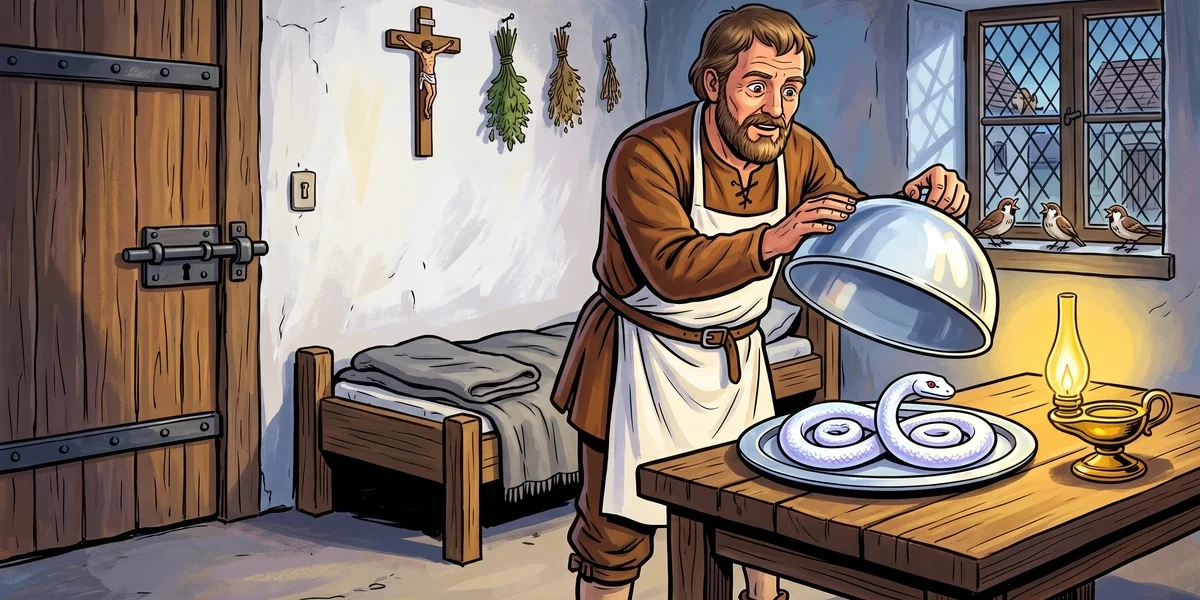
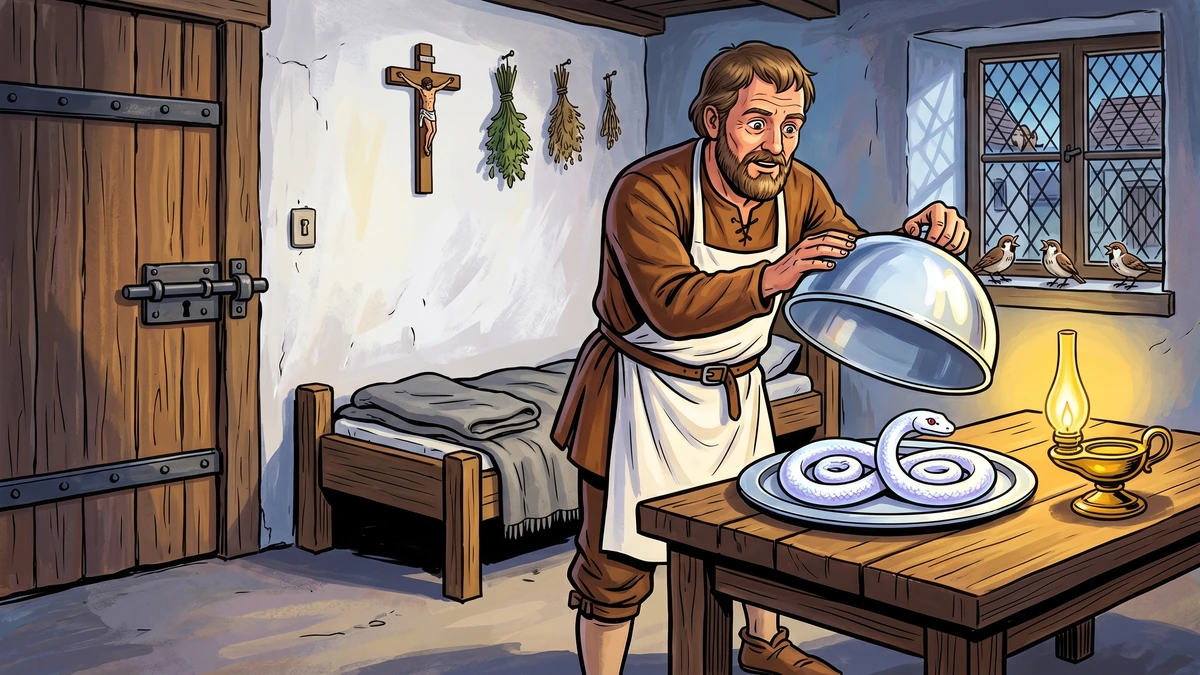
One afternoon curiosity wins. The servant carries the dish out of the hall as usual, but instead of returning it untasted to the kitchen he carries it to his own small room above the stables and locks the door behind him. He lifts the cover. On the dish, gleaming faintly in the lamplight, lies a single white snake, coiled and dressed for eating. He stares at it for a long moment. He knows perfectly well that he should put the lid back on and return the dish, that this is a thing he has no right to look at, let alone taste. But the longer he looks, the more the snake seems to glow with a strange persuasion, and at last he draws his knife, cuts off the smallest possible sliver, and lays it on his tongue.
The instant the white flesh touches his tongue the room changes. From the courtyard outside his window, the chattering of sparrows resolves itself into actual sentences. He hears one starling tell another about a hawk on the eastern roof; he hears a swallow under the eaves complaining about the noise of the cooper’s hammer; he hears a fly explain to a spider that it would prefer not to be eaten today, thank you very much. He sets down the cover, very carefully, and sits on his stool, and listens to the world for the first time in his life. The Grimms do not need to tell us he has been changed; the change has already happened. The world has acquired a million new mouths, and the servant alone in the kingdom can now hear them all.
The Lost Ring and the Three Grateful Animals
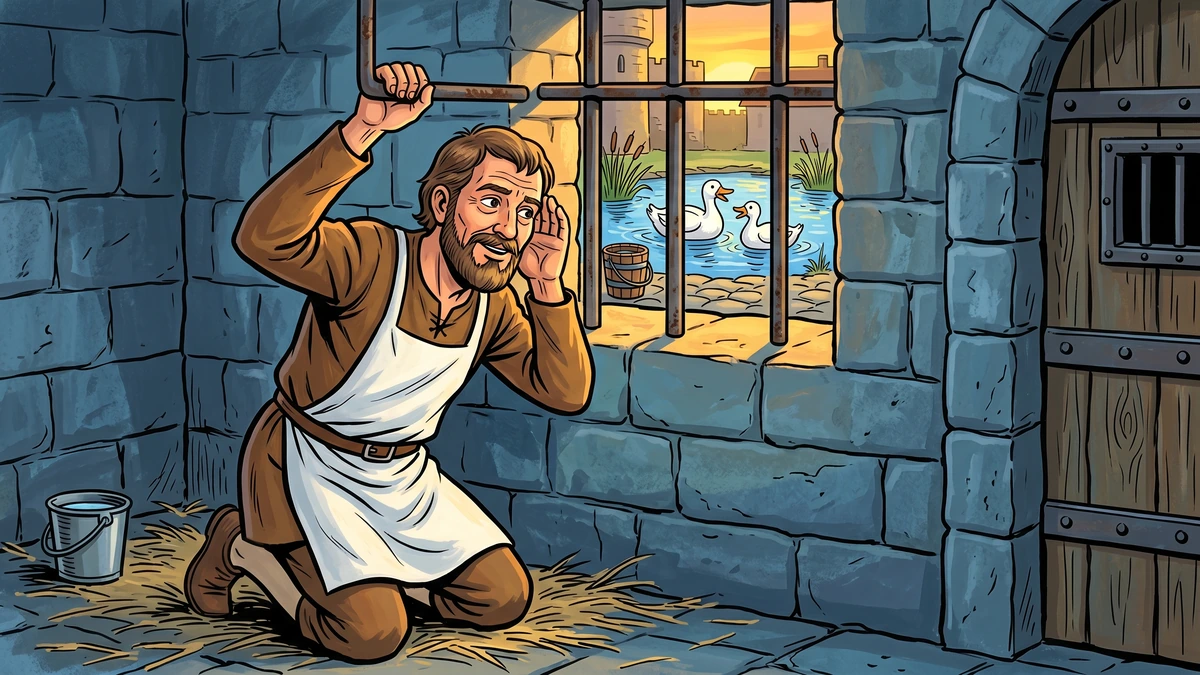
That same evening the queen loses her favourite ring, a thin band of gold set with a single emerald. The whole household is searched; suspicion settles on the servant who waits at table, for he was last in her chambers. Tomorrow at dawn, says the steward, he will be hanged from the gibbet on the green outside the city gate, unless he can name the thief. The servant is locked in a cellar to await execution, and through the small barred window he hears two ducks on the kitchen pond gossiping about the day. “What heavy thing have you eaten today?” asks one. “Oh,” replies the other, with the long sigh of a duck whose stomach disagrees with her, “a queer little metal thing fell into the grass when I went looking for snails this morning, and I swallowed it whole, and now it lies here heavy as a stone.” The servant, listening through his bars, smiles for the first time since the dish was opened.
He is brought before the king and offers a wager: let the kitchen-master kill the second duck on the pond and open her crop. The king, amused at the audacity, agrees. The duck is killed; the green-set ring rolls out of her crop into a copper basin; the queen weeps with joy and apology; the servant is freed and offered any reward. He asks only for a horse, a saddlebag of provisions, and leave to ride out and see the world; for now that he can hear all that the animals say, the world has become too interesting to stay indoors. The king, generous in his shame, grants it at once.
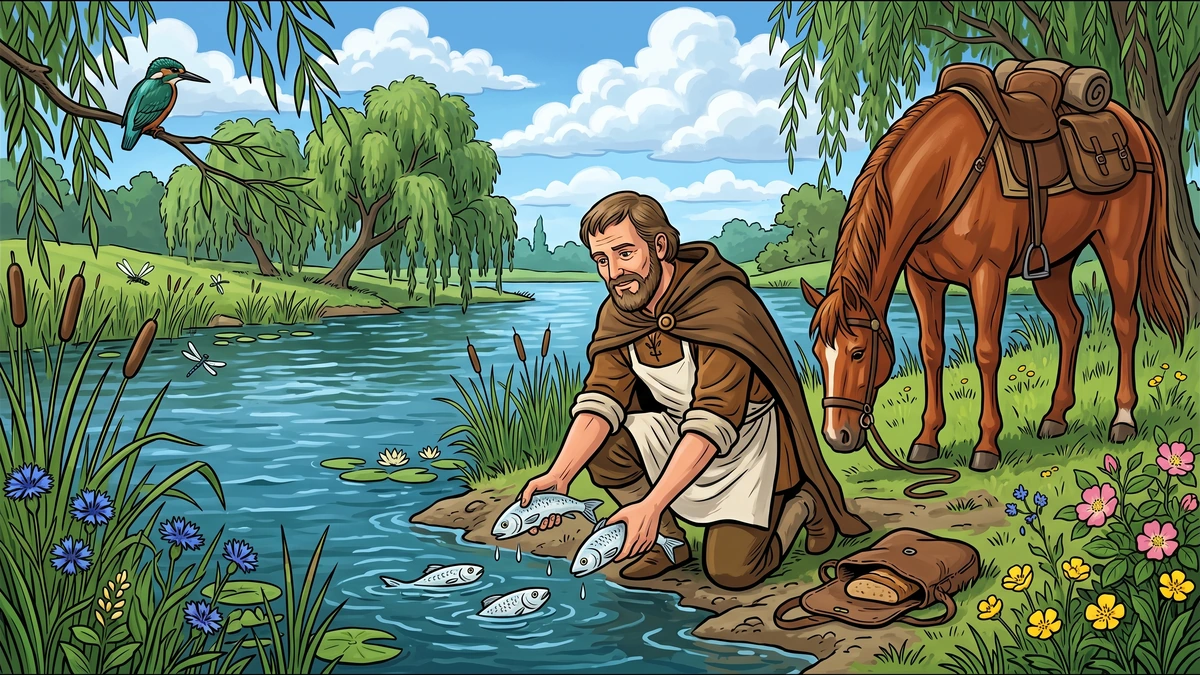
And so he rides. On the first day of his journey he comes to the bank of a river where three small fish are flapping desperately in the reeds, beached by a careless wave. “Help us, friend, help us,” they pant in their thin fish-voices, “or we shall die here in the air.” He swings down from his saddle, picks them up gently, and drops them back into the cool current; they thank him by name and slip away into the deep water. On the second day he rides through a meadow alive with ant-hills, and his horse is about to set its hoof on a great citadel of red ants when the ant-king, half a thumbnail high, climbs onto a flower and shouts up at the rider in a voice the size of a needle, “Have a care, kind sir, and spare us!” The servant turns his horse aside. The ant-king bows. On the third day he comes upon three young ravens standing weak and starving on the edge of a forest path, abandoned by their parents because the nest is too crowded. He has no bread; but he draws his knife and kills his own horse and lays it open as food for them, and walks on his own feet, carrying his saddle, into the next village.
The Bridal Quest and the Three Impossible Tasks
In the next kingdom he hears that a great princess of unmatched beauty has declared she will marry only the man who can perform three impossible tasks; and any suitor who tries and fails will be put to death. Many princes and adventurers have already left their heads on the city wall. The servant, who is no prince and has no name worth speaking, walks calmly into the palace and offers himself anyway. The princess looks at him in mild astonishment — he is travel-stained, weaponless, and on foot — but the law is the law: she sets him his first task.
She takes a gold ring from her finger, walks with him to the cliff at the edge of the sea, and throws the ring into the deep blue water. “Bring it back to me,” she says, “or die at sundown.” He stands at the edge of the cliff and looks out across the waves, and for a moment his heart fails him; he has no boat, no diving-bell, no way to reach the bottom. Then a small voice rises out of the foam below, and he sees a fish — one of the three he saved — with the gold ring balanced on its back, swimming up to the surface and laying the ring at his feet. He carries it to the princess, who turns very pale.
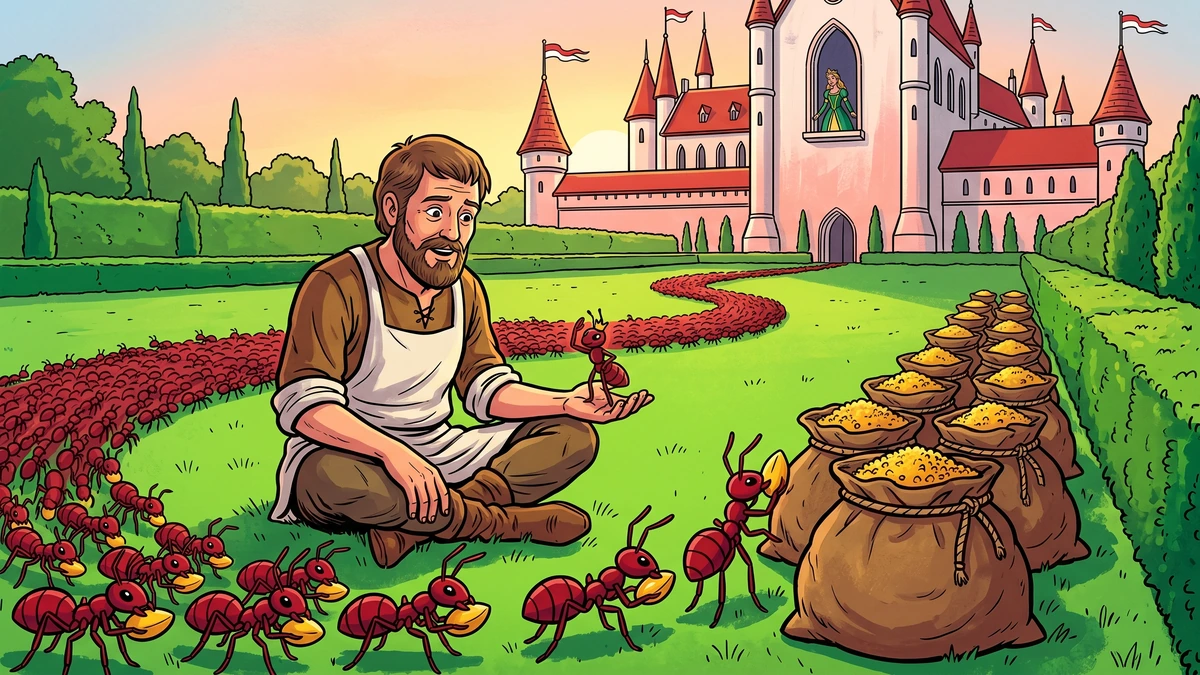
For the second task she has her servants empty ten great sacks of millet seed onto the lawn of the palace and mix the seed thoroughly with the grass and the earth. “Pick up every grain by sunset,” she tells him, “and let no single seed remain on the ground.” He sits down on the grass in despair; ten sacks of millet would take a hundred men a hundred days. But almost at once the earth begins to ripple, and out of every ant-hill in the meadow comes an army of red ants, the ant-king at their head; they swarm the lawn, each ant carrying one tiny seed in its jaws, and before the sun has set they have heaped every grain back into the ten sacks and tied the sacks shut with their own threads of grass. The princess watches from her window, biting her lip.
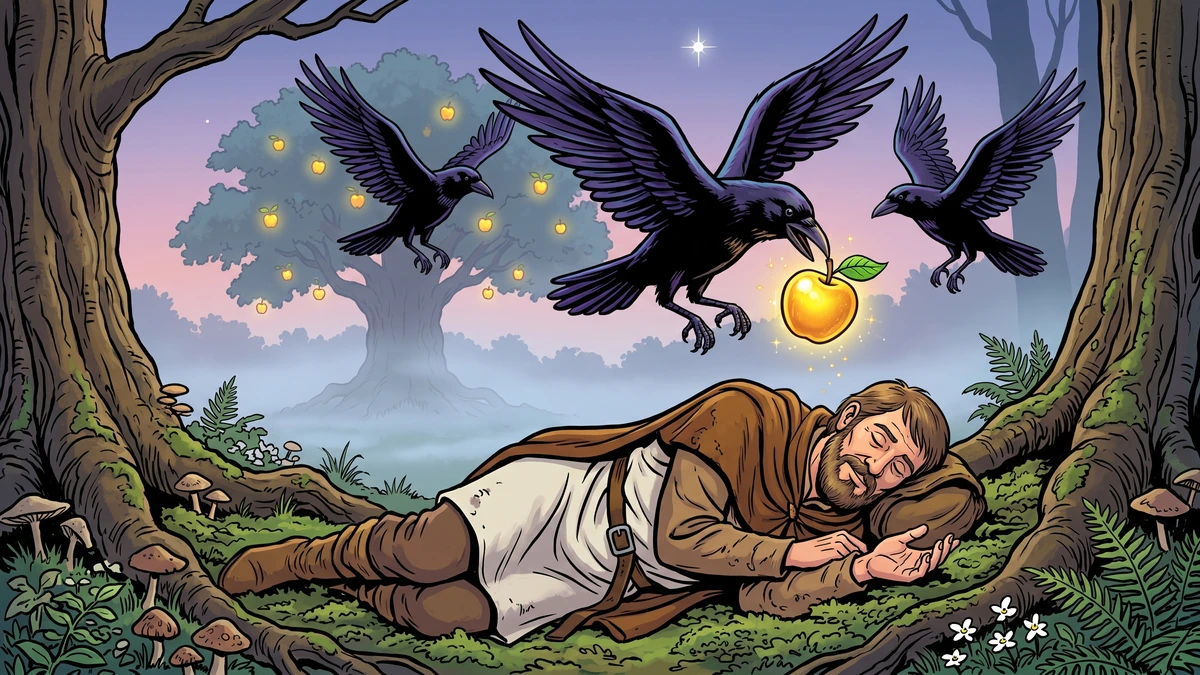
For the third task — she sets the hardest one she can imagine — she demands that he bring her an apple from the Tree of Life, which grows at the edge of the world and which no mortal has ever found. He sets out without map or compass; he wanders for a year and a day through forests and over mountains; and on the very last evening, footsore and despairing, he lies down under a strange tree and falls asleep. While he sleeps, three young ravens — the same three he once fed with his horse’s flesh — fly across the entire world to the garden where the Tree of Life still grows, pluck a single golden apple from its highest branch, and lay it gently in his open hand as he sleeps. He wakes at dawn with the apple cool against his palm; and he rides home and lays it before the princess, who at last takes it, cuts it in two, and shares it with him.
The Apple of Life and the Marriage of Equals
The marriage is celebrated at midsummer in the great hall of the princess’s father. The Grimms add a closing line that tells the audience exactly what the apple of the Tree of Life does: when two share it, their hearts beat with one rhythm for the rest of their lives, and they live to a long and unenvied age. The princess, who began as a riddle-setting executioner, ends as a wife who has finally found someone she did not need to defeat to admire. The servant, who began as a curious thief in his own kitchen, ends as a king of the second realm and the husband of its queen. The white snake itself is never mentioned again; the gift it gave him — the speech of animals — remains with him to the end of his days, and the Grimms tell us in their final paragraph that he ruled wisely because he could hear what the smallest creatures of his country said about his rule.
Within the international catalogue of tales, this ending is the standard ATU 554/673 close: the grateful animals, having been spared at small cost, repay the hero at impossible scale; the hierarchy of the world is inverted by kindness; the princess who set the tasks is herself the prize, and the prize is also the partnership. What the Hassenpflug daughters added to the type, in their telling at Kassel, was the long, patient opening with the covered dish — the moment of curiosity that makes the whole rest of the tale possible. Without that moment the servant would still be carrying covered plates back and forth across a hall in which no one ever heard a sparrow speak.
The Moral: Curiosity, Kindness, and the Speech of Small Things
The 1857 Grimm edition closes the tale with a single line of moral commentary, in the spare cadence the brothers reserved for their oldest material:
“Wer den Tieren wohltut, dem tun sie auch wohl; und wer ihre Sprache versteht, dem ist die Welt nicht stumm.”
— Whoever does the animals good, the animals do good to him; and whoever understands their speech, the world is not silent for him.
The deeper moral the tale carries is double. The first half — the covered dish, the secret meal, the bite of the white snake — is a parable about curiosity. The Hassenpflug daughters knew, as the Grimms did, that the European folktale tradition is full of warnings about looking into rooms and dishes one is forbidden to open: Bluebeard’s chamber, Pandora’s box, the wife of Lot’s backward glance. KHM 17 inverts the warning. The servant breaks the rule, and the rule’s breaking is the salvation of his life and the birth of his fortune. The tale is not telling us to obey; it is telling us that there are rules whose breaking is the whole point of being alive. The second half — the fish, the ants, the ravens, the ring and the millet and the apple of life — is a parable about kindness at small cost. The servant gives away nothing he could not have spared. He picks up three fish; he turns his horse aside; he kills the horse he was about to lose to hunger anyway. The world remembers each gift, and at the moments when his life depends on it, the world repays him exactly. Curiosity opens the door; kindness keeps it open.
Why the Tale Has Lasted: From Sigurd to Solomon to KHM 17
Of the two hundred or so tales the Grimms collected, “The White Snake” is one of the dozen with the deepest mythological roots, and the depth is precisely why the tale has refused to die. The motif of the man who tastes a magical creature and is granted the speech of animals is, as we have seen, recorded in the Völsunga saga with Sigurd and Fafnir’s heart, in Apollodorus’s Bibliotheca with Melampus and the snakes that licked his ears, in the Talmud with Solomon’s ring and the queen’s ant, in the Arabic Alf Laylah with the woodcutter and the fish, and in dozens of European peasant variants from Iceland to Lithuania. The Swiss psychoanalyst Marie-Louise von Franz devoted a chapter of The Interpretation of Fairy Tales (1970) to the symbolism of the white snake, reading it as the unconscious itself — the part of the king’s wisdom he keeps hidden under the cover, and which, once tasted by the curious, gives the taster a permanent capacity to listen to the small voices that the powerful normally cannot hear.
Bruno Bettelheim used KHM 17 in The Uses of Enchantment (1976) as one of his clearest examples of the gift-of-attention tale: the protagonist is rewarded not for strength, lineage, or cleverness, but for paying attention to creatures the rest of the world has stopped seeing. Across two centuries of children’s editions — from the first 1812 volume through the Edgar Taylor English text of 1823, the Margaret Hunt translation of 1884, the Arthur Rackham illustrations of 1909, the Wanda Gág children’s edition of 1936, and the dozens of post-war picture books that retold the tale in a single sitting — the bones of KHM 17 have not shifted. There is always a covered dish. There is always a man who lifts the lid. There is always a fish, an ant, a raven, a princess, and an apple. And there is always, in the end, a man who understands what the animals are saying about him, and who rules better because of it. The tale survives because every reader, eventually, becomes the servant in the kitchen and wonders what the king has been keeping under the cover; and every reader, eventually, lifts the cover, and listens.
You May Also Like
 Grimm's Fairy Tales
Ages 9-12
Grimm's Fairy Tales
Ages 9-12
The Brave Little Tailor
The Brave Little Tailor: In a small cottage at the edge of a great city, there lived a tailor whose hands were as skilled as any craftsman in the kingdom, but
 Grimm's Fairy Tales
Ages 9-12
Grimm's Fairy Tales
Ages 9-12
The Juniper-Tree
The Juniper-Tree: Long, long ago, some two thousand years or so, there lived a rich man with a good and beautiful wife. They loved each other dearly, but
 Grimm's Fairy Tales
Ages 9-12
Grimm's Fairy Tales
Ages 9-12
The Wolf and the Seven Young Goats
The Wolf and the Seven Young Goats: In the days when animals spoke and understood the human tongue, there lived a mother goat with seven children born under a