1. How They Went To The Mountains To Eat Nuts
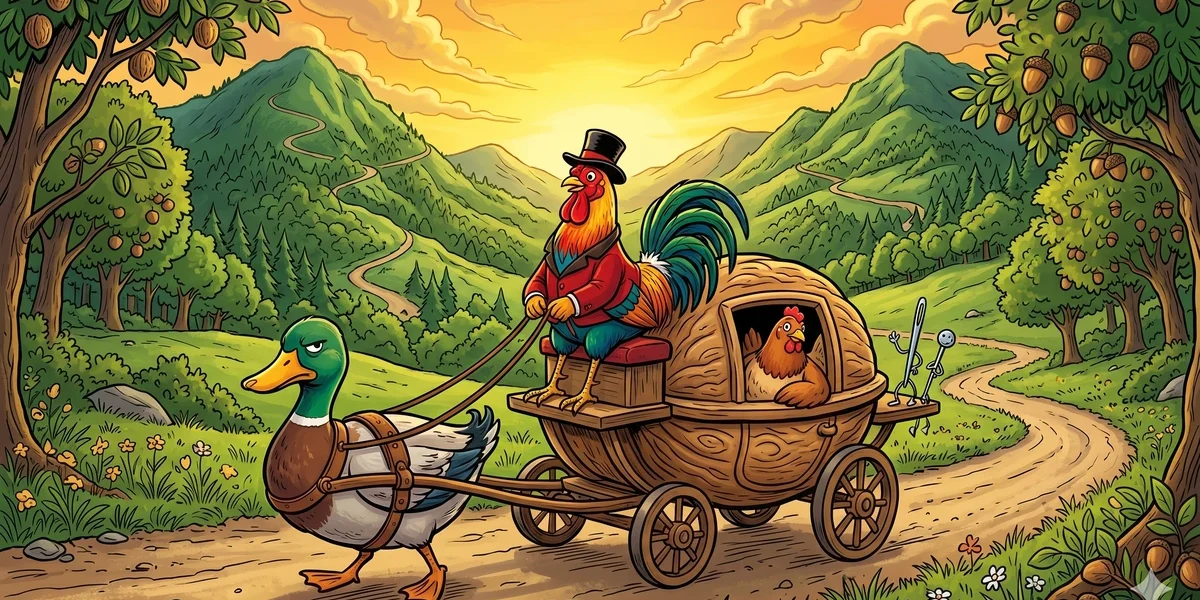
1. How They Went To The Mountains To Eat Nuts: The nuts are quite ripe now,’ said Chanticleer to his wife Partlet, ‘suppose we go together to the mountains
The Mountain Nutting Expedition: Community in Motion
Among the Grimm brothers’ more charming animal tales, the story of how a rooster and hen — and often their animal companions — set off together to gather nuts in the mountains stands as a gentle exploration of what it means to travel as a community: sharing resources, navigating obstacles together, and discovering that the journey itself constitutes a form of relationship-building that the destination alone could never provide. The tale, which appears as the first story in the Grimm collection’s “Chanticleer and Partlet” cycle, establishes the foundational premise that cooperation among different-natured creatures — a rooster, a hen, a duck, a cat, a millstone — produces both comedy and genuine mutual support.
The tale’s premise resonates across the world’s folk narrative traditions. In Indian folklore, the corresponding genre is the yatra-katha (journey tale), in which a group of pilgrims, merchants, or animals travels together toward a shared destination, and the journey itself — with its unexpected obstacles, small generosities, and moments of crisis — reveals character and forges bonds that the destination itself could not create. The Panchatantra’s travel narratives operate on exactly this principle: the journey to distant markets reveals which merchants can be trusted when the road becomes dangerous, and the road’s dangers themselves become the crucible of genuine friendship.
The Nut Harvest and the Ethics of Shared Abundance
The tale’s specific destination — mountains to gather nuts — is not arbitrary. Nut-harvesting in European folk tradition (as in Indian tradition with mango and berry gathering) is a communal activity par excellence: the mountains or forests contain abundance that cannot be privately owned, and gathering expeditions are therefore inherently collective. The decision to go as a group rather than individually is not merely practical (safety in numbers, more hands to carry) but ethical — the communal harvest is an assertion of shared relationship to the natural world’s abundance.
In Indian terms, this resonates with the concept of samanyabhoga — the sharing of common enjoyment — that characterizes festivals, harvests, and communal meals. The natural world’s abundance is a gift to the community rather than to individuals, and the appropriate response to that gift is collective participation. When Chanticleer and Partlet set off together to gather nuts, they are enacting this communal ethic: the nuts are not for one bird but for the household, and the gathering is not a solo enterprise but a shared adventure whose pleasures exceed the nuts themselves.
Chanticleer and Partlet: The Married Couple as Comedic Pair
The rooster-and-hen pair of Chanticleer and Partlet — names derived from medieval European tradition (chante clair, “sing clearly”; pertelet, “little partridge”) — function as a comedic conjugal pair whose dynamic mirrors the tensions and tenderness of any long-married couple. Their interactions carry the warmth of mutual knowledge: they know each other’s tendencies, anticipate each other’s decisions, and navigate disagreement with the practiced ease of long experience. This comedic partnership resonates with the Indian folk tradition of the dampati (married couple) story, in which the husband-wife dynamic is the primary generator of both comedy and wisdom.
The Puranas and folk narratives are full of such pairs: Shiva and Parvati’s domestic negotiations produce both cosmic events and domestic comedy; the conversations of Nala and Damayanti reveal character through conjugal dialogue; village tales across India use the husband-wife pair as a mirror of the community’s own tensions and reconciliations. Chanticleer and Partlet, traveling to the mountains together, enact the same dramatic grammar: the journey as conjugal negotiation, the destination as shared aspiration, the obstacles as conjugal comedy.
The Animal Companions and the Improvised Community
What makes the Grimm tale structurally interesting is the progressive accumulation of companions — the duck who joins them, the cat who seeks warmth, the millstone whose rolling creates both comedy and rescue. This structure of progressive inclusion — journey beginning with two, expanding to include whoever is met along the way — reflects the folk narrative principle that genuine community is not planned but discovered: you find out who your companions are by seeing who appears and who can be accommodated.
This structural principle connects to the Indian concept of sangha (community of practitioners) in the Buddhist tradition: the sangha is not a pre-selected group but a community that forms around shared aspiration and is constituted by whoever is drawn to the path. The rooster-and-hen’s nutting expedition is a secular, comic version of this principle: whoever joins the journey becomes part of its community, and the community’s composition — however improbable — is itself part of the adventure’s meaning.
“They set off for the mountains to gather nuts and came home with more than they expected — including a duck who carried them in a boat, a cat who kept them warm, and a millstone that rolled down the stairs at exactly the right moment.”
Why This Story Lasted
The Nutting Expedition has lasted because it celebrates one of the simplest and most satisfying human experiences: setting off together toward something good, with companions whose company turns the journey itself into a pleasure equal to the destination. The tale’s comedy (the improbable companions, the unexpected obstacles, the millstone’s dramatic exit) does not diminish its warmth — it amplifies it. Adventures shared with companions are stories worth telling; adventures undertaken alone are merely experiences. Chanticleer and Partlet understood this, which is why they asked the duck to come along.
Frequently Asked Questions
Where does this tale appear in the Grimm collection?
This tale is the first story in the Brothers Grimm’s “Chanticleer and Partlet” cycle — a sequence of interconnected tales featuring the same rooster-and-hen pair across multiple adventures. The Grimm brothers collected it from German oral tradition and published it in their Kinder- und Hausmärchen (Children’s and Household Tales), first published in 1812.
What is the Indian equivalent of this journey tale genre?
The Indian equivalent is the yatra-katha (journey tale) — narratives in which a group travels together toward a shared destination, and the journey itself reveals character and forges bonds. The Panchatantra’s travel narratives operate on this principle: the road’s dangers become the crucible of genuine friendship, revealing which companions can be trusted when circumstances become difficult.
What do the names Chanticleer and Partlet mean?
Chanticleer derives from Old French “chante clair” (sing clearly) — the rooster’s defining quality as dawn-announcer. Partlet derives from “pertelet” (little partridge) — a traditional feminine name for the hen in medieval European animal literature. Both names appear in Chaucer’s Canterbury Tales’ “The Nun’s Priest’s Tale,” indicating the pair’s deep roots in European folk narrative tradition.
What is samanyabhoga and how does it relate to the nut harvest?
Samanyabhoga (shared common enjoyment) is the Indian concept that the natural world’s abundance is a gift to the community rather than to individuals, and that the appropriate response is collective participation — festivals, communal harvests, shared meals. The nut-gathering expedition enacts this ethic: the mountains’ nuts belong to no one and everyone, and gathering them communally is both practically efficient and ethically appropriate.
How does the progressive accumulation of companions reflect folk narrative structure?
The progressive inclusion of companions (duck, cat, millstone joining the original pair) reflects the folk principle that genuine community is discovered rather than planned. This connects to the Buddhist sangha concept — community forming around shared aspiration, constituted by whoever is drawn to the path. The improbable companions’ usefulness at critical moments validates the principle that inclusive community is also practical community.
You May Also Like
 Grimm's Fairy Tales
Ages 9-12
Grimm's Fairy Tales
Ages 9-12
Hans In Luck
Hans In Luck: Some men are born to good luck: all they do or try to do comes right all that falls to them is so much gain all their geese are swans all their
 Grimm's Fairy Tales
Ages 9-12
Grimm's Fairy Tales
Ages 9-12
The Valiant Little Tailor
The Valiant Little Tailor: One summer’s morning a little tailor was sitting on his table by the window; he was in good spirits, and sewed with all his might. A
 Grimm's Fairy Tales
Ages 9-12
Grimm's Fairy Tales
Ages 9-12
Lily And The Lion
Lily And The Lion: A merchant, who had three daughters, was once setting out upon a journey; but before he went he asked each daughter what gift he should