The Unforgiving Monkey
The Unforgiving Monkey: Chandra was a king, whose sons kept a group of monkeys as pets. These monkeys were treated as royal pets, and were provided with the

The Unforgiving Monkey
Source: Panchatantra, Book I — Mitrabheda (The Separation of Friends), attributed to the sage Vishnu Sharma, composed c. 300 BCE–300 CE; this redaction follows the Sanskrit Tantrakhyayika recension and Patrick Olivelle’s critical translation (Oxford University Press, 2006).
न विश्वासेन खलानां संगं कुर्यात् कधाचनःः
A king keeps a monkey as a beloved companion and personal guard, trusting the animal’s fierce loyalty absolutely. When a fly lands on the sleeping king’s face and the monkey, sword in hand, swats it away — the sword kills not the fly but the king. The tale is the Panchatantra’s most concentrated argument that loyalty without judgment is indistinguishable from its opposite, and that the most dangerous companion is not the enemy but the zealous friend who lacks the wisdom to match his devotion.
Part I: The Perfect Guardian
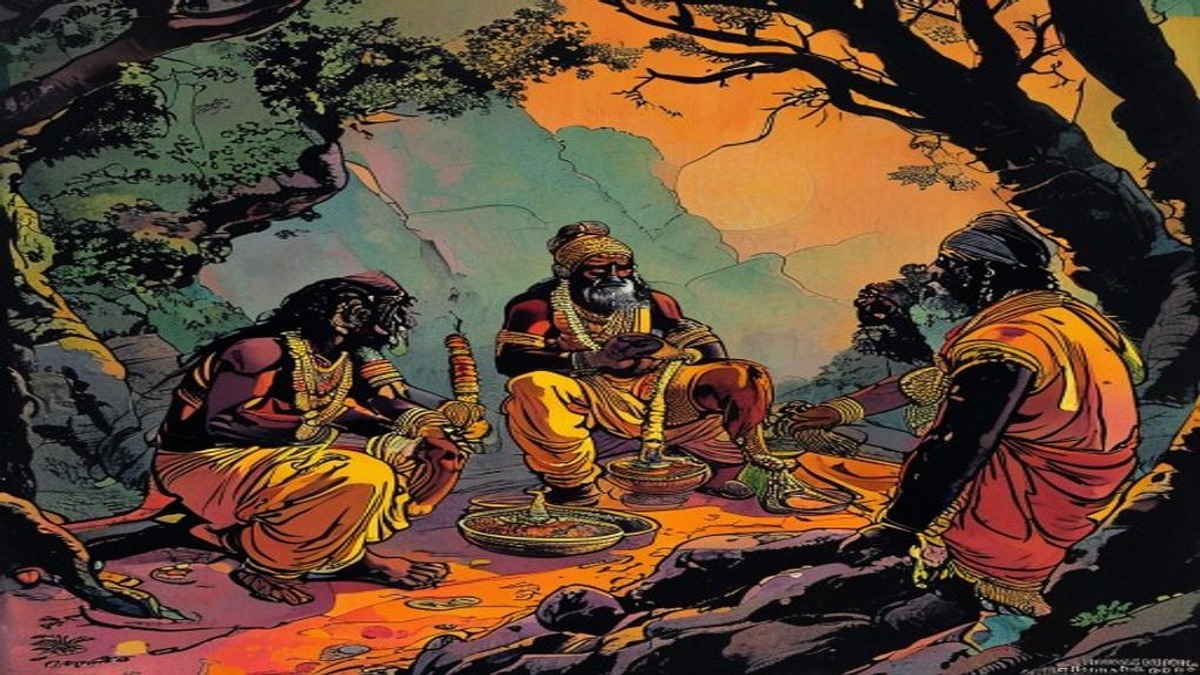
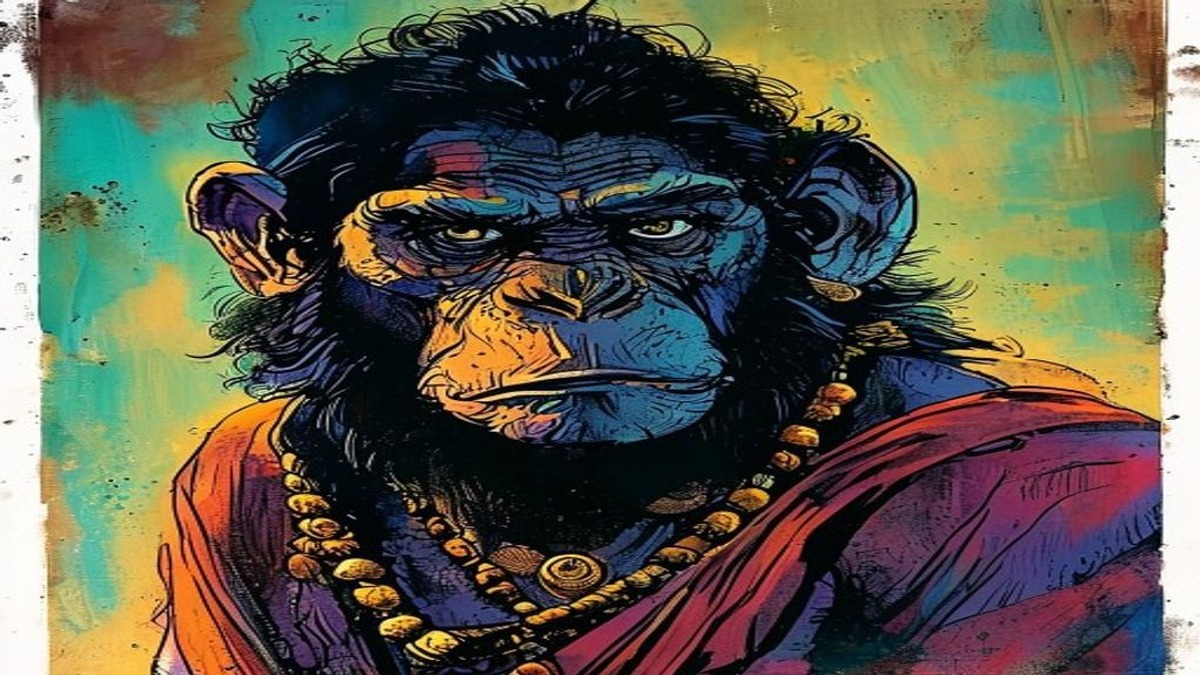
King Nandavarma of the city of Vardhamana had many advisors, several generals, and one companion whom he trusted above all others: a monkey named Kapishrestha who had lived at court since he was an infant and who regarded the king’s wellbeing as the entire purpose of his existence. The monkey had demonstrated his loyalty on several occasions — alerting the king to a servant who had been bribed, driving off a snake that entered the bedchamber, maintaining his watch through nights when the human guards drifted into sleep.
Kapishrestha was fierce, devoted, and enormously proud of his position. The king trusted him enough to allow him access to the royal apartments at all hours and, on occasion, to sleep in the same chamber while the monkey kept watch. For this duty the monkey was permitted to hold the king’s own sword — a fine weapon, sharp enough to split a thread.
The king’s ministers had expressed reservations about this arrangement on more than one occasion. Their objections were not about the monkey’s loyalty, which was beyond question, but about the pairing of that loyalty with a weapon. Vishnu Sharma records the specific warning one senior minister gave: “A devoted fool is more dangerous than a wise enemy, because the enemy’s attacks can be anticipated and defended against, while the devoted fool’s attacks arrive with the full force of goodwill.” Nandavarma had listened to this with the patience of a man who was certain that his minister was wrong.

Part II: The Fly and the Sword
On a summer afternoon, the king slept in his chamber after the midday meal. The chamber was warm. The monkey sat at his post, sword across his knees, watching the king’s face with the intensity of an animal whose entire emotional world is concentrated in a single object of devotion.
A fly entered through the window. It circled the chamber for a time, then landed on the sleeping king’s face — on his cheek, near his eye. The king did not wake. The fly settled.
The monkey regarded the fly. His charge was to guard the king from harm. The fly was on the king’s face. The fly was, therefore, harming the king — or at minimum, disturbing the king’s rest, which the monkey interpreted as equivalent. He had a sword. He had been given the sword specifically for the purpose of protecting the king. He raised it.
What the monkey did not possess was the capacity to think through the relationship between the problem, the instrument, and the consequences of the instrument’s use. He did not ask whether a sword was the correct tool for a fly. He did not ask whether the consequences of a missed stroke were preferable to the consequences of the fly remaining on the king’s cheek. He had a problem. He had a tool. He used the tool.
The sword stroke was precise. The fly was destroyed. The king was also destroyed, because the fly had been resting on his face and the sword had been directed at the fly. The monkey sat for a moment with the sword in his hand. Then he understood what he had done. The sword fell from his hands.
Part III: The Minister’s Analysis
The senior minister who had warned the king about the arrangement came to the chamber when the alarm was raised. He looked at the scene: the king, the monkey, the sword, the fly. He understood it immediately. He did not express satisfaction at having been correct; the text notes specifically that he was grieved by the outcome, because he had tried to prevent it and failed. But he did speak, both for the record and for those who would govern after this king.
“The monkey is not guilty of malice,” he said. “He is guilty of something that produces identical outcomes to malice in specific conditions: he had devotion without the capacity to judge the appropriate expression of devotion. He was given a tool designed for large threats. He applied it to a small one, because no one had helped him understand the difference. The king’s error was not in trusting the monkey’s loyalty; the loyalty was genuine. The error was in assuming that loyalty and judgment arrive together.”
He continued: “The minister who warns against a fool is not warning against loyalty or affection. He is warning against the specific danger of a good intention paired with an inadequate understanding of consequences. The enemy who wants to harm you can be identified and guarded against. The loyal companion who does not know the limits of his tools cannot be guarded against, because he approaches from the direction of your trust.”
Vishnu Sharma closes the narration here, letting the minister’s analysis stand as the story’s conclusion. He does not record what happened to Kapishrestha. The monkey’s fate is not the point. The lesson is.

Part IV: Devotion and Judgment
The Sanskrit commentarial tradition treats this story as the Panchatantra’s most concentrated argument about the relationship between two qualities that are often conflated: loyalty and competence. Kapishrestha possessed the first in excess. He lacked the second entirely in the specific domain required: the domain of threat assessment and proportionate response.
The story’s argument is not that loyalty is dangerous — the Panchatantra elsewhere praises loyalty as among the highest virtues a companion can possess. The argument is that loyalty untempered by judgment is a variable that the person being protected cannot control, because the loyal companion acts from the inside of the protected space, in the moments of greatest vulnerability, with the full confidence of the trusted.
Vishnu Sharma’s formulation is precise: the enemy attacks from outside, is recognized as enemy, can be resisted. The devoted but incapable guardian attacks from inside, is recognized as friend, cannot be resisted — and does not intend harm, which makes the harm no less final and makes prevention impossible through the normal instruments of caution.
The story’s prescription — stated here by the minister and in multiple other tales by Vishnu Sharma — is that the qualities required of a trusted companion must include both loyalty and the specific competence needed for the role the companion is given. A sword is not a fly-swatter. A loyal guardian who does not know this is, in the moment when the fly lands, an unguarded weapon.
Why This Story Has Lasted Three Thousand Years
“The Unforgiving Monkey” endures because it describes a failure mode that every era produces in every institution: the trusted person whose loyalty is beyond question and whose judgment in the specific required domain is inadequate, placed in a position where the gap between the two causes catastrophic harm. The story is called “unforgiving” not because the monkey is vindictive — he is the opposite — but because the outcome of his action is the same as if he had been. Outcomes do not forgive intentions.
The tale entered Arabic Kalila wa Dimna and was cited extensively in medieval Islamic discussions of how rulers should select advisors and companions — the argument being that loyalty and competence must both be assessed independently, because the presence of one does not imply the presence of the other. In European fabliaux and Renaissance conduct literature it became a standard example of the danger of misplaced trust — not in the person’s loyalty but in the person’s capability for the role assigned to them.
For modern readers the story resonates in every context where someone is promoted or trusted beyond their competence in a specific domain because their loyalty or dedication is not in doubt. The monkey is not a metaphor for stupidity; he is intelligent enough to be a faithful guardian, alert enough to detect the fly, decisive enough to act immediately. What he lacks is the specific meta-competence of asking whether the action he is about to take is appropriate to the situation. This meta-competence — the capacity to pause before the sword stroke and ask whether a sword is the right instrument — is what Vishnu Sharma argues must be assessed before any trusted companion is handed a weapon, literal or otherwise.
Frequently Asked Questions
What is the moral of The Unforgiving Monkey?
The story teaches that loyalty without judgment is as dangerous as its opposite. The monkey's devotion to the king is absolute and genuine — he acts to protect the king from a fly. But he lacks the capacity to assess whether the sword is the right instrument for the threat. Outcomes do not forgive intentions: the king is equally dead whether the monkey intended harm or devoted himself to preventing it. The lesson is that trusted companions must be evaluated for both loyalty and the specific competence required by their role.
Why is the story called The Unforgiving Monkey if the monkey is devoted?
The title refers not to the monkey's character but to the nature of the outcome. The monkey is forgiving in disposition — he is the opposite of vindictive. The word 'unforgiving' describes the consequence of his action: it is final and irreversible regardless of his intention. This is the story's sharpest point: the world does not forgive good intentions when the action taken is irreversibly wrong.
Which book of the Panchatantra does this story come from?
The story comes from Book I, Mitrabheda (The Separation of Friends), which explores the many ways that relationships of trust can produce catastrophic outcomes — through betrayal, manipulation, or, as here, through the failure of a loyal companion to match devotion with appropriate competence.
What warning did the minister give before the tragedy?
The minister warned that a devoted fool is more dangerous than a wise enemy because the enemy's attacks can be anticipated and defended against, while the devoted fool attacks from the direction of trust and in the moment of greatest vulnerability. He specifically objected to the pairing of the monkey's loyalty with an actual sword, arguing that devotion and the capacity for proportionate response are separate qualities that must both be assessed independently.
How has this story been used in political and leadership literature?
The story entered Arabic Kalila wa Dimna and was widely cited in medieval Islamic discussions of how rulers should evaluate advisors and companions — the argument being that loyalty and role-specific competence must be assessed separately. In European conduct literature it became a standard example of the danger of promoting or trusting someone beyond their competence because their loyalty is unquestioned. Modern organizational behavior literature uses the same argument under the heading of the 'Peter Principle' — the tendency to promote people to their level of incompetence.
You May Also Like
 Panchatantra Stories
Ages 6-8
Panchatantra Stories
Ages 6-8
The Bug and the Poor Flea
The Bug and the Poor Flea: The false promises of friends as well as strangers have no value. You end up paying for it.” Mandavisarpini was a white flea. The
 Panchatantra Stories
Ages 9-12
Panchatantra Stories
Ages 9-12
The Grain of Corn
A farmer plants a single grain of corn and cultivates it into an abundant harvest through faith and hard work.
 Panchatantra Stories
Ages 9-12
Panchatantra Stories
Ages 9-12
The Story of the Four Learned Fools
The Story of the Four Learned Fools: In a certain town, there lived four Brahmins whohad become great friends. They were all extremely naiveby nature. The