The Three Golden Hairs of Grandfather Know-All: A Czech Tale of Wit and Destiny
The Three Golden Hairs of Grandfather Know-All: A Czech Tale of Wit: In the Kingdom of Bohemia, there lived a nobleman who was obsessed with destiny. He had

Among the treasures of Czech folk literature, few tales are loved as deeply as The Three Golden Hairs of Grandfather Know-All. In its homeland it is known as “Tři zlaté vlasy děda Vševěda,” and it was given its enduring literary form by the great Bohemian folklorist and poet Karel Jaromír Erben (1811–1870), who first published it in the almanac Máj in 1860 before it took its lasting place among his celebrated collection of national tales. Erben gathered the story from the oral tradition of the Czech countryside, where it had been told for generations beside winter hearths.
The tale belongs to one of the most widely travelled story-patterns in the world. Folklorists classify it as ATU 461, “Three Hairs from the Devil’s Beard,” in the Aarne–Thompson–Uther international index of tale types. Its closest cousin is the German Der Teufel mit den drei goldenen Haaren (“The Devil with the Three Golden Hairs”), recorded by the Brothers Grimm as tale number 29 of their Kinder- und Hausmärchen. Where the German version sends its hero to the Devil himself, the Czech tradition is gentler and stranger: the keeper of all secrets is an old, all-knowing grandfather — a sun-figure who rises and sets like the day. The story was carried into English by the translator Walter William Strickland in 1896, and it has never since left the nursery shelves of Europe.
A Child Marked by the Stars
In the Kingdom of Bohemia there lived a nobleman who could not rest for thinking about the future. He had questioned astrologers and fortune-tellers across the realm, always hungry to know what lay ahead. So when his servants told him that a poor charcoal-burner’s wife, sheltering one stormy night beneath his roof, had given birth to a son, he summoned at once the oldest stargazer in the land to read the infant’s fate.
The stargazer studied the wheeling planets and the pale face of the moon, and his own face grew grave. “This child,” he said slowly, “is born beneath the Star of Destiny. In his twenty-first year he shall marry the king’s own daughter, and a crown shall come to rest upon his head.”
The nobleman was seized with cold anger. A charcoal-burner’s son wedded to a princess? It could not be allowed to happen. He offered the poor parents a purse of gold for the infant, telling them their boy would be raised in comfort; and the weary, frightened couple, believing they were giving their child a better life, agreed. But the moment the baby was in his hands, the nobleman sealed him inside a small wicker basket and set it adrift upon the swift dark river, certain the water would carry the prophecy away.
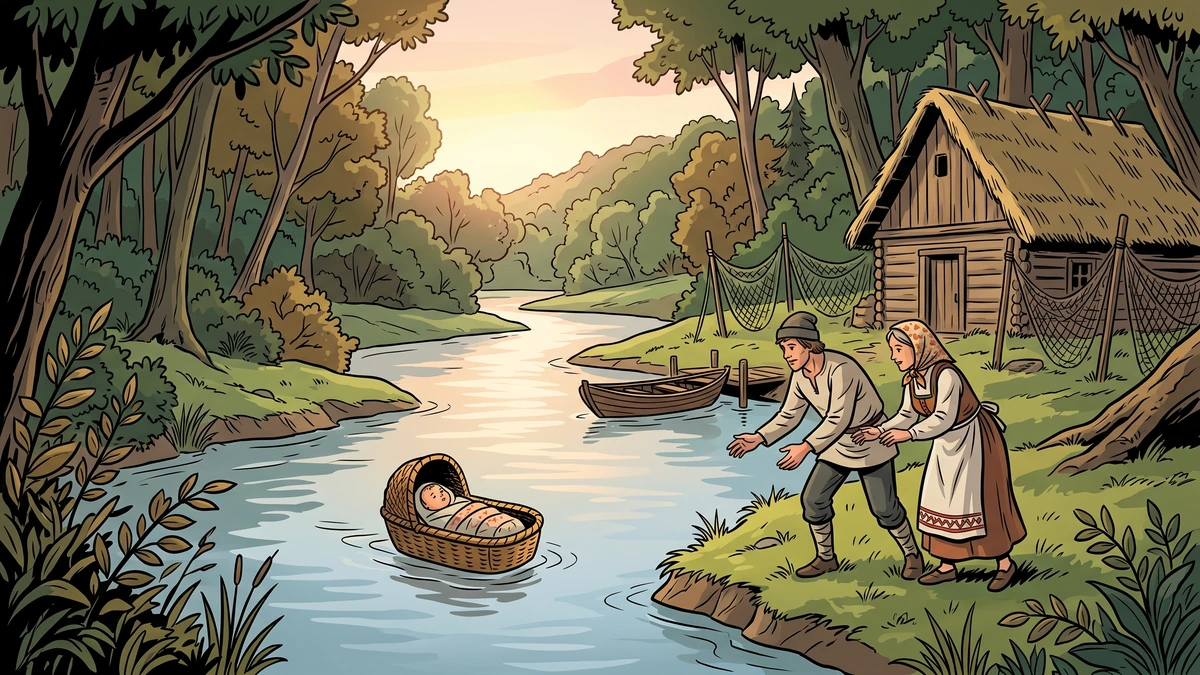
The river, however, keeps its own counsel. The basket did not sink. It spun and floated downstream until it lodged gently against the nets of a fisherman, who lived with his childless wife in a cottage by the bank. They lifted the basket, opened it, and found a living, laughing boy. Because the river had brought him, they raised him as their own, and the child grew strong, kind, and quick of mind. They called him Jan, and he knew nothing of the stars that had been read above his cradle.

The Letter That Was Meant to Kill
Twenty years passed. One day the nobleman — older now, and grown great enough to sit at court — lost his way while hunting and stopped at the fisherman’s cottage to ask for water. There he saw a tall, fair young man whose face stirred an old unease in him. When he learned that the youth had been found two decades earlier in a basket upon the river, the nobleman understood with a chill that fate had outrun him.
He hid his fear behind a smile. “Such a fine young man should not waste his days mending nets,” he said. “Let him carry a letter for me to the royal castle, and I shall see him richly rewarded.” The fisherman and his wife, proud of their son, agreed gladly. But the letter the nobleman pressed into Jan’s hand was a death-warrant. It commanded, in the nobleman’s own sealed authority, that the bearer be put to the sword the very hour he arrived.
Night fell while Jan was still deep in the forest, and he knocked at a lonely cottage to beg a bed. Inside lived an old woman with kind, knowing eyes — for this was no ordinary house, but a dwelling of Fate herself, the godmother who watches over those the stars have chosen. While Jan slept, she lifted the sealed letter, and with a breath she changed every cruel word. When she set it back beside him, it now commanded that the bearer be wedded to the king’s daughter without delay. Jan walked on at dawn knowing nothing of the gift that had been worked for him in the dark, and at the castle the king, reading the altered letter, gave him the princess in marriage. The two were young, and they loved one another at once.

The Quest for Three Golden Hairs
When the nobleman came to court and found Jan not dead but married to the princess and beloved by all, his fury knew no bottom. Yet he could not strike at a prince openly. So he set what he believed was an impossible price upon the marriage. “No man may keep my favour,” he declared, “who has not brought, as a true wedding-gift, three golden hairs from the head of Grandfather Know-All — he who dwells where the sun lies down to sleep.” No traveller had ever returned from that country. The nobleman was sure the road itself would do his killing for him.
But Jan only kissed his wife farewell and set out without complaint. His journey carried him to the edge of the known world, and three times along the way he was stopped by those in need of wisdom. First he came to a city whose people crowded around him in despair: their famous well, which had once flowed with the water of life, had run dry, and no one knew why. They begged him to ask Grandfather Know-All the reason. Further on stood a second city where a great apple tree, whose fruit once restored youth to the old, had withered to bare grey wood; its people too pleaded for an answer. At last Jan reached a wide, black river, where a weary ferryman poled his boat back and forth without rest. “I have rowed this water longer than I can remember,” the old man said. “Ask Grandfather Know-All how I may set down my oar and be free.” Jan promised to carry every question, and the ferryman rowed him to the far shore.
In the House Where the Sun Sleeps
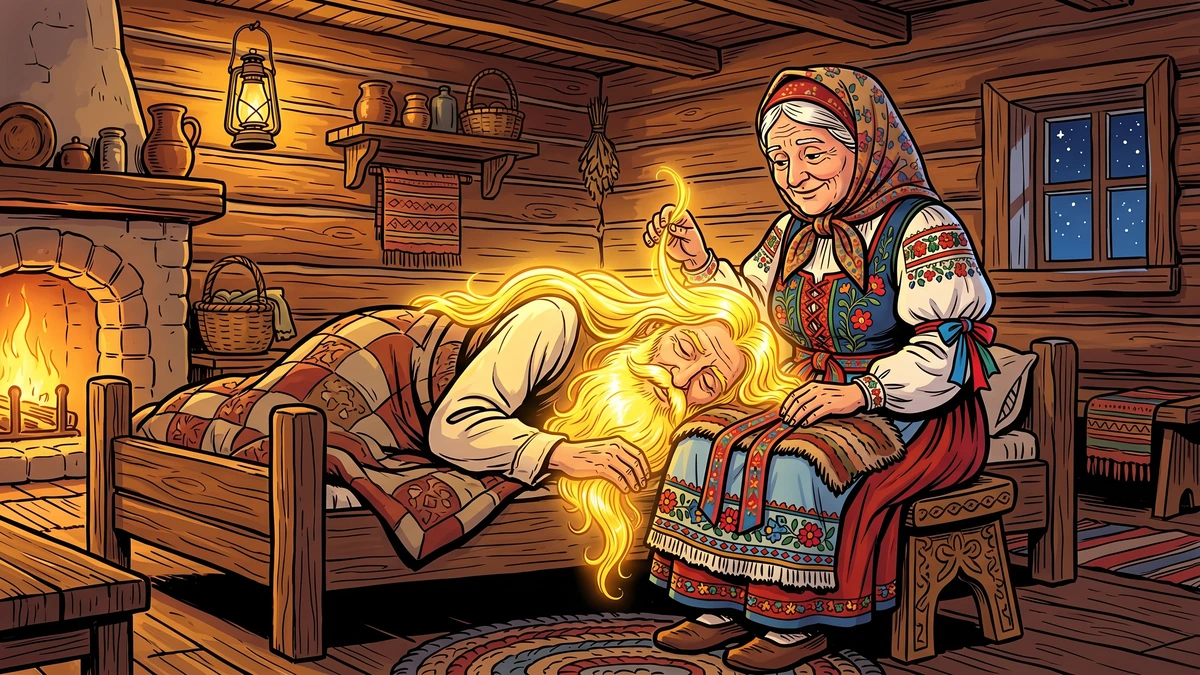
Beyond the black river, in a golden cottage at the world’s end, Jan found again the old woman of the forest — for she was the mother of Grandfather Know-All, and Fate and the all-knowing sun are kin. She welcomed him, but warned him that her son would devour any mortal he discovered. So she touched Jan with her hand and changed him into a small beetle, and tucked him safely into the folds of her skirt.
At dusk Grandfather Know-All came home — an old man whose hair and beard shone like the noon sun — ate his supper, and laid his bright head in his mother’s lap to sleep. As he slept, she gently plucked one golden hair. “Why do you wake me, Mother?” he murmured. “I dreamed of a city whose well has failed.” “A toad sits upon the spring beneath the well,” she answered for him; “let them kill it, and the water of life will rise again.” A second hair, a second drowsy complaint, a second dream: beneath the withered apple tree gnawed a serpent at its root; kill the serpent, and the tree would fruit once more. A third hair, and the last answer: the ferryman need only press his oar into the hand of the next passenger, and step ashore a free man forever. By morning the old woman had three golden hairs and three priceless answers, and Jan crept away as a beetle before the sun rose to begin again its endless circuit of the sky.
Homeward Jan went, and at each stop he paid the debt of his promise. He told the second city of the serpent; they killed it, the apple tree blossomed, and in gratitude they loaded him with twelve horses bearing silver. He told the first city of the toad; the water of life leapt up clear and sweet, and they gave him twelve horses bearing gold. The ferryman’s secret he kept, honestly, to deliver only at his journey’s very end. So Jan came back to the castle not a corpse but a lord of treasure, and laid three shining hairs in his wife’s hands.
The Moral of the Tale
The nobleman’s eyes did not see the three golden hairs at all. They saw only the gold and silver, and his old greed woke hungrier than ever. “Where,” he demanded, “does such wealth come from?” “From the far side of the black river,” Jan answered truthfully, “where the sands gleam with it.” The nobleman set out that very hour. He came to the river, the ferryman held out his oar, and the nobleman — too eager to be careful — took it. The boat carried the ferryman, free at last, to shore; and the nobleman remained, poling the black water back and forth, perhaps poling it still.
The wisdom of the tale is older than any of its tellers. The Czech proverb that sums it best has been spoken by Bohemian grandmothers for centuries:
“Co se má státi, to se stane.”
“What is to be, will be.”
Three times the nobleman tried to murder destiny — with a river, with a letter, with an impossible quest — and three times his own cruelty became the very road by which the prophecy walked toward him. Fate in this story is not blind chance; it rewards a kind heart and an honest tongue, and it hands the cruel the exact tool of their undoing. Jan never lies, never breaks a promise, and never tries to cheat the future. He simply walks forward with courage and good faith, and the world arranges itself around his goodness. The nobleman, who trusts only in scheming and in gold, ends bound to an oar by his own grasping hand.
The Tale Across Borders
To read The Three Golden Hairs of Grandfather Know-All beside its relatives is to watch a single story breathe in many languages. The international type-index lists hundreds of recorded versions of ATU 461 across Europe, the Caucasus, the Near East, and India, and each culture has bent the tale toward its own imagination. In the Grimms’ German Der Teufel mit den drei goldenen Haaren, the hero is a “luck-child” born with a caul, and the keeper of the three hairs is the Devil, from whose head the hairs are pulled by his grandmother while he dozes in hell. Russian, Slovak, and South Slavic tellings keep the structure but exchange the antagonist again — sometimes a sea-king, sometimes a serpent, sometimes a witch. The Czech version’s distinctive gift is its mildness: it replaces the Devil with Děd Vševěd, the “All-Knowing Grandfather,” an old man of golden hair whom many readers understand as a personification of the sun, journeying from his rising in the east to his rest beyond the black river in the west.
Two ancient story-motifs are woven through the plot, and naming them shows how deep the tale’s roots run. The first is the “letter of death” — the message a powerful man sends ahead of his victim, ordering the bearer’s own execution, which is then secretly altered to spare him. Folklorists call this the Uriah motif, after the Biblical King David’s letter against Uriah the Hittite, and versions of it appear in Greek myth, in Hamlet, and in folktales from Ireland to Mongolia. The second is the cursed ferryman, doomed to ply his oar until he can place it in another’s hand — a figure that echoes through medieval European legend and gives the tale its quietly perfect ending, in which the villain’s greed becomes the lock of his own prison. The Czech storytellers did not invent these motifs, but they joined them with rare elegance, so that every cruelty the nobleman commits becomes, in time, a rung on the ladder destiny climbs toward him.
Erben himself was a scholar as well as an artist. A trained archivist and one of the founders of Czech folkloristics, he collected songs, proverbs, and tales during the nineteenth-century Czech National Revival, when a people living under Habsburg rule were reclaiming their language and their stories as a source of identity. He did not merely transcribe; he shaped his material with a poet’s ear, giving the oral tale a polished, rhythmic prose that has carried it intact to the present day. Because of his care, the modern reader meets the story very nearly as a Bohemian villager would have told it — complete with its sly humour, its dignity, and its faith that the future belongs to the kind.
Why This Tale Has Lasted
For more than a century and a half, The Three Golden Hairs of Grandfather Know-All has remained one of the best-loved stories in the Czech-speaking world. It has been read aloud, staged for radio, and adapted for the screen, and it remains a fixture of childhood for readers across Central Europe. Its endurance is no accident. The story braids together motifs that reach across all of Eurasia: the prophecy a powerful man tries to escape, the “letter of death” secretly rewritten, the threefold quest in which a hero gathers wisdom by carrying other people’s questions, and the cursed ferryman freed only when he passes his burden to another.
The tale also rewards a second reading by adults, who notice how carefully it is built. Every promise Jan makes is kept; every question he agrees to carry is answered; every kindness shown to him is repaid in exact measure. The plot is a closed circuit of cause and consequence, and nothing in it is wasted — the same three towns and the same ferryman that test the hero on his way out reward him on his way home, and finally trap the villain who follows. This tidy architecture is part of why the story survives translation so well: strip away the Bohemian costumes and the golden cottage, and the moral machinery underneath still turns perfectly. It is a fable disguised as an adventure.
Yet what keeps the tale alive is not its scholarly pedigree but its warmth. Children feel the justice of it at on
You May Also Like
 Celtic Folk Tales
Ages 9-12
Celtic Folk Tales
Ages 9-12
Gold-Tree And Silver-Tree
Gold-Tree And Silver-Tree: Once upon a time there was a king who had a wife, whose name was Silver-tree, and a daughter, whose name was Gold-tree. On a certain
 Celtic Folk Tales
Ages 9-12
Celtic Folk Tales
Ages 9-12
The Shepherd Of Myddvai
The Shepherd Of Myddvai: Up in the Black Mountains in Caermarthenshire lies the lake known as Lyn y Van Vach. To the margin of this lake the shepherd of
 Celtic Folk Tales
Ages 9-12
Celtic Folk Tales
Ages 9-12
Princess Finola And The Dwarf
Princess Finola And The Dwarf: A long, long time ago there lived in a little hut in the midst of a bare, brown, lonely moor an old woman and a young girl.