The Three Evils
The Three Evils: Once upon a time, in the old days, there lived a young man by the name of Dschou Tschu. He was of more than ordinary strength, and no one
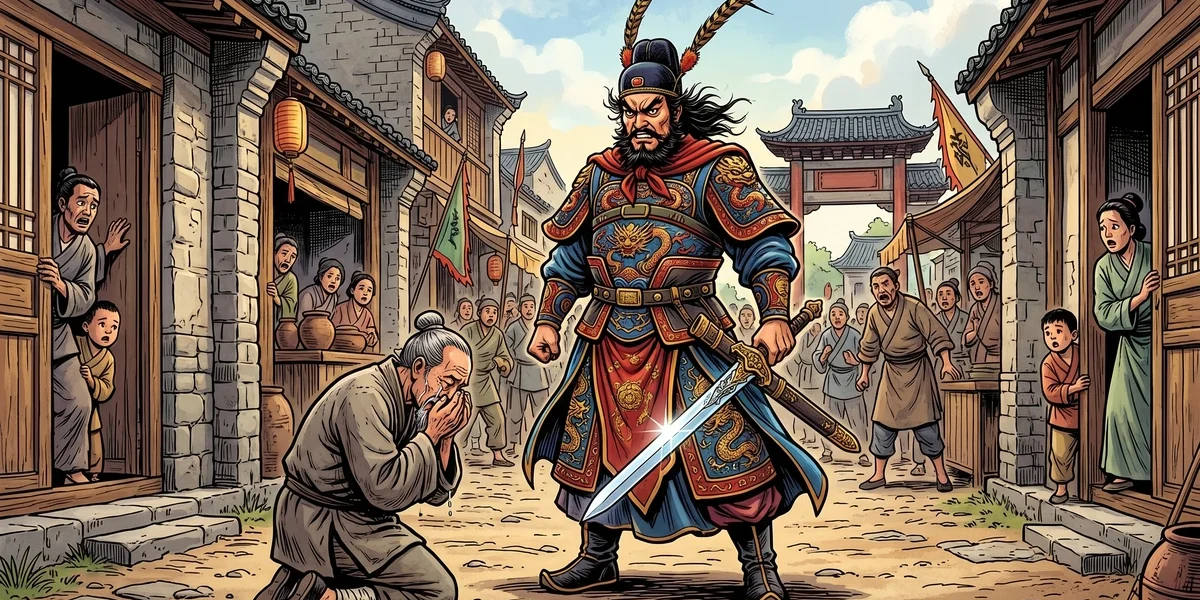
Zhou Chu and the Problem of the Monster Within: A Tale of Transformation Through Action
The Three Evils is one of the most celebrated moral transformation stories in Chinese popular literature, attributed to the historical figure Zhou Chu (周處, 236–297 CE), a military officer of the Jin dynasty whose biography in the Jin Shu (晉書, History of the Jin Dynasty) contains the essential elements of this legend. The story is unusual in the tradition of Chinese cautionary tales because its protagonist begins as the object of the cautionary lesson — he is one of the three evils — and ends as its exemplar, demonstrating that radical self-transformation is possible and that the courage to confront external evil may be the same courage required to confront evil within oneself.
The legend participates in the Confucian tradition of zi xing (自省, self-examination) and gai guo (改過, correcting one’s faults), which treats moral transformation not as a single dramatic conversion but as the result of honest self-assessment followed by sustained effort. What distinguishes this particular account is its use of physical courage as the catalyst for moral insight — the moment of genuine bravery against external danger becoming the occasion for recognition of one’s own place in the moral order.
Beat I — The Three Plagues of Yishan
In the district of Yishan during the turbulent period preceding the Jin dynasty’s consolidation, the local community suffered under what residents described as three evils. The first was a fierce tiger that had established itself in the southern hills and preyed on livestock and occasionally on travelers who came too close. The second was a river serpent — large enough to overturn fishing boats — that inhabited a deep pool in the local river and had drowned several people in the past year.
The third evil was Zhou Chu, a young man of the district who had grown up large, strong, and entirely without restraint. He was the son of a minor military official who had died young, leaving his son without the discipline of paternal authority and with enough physical imposing presence to avoid natural social correction. Zhou Chu bullied, extorted informal tolls from merchants passing through the district, started fights at festivals, and generally made himself feared in the way that strong, unconstrained young men with no larger purpose have always made themselves feared in small communities.
The community had, with the pragmatic resignation of people who have learned that certain problems cannot be easily resolved, adapted to all three evils. People avoided the southern hills, fished the river only in groups, and gave Zhou Chu what he demanded when he demanded it. The tiger, the serpent, and the bully had all been incorporated into the local mental map as features of the landscape rather than problems amenable to solution.
Zhou Chu, for his part, was aware that people feared him and had taken this for respect until a chance overheard conversation disabused him. Returning from a festival, he heard several older men speaking quietly about the district’s three evils — listing them: the tiger, the serpent, and himself — and calculating, with the unsentimental arithmetic of people who have lived with chronic danger, which of the three was most likely to be survived. The answer was not flattering. Zhou Chu, whom they considered the most dangerous of the three, was also the one against whom they had the least defense.
Beat II — The Decision and the Ordeal
The eavesdropped conversation produced in Zhou Chu something that the legends and the historical record agree had been entirely absent from his young manhood: shame. Not the performative shame of being caught in an embarrassing situation — he had been caught in those many times and had responded with aggression — but a deeper recognition of himself as others genuinely saw him. He was a plague. He was in the same category as a tiger and a river monster. This perception, arriving unmediated and not delivered by someone he could physically intimidate into retraction, penetrated in a way that no previous social feedback had managed.
His response was characteristically direct. He went to the village elders and told them he wished to address the district’s three evils. The elders, who had not yet registered that Zhou Chu was aware of his inclusion in the count, explained the tiger and the serpent. Zhou Chu explained that he had overheard; he knew. He proposed to address all three. The elders, for reasons they probably could not fully articulate, believed him and sent him with the community’s guarded approval.
He killed the tiger first, which was dangerous but straightforward for a man of his strength and training. He then entered the river pool to fight the serpent, which was genuinely life-threatening: the creature was large enough to kill, the water was its element rather than his, and the fight extended across three days and nights of underwater struggle that the community, watching from the banks, eventually concluded had killed both combatants. They held a kind of cautious celebration — they were free of two of the three evils, and the third had apparently disposed of itself in eliminating the second.
Zhou Chu emerged from the river on the third day. He was considerably marked by the encounter. He walked to the bank, sat for a while, and observed the community’s celebration. Understanding, now, that they had been celebrating his probable death as net positive, he experienced a second wave of shame that was, if anything, more clarifying than the first. He was free. He had not died. The question of what to do with this freedom, and with the self-knowledge the past three days had produced, was entirely open.
Beat III — Gai Guo and the Possibility of Radical Change
What happened next in Zhou Chu’s life is documented in the Jin Shu with the particular admiration that Chinese historical writing reserves for genuine moral transformation: he sought out two of the most respected scholars of his era, studying with Lu Ji and Lu Yun of the renowned Lu family, and devoted himself with the same intensity he had previously directed toward intimidation to the study of classical literature, military strategy, and the Confucian texts. He eventually became a military official of considerable distinction, serving the Jin dynasty in frontier campaigns and dying in battle at age sixty-one while refusing to retreat from a militarily compromised position — which the tradition treats as the final expression of the courage that had first appeared at the river pool.
The legend uses Zhou Chu’s transformation to make a claim that is potentially radical within the Confucian tradition’s generally conservative view of character: that even a person who has become genuinely harmful can achieve genuine change if they are willing to face the truth about themselves honestly and then act on it with consistency. The Confucian emphasis on gai guo (改過, correcting faults) acknowledges this theoretical possibility, but the tradition’s practical expectation tends toward gradual cultivation from an early age rather than dramatic mid-career transformation.
Zhou Chu’s case is exceptional because the catalyst for his transformation is not teaching or advice but self-recognition: the moment of hearing himself categorized accurately, without defense, by people who had no reason to soften the truth for his benefit. This is the zi xing (自省, self-examination) that Confucian ethics recommends as a regular practice, but which Zhou Chu had apparently never performed — and when it was thrust upon him involuntarily, its effect was complete and immediate in a way that years of gradual cultivation might not have achieved.
Beat IV — Courage, Self-Confrontation, and the Official’s Moral Responsibility
The legend’s political dimension — its relevance to questions of governance — lies in its implicit argument about what kind of courage good administration requires. The district of Yishan had adapted to its three evils through the natural human tendency to treat chronic problems as features of the landscape once they have persisted long enough. The tiger and the serpent were dangers; Zhou Chu was a nuisance and a threat; but all three had been incorporated into normal life as tolerable because the alternative — confronting them — seemed too costly.
This adaptation is rational at the individual level and collectively harmful. A community that teaches itself to tolerate evils it could in principle address loses something important: the capacity to recognize harm as harm rather than as simply the way things are. The official or administrator who confronts what others have learned to tolerate demonstrates something essential to effective governance — that the status quo, however comfortable it has become, is not the same as the right order of things.
Zhou Chu’s willingness to address all three evils simultaneously — including himself — is the legend’s model of this comprehensive courage. He does not eliminate the tiger and the serpent while leaving the third evil (himself) in place. He understands that partial reform that preserves the most convenient evil is not reform at all. This is an observation with clear relevance to officials in any era: the administrator who addresses some problems while protecting others — particularly others in which they have a personal stake — is not governing well regardless of what specific problems they do address.
“When he heard himself named among the evils, he did not argue. He asked what could be done. This is the beginning of all genuine change.”
— Reflection on the Zhou Chu legend in Chinese moral literature
Why This Legend Has Lasted
The Three Evils has persisted for nearly two thousand years because it refuses the comfortable narrative of the person who was always good being revealed as such, and instead tells the much harder story of someone who was genuinely harmful becoming genuinely good — and the specific mechanism by which this happened. The mechanism is simple enough to state: he heard the truth about himself from people with no reason to soften it, felt the appropriate shame, and then acted on that shame with the same directness he had previously directed toward less constructive ends.
This is not a story about magical reformation or divine intervention. It is a story about what accurate self-knowledge, when genuinely received and not defended against, is capable of producing in a person who has the courage to act on it. Zhou Chu’s subsequent career — the distinguished military service, the death in battle refusing an ignoble retreat — is the tradition’s evidence that the transformation was real and not merely a temporary resolution. He became what the courage at the river pool suggested he was capable of being: someone whose strength served something larger than his own appetite.
Zhou Chu in Historical Record and Popular Tradition
Zhou Chu (周處, 236–297 CE) is a documented historical figure whose biography appears in the Jin Shu (晉書, compiled 648 CE under Tang dynasty imperial sponsorship). The historical record confirms the essential elements: his reputation for violence in his youth, his transformation after studying with the Lu brothers (Lu Ji and Lu Yun, both celebrated calligraphers and poets), and his subsequent distinguished military career culminating in death at the Battle of Xia (today’s Shaanxi Province) fighting the Di people. The tiger and serpent episode appears in an early form in Shishuo Xinyu (世說新語, A New Account of the Tales of the World, 5th century CE). The “three evils” formulation — explicitly naming Zhou Chu as the third alongside the tiger and serpent — appears to be a later folk development that sharpened the story’s moral focus. The story became a staple of Chinese moral instruction literature and continues to appear in children’s educational materials in contemporary China, where it is used to illustrate the value of courage, honest self-examination, and the possibility of genuine moral transformation regardless of one’s starting point.
You May Also Like
 Chinese Folk Tales
Ages 9-12
Chinese Folk Tales
Ages 9-12
The God Of War
The God Of War: Guan Di, was really named Guan Yu. At the time when the rebellion of the Yellow Turbans was raging throughout the empire, he, together with two
 Chinese Folk Tales
All Ages
Chinese Folk Tales
All Ages
Black Arts
Black Arts: The wild people who dwell in the South-West are masters of many black arts. They often lure men of the Middle Kingdom to their country by promising
 Chinese Folk Tales
All Ages
Chinese Folk Tales
All Ages
Kwang-Jui And The God Of The River
Kwang-Jui And The God Of The River: China is a land where the great masses of the people have to toil and struggle incessantly in order to obtain even the bare