The Temple To The God Of War
The Temple To The God Of War: When he was a child a blind fortune-teller came and cast his future, saying, “This boy will be very great indeed.” At seven years
[Yi Hang-bok.–When he was a child a blind fortune-teller came and cast his future, saying, “This boy will be very great indeed.”
At seven years of age his father gave him for subject to write a verse on “The Harp and the Sword,” and he wrote–
“The Sword pertains to the Hand of the Warrior And the Harp to the Music of the Ancients.”
At eight he took the subject of the “Willow before the Door,” and wrote–
“The east wind brushes the brow of the cliff And the willow on the edge nods fresh and green.”
On seeing a picture of a great banquet among the fierce Turks of Central Asia, he wrote thus–
“The hunt is off in the wild dark hills, And the moon is cold and gray, While the tramping feet of a thousand horse Ring on the frosty way. In the tents of the Turk the music thrills And the wine-cups chink for joy, ‘Mid the noise of the dancer’s savage tread And the lilt of the wild hautboy.”
At twelve years of age he was proud, we are told, and haughty. He dressed well, and was envied by the poorer lads of the place, and once he took off his coat and gave it to a boy who looked with envy on him. He gave his shoes as well, and came back barefoot. His mother, wishing to know his mind in the matter, pretended to reprimand him, but he replied, saying, “Mother, when others wanted it so, how could I refuse giving?” His mother pondered these things in her heart.
When he was fifteen he was strong and well-built, and liked vigorous exercise, so that he was a noted wrestler and skilful at shuttlecock. His mother, however, frowned upon these things, saying that they were not dignified, so that he gave them up and confined his attention to literary studies, graduating at twenty-five years of age.
In 1592, during the Japanese War, when the King escaped to Eui-ju, Yi Hang-bok went with him in his flight, and there he met the Chinese (Ming) representative, who said in surprise to his Majesty, “Do you mean to tell me that you have men in Cho-sen like Yi Hang-bok?” Yang Ho, the general of the rescuing forces, also continually referred to him for advice and counsel. He lived to see the troubles in the reign of the wicked Kwang-hai, and at last went into exile to Puk-chong. When he crossed the Iron Pass near Wonsan, he wrote–
“From the giddy height of the Iron Peak, I call on the passing cloud, To take up a lonely exile’s tears In the folds of its feathery shroud, And drop them as rain on the Palace Gates, On the King, and his shameless crowd.”]
The Story
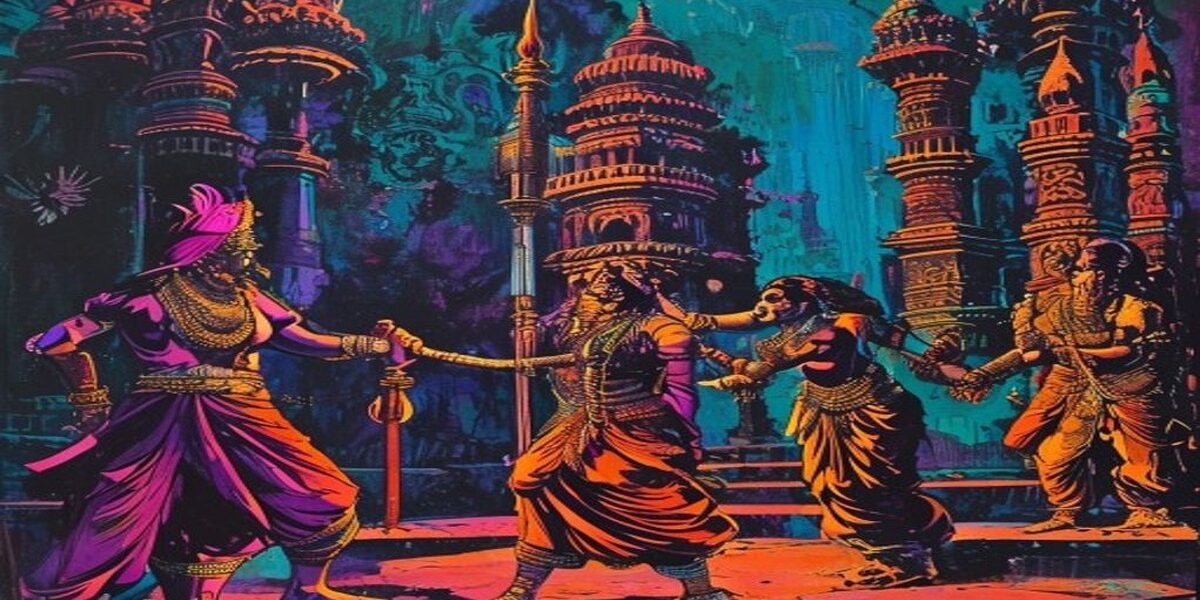
During the Japanese War in the reign of Son-jo, the Mings sent a great army that came east, drove out the enemy and restored peace. At that time the general of the Mings informed his Korean Majesty that the victory was due to the help of Kwan, the God of War. “This being the case,” said he, “you ought not to continue without temples in which to express your gratitude to him.” So they built him houses of worship and offered him sacrifice. The Temples built were one to the south and one to the east of the city. In examining sites for these they could not agree on the one to the south. Some wanted it nearer the wall and some farther away. At that time an official, called Yi Hang-bok, was in charge of the conference. On a certain day when Yi was at home a military officer called and wished to see him. Ordering him in he found him a great strapping fellow, splendidly built. His request was that Yi should send out all his retainers till he talked to him privately. They were sent out, and then the stranger gave his message. After he had finished, he said good-bye and left.
Yi had at that time an old friend stopping with him. The friend went out with the servants when they were asked to leave, and now he came back again. When he came in he noticed that the face of the master had a very peculiar expression, and he asked him the reason of it. Yi made no reply at first, but later told his friend that a very extraordinary thing had happened. The military man who had come and called was none other than a messenger of the God of War. His coming, too, was on account of their not yet having decided in regard to the site for the Temple. “He came,” said Yi, “to show me where it ought to be. He urged that it was not a matter for time only, but for the eternities to come. If we do not get it right the God of War will find no peace. I told him in reply that I would do my best. Was this not strange?”
The friend who heard this was greatly exercised, but Yi warned him not to repeat it to anyone. Yi used all his efforts, and at last the building was placed on the approved site, where it now stands.
Im Bang.
XXXII
Moral
Yi Hang-bok learned that wisdom gained from humility serves better than pride. By listening to the blind fortune-teller and following her counsel without arrogance, he transformed not only his own destiny but earned respect through genuine understanding.
Historical & Cultural Context
Korean folk tales root themselves in Confucian family ethics, Buddhist compassion and Shamanic wonder, often set in thatched villages, mountain temples or the courts of the Joseon Dynasty.
This tale belongs to the Korean oral storytelling tradition and reflects Confucian values of respect for wisdom, regardless of a person’s status. The blind fortune-teller figure appears across East Asian folklore as an archetypal wise elder whose insight transcends physical limitation. Scholars trace this motif to traditions valuing inner sight over worldly appearance, common in Daoist and Buddhist-influenced Korean narratives. Yi Hang-bok’s acceptance of counsel aligns with Joseon-era moral teachings that elevated filial obedience and receptiveness to guidance.
Reflection & Discussion
- What made Yi Hang-bok decide to trust the fortune-teller when others mocked her prediction?
- Think of a time when you rejected advice from someone and later wished you had listened. What changed your mind?
- If Yi Hang-bok had stayed arrogant and ignored the fortune-teller’s warning, how would his life have unfolded?
Did You Know?
- Korean folk tales, called ‘jeonrae donghwa,’ often feature magical tigers who can speak and transform.
- The mythical creature ‘dokkaebi’ (Korean goblin) appears in many Korean folk tales as a mischievous but sometimes helpful being.
- Many Korean folk tales emphasize the Confucian values of filial piety, loyalty, and respect for elders.
What This Tale Teaches Us Today
Old stories keep their power because their lessons never stop being useful. Here is how this one still applies:
- Reading folk tales aloud to children builds vocabulary, imagination, and a sense of cultural inheritance.
- Traditional stories remind us that wisdom belongs to many cultures. No single tradition holds all the answers.
- Stories that have survived for centuries have done so because their lessons still work.
Why This Story Still Matters
The Temple To The God Of War joins a vast global library of folk tales that human beings have been telling one another for thousands of years. Every culture has produced its own stories, but the deepest themes – courage, kindness, cleverness, loyalty, the cost of greed – appear again and again in different clothes. Modern readers who spend time with folk tales inherit something precious: a sense that people have always wrestled with the same basic questions, and that good stories can still help us find good answers. That is why these tales persist. Each one is a small tool for living, handed down quietly through generations.
Cultural Context and Continuing Influence
Folk tales like this one survived for hundreds of years through oral storytelling before any scholar thought to write them down. Grandparents told them to grandchildren, travelers traded them along roads and rivers, and mothers repeated them to babies who would one day repeat them to their own children. Each small retelling sharpened the story, discarded unnecessary parts, and polished the essential lesson. That long process of refinement is why a good folk tale feels so weighty – it has been shaped by thousands of listeners across generations, each contributing something small to the story we read today.
Modern readers sometimes wonder whether folk tales are still relevant in an age of apps and smartphones. The answer is yes, perhaps more than ever. The technology changes, but the underlying questions – about kindness, courage, loyalty, greed, family, fear, love – do not. These are the same questions that children asked around a fire in ancient India, around a hearth in medieval Ireland, around a campfire in 19th-century Korea. And they are the same questions children ask their parents today, just phrased differently. That is why a family that reads folk tales together is doing real cultural and emotional work, not simply entertaining itself.
Reading Folk Tales With Children
Reading folk tales aloud to children is one of the oldest and most effective forms of moral education. Unlike a lecture or a rule, a story slides past a child’s natural resistance and plants its lesson in the imagination, where it quietly grows. Years later, when the child meets a real situation that resembles the story – a bully at school, a dishonest coworker, a moment of temptation – the old tale rises to the surface of memory and offers guidance. That is why parents and teachers across every culture have trusted stories to do the work of raising good humans, long before formal schools or textbooks existed.
When reading this story with a young listener, try pausing at key moments and asking what the child thinks will happen next. Let them guess, even if they are wrong. That small act of prediction turns a passive listener into an active thinker. After the story ends, a simple open question – “What would you have done?” or “Who do you think was the smartest character?” – invites the child to connect the tale to their own life. Those conversations are where real learning happens, not during the reading itself but in the quiet moments that follow.
Older children and teenagers sometimes think they have outgrown folk tales. In reality, the best tales only deepen with age. A ten-year-old hears the surface plot; a fifteen-year-old notices the irony; a twenty-year-old sees the economic and political pressures on the characters; a forty-year-old understands the parents in the story for the first time. A good folk tale is a gift that keeps unfolding for decades. Families who read and reread the same stories across the years discover this naturally, and pass the discovery down.