The Story Of The Old Man Who Made Withered Trees To Flower
The Story Of The Old Man Who Made Withered Trees To Flower: Long, long ago there lived an old man and his wife who supported themselves by cultivating a small
Origin & Tradition
Hanasaka Jiisan (花咲か爺さん, “The Flower-Blooming Grandfather”) is one of Japan’s three canonical folk tales, taught alongside Momotarō and Urashima Tarō as foundational narratives of Japanese childhood. Documented in Edo-period collections and retold continuously through woodblock-print illustrations, children’s books, and animated adaptations, the story belongs to the genre of on-gaeshi (恩返し, grace-debt return) tales but adds a specifically Japanese element: the idea that the power to make things bloom is not a transferred technology but a natural expression of a particular kind of character. The flower-ash the old man scatters is not magic he has acquired — it is, the tale implies, what emerges naturally from a person whose inner orientation has always been toward life and giving.
Beat I — The Dog and the Gold
A kind old man and his wife keep a dog they love as their own child. One day the dog begins digging insistently in the garden, barking and pawing at a specific spot. The old man digs where the dog indicates and finds a cache of gold coins — enough to transform the household’s circumstances entirely. The old couple share their good fortune generously with their neighbours and live with quiet contentment.
The greedy neighbour who lives nearby hears of the gold and borrows the dog. It digs in his garden, he follows it with eager shovels, and finds — in different versions — refuse, filth, or nothing useful. Enraged, he kills the dog. The old man buries his beloved companion under the pine tree in the garden.
That night, the dog appears to the old man in a dream and tells him to cut the pine tree: the wood will make a mortar that will multiply rice. The old man does so. The mortar works: whatever rice is placed in it multiplies. The greedy neighbour borrows the mortar, finds it produces only bran and waste when he uses it, and burns it in frustration. The old man collects the ashes.
Beat II — The Ash That Makes Dead Trees Bloom
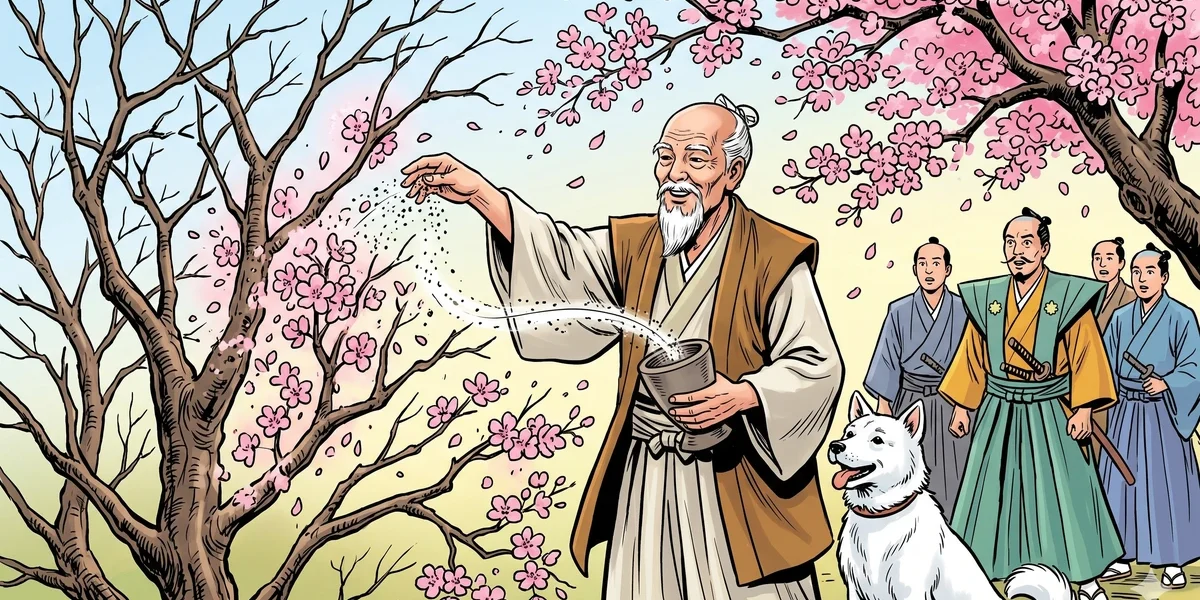
The old man, carrying the ashes of his beloved dog’s mortar, scatters them around the withered cherry trees in the garden. The trees burst into full bloom — white and pink blossoms in the middle of winter, a display so extraordinary that the news travels to the lord of the district. The lord summons the old man and asks him to bloom the trees in the lord’s garden. He scatters the ash. Every withered tree in the lord’s garden erupts in spring. The lord rewards him with gifts of great value.
The greedy neighbour hurries to gather the remaining ash from his fireplace — the burned remains of the mortar — and goes to the lord. He scatters the ash on the lord’s trees. Nothing blooms. The ash goes into the lord’s eyes. The greedy neighbour is punished for the deception.
Beat III — Ikigai and the Generative Character
Japanese folk commentary on Hanasaka Jiisan has consistently resisted the explanation that the ash is simply magic — a transferred power granted by the dog’s spirit and available to anyone who holds the correct material. The tale is structured to make this interpretation impossible: the greedy neighbour has the same ash, from the same mortar, and it produces the opposite effect. If the ash were a magical substance, it would work for whoever held it. It does not. What it responds to is the character of the person scattering it.
The concept of ikigai (生き甲斐, reason for being / that which makes life worth living) is relevant here: the old man’s character is constituted by his orientation toward life — his love for the dog, his generosity with the gold, his tenderness toward withered trees. When he scatters ash, he is scattering himself — the accumulated expression of a character that has always looked at dead things and wanted to see them bloom. The trees respond to this. The same ash in the greedy neighbour’s hands is scattering a different character — one constituted by the desire to acquire and the inability to give — and the trees are indifferent to it, or the lord’s eyes are not.
This is the tale’s most sophisticated claim: that what we carry inside us is what we actually scatter when we perform any action in the world, and that the world responds to what is scattered rather than to the gesture of scattering.
Beat IV — The Winter Blooming and the Lord’s Recognition
The flowering of winter trees is an image of extraordinary resonance in Japanese aesthetic tradition. Cherry blossoms — which bloom briefly in spring and are the subject of centuries of Japanese poetry, painting, and festival — are beautiful precisely because of their brief, intense presence in a world that will soon be green and ordinary again. Cherry trees in winter bloom, out of season, at a man’s touch: this is not merely a magical feat but a condensed symbol of what a person who carries genuine generative love can do to the world. He can restore to dead things the vitality they had when they were most alive, and he can do it in winter, when the world has stopped expecting it.
The lord’s recognition and reward are the tale’s conventional resolution, but they are not its point. The point is the moment of blooming — the scattering of ash by a man who does not know if it will work, who loved a dog and carried its remains with him because they were all he had left, and who offered them to the withered trees with the same uncalculating generosity that had characterised everything he had ever done. The trees knew.
“The power to make dead things bloom is not a technique that can be stolen — it is the natural expression of a character oriented toward life, and the one who copies the action without possessing the character finds that the same gesture produces a different result entirely.”
Why This Story Lasted
Hanasaka Jiisan has lasted because it makes a claim that everyone who has tried to replicate another person’s success by copying their method has discovered: the method is not the operative variable. What the old man does — scatter ash — is not what makes the trees bloom. What makes the trees bloom is what the old man is, expressed through the scattering. The story is the folk tradition’s most precise statement about the relationship between character and action.
The Three Great Japanese Folk Tales
Momotarō, Urashima Tarō, and Hanasaka Jiisan (or in some lists, Kintarō) form the canonical trio of Japanese folk tales taught to every child. Of the three, Hanasaka Jiisan is the most explicitly focused on generosity and its natural rewards — the on-gaeshi cycle taken to its fullest expression. The tale has been animated by Studio Ghibli affiliate studios, adapted into NHK children’s programming, and illustrated by every generation of Japanese children’s book artists. The image of the grandfather scattering ash around blooming winter cherry trees is one of the most recognisable visual icons in Japanese folk culture.
Frequently Asked Questions
What is the moral of Hanasaka Jiisan?
The action — scattering ash — is not what makes the trees bloom. What makes them bloom is the character of the person performing the action, which is expressed through everything they do. The greedy neighbour copies the gesture with the same material and produces the opposite result, because the material responds to what it carries — the person’s inner orientation — rather than to the procedure of scattering.
Why does the dog’s mortar multiply rice for the old man but not the neighbour?
The same reason the ash makes trees bloom for one but not the other: the mortar responds to the character of the user. The old man receives it because he genuinely loved the dog — not as an investment but as a companion — and uses it with the same uncalculating generosity. The neighbour uses it as a tool for acquisition, which is not what the mortar was given to serve.
What does winter cherry blooming symbolise in Japanese tradition?
Cherry blossoms are the supreme symbol of transient beauty in Japanese tradition — beautiful because they appear briefly and fall. Winter blossoming — out of season, at a person’s touch — is a compression of this symbol: it suggests that genuine generative love can restore to the world the beauty it had at its most alive, independent of whether the season supports it. The old man makes winter into spring, which is the folk tradition’s image of what a genuinely generous character does to the world around it.
Why does the greedy neighbour’s ash go into the lord’s eyes?
Because dead ash scattered without generative intent is just ash — and ash in the wind goes where the wind takes it, which in this case is directly into the eyes of the person the neighbour was trying to impress. The tale is not cruel about this: the neighbour is simply carrying nothing that the lord’s trees could respond to, and the ash behaves accordingly. The result is not punishment but physics.
What is on-gaeshi and how does this tale exemplify it?
On-gaeshi (恩返し, return of grace-debt) is the obligation a creature feels and discharges when it has received genuine, uncalculated benefit. In this tale, the dog’s on-gaeshi extends beyond its death — appearing in dreams, directing the old man to the mortar, indirectly producing the ash that makes the trees bloom. The dog’s on-gaeshi is proportionate to the love it received: not merely rice-multiplication or gold-finding, but the gift of the old man’s most celebrated public moment, which brings him recognition and reward in his final years.
You May Also Like
 Japanese Folk Tales
All Ages
Japanese Folk Tales
All Ages
The White Hare And The Crocodiles
The White Hare And The Crocodiles: Long, long ago, when all the animals could talk, there lived in the province of Inaba in Japan, a little white hare. The
 Japanese Folk Tales
All Ages
Japanese Folk Tales
All Ages
The Farmer And The Badger
The Farmer And The Badger: Long, long ago, there lived an old farmer and his wife who had made their home in the mountains, far from any town. Their only
 Japanese Folk Tales
Ages 9-12
Japanese Folk Tales
Ages 9-12
The Sagacious Monkey And The Boar
A clever monkey and a strong boar overcome their differences to work together, discovering that cooperation beats individual struggle.