The White Hare And The Crocodiles
The White Hare And The Crocodiles: Long, long ago, when all the animals could talk, there lived in the province of Inaba in Japan, a little white hare. The
Origin & Tradition
The White Hare and the Crocodiles (Inaba no Shiro Usagi, 因幡の白兎, “The White Hare of Inaba”) is one of the oldest narratives in the Japanese literary record, documented in the Kojiki (古事記, 712 CE) as part of the mythology of the god Okuninushi (大国主命). The creatures the hare crosses on are identified in the Kojiki as wani (和邇) — a word that can mean both shark and crocodile, and whose precise identification has been debated by scholars for centuries. The tale is a cosmological narrative about the hare’s suffering and Okuninushi’s compassion, and it introduces the god who will become the ruler of the earthly realm before the descent of the heavenly gods. It has been told and retold continuously in Japan, illustrated in woodblock prints, taught in schools, and adapted into children’s media across the modern period.
Beat I — The Bridge of Wani
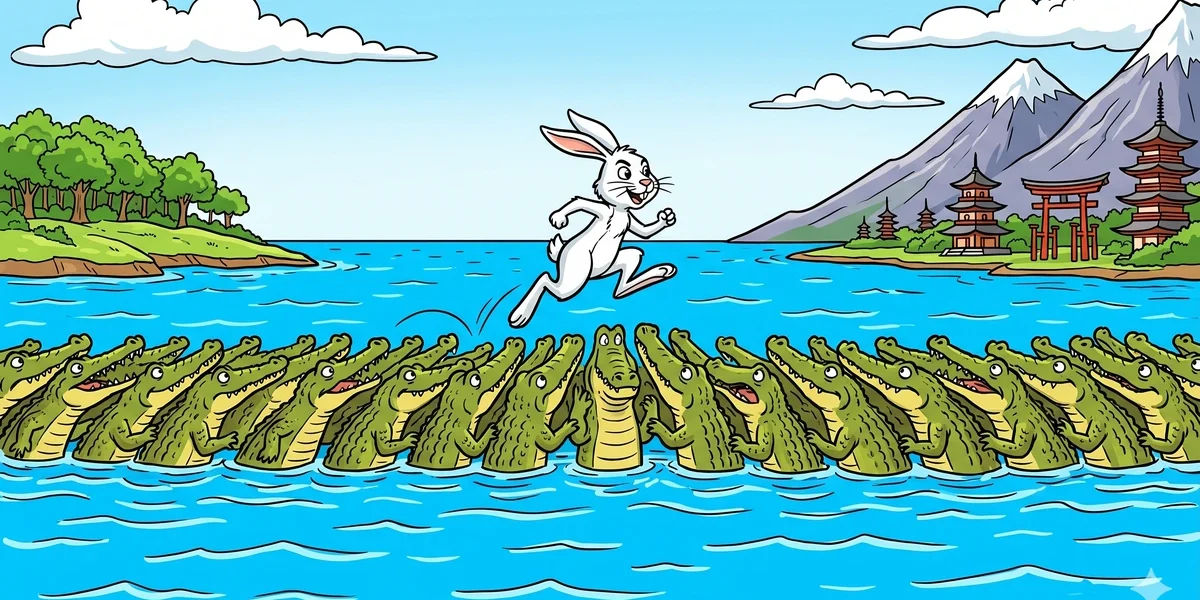
A white hare lives on the island of Oki and wishes to cross to the mainland of Inaba. It has no boat and cannot swim the distance. But it is clever, and it has an idea. It approaches the wani — the crocodile-sharks of the strait — and proposes a counting competition: which is more numerous, the hare’s kind on land or the wani’s kind in the sea? To count fairly, the hare says, the wani should line up from the island of Oki to the shore of Inaba in a single row, and the hare will count them as it crosses.
The wani, whose vanity is engaged by the competition, line up. The hare runs across their backs — one, two, three, counting as it goes — and reaches the final wani just before the mainland shore. There it makes its mistake: it laughs and tells the last wani the truth. It was never counting a population; it simply needed a bridge, and the wani provided it.
The last wani, furious, grabs the hare and strips it of its fur. The hare lies on the beach, skinless and in agony, when the eighty gods of the Okuninushi myth pass by on their way to court the princess of Inaba.
Beat II — The False Cure and the True One
The eighty gods see the hare’s suffering. They give it advice — but their advice is false, perhaps deliberately: wash in the seawater and dry in the wind. The hare follows the instructions. The salt and wind make its condition enormously worse. It writhes on the beach, suffering more than before.
The god Okuninushi arrives last, carrying the other gods’ baggage — he is treated as a servant by his brothers. He sees the hare and asks what happened. The hare explains: the crossing by deception, the boast, the punishment, and then the false cure. Okuninushi gives genuine instructions: wash in fresh water, roll in the pollen of kama grass, and lie in the sun. The hare does so. Its fur grows back. It is healed.
In gratitude, the hare tells Okuninushi a prophecy: he will win the princess of Inaba despite his eighty brothers. This comes true. Okuninushi’s kindness to the hare — uncalculating, given to a suffering creature when he had little reason to stop — is the first event of his divine career, the initial demonstration of the quality of compassion that will eventually make him the ruler of the earthly realm.
Beat III — Uso no Mukui: The Paradox of the Honest Boast
The hare’s error is structurally precise: it uses deception to accomplish a legitimate goal (crossing the sea), succeeds completely, and is then destroyed by honesty — specifically by boasting about the deception to the very party it deceived. This is uso no mukui (嘘の報い, the consequence of the lie) in its most paradoxical form: the suffering does not come from the lie itself but from the truth that revealed it at the worst possible moment.
Japanese folk tradition does not entirely condemn the hare’s initial cleverness — crossing the sea by convincing the wani to serve as a bridge is genuinely admirable in its audacity. What the tradition condemns is the boast: the inability to achieve the crossing and simply proceed with gratitude. The hare needed to lie to accomplish what it needed; it did not need to tell the wani it had lied. The boast served no purpose except the hare’s own satisfaction at its own cleverness, and that satisfaction cost it its fur.
This is the story’s most practical wisdom: the deception that works is best left unannounced, not because deception is honourable but because announcing it transforms a completed act into an ongoing insult. The wani would never have known they had been used as a bridge rather than as counting subjects if the hare had not told them. The hare chose to give them that knowledge, at the moment of maximum vulnerability — the last wani, last step before shore — and it paid the price that knowledge cost.
Beat IV — Okuninushi’s Compassion as Divine Credential
The tale’s second movement — Okuninushi’s healing of the hare — is not a folk moral about kindness rewarded. It is a theological statement about what makes a god qualified to rule. The eighty gods who gave false advice did so from a position of social superiority: they were already powerful, already on their way to court the princess, and had no particular reason to help a skinless hare on a beach. Okuninushi, carrying their luggage, had even less apparent reason to stop — and stopped, and helped correctly, and received a prophecy in return.
The Kojiki’s account of Okuninushi consistently frames his qualification for earthly sovereignty through his pattern of response to suffering: he helps when helping is inconvenient, without calculating whether the sufferer deserves help or whether the help will produce a return. The white hare on the beach — wounded by its own mistake and made worse by the advice of the powerful — is the first test of this quality, and Okuninushi passes it without knowing it is a test. The hare’s prophecy is not a reward for passing; it is the natural result of being helped correctly by someone who recognised what the correct help was.
“Cleverness used to manipulate those who trust you turns against you the moment you tell the truth — the hare that crossed the sea by deception could not unsay the deception, and suffered for the honesty that came too late and in the wrong direction.”
Why This Story Lasted
The White Hare of Inaba has lasted across thirteen centuries because it captures two experiences simultaneously: the specific pain of suffering that you brought upon yourself through your own mistake, and the specific relief of meeting someone who helps you anyway without judging you for the mistake. The hare’s beach agony is the folk tradition’s image of remorse; Okuninushi’s fresh water and grass pollen is the folk tradition’s image of genuine compassion — the kind that does not ask how you got here before deciding whether to help.
The White Hare in Japanese Religion and Art
The White Hare of Inaba is preserved at Hakuto Shrine (白兎神社) in Tottori Prefecture — the site traditionally identified as where the hare was healed — where it is venerated as a deity associated with matchmaking, an association that comes from its prophecy about Okuninushi and the princess. Tottori Prefecture, which was historically the Inaba Province, uses the white hare as its regional symbol. The story appears in the Kojiki’s account of Okuninushi’s early career and connects to the larger narrative of the earthly gods’ rule before the descent of the heavenly Ninigi. Woodblock-print illustrations of the hare on the wani’s backs and of Okuninushi’s healing are among the most frequently reproduced images in the Shinto mythological iconography.
Frequently Asked Questions
What is the moral of The White Hare and the Crocodiles?
Deception that accomplishes a legitimate goal is best concluded in silence — announcing it to those you deceived converts a completed crossing into an ongoing insult at your most vulnerable moment. The hare’s suffering comes not from the lie but from the boast about the lie, which was unnecessary, poorly timed, and served no purpose except the hare’s own satisfaction in its own cleverness. The story also teaches that genuine help, given without judgment about how the suffering was incurred, is both morally superior and practically more effective than advice given from superiority.
Are the creatures in the story crocodiles or sharks?
The Kojiki uses the word wani (和邇), which can refer to crocodiles, sharks, or a general category of dangerous sea creature. Classical Japanese scholarship has debated this for centuries. Modern consensus tends toward shark, since crocodiles are not native to Japan’s seas, while sharks are. Popular retellings use crocodiles for visual clarity and dramatic effect. The tale functions identically regardless of which creature the wani are.
Why do the eighty gods give the hare false advice?
The Kojiki does not explain their motive, and interpretations vary: deliberate cruelty, casual indifference, or the assumption that salt water is good for wounds (which it sometimes is, but not in this condition). The false advice serves the narrative function of contrasting with Okuninushi’s correct advice, establishing that the quality of help depends on whether the helper genuinely attends to the specific condition of the person suffering or simply applies a general rule without attention.
Why does the hare’s prophecy come true?
In Kojiki theology, gratitude of this intensity — expressed by a creature that has been genuinely, correctly, compassionately helped — carries the force of divine declaration. The hare is not an ordinary animal; it is a being in the Shinto mythological world where boundaries between divine, human, and animal are more fluid than in ordinary experience. Its prophecy is the natural expression of its recognition of what Okuninushi is, which the quality of his help has revealed to it.
What is Okuninushi’s significance in Shinto mythology?
Okuninushi (大国主命, “Great Land Master”) is the god who rules the earthly realm before the descent of the heavenly gods — specifically before Ninigi, the ancestor of the imperial line, descends from the High Plain of Heaven. His career is characterised by a series of trials and acts of compassion, of which the White Hare episode is the first. He is associated with medicine, agriculture, and relationships — all of which connect to the qualities his early life demonstrates. His shrine, Izumo Taisha in Shimane Prefecture, is one of the oldest and most sacred Shinto sites in Japan.
You May Also Like
 Japanese Folk Tales
All Ages
Japanese Folk Tales
All Ages
The Adventures Of Kintaro, The Golden Boy
The Adventures Of Kintaro, The Golden Boy: Long, long ago there lived in Kyoto a brave soldier named Kintoki. Now he fell in love with a beautiful lady and
 Japanese Folk Tales
All Ages
Japanese Folk Tales
All Ages
Momotaro, Or The Story Of The Son Of A Peach
Momotaro, Or The Story Of The Son Of A Peach: Long, long ago there lived, an old man and an old woman; they were peasants, and had to work hard to earn their
 Japanese Folk Tales
All Ages
Japanese Folk Tales
All Ages
The Jelly Fish And The Monkey
The Jelly Fish And The Monkey: Long, long ago, in old Japan, the Kingdom of the Sea was governed by a wonderful King. He was called Rin Jin, or the Dragon King