The Farmer And The Badger
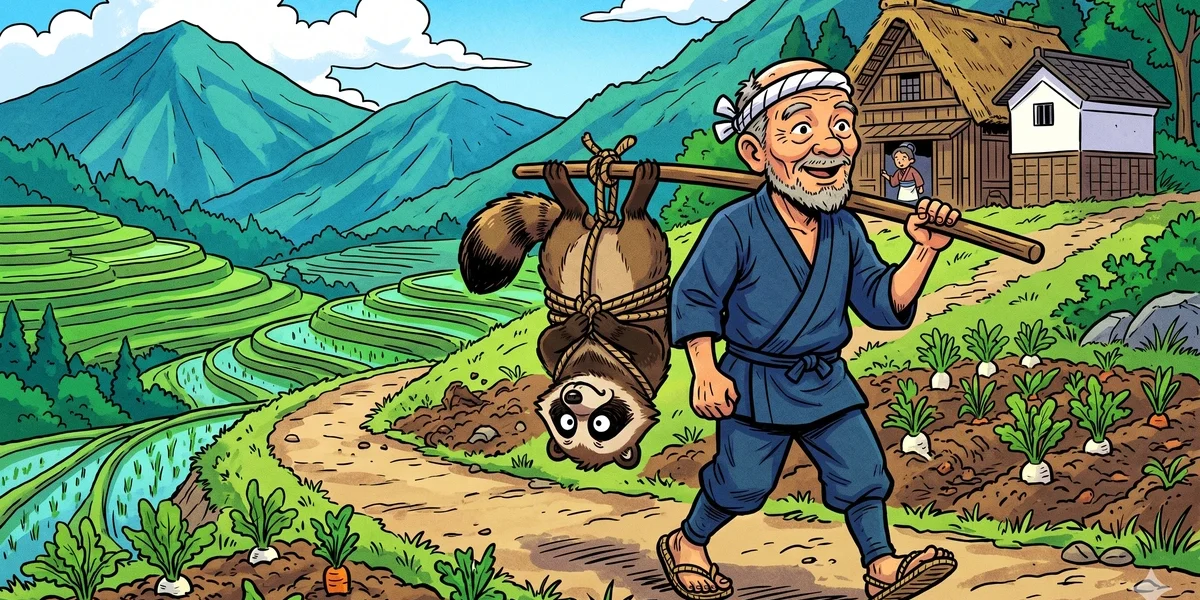
The Farmer And The Badger: Long, long ago, there lived an old farmer and his wife who had made their home in the mountains, far from any town. Their only
Origin & Tradition
The Farmer and the Badger belongs to the Japanese tradition of tanuki (狸) tales — stories featuring the raccoon dog, a creature whose supernatural capacity for shapeshifting (henge, 変化) makes it one of Japanese folklore’s most morally complex figures. Unlike the fox (kitsune), whose deceptions in folk tradition are often ambiguous in motive, the tanuki of this tale is straightforwardly malicious: it repays the farmer’s mercy with murder, destroys his household, and escapes detection by assuming the wife’s face. The tale is typically paired with a rabbit’s revenge sequence and belongs to the sub-genre of fukushū-tan (復讐譚, revenge narratives), in which justice unavailable through ordinary channels is delivered by an unexpected ally. It appears in numerous regional variants and was widely collected in Meiji-era folklore anthologies as one of the core Japanese tales of supernatural malice and its consequences.
Beat I — Mercy Given to the Malicious
A farmer catches a badger (tanuki) that has been raiding his vegetable garden. He ties it to a post, intending to make soup of it when he returns from the fields. His wife, who is generous in the way that kind people are generous without calculation, takes pity on the creature — it looks miserable, trussed and helpless — and unties it. The tanuki thanks her with apparent sincerity and departs.
It returns later that day. It kills the farmer’s wife, skins her, and cooks her in the soup pot. When the farmer comes home tired from the fields, the tanuki — wearing the wife’s face — serves him his supper. He eats. Only when the tanuki can no longer contain its satisfaction and begins to laugh does the farmer understand what he has eaten and what has happened. The tanuki drops the disguise, shows him its true form, and vanishes into the night.
Beat II — The Rabbit’s Revenge
The farmer is destroyed — not only by grief but by horror. He is an old man alone, without means of recourse; he cannot chase a shapeshifter through the mountains; he has no power the tanuki needs to fear. He sits in his ruined house and weeps.
A rabbit from the neighbouring forest hears of what happened. The rabbit and the farmer’s wife had known each other — she had left vegetables at the forest’s edge, and the rabbit had eaten them, and this was a kind of friendship that meant something. The rabbit makes a decision. It befriends the tanuki — which is not difficult, because the tanuki is pleased with itself and glad of admiration — and over a series of encounters engineers a sequence of punishments that are proportionate to the crime, methodical, and final. The specific methods vary across regional versions: fire, a broken boat of mud that dissolves under the tanuki in the sea, a false promise of medicine that is in fact something that burns. The tanuki dies — painfully, and with the rabbit watching.
The rabbit returns to the farmer and tells him it is done. The farmer weeps again, but differently.
Beat III — Tanuki as Malice in Shapeshifter Form
Japanese folk tradition maintains a nuanced taxonomy of shapeshifters. The kitsune (fox) transforms for complex reasons — sometimes to deceive, sometimes to repay debts, sometimes from love. The tanuki of this tale is not complex: it uses its shapeshifting capacity purely for malicious purposes, exploiting the farmer’s wife’s compassion to get close enough to kill her and then using her appearance to compound the horror by feeding the murder to the victim’s husband.
This tale is unusual in Japanese folklore for the directness of its moral: mercy was given and was weaponised. The farmer’s wife did nothing wrong — her compassion was genuine and was the precise quality the tanuki exploited. Japanese storytellers do not use this to argue against compassion; they use it to argue about the nature of evil. The tanuki is dangerous not because it is powerful but because it is able to wear the face of what is good. The most dangerous malice, the story claims, is the kind that presents itself as deserving mercy — and the only reliable defence against it is recognition, which arrives too late for the farmer’s wife and just in time for the rabbit.
Beat IV — Righteous Anger and the Limits of Forgiveness
The rabbit’s revenge is the tale’s most ethically complex element. The rabbit does not offer the tanuki an opportunity for remorse, does not give it a chance to make restitution, does not apply a proportionate punishment and leave it at that. The rabbit kills the tanuki — methodically, in stages, with the specific cruelty that mirrors the tanuki’s own treatment of the farmer’s wife. This is the me ni wa me (目には目, eye for eye) principle applied by a creature that has decided the normal channels of restraint do not apply to this particular case.
Japanese audiences have consistently read the rabbit’s revenge not as excessive but as appropriate — because the crime was not merely violence but the specific violation of trust, the weaponisation of mercy, and the compounding of murder with the theatrical horror of the husband eating his wife. The normal proportionality of response does not calibrate against this. The rabbit understands this intuitively, which is why it does not hesitate and does not apologise for what it does.
“Malice that wears the face of helpfulness is the most dangerous kind — and the creature that exploits trust and kindness to cause harm discovers that the one who was harmed may have allies in the natural world that malice cannot anticipate.”
Why This Story Lasted
The tale has lasted because it names and takes seriously a specific form of evil that polite discourse tends to underestimate: malice that presents itself as deserving compassion. The farmer’s wife is not naive — she is doing what kind people do. The tanuki is not confused — it knows exactly what it is doing. The story does not suggest she should have been less kind; it suggests the tanuki is a category of being that kind people need to be warned about. The rabbit’s revenge provides the satisfaction that the horror of the crime demands and that ordinary justice cannot deliver.
The Tanuki in Japanese Culture
The tanuki (raccoon dog, Nyctereutes procyonoides) is one of Japan’s most culturally prominent animals — the subject of a vast body of folklore, a common symbol of good luck in business (tanuki statues are placed outside shops and restaurants), and a figure in art from medieval scrolls to modern animation (Studio Ghibli’s Pom Poko). Its folk-tradition duality — simultaneously comic, lucky, and capable of lethal shapeshifting malice — makes it one of the most complex animals in the Japanese supernatural bestiary. The farmer-and-badger tale represents the tanuki’s most malicious mode; other tales depict it as comic, benign, or merely mischievous.
Frequently Asked Questions
What is the moral of The Farmer and the Badger?
Malice that presents itself as deserving compassion is the most dangerous kind, and the person who extends mercy in good faith is not at fault when that mercy is weaponised. The rabbit’s revenge is the story’s answer to the question of what justice looks like when a crime is so extreme that ordinary proportionality cannot contain it — and when the criminal has made calculation and restraint impossible by what it chose to do.
Why does the farmer’s wife release the tanuki?
Because it is tied up and looks miserable, and she is a kind person. The story does not frame this as a mistake in her character — it frames it as the precise quality the tanuki exploited. She did what kind people do. The tanuki chose to weaponise that kindness. The moral responsibility is entirely the tanuki’s.
Why does the rabbit take revenge on the farmer’s behalf?
Because the farmer’s wife had been kind to the rabbit — leaving vegetables at the forest edge — and the rabbit understood this as a relationship that carried weight. The rabbit’s revenge is not altruistic in the abstract; it is the specific response of a creature that knew the victim and chooses to act because ordinary channels of justice are not available to an old man against a supernatural shapeshifter.
Is the tanuki always malicious in Japanese folklore?
No — the tanuki is a morally complex figure in Japanese tradition. In many tales it is comic, harmless, or even beneficial; tanuki statues are common symbols of prosperity. The farmer-and-badger tale represents the tanuki’s extreme malicious mode, which exists alongside its comic and benign modes in the same tradition. The same shapeshifting capacity that enables kindly pranks enables this murder — the difference is entirely in the character of the individual tanuki, not in the species.
How does this tale relate to other Japanese revenge narratives?
Japanese tradition has a rich genre of fukushū-tan (revenge tales), of which the most famous is the historical account of the Forty-Seven Rōnin. The farmer-and-badger tale belongs to the folk-tradition version of this genre, in which the avenger is not a samurai but a small animal, and the target is not a corrupt official but a supernatural malicious being. The folk version makes the same argument as the aristocratic version: that certain crimes place their perpetrators outside the protection of normal moral restraints, and that the avenger who acts against them is performing a function the world requires.
You May Also Like
 Japanese Folk Tales
Ages 9-12
Japanese Folk Tales
Ages 9-12
The Snow Woman (Yuki-Onna)
The Snow Woman (Yuki-Onna): In the mountains of Japan, where winter descended with the weight of ancient spirits and snow fell so thickly that the world became
 Japanese Folk Tales
All Ages
Japanese Folk Tales
All Ages
The Story Of Urashima Taro, The Fisher Lad
The Story Of Urashima Taro, The Fisher Lad: Long, long ago in the province of Tango there lived on the shore of Japan in the little fishing village of
 Japanese Folk Tales
All Ages
Japanese Folk Tales
All Ages
My Lord Bag Of Rice
My Lord Bag Of Rice: Long, long ago there lived, in Japan a brave warrior known to all as Tawara Toda, or “My Lord Bag of Rice.” His true name was Fujiwara