The Story of the Lion and the Hare
The Story of the Lion and the Hare: In the jungle, there lived a lion by the name of Bhasuraka. He was very powerful and used to kill the other animals

The Story of the Lion and the Hare
Origin and Manuscript Tradition
This is among the most celebrated tales in the entire Panchatantra, appearing in every known Sanskrit manuscript family and surviving the journey through Persian, Arabic, and European transmission without losing a single essential element. The story appears in the Pali Jataka collection as well (Jataka no. 322, the Sasa Jataka), where the Buddha in a former life appears as the hare that outwits the lion, lending the narrative both Brahmanical and Buddhist canonical authority. In all versions, the core argument is identical: the capacity to reason, deployed at precisely the right moment, is the superior force against any power that operates on instinct alone. Vishnu Sharma placed it in Book I (Mitra-bheda, The Separation of Friends) as the preeminent demonstration that intelligence overmatches strength when the intelligent actor controls the information available to the stronger one.
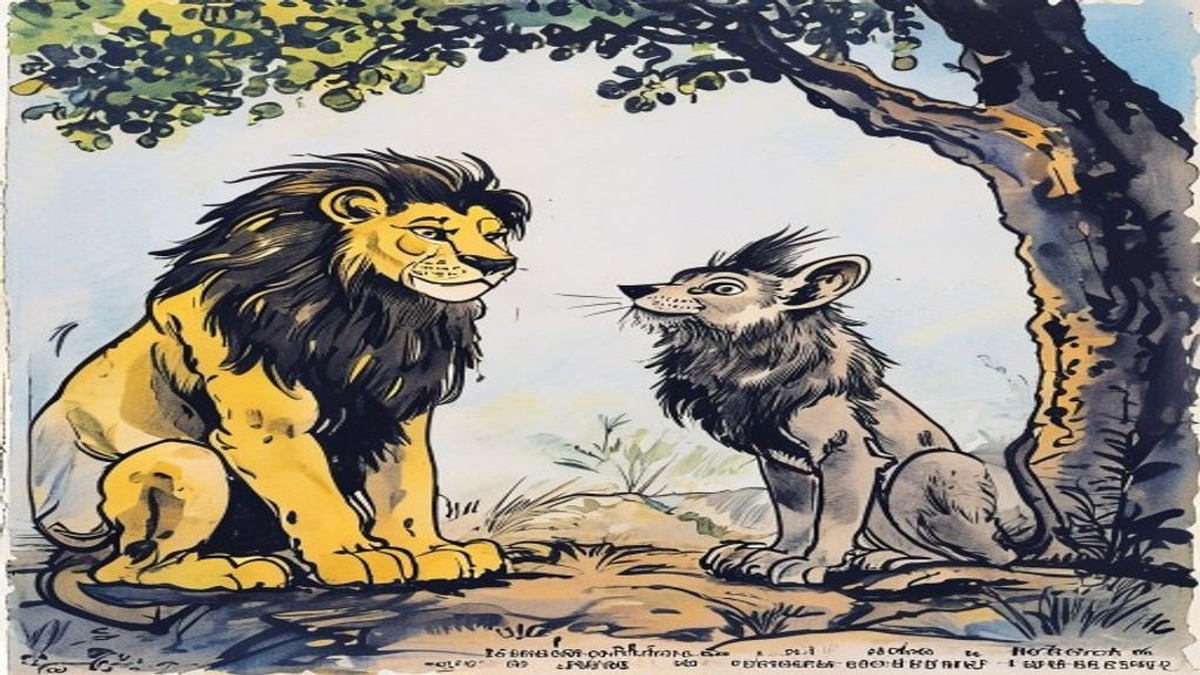
The Terrible Bargain
A lion called Bhasuraka had taken up residence in a forest and was killing indiscriminately — not from hunger alone but from the pleasure of hunting, chasing, and asserting dominance. On some days he killed three or four animals and left most of the carcasses untouched. The forest’s population declined visibly with each season. The deer no longer grazed; the rabbits no longer emerged from their burrows; the birds fell silent in the lower canopy. The entire ecology of the forest contracted around the lion’s unpredictable violence.
The animals held council beneath the great banyan tree. After long discussion they sent a delegation to the lion with a proposal: they would send him one animal each day, willingly, to eat. In exchange he would stop hunting. The lion would have guaranteed food with no expenditure of energy; the animals would lose one member per day but would retain the predictability needed to rebuild their populations. The lion considered this. He was old enough to know that hunting was becoming harder as he aged. He accepted.
For many weeks the arrangement held. Each morning the animals chose by lot who would go. Each morning one creature walked to the lion’s den and did not return. The forest recovered marginally — the deer grazed again, the birds returned — but the daily offering was a wound that never closed. When the lot fell on the hare named Sheelavati, the other animals expected her to walk to her death as the others had. Sheelavati had other intentions.

The Hare’s Delay and the Story She Told
Sheelavati arrived at the lion’s den long after midday. The lion was furious — pacing, hungry, his tail lashing. “You are small and you are late,” he roared. “Why should I not kill every animal in the forest for this insult?” Sheelavati bowed her head respectfully and replied with perfect composure: “Your Majesty, I am late because I was delayed. I was sent with five companions, so that you might have a proper meal, but on the road through the ravine we were stopped by another lion. He declared that this forest was his territory and demanded we surrender to him. I alone escaped to bring you this news.”
The lion went very still. Another lion. In his forest. Claiming his territory. “Show me this lion,” he said, in a tone that suggested the other lion’s remaining moments were numbered. Sheelavati led him through the forest, by a careful route she had already walked twice to verify the detail she needed, to the edge of a deep, still well. She stopped and pointed down. “He lives in there, Your Majesty.”
The lion leaned over the edge of the well and looked down. He saw a lion looking back up at him — large, maned, furious, and apparently unafraid. He roared. The lion in the well roared back, delayed by the well’s acoustics but seemingly with equal force. The lion on the rim gathered his haunches and leaped at his reflection to destroy it.

The Well, the Reflection, and the Freedom
The lion fell into the well. The walls were too steep and too wet for him to climb. The hare sat at the well’s rim and listened to the splashing below until it stopped. Then she walked back through the forest at a pace entirely different from the one she had used on the way out.
The animals gathered when she returned and asked what had happened. She told them. The council was silent for a moment — the silence of creatures that have just understood that the thing they believed immovable was, in fact, movable by a mind small enough to fit in a burrow. Then the forest came alive with sound: the deer called, the birds sang, the monkeys crashed through the canopy in the specific way they only did when the top of the hierarchy had changed and movement was safe again.
Vishnu Sharma’s observation at the tale’s close is precise: the lion was not defeated by superior force. He was defeated by the management of information. Sheelavati never confronted the lion’s strength; she redirected it. She gave him exactly what his nature demanded — a rival, a threat to his dominance, something to destroy — and arranged reality so that what his nature demanded of him was fatal. The lion cooperated perfectly in his own destruction. He could not have done otherwise; he was a lion.

Moral and Sanskrit Wisdom
बुद्धिर्यस्य बलं तस्य
Buddhiryasya balam tasya — “The power belongs to the one who has intelligence.”
— Panchatantra I, proverbial tradition
This aphorism, one of the most widely cited in Sanskrit literature, is the thematic key to the entire story. Bhasuraka had physical power in absolute abundance; Sheelavati had none. Yet power without intelligence is directional rather than strategic: it goes where it is pointed. The hare’s achievement was to point the lion’s power at the lion. The Sanskrit tradition calls this prajna-bala — the strength that comes from wisdom — and considers it categorically superior to muscular force precisely because it can redirect force rather than merely resist it.
Why This Story Has Lasted 2,300 Years
The Lion and the Hare endures because it resolves the apparently hopeless situation — small creature, overwhelming opponent, no escape — through a method that is genuinely reproducible rather than miraculous. Sheelavati does not receive divine assistance. She does not discover that the lion has a hidden weakness. She uses what she knows about the lion’s psychology — his territorial aggression, his need to dominate, his inability to back down from a perceived challenge to his sovereignty — and constructs a situation in which those properties destroy him. This is within the reach of any mind capable of accurate modelling of another’s behaviour.
The story has been read as a political manual for the weak against the powerful since antiquity. Every tradition that has transmitted it has found in it the same lesson: the asymmetry of physical power is not the asymmetry of effective power. A small actor who understands the powerful actor’s psychology thoroughly, and who can construct the right information environment, can prevail against an adversary of vastly greater physical strength. The well is not just a literal well; it is any situation in which the powerful actor’s own nature becomes the trap.
There is also a subtler lesson embedded in the story’s framing. The animals’ bargain with the lion — one life per day for collective survival — was not cowardice but rational adaptation to a constraint that appeared immovable. Sheelavati did not condemn the bargain; she simply tested whether it was actually immovable. It was not. The lesson is not that the animals were wrong to make the bargain but that no constraint should be accepted as permanent before the truly intelligent member of the group has had an opportunity to examine it. The hare did not need to be braver than the lion. She needed to be smarter, and she was.
Frequently Asked Questions
What is the moral of the Lion and the Hare?
Intelligence overmatches physical strength when the intelligent actor can redirect the stronger actor's own power against itself. Sheelavati defeated the lion not by resisting his strength but by aiming it at his own reflection.
What Sanskrit aphorism does this story illustrate?
Buddhiryasya balam tasya — 'The power belongs to the one who has intelligence.' This is one of the most widely cited aphorisms in Sanskrit literature and runs through the Panchatantra as an organising principle.
Is there a Buddhist version of this story?
Yes — the Sasa Jataka (no. 322) presents a parallel in which the Buddha in a former life appears as the hare that outwits the lion. The tale thus has authority in both the Brahmanical Panchatantra tradition and the Pali Buddhist Jataka canon.
Why did the animals agree to send one creature per day to the lion?
The bargain was rational adaptation to a constraint that appeared immovable: random slaughter was worse than a predictable one-per-day toll. The hare's achievement was to test whether the constraint was truly immovable — and find that it was not.
What is prajna-bala in Sanskrit thought?
Prajna-bala means the strength that comes from wisdom, as distinct from muscular force. The tradition considers it categorically superior because it can redirect strength rather than merely resist it — exactly what Sheelavati demonstrates by turning the lion's aggression against himself.
You May Also Like
 Panchatantra Stories
Ages 3-5
Panchatantra Stories
Ages 3-5
The Lion And The Crane
The Lion And The Crane: The Bodhisatta was at one time born in the region of Himavanta as a white crane; now Brahmadatta was at that time reigning in Benares.
 Panchatantra Stories
Ages 3-5
Panchatantra Stories
Ages 3-5
The Bird and the Monkey
The Bird and the Monkey: Never give advice unless you are asked for it.” There lived a group of monkeys in the mountains. During one winter, there were heavy
 Panchatantra Stories
Ages 9-12
Panchatantra Stories
Ages 9-12
The Camel, The Jackal And The Crow
The Camel, The Jackal And The Crow: In a far off forest, there lived a lion named Madotkata served by a leopard, a jackal and a crow. One day they sighted