The Lion, the Camel, the Jackal and the Crow
Trust given despite proven dishonesty proves fatal when a camel ignores a jackal's conspiracy.
“A king’s word is the cornerstone of his kingdom. The moment he allows a loophole in it, the loophole becomes the door through which his kingdom collapses.”
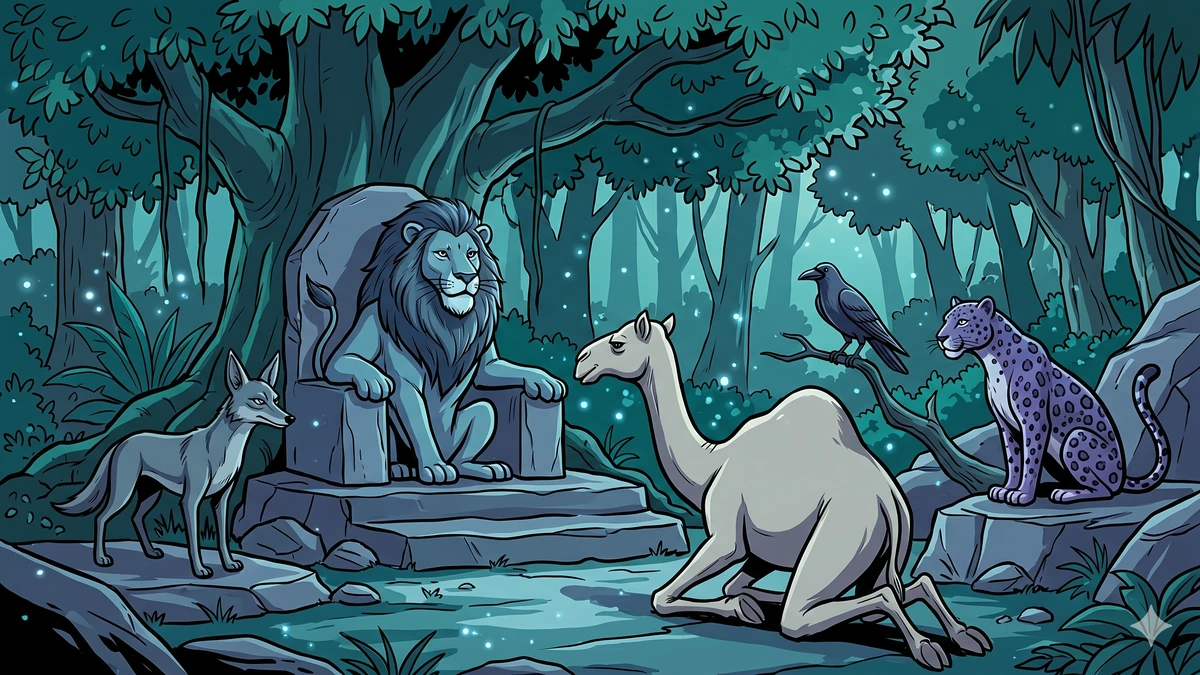
This is one of the most pointed and most political fables in the entire Panchatantra. It is the story of Madotkaṭa the lion-king, Kṣudrabuddhi the jackal, Vāyasa the crow, Citravarṇa the leopard, and Kathanaka the camel — a tale about how a king’s pledge of protection can be eroded by sweet counsel and false ritual until the protection becomes a lie. It comes from Book III of the Panchatantra, called Kākolūkīyam (काकोलूकीयम्, “Of Crows and Owls”), which is the great Panchatantra book on counsel, alliance, and betrayal. Within the larger Crows-and-Owls war frame, the wise old crow-counsellor Sthirajīvin tells this fable to illustrate the danger of false counsel and broken protection.
The Sanskrit names in this story are not decorative. They are the moral. The lion’s name Madotkaṭa means “the proud one” — a king consumed by his own pride. The jackal’s name Kṣudrabuddhi means “petty-minded” — and the petty mind, the Sanskrit text is saying, is dangerous precisely because it is small enough to fit through any loophole. The camel’s name Kathanaka evokes the rough, hardy, out-of-place creature that he is: a domesticated trader’s beast wandered into a court of wild animals. When you read the names back into the story, the Panchatantra’s argument becomes precise: when “the proud one” lets “the petty-minded one” speak in his court, even “the rough hardy outsider” who has been promised safety will not survive the day.
Here is the story as the Panchatantra has held it for two thousand years.
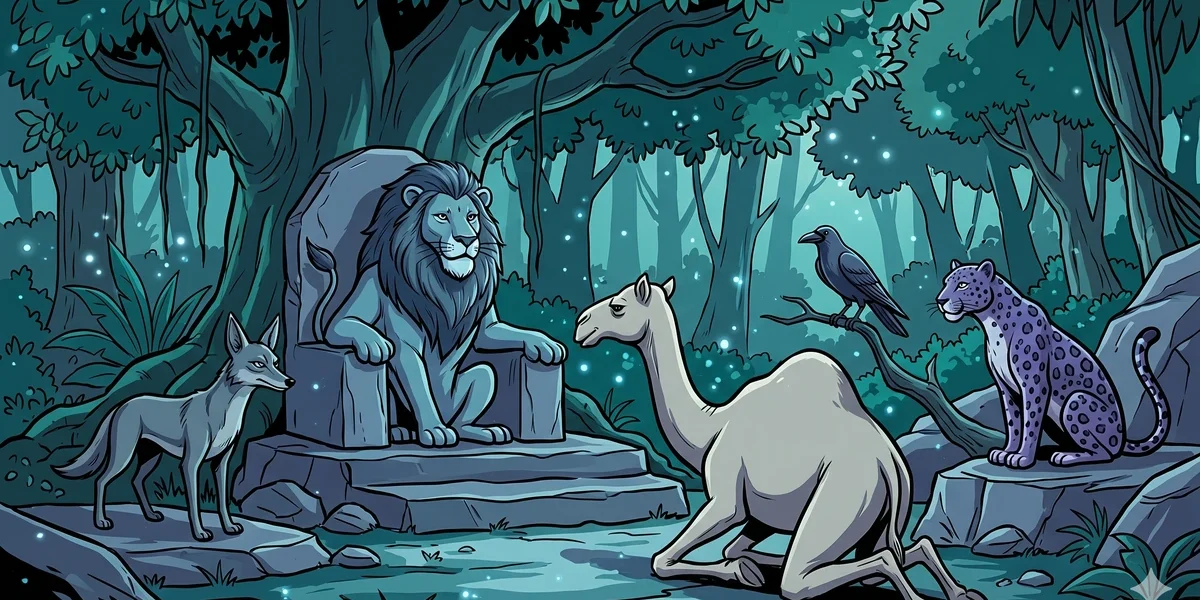
In a great forest of teak and bamboo and cool dark śāl trees, there ruled a lion-king named Madotkaṭa. He was a king in the old sense — strong-shouldered, deep-voiced, his mane like a thunderhead. At his court were three retainers: Kṣudrabuddhi the jackal, slate-grey and narrow-eyed; Vāyasa the crow, watchful and quick; and Citravarṇa the leopard, dappled and silent. They lived on the king’s leavings and walked with him in the morning round of his kingdom.
One day, while wandering in the deeper part of the forest where the old trade-roads ran, the king saw a creature he had never seen before — a tall, long-necked, hump-backed beast with patient eyes, grazing in a meadow. It was a camel. He had separated from his trader’s caravan and had wandered, lost, into the jungle. His name was Kathanaka.
The crow, who flew far and saw villages, knew. “Master, that is a camel. He is a beast of the towns. His flesh is said to be sweet. Let us kill him.”
But Madotkaṭa shook his great head. “No. He has come into my forest unknowing. He is a stranger and a guest. Go and bring him to me, and tell him from me that no harm shall come to him.”
The retainers went and gave the king’s word, and Kathanaka, who had no other choice, came. He bowed his long neck before the lion and told the story of how he had been left behind by his caravan.
And Madotkaṭa, in the way of true kings, gave him abhayadāna — the king’s pledge of protection. “Live in my forest, friend. The grass is rich. No animal under my rule will harm you. You are under the king’s word.”
And so it was, for many seasons. The camel grew sleek on the cool jungle grasses; he walked at a respectful distance with the king’s morning court; and the king’s word stood.
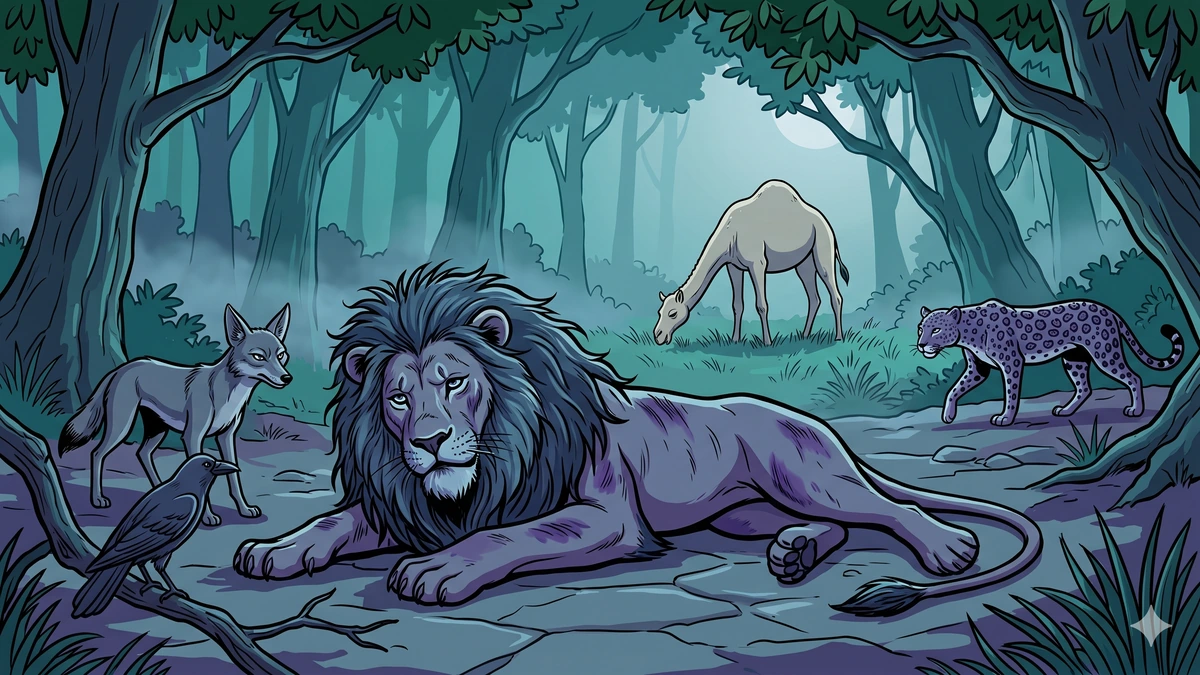
Then came a misfortune. A mad bull-elephant — one of those rogues who broke from the herd in the dry months — entered the king’s territory, and Madotkaṭa fought him. The lion drove the elephant back, but he himself was so deeply gored that for many days afterwards he could not stand, much less hunt. He lay on the dappled stone of his lair, breathing slow, and the forest grew quiet around him.
The retainers grew hungry. They had grown soft on the king’s leavings, and now there were no leavings. They walked the forest looking for game and came back with nothing. (The truth was that they had grown lazy and had forgotten how to hunt for themselves; but no retainer ever admits this aloud.)
It was Kṣudrabuddhi the jackal — the petty-minded one — who saw the opening first. He drew the crow aside under a cool dark fig-tree. “Listen, brother. We are wasting our claws looking for game in the forest when there is enough food walking among us to feed us all for a month.”
The crow’s small black eyes turned cold. “You mean Kathanaka.”
“I mean Kathanaka.”
“The king has given him abhayadāna. He will never agree.”
“Leave the king to me.”
And the jackal went alone into the lion’s lair.
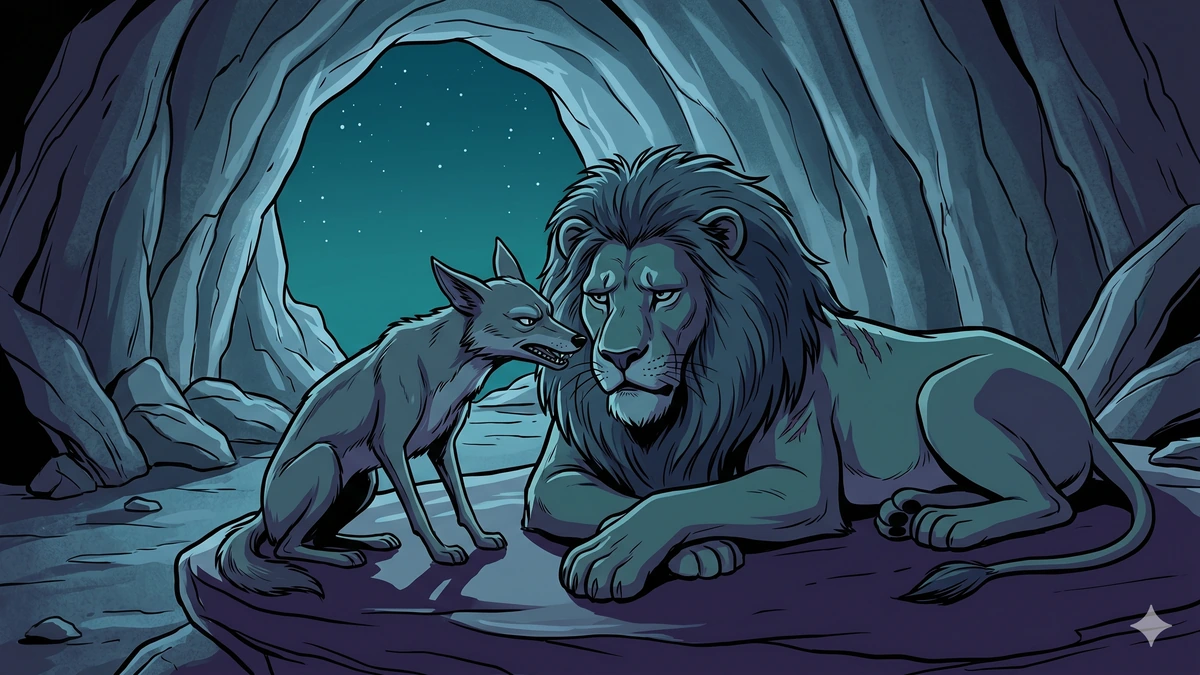
“Master,” said Kṣudrabuddhi softly, “we are starving. The forest has no prey for us. Your retainers grow weak. There is one solution, and only one.” He paused, watching the king’s face. “The camel.”
The lion, weak as he was, half-rose from his stone in fury. “Out of my sight! I have given Kathanaka the king’s word. I have given him abhayadāna. To kill him would be the gravest sin a king can commit. The kingdom of any king who breaks his pledge falls into dust. Speak no more of it.”
And here Kṣudrabuddhi did what petty-minded counsellors do in every age. He bowed deeply. He lowered his voice. And he offered the loophole.
“Of course, sire. Of course. To kill him having pledged him safety would be unforgivable. I would never propose it. I propose only this: if Kathanaka were, of his own free will, to offer himself as food for his suffering king — then to accept the gift would not be sin. It would be the receiving of a guest’s freely-given offering. Not killing. Acceptance.”
The lion was silent for a long while. He was hungry. He was proud. And the loophole — like all good loopholes — sounded almost like dharma.
“If he offers himself,” said Madotkaṭa at last, very low, “then it is not killing.”
The jackal smiled, and bowed, and went out.
What followed was the part of the story the Panchatantra never lets us forget — and never lets us forgive. The retainers gathered. The jackal explained. They would all go before the king in turn, the crow first, then the jackal, then the leopard. Each would offer himself. Each would be “spared” by another retainer’s objection. The camel, watching, would feel the social weight of all of them having offered themselves nobly, and would offer himself in turn — and the jackal would be ready to declare his offering binding.
Vāyasa the crow stepped forward first. “Master, I beg you. Eat me. Let your servant feed his king.” Kṣudrabuddhi cried out: “No, master, no — the crow is too small. To kill him would defile your kingship for no benefit.”
Then the jackal himself: “Master, eat me. I lay down my body for my king.” The crow cried out: “No, master — the śāstras forbid the eating of jackals. The king would be polluted.”
Then Citravarṇa the leopard: “Master, eat me. The honour would be mine.” Both crow and jackal cried out together: “No, master — the leopard is the king’s cousin in the jungle. Cousin-flesh is forbidden. The king would be doubly polluted.”
Three offerings. Three refusals. A flawless little theatre.
And the camel, standing at the edge of the lair — Kathanaka, who knew nothing of jungle politics, who had only ever known the trader’s road and the kindness of his master — saw three creatures offer themselves and be honourably spared, and he understood, with the simple honour of a domesticated beast, that the only thing left for him to do was to step forward in his turn.
“Master,” said Kathanaka, lowering his long neck, “eat me. Let me give back to the king who gave me his shelter.”
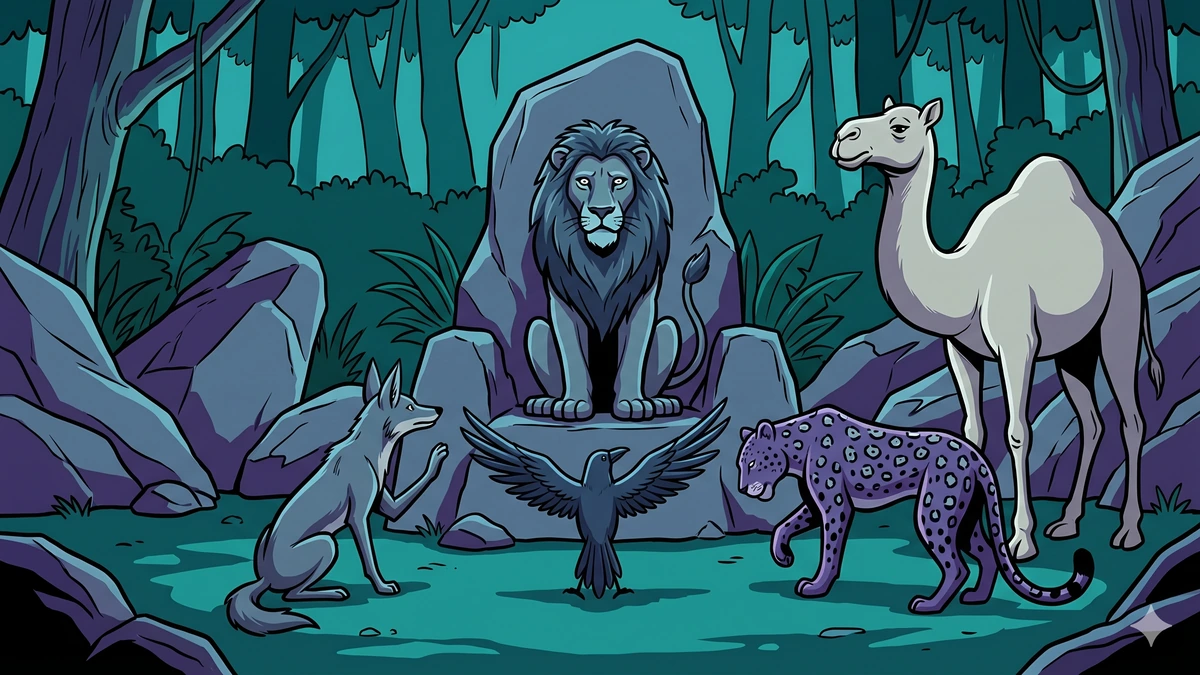
The jackal turned at once to the lion. “Sire — his offering is freely given. To accept is no sin.”
And the king, who had been weak and proud and now was nothing more than weak, allowed the loophole he had bought.
The retainers fell on the camel.
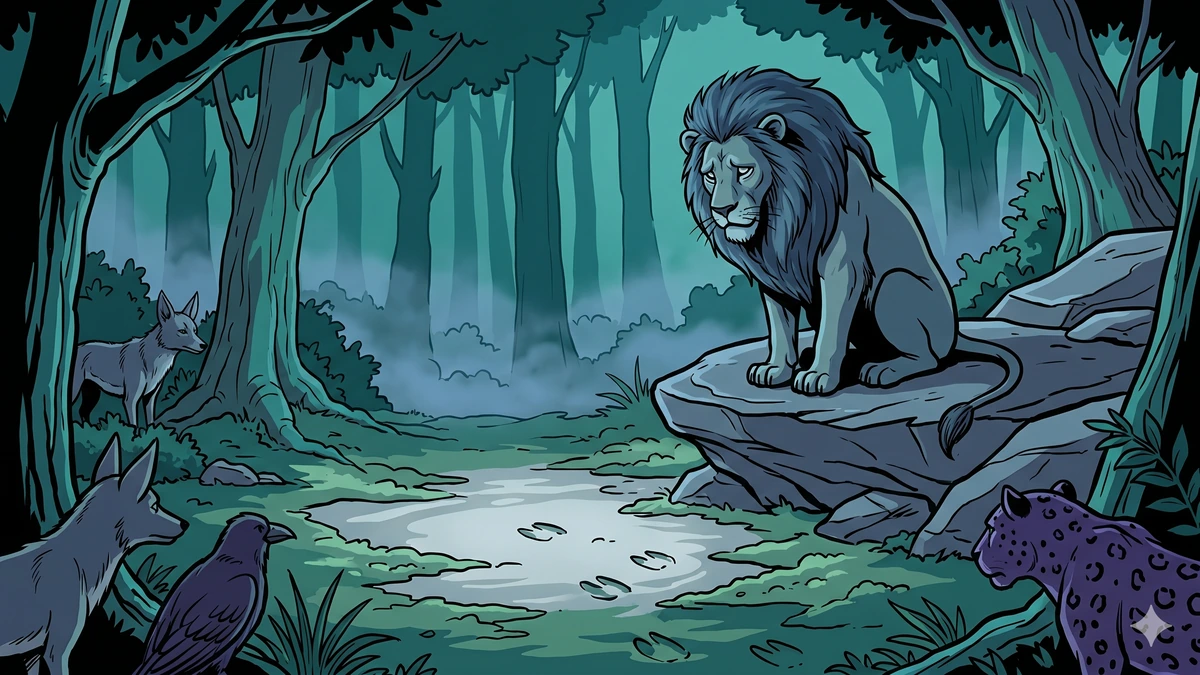
And here the story does something the Panchatantra is famous for. It does not pretend the king is rewarded. It does not pretend he is now strong, or that the kingdom prospers. The lion eats. The retainers eat. And then they sit on the cool stone of the lair, and there is a silence between them, and Madotkaṭa is no longer a king. He is the head of a band of conspirators. The grasses where the camel once grazed are empty. The forest no longer trusts the king’s word, because the forest has noticed how the king’s word can be turned into its opposite by a sentence and a smile.
“From this day,” says the Panchatantra, “the king never again recovered his strength.”
What the story is really about
The most important Sanskrit verse attached to this fable is durjana-saṅgāt parityajeta (दुर्जन-सङ्गात् परित्यजेत) — “shun the company of the wicked.” The surface moral is the obvious one: do not keep company with petty-minded people, because their counsel will eventually corrupt your decisions. Vishnu Sharma is teaching the young princes who are the audience of the Panchatantra a basic survival lesson: the people you allow into your court are the people whose minds will, slowly, become your mind.
But the deeper teaching of this fable, and the reason it is in Kākolūkīyam rather than in any of the other books, is something more uncomfortable. This is a story about the fragility of the king’s pledged word. Madotkaṭa never says “kill the camel.” He never directly breaks abhayadāna. The jackal’s loophole — “if Kathanaka offers himself, accepting is not sin” — is technically and legally true. The lion is innocent in the letter of his protection. But the Panchatantra’s deepest argument is that the letter of the king’s word is not the king’s word. The king’s word is a moral atmosphere, a circle of safety that surrounds the protected one. The moment the king allows a clever counsellor to find a loophole in that atmosphere, the atmosphere is gone, no matter what the words technically say. And once the king’s word is no longer trustworthy, the king is no longer a king. He is the head of a band.
This is one of the rare fables in world literature that names the disease so precisely. It is not the wicked counsel that destroys the kingdom. It is the king’s willingness to entertain the loophole. The jackal cannot, by himself, kill the camel. The jackal can only offer the king a way to seem innocent while doing the unthinkable. And the king’s tragedy is that, weak and hungry, he accepts.
The classical commentators add another layer. The petty-minded counsellor — the kṣudrabuddhi — is dangerous precisely because his mind is small. A great mind cannot find the loophole, because a great mind moves in great circles and does not see the small openings. The petty mind is shaped exactly like the loopholes it finds. And the tragedy of every court is that the petty mind, by sheer specialisation, eventually convinces the great mind that the loophole is “really” the truth.
How the story travelled
The story moved out of India in the 6th century CE, when the Persian physician Borzūya translated the Panchatantra into Pahlavi for the Sasanian court of Khosrow I. From Pahlavi it passed in the 8th century into Arabic in Ibn al-Muqaffaʿ’s Kalīla wa Dimna, where it survives almost intact under the chapter of “The Lion and the Bull” cycle. From Arabic it moved into Persian as the Anvār-i Suhaylī (15th century), into Hebrew through the work of Rabbi Joel, into Latin in John of Capua’s Directorium Humanae Vitae (13th century), and into Spanish as Calila e Dimna (1251), the version commissioned by Alfonso X of Castile — one of the earliest pieces of secular Spanish prose. It is one of the most-translated fables in the entire Kalīla wa Dimna tradition, because the moral about court loopholes was as urgent in medieval Persia and Spain as it had been in ancient India.
A close Buddhist parallel is preserved in the Pali Sigāla-Jātaka (Jātaka 152), in which a jackal-counsellor in a royal court manipulates a lion-king through false ritual. The structural similarity is so close that some scholars consider the two to share a single oral source older than either text.
The motif is catalogued in modern folklore studies under ATU motif K2010, “Hypocrite pretends friendship but attacks,” and is closely related to ATU 121, “Wolves climb on top of one another.” But the Panchatantra version remains the unsurpassed model — because it is not merely about hypocrisy. It is about the precise mechanism by which a king’s word, the most sacred political fact in classical Indian thought, can be unmade by a single sentence in a single mouth.
For thoughtful readers — a small reflection
The hardest line in the entire fable is the one Madotkaṭa speaks to himself in silence after the jackal leaves: “If he offers himself, then it is not killing.” He has not yet eaten the camel. The camel is still alive in the meadow. There is still time to call the jackal back. But the lion has already, in his own mind, agreed to the loophole — and once the loophole is agreed to, the deed is done. The Panchatantra is showing us, with extraordinary precision, the moment of moral failure: not the act, but the silent assent in the king’s mind to the framing.
This is why the fable belongs in Kākolūkīyam, the book of counsel and betrayal. It is a king’s manual disguised as an animal story. And its quietest, most important warning is this: the moment you find yourself searching for the framing in which the unthinkable becomes acceptable, you have already done the thing. The act follows the framing as the body follows the shadow. Refuse the framing — refuse to even hear the loophole — and the kingdom is safe. Entertain the loophole, and the kingdom is already, in some invisible sense, gone.
This is why the moral of the fable is not, in the end, about jackals or camels at all. It is about the kingship that lives, or fails to live, inside every person who has ever been asked to compromise a pledged word. Durjana-saṅgāt parityajeta — shun the company of the wicked. But more deeply: shun the loopholes their company offers you, because the loopholes, once entertained, become the doors through which everything you have promised walks out of your life forever.
Moral
दुर्जनसङ्गात् परित्यजेत्। — durjana-saṅgāt parityajet — “Shun the company of the wicked.” This is the maxim of the fable in its Pūrṇabhadra recension. But the Panchatantra’s deeper warning is finer than that: shun the loopholes their company offers you. King Madotkaṭa does not eat the camel. He merely listens, in silence, to the framing in which eating the camel becomes acceptable. The act follows the framing as the body follows the shadow. The moment you find yourself searching for the form of words in which the unthinkable becomes acceptable, you have already done the thing. The kingdom is already, in some invisible sense, gone.
Frequently Asked Questions
What is the moral of The Lion, the Camel, the Jackal and the Crow?
Which Panchatantra book has The Lion, Camel, Jackal and Crow?
Why was the camel killed by the lion in the story?
What lesson does this Panchatantra story teach about courts and kings?
Is The Lion, the Camel, the Jackal and the Crow a good story for kids?
You May Also Like
 Panchatantra Stories
Ages 6-8
Panchatantra Stories
Ages 6-8
The Story of the Bug and the Flea
The Story of the Bug and the Flea: In a certain country lived a king who had a verybeautifully decorated bedroom. An exquisite white silksheet covered the bed
 Panchatantra Stories
All Ages
Panchatantra Stories
All Ages
The Story of Mother Shandili
The Story of Mother Shandili: Once, during the monsoon season, I requested a Brahmin to allow me to stay with Qim, so that I couldfast and pray undisturbed.
 Panchatantra Stories
Ages 6-8
Panchatantra Stories
Ages 6-8
The Thief and the Brahmins
Brahmins trust a reformed thief with their treasure and pay the price when his nature resurfaces.