The Horned Women
The Horned Women: A rich woman sat up late one night carding and preparing wool, while all the family and servants were asleep. Suddenly a knock was given at
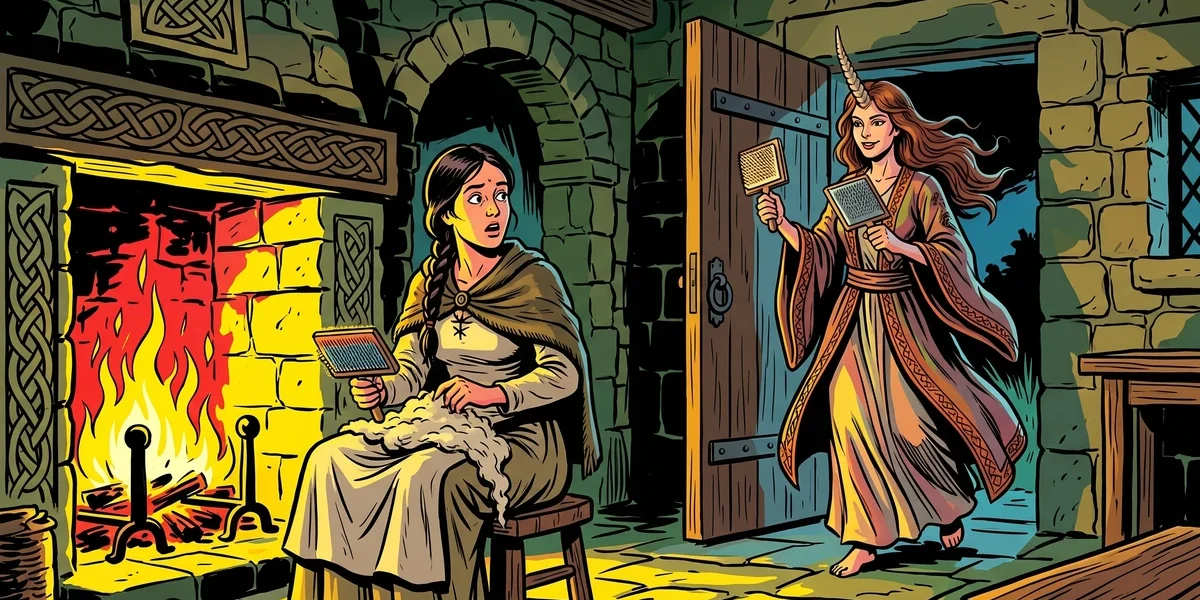
I. The Knock at the Door
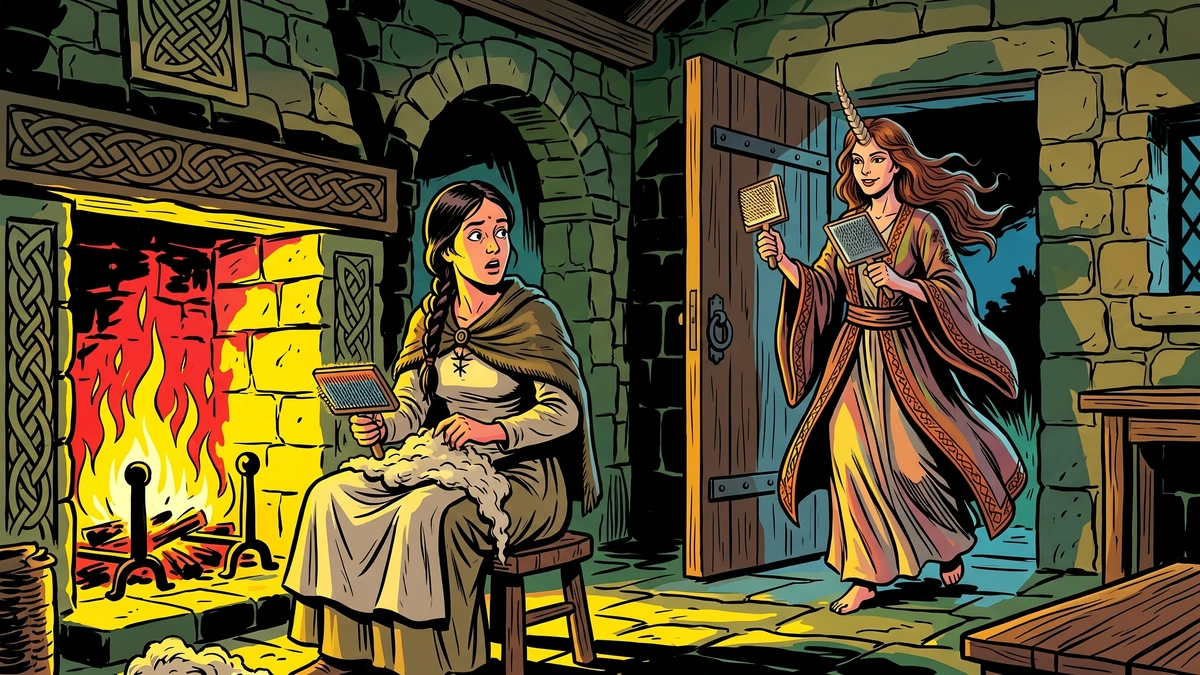
Late one winter night, when the rest of the household had long since retreated to their beds, a woman of rank and consequence sat alone by the hearth carding wool. The fire was low and red, the house silent but for the rhythmic scrape of the wool-carders and the settling of ash in the grate. Outside, the Irish night lay thick and cold over the fields.
Then came a knock at the door — one sharp, imperative blow — and a voice called out: “Open! Open!”
“Who is there?” the woman of the house called back.
“I am the Witch of One Horn,” came the answer.
The mistress, supposing in her tired mind that some neighbour had come in need of assistance — perhaps a difficult birth, perhaps a sick animal, perhaps some other urgent matter of rural Irish life — rose and unbarred the door. What entered was a woman, but not quite a woman: she carried in her hands a pair of wool-carders, and growing from her forehead, as naturally as a cow’s, was a single horn. She seated herself at the fire without invitation or word and began to card the wool with violent, mechanical haste.
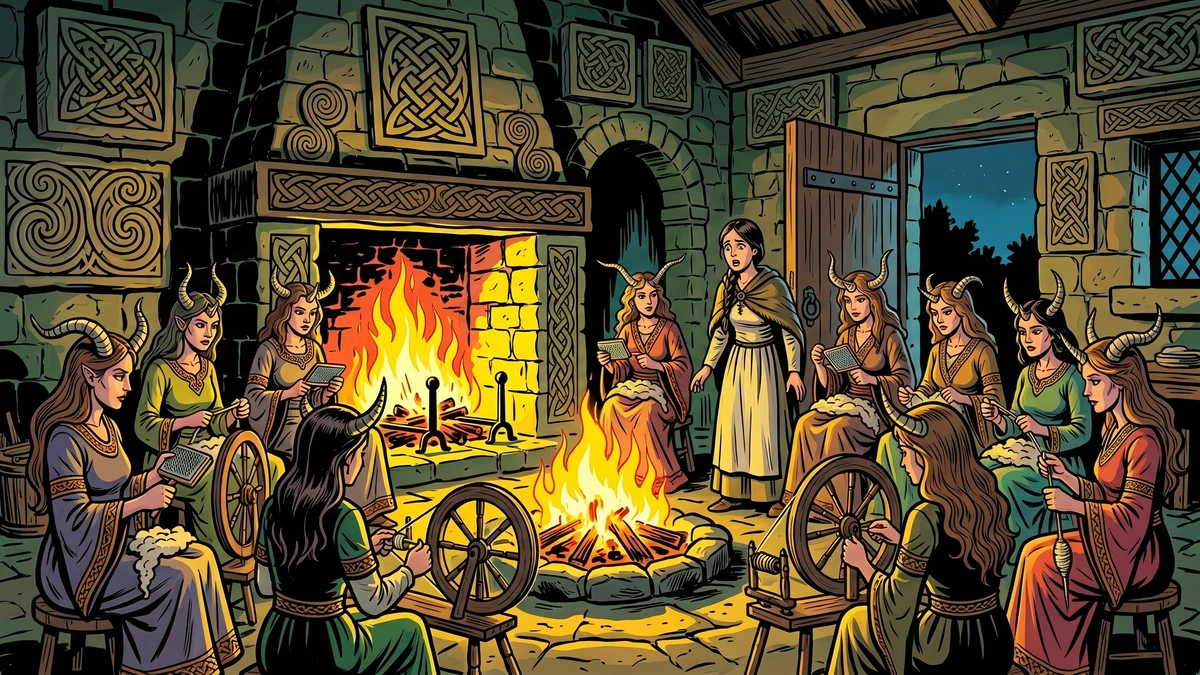
Then she stopped. She tilted her horned head and called out to no one visible: “Where are the women? They delay too long.”
A second knock came immediately. A second horned woman entered — this one bearing two horns — and sat beside the first, carding and spinning. Then a third with three horns. Then a fourth with four. Each new arrival seated herself and fell wordlessly to work, and each in turn paused to call out for the others. The knocking and the entering and the counting continued without pause: five horns, six, seven, eight, nine, ten, eleven — until twelve horned women sat in a circle round the fire of the household, their carders hissing through the wool, their horns gleaming in the firelight like the tines of a great antler-crown.
The mistress of the house sat among them, frozen. She understood now that she had opened her door to something that should never have been invited in, and that the error could not be unmade by simply wishing it undone. The witches worked around her as if she were a piece of furniture, speaking to each other in words she could not understand, their fingers moving with terrible, inhuman speed.
II. The Cake and the Water
After a time that felt both very short and very long, the Witch of One Horn looked up from her carding and addressed the mistress directly. “Rise,” she said, “and make us a cake.”
The mistress rose, because she found she could not refuse. But the witches had arranged matters so that every instrument she needed was either absent or made impossible: there was no vessel to fetch water, no implement to grind, and the fire had been banked in some way that made ordinary cooking uncertain. The mistress was sent to the stream to fetch water in a sieve — and as every Irish countrywoman knew, water does not stay in a sieve — and she went, because the compulsion was on her, walking in the cold night toward the sound of moving water.
At the stream, she dipped the sieve and lifted it and watched the water fall away through the mesh as it always does, as it always must. She tried again. Again the water ran out between her fingers in silver threads. The cold of the night settled deeper into her bones.
Then, from downstream, a voice came to her — a voice that seemed to rise from the water itself, from some spirit of the place, some guardian that the old Irish traditions would have called a genius loci. “Plaster the sieve,” said the voice, “with clay and green moss from the bank.”
She did exactly as instructed: gathered the dark riverbank clay and the bright cold moss, pressed them together into the mesh of the sieve until the holes were sealed. The sieve held water. She carried it back full to the house, and as she went, the same voice — carried now by the night wind — called to her again, warning her: the witches meant to drain her blood, to use it in their cake-baking, to leave her drained and empty as a wineskin. She must, the voice told her, call out the names of the dead who rested in the nearest churchyard. Their names, spoken aloud at her own threshold, would be a form of protection.
She reached the house. She stood on the threshold and called out the names of the dead — her dead, the village dead, the churchyard names she had known since childhood — and with each name something shifted in the air inside the house, some pressure that had been building and building since the first horned knock began to ease.
III. The Spirit’s Instructions
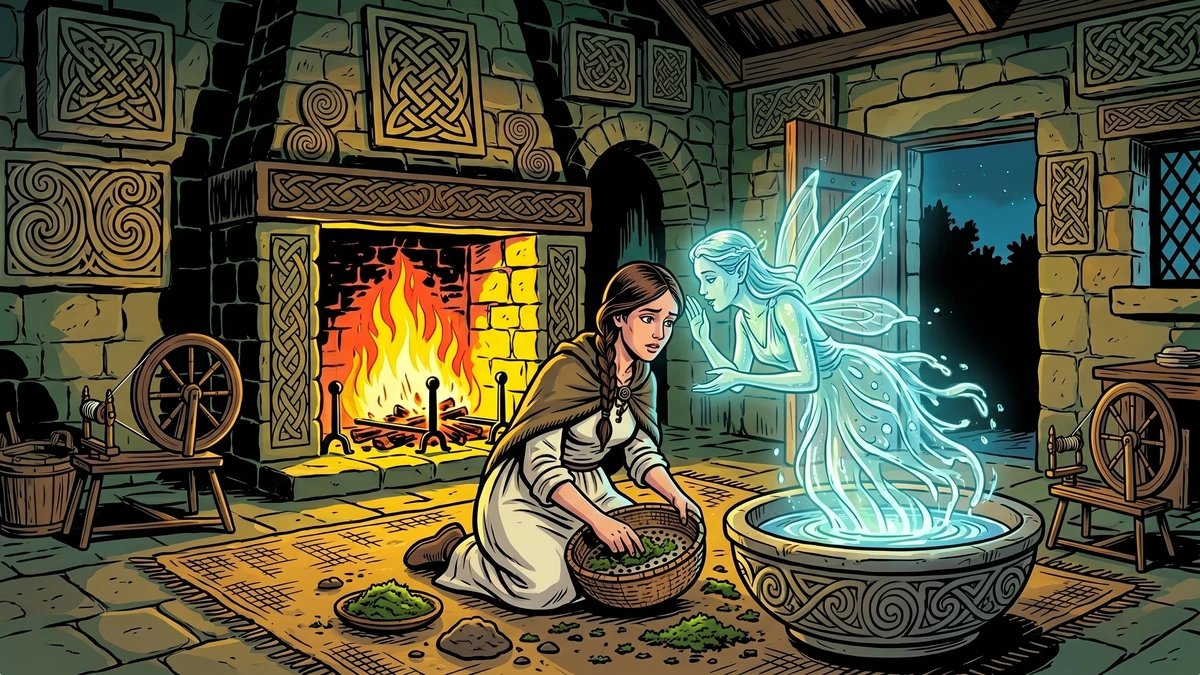
Before she could re-enter, the spirit voice — the genius loci of the stream, the house-guardian, call it what one will — gave her a further set of instructions that were precise and must be followed exactly, in order, without deviation.
She must go back inside. She must find the cloth that the witches had woven and take it out of the house without their seeing. She must take the water she had brought in the sieve and sprinkle it on the threshold, on the doorstep, on the lintel above the door. She must extinguish the fire with the remaining water — not smother it, but actively douse it. She must take the cake the witches had made and break it into pieces and put a piece in the mouth of every sleeping member of the household, so that the household-binding the witches had cast upon the sleeping would be broken and they would wake. And she must bolt the door with the great iron bolt that hung beside it — iron being, as every child in Ireland knew, the one material that powers from the sídhe cannot pass through or break.
The woman listened. She held each instruction in her mind in careful order. Then she walked back through her own front door into the circle of horned women and began to do what she had been told.
The witches watched her. They did not speak. They continued to card their wool with that same mechanical, inhumane speed, their twelve pairs of eyes tracking her as she moved through the room. The fire crackled low. The wool-carders hissed. Outside, somewhere in the dark, an owl called twice and was silent.
She found the woven cloth. She took it up. She carried the water to the threshold and sprinkled it as she had been told, then poured the remainder onto the fire, which guttered and died with a sound like a sigh. She broke the witch-cake and placed a morsel between the lips of every sleeper in the house: her husband, her children, the servants in their beds — and each, as the fragment touched them, stirred and woke with a gasp, as if surfacing from a deep cold water.
Then she slammed shut the door and threw the iron bolt home.
IV. The Voices at the Threshold
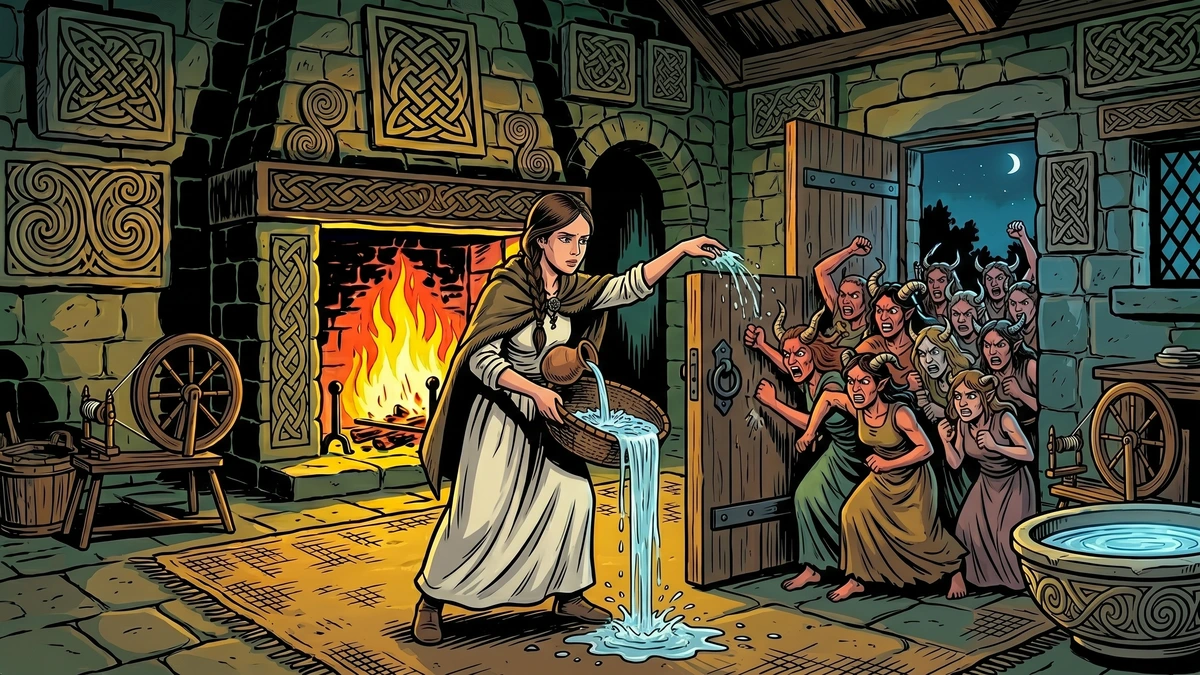
The twelve horned women found themselves outside the house they had occupied for hours. There was silence for a moment — the silence of twelve inhuman beings reconsidering their position — and then came the voices: rising in anger, beating at the doors, calling through the keyhole, summoning through the darkness every form of compulsion and curse they possessed.
“Mistress!” called the Witch of One Horn, her voice carrying through the bolted door with a clarity that seemed to bypass the wood entirely and enter the mind directly. “The cloth! You have taken our cloth. Give it back and we will leave you in peace.”
The woman held the cloth and said nothing.
“The water from the sieve is on your threshold,” called another witch. “The fire is out. You have used our own gifts against us. Give back what you have taken and open the door.”
Still nothing. The iron bolt held. Iron does not negotiate with the sídhe. Iron is simply iron.
The voices rose further — calling down the losses and misfortunes that were theirs to distribute: the loss of the butter from the churn, the loss of the milk from the cows, the death of lambs in the early spring. But each curse struck the threshold — wet with the stream-water the spirit had directed her to use — and broke apart and fell to nothing, like waves breaking on rock. The power of the bean feasa‘s instructions was this: the stream-water, gathered in faith and faith-sealed in a sieve, carried its own protection when scattered on the threshold of an honest house.
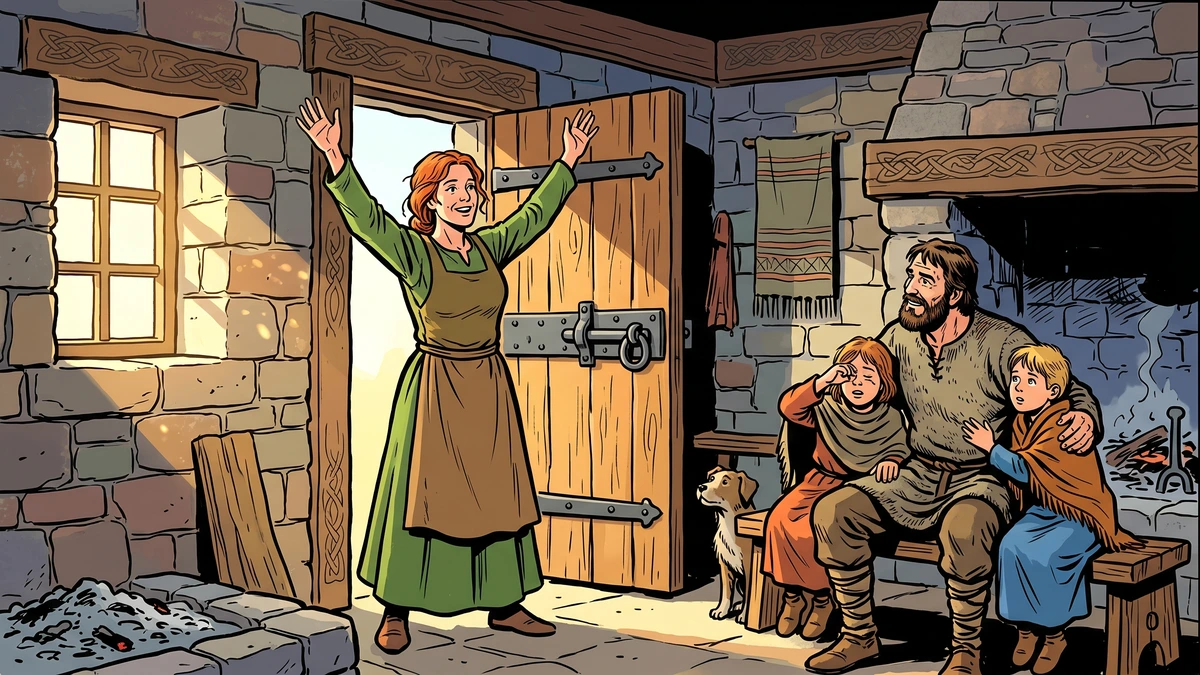
As the first grey light of dawn began to show in the east, the voices diminished. Then they were gone entirely. The horned women were gone. The house stood as it had always stood: stone walls, thatched roof, the smell of cold ash in the grate, the sleeping household waking and blinking and wondering why they felt as though they had swum up from some great depth.
The Witch of One Horn was never heard at that door again.
The Moral of the Tale
“Ní fheicfidh an súil a bhfeicfidh an croí.”
(The eye will not see what the heart has already seen.)
— Irish proverb, traditional
The Horned Women is, structurally, a test of whether a householder can recover wisdom after a catastrophic lapse of it. The mistress’s error is not stupidity — it is misplaced hospitality, one of the highest Irish virtues turned against itself. The brídeog tradition and the laws of hospitality (the féidhlim) required the Irish householder to open the door to any who knocked; the witches exploit this obligation precisely. The tale’s argument is not that hospitality is wrong but that discernment must accompany it. The spirit at the stream is the force of discernment: it gives the mistress not just the means of defence but the specific and precise knowledge she needs, one step at a time, in the right order. Iron, running water, the names of the dead, the threshold rituals — each element of the counter-magic reflects actual pre-Christian Irish household protection practice that survived into the 19th century when Lady Wilde collected it. The tale endures because it is honest about human weakness (the mistress makes the error, cannot unmake it alone) while insisting that help is available to those who listen carefully and act precisely on what they hear.
Why This Story Has Lasted
“The Horned Women” is one of the most widely cited examples of the Irish witch-invasion narrative, a subtype of the international household-violation story that appears across European folk traditions but in Ireland takes a distinctly domestic, ritual-specific form. Lady Wilde’s 1887 collection preserved a text that was already regarded by folklorists as one of the finest examples of the genre, and it has been reprinted in almost every major collection of Irish folklore since. W.B. Yeats included it in his 1888 anthology Fairy and Folk Tales of the Irish Peasantry and commented that it preserved “the most authentic record we possess of old Irish household magic.” The story’s power derives from its combination of genuine ritual detail — the sieve-water test, the iron-bolt protection, the threshold-sprinkling, the broken-cake counter-spell — with a narrative structure of almost unbearable suspense. It also speaks to a specifically Irish dread: the transformation of the domestic hearth, which is the safest and most beloved space in Irish rural life, into a place of invasion and compulsion. The restoration of the hearth through precise ritual action is thus both a practical guide and a metaphor: the home can always be recovered, but the recovery requires knowledge, courage, and exact obedience to the instructions of those who know more than we do.
Primary source: Lady Jane Francesca Wilde (“Speranza”), Ancient Legends, Mystic Charms and Superstitions of Ireland (London: Ward & Downey, 1887), Vol. I, pp. 50–55; also reprinted in W.B. Yeats, Fairy and Folk Tales of the Irish Peasantry (London: Walter Scott, 1888). Tale type: ATU 326A* (Soul Released from Torment, witch-invasion subtype). Motifs: G249.7 (Witches enter house), F382 (Iron wards off fairies), D2176 (Magic object protects house), G225 (Witch’s power broken by counter-charm), F382.1 (Iron threshold protection). Related tales: “The Wild Witches” (Scottish); “The Night-Visitors” (Breton); “La Masca” (Piedmontese).
Frequently Asked Questions
Who collected 'The Horned Women' and where was it first published?
The story was collected and first published by Lady Jane Francesca Wilde (pen name 'Speranza'), mother of Oscar Wilde, in her landmark anthology 'Ancient Legends, Mystic Charms and Superstitions of Ireland' (London: Ward & Downey, 1887), Vol. I, pp. 50–55. Lady Wilde gathered the tale from living oral tradition in Munster and Connacht in the 1860s–1870s. W.B. Yeats later reprinted it in 'Fairy and Folk Tales of the Irish Peasantry' (1888), calling it one of the finest examples of authentic Irish household magic narrative.
What do the horns on the witches symbolise in Irish folklore?
In Irish folk tradition, the horned women (mná adharcacha) represent a class of supernatural beings who inhabit the liminal space between the human world and the sídhe (fairy realm). The number of horns on each woman marks her rank or seniority within the group, with the Witch of One Horn appearing first and leading the others. Horns in pre-Christian Celtic iconography were associated with supernatural power and otherworldly status — they appear on figures like Cernunnos in Continental Celtic art. In the domestic Irish tradition, they mark the witches as definitively non-human visitors who have assumed a quasi-human form to gain entry to a household.
Why does the spirit tell the woman to carry water in a sieve?
The sieve test is a classic folk-magic ordeal found across European witch-trial and fairy-encounter narratives. In its Irish form, it tests whether the person attempting it acts on genuine instruction (the spirit's guidance to plaster the sieve with clay and green moss) rather than conventional wisdom (which says water cannot be held in a sieve). The sealed sieve then produces water that carries the authority and protection of the spirit who directed its gathering — when sprinkled on the threshold, this ritually-gathered water creates a barrier that supernatural visitors cannot cross. The test also demonstrates that the protection of the household requires specific, accurate knowledge, not just good intentions.
Why does iron protect against the witches in this story?
Iron's protective power against the sídhe (fairy folk) and related supernatural beings is one of the most consistent and ancient beliefs in Celtic tradition, documented from at least the early medieval period in Irish legal and literary texts. The belief likely originates from the historical period when iron-using peoples displaced earlier bronze-using cultures — iron was the new, powerful, 'magical' metal associated with the dominant culture. In folk practice, iron threshold objects (hinges, bolts, horseshoes), iron implements buried at boundaries, and iron in the form of a bolt or bar across a door were all understood to create an impenetrable barrier against beings from the otherworld, who could neither touch nor pass through iron.
What is the significance of calling the names of the dead in this story?
In Irish household-protection tradition, the names of the dead served multiple functions. Most directly, calling the names of those buried in the local churchyard at one's own threshold invoked the protective presence of the community's ancestors — beings who, while dead, retained an interest in the welfare of the living households they had known. It also signalled to supernatural visitors that the householder was connected to a community of the dead as well as the living, making them a more formidable adversary than a lone isolated individual. Some folklorists interpret this element as a survival of ancestor-cult practice in which the dead were regularly called upon as household guardians, a tradition that Christianity absorbed but did not entirely eliminate from Irish folk practice.
You May Also Like
 Celtic Folk Tales
Ages 9-12
Celtic Folk Tales
Ages 9-12
The Sea-Maiden
The Sea-Maiden: There was once a poor old fisherman, and one year he was not getting much fish. On a day of days, while he was fishing, there rose a sea-maiden
 Celtic Folk Tales
Ages 9-12
Celtic Folk Tales
Ages 9-12
The Field Of Boliauns
The Field Of Boliauns: One fine day in harvest it was indeed Lady-day in harvest, that everybody knows to be one of the greatest holidays in the year Tom
 Celtic Folk Tales
Ages 9-12
Celtic Folk Tales
Ages 9-12
Connla And The Fairy Maiden
Connla And The Fairy Maiden: Connla of the Fiery Hair was son of Conn of the Hundred Fights. One day as he stood by the side of his father on the height of