The Greek Princess and the Young Gardener
The Greek Princess and the Young Gardener: here was once a king, but I didn’t hear what country he was over, and he had one very beautiful daughter. Well, he
I. The Feather That Changed Everything
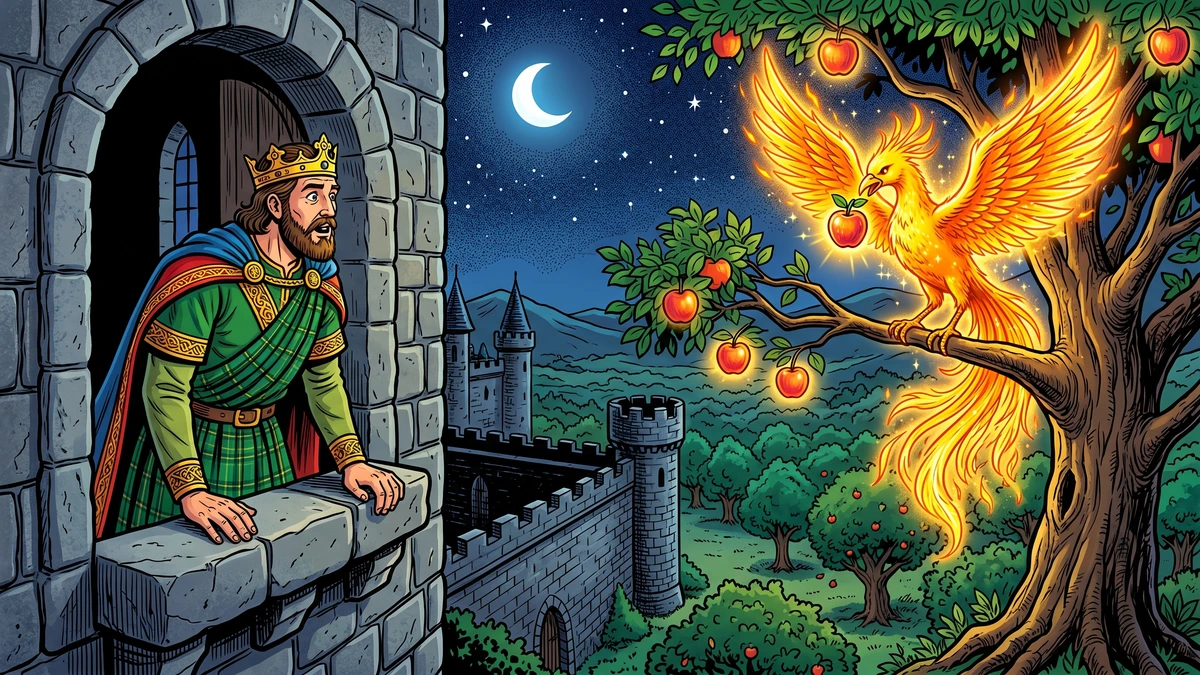
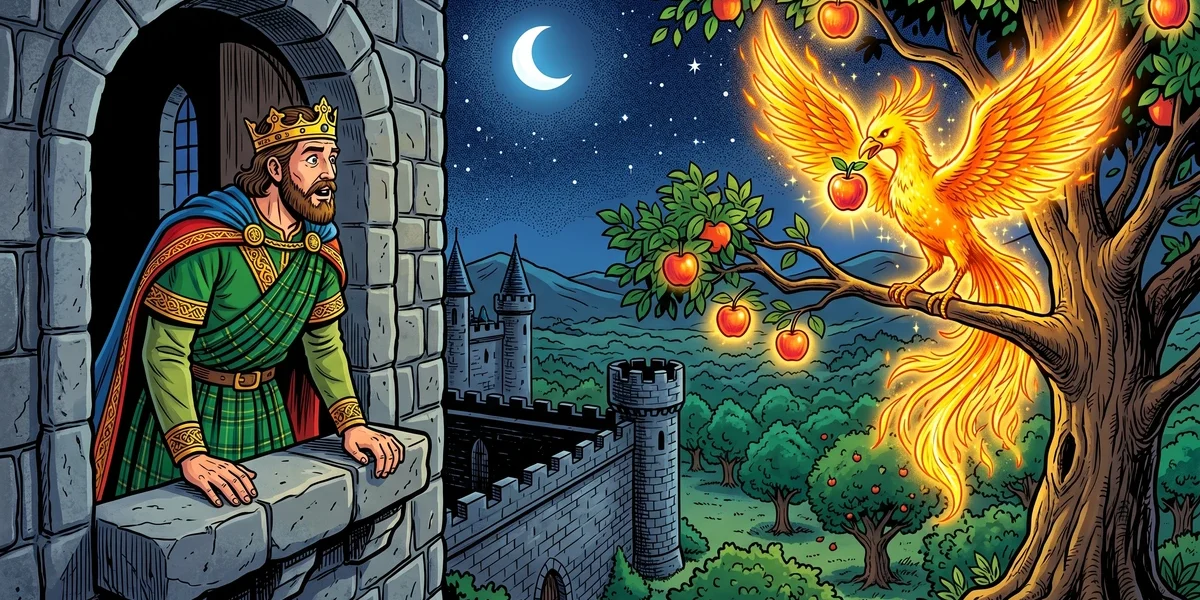
There was once a king — no one quite remembered which country lay beneath his crown — and he had a daughter of surpassing beauty and a magical apple tree that grew in the orchard just beneath his chamber window. The doctors of the realm had discovered that the apples of this particular tree were sovereign medicine for the king’s creeping illness; every ripe apple eaten in autumn sent the winter’s ailments retreating for another season. Small wonder, then, that the king watched those apples with the jealous vigilance of a miser counting gold.
But one harvest night, just as the fruit began to blush from green to red, the king was startled from his pillow by a great rushing of wings. He pushed open the casement and peered into the moonlit garden, and there on his precious tree perched a bird unlike any creature he had ever seen. Its feathers blazed with a light that cast silver shadows across the orchard wall — each quill a bar of living gold, each wingbeat scattering sparks that died in the grass like fallen stars. Before the king could cry out, the bird plucked a ripe apple from the highest branch and vanished into the night sky, leaving only the faint echo of its wings and the sharp smell of disturbed leaves.
“Botheration to that thief of a gardener!” the king roared from his window, waking half the palace. By dawn he had summoned the gardener and delivered a blistering rebuke. The gardener, a loyal and unflappable man, promised that his three sons — each reputed the finest archer in the province — would watch the orchard in turns until the golden bird was caught or driven away.
The eldest son took the first watch, his bow strung and an arrow nocked between his fingers. He watched and watched until the dead hour, when his eyelids grew heavy as millstones and he slid into a pishtrogued sleep leaning against the orchard wall. The bird came, plucked an apple, and was gone before the boy could fumble his arrow to the string. The second son fared no better; though he struggled awake at the first stroke of midnight, he too collapsed under the fairy-spell and woke only to the king’s furious shout, just in time to send a wild arrow uselessly into the dark sky. The king raged, but he was a reasonable man: he could see the enchantment upon both boys and knew their failure was not their own fault. Still, two apples gone was two fewer doses of his medicine.
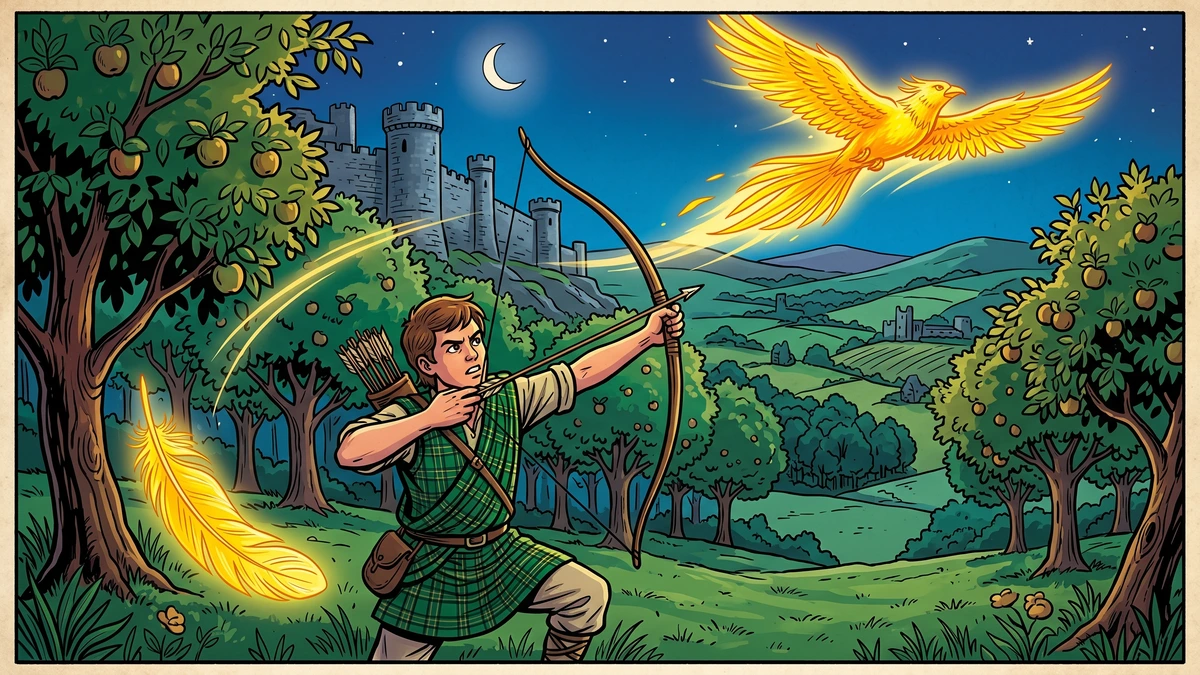
The third night fell to the youngest son, a bright-faced lad with a reputation for cool nerve and quick judgment. The king himself stood at his window watching, calling down encouragements as the clock crept toward midnight. At the last stroke of twelve, a radiance swept across the orchard — the golden light preceding the bird — and the rushing of enormous wings filled the air. But this time an arrow sang through the darkness and struck the bird’s flank with a crack heard a quarter-mile away. A screech tore the night in two. The bird fled, shedding a single feather that spiralled down into the orchard grass; when the boy brought it to the king’s chamber it proved heavier than lead and shone with the warm burnish of the finest beaten gold.
The court went wild with admiration. For a week the youngest son kept faithful watch, but the luminous visitor never returned. At last the king proclaimed before all his assembled nobles: he would give his daughter’s hand and half his kingdom to whoever brought him that golden bird — dead or alive.
II. The Fox on the Road
The gardener’s eldest son set out first, his wallet full of cold meat and bread, his quiver across his back. He had barely left the town behind when a handsome fox trotted out of a gorse thicket and sat in the middle of the road with an air of polite expectation.
“Would you spare a bite for a hungry traveller?” the fox asked, in the easy manner of one who considers the whole world his table.
The eldest son stared at the talking animal and then — either from irritation or pure bravado — shot at it. The arrow glanced off the fox’s flank as if he were hammered iron and buried itself in a tree trunk a hundred yards away. The fox merely shook himself, gave the young man a long look of resigned disappointment, and vanished into the gorse. The eldest son continued alone, chose the wrong road at every crossroads, wasted his money in a fine inn, and came home empty-handed before the year was out, inventing elaborate excuses for his failure.
The second son set out next with high confidence. The same fox appeared at the same spot, made the same polite request, and was met with the same arrow — to the same effect. He too returned home before the cold weather set in, his wallet empty, his spirit deflated, claiming the quest was impossible.
The youngest son, whose name was simply Jack in the telling, set out last. He was eating bread and cheese at a sunny bank when the fox appeared, sat down, and regarded him with bright amber eyes.
“Would you spare a bit of that for a poor body that’s hungry?” the fox asked.
Jack studied the creature. He had heard his brothers’ accounts of their encounters, but Jack was a young man who believed that courtesy cost nothing and rudeness cost much. He cut a generous portion of his bread and meat and held it out. The fox ate with dignified speed, licked his chops, and fixed Jack with a look that seemed to weigh everything about him.
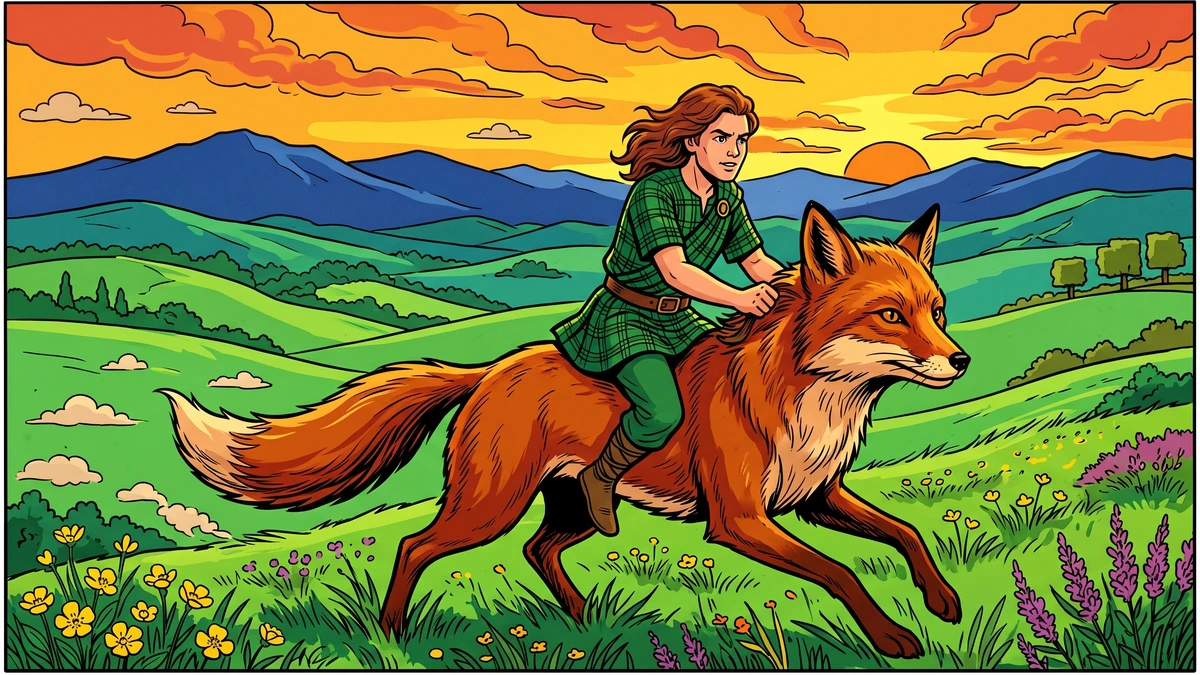
“You did right,” said the fox at last, “and I’ll do right by you. Sit on my back and I’ll carry you where you need to go faster than your feet could dream.”
Jack, being sensible as well as generous, climbed onto the fox’s back. The animal stretched into a loping gait that ate the miles like smoke, and as they ran the fox poured counsel into Jack’s ear: where the golden bird was kept, how to navigate the enchanted palace that guarded it, and above all — above all — to resist the temptation of the gilded cage. “Take the bird in its plain wooden cage,” the fox said, “not the golden one that shines beside it. Touch the golden cage and the whole palace wakes.”
III. The Palace Beyond the Eastern Mountains
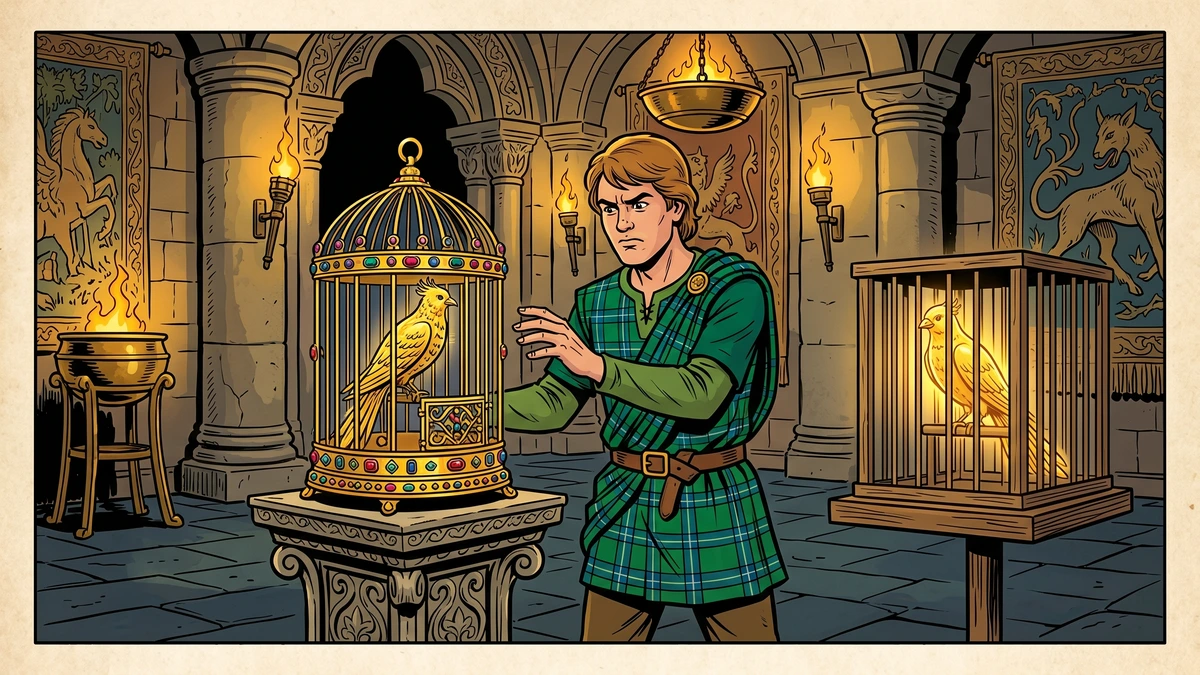
The fox carried Jack to a palace that stood beyond a range of blue-grey mountains, its walls gleaming faintly in the perpetual half-light of an enchanted evening. Inside, in a great hall hung with tapestries showing the hunts of forgotten kings, sat the golden bird on a perch inside a plain wooden cage. Beside it, as the fox had foretold, stood an identical cage of hammered gold, jewelled with emeralds and sapphires, its bars chased with vine-work of extraordinary beauty.
Jack walked softly through the sleeping palace — every guard, every servant, every hound drooped in enchanted slumber — and took the plain cage from its stand. He was at the door, the bird quiet in his arms, when the golden cage caught the light of a single candle and flashed such a blaze of beauty into his eyes that his hand moved almost without his will. He reached out and touched the golden cage with one finger. The bell-clear ring of metal filled the hall. Every sleeper in the palace snapped awake at once. Guards seized Jack from all sides; the king of the palace stood before him, cold-eyed and precise.
“You have tried to steal my bird,” said the king. “There is only one penalty for that — death — unless you can do for me what I have been unable to do for myself. Bring me the wonderful horse that the giant keeps in his stable seven mountains beyond here, and I will give you the bird freely.”
Jack was marched to the gate and released. The fox was waiting in the shadows, unsurprised. “I warned you about the golden cage,” it said, with the measured patience of one who has been right before. “Now you must fetch a horse. Let me show you the way.”
At the giant’s stable — a stone fortress reeking of horse-breath and old leather — the fox gave the same precise counsel: take the horse in the plain bridle, not the jewelled one hanging beside it. Jack moved through sleeping giants, reached the horse, lifted the plain bridle — and then, in the torchlight, the jewelled bridle caught every gem and threw rainbow fire across the walls. His hand moved. He touched it. The giant world woke.
The giant king sentenced him to death or quest: bring back the Greek princess who lived at the edge of the known world, the woman whose beauty was spoken of in every language, and the horse would be his. Jack was ejected into the night once more, where the fox waited with an expression that managed to convey both long-suffering and fundamental affection.
“Three tests,” said the fox. “At the third, do not touch what dazzles you. Listen to me this time.”
IV. The Greek Princess and the Road Home
The princess lived in a palace at the world’s edge, beyond seven seas and seven mountain ranges, in a country where the light was always the particular gold of late afternoon. She was guarded not by force but by reputation: no suitor had ever successfully carried her away because no suitor had possessed the fox’s instruction. Jack had that instruction now, and he listened to every word of it.
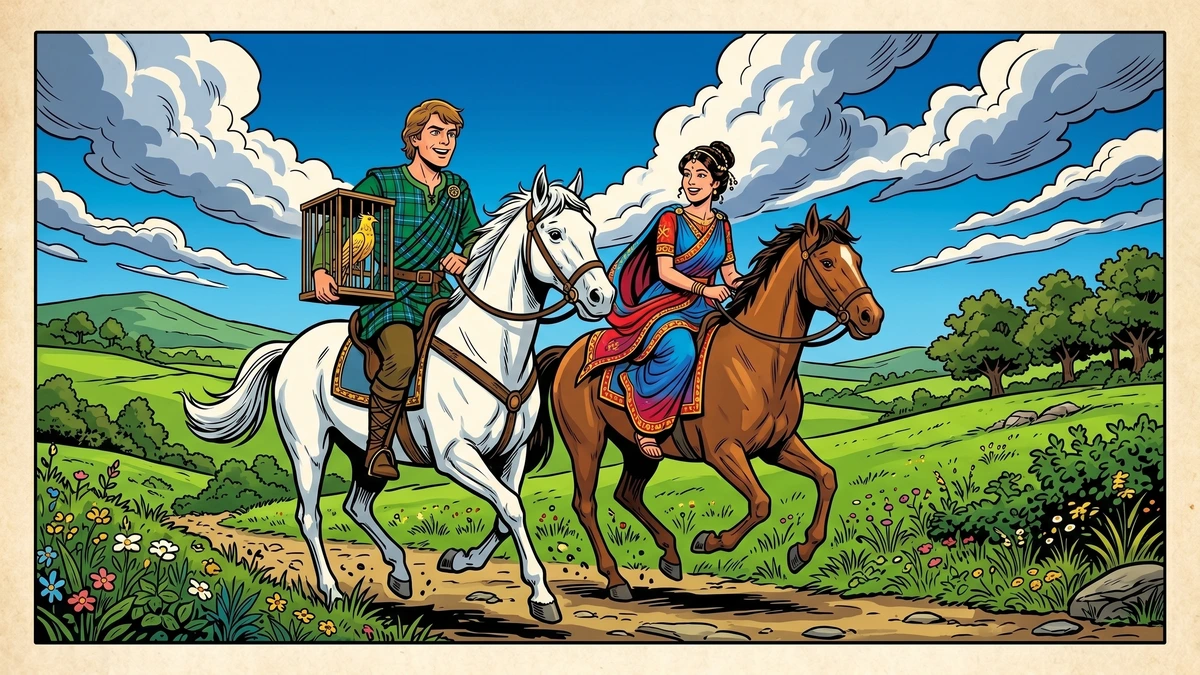
The fox disguised himself as a merchant’s horse of magnificent appearance and told Jack to sell him to the princess’s father in exchange for the princess herself — but to keep the bridle. Whatever the king offered in gold, Jack was to accept only the girl. The ruse worked: the king, dazzled by the magnificent “merchant’s horse,” agreed to the exchange. As Jack and the princess rode away, the fox (still in horse-form, ridden by the palace groom who led him to the stable) waited until the bolts were shot, then leapt the stable wall in a single bound and caught up with Jack on the road.
Now the fox reversed the chain: he became a false princess so perfect in appearance that when Jack arrived at the giant’s kingdom, the giant examined his “princess” with all the satisfaction of a collector and handed over the wonderful horse without a second thought. A mile down the road, the false princess dissolved back into the fox, and they rode on to the palace of the sleeping golden bird.
There the fox became a false horse of breathtaking beauty. The king of the palace, beguiled, exchanged the golden bird in its plain wooden cage for the magnificent animal before him. Jack, the real princess, the real horse, and the real golden bird were ten miles away before the king looked at his new steed and noticed something strange about the shape of its ears.
The fox caught up with them at the crossroads where their journey had begun. He sat down in the road and looked at Jack with an expression of complete satisfaction.
“Now,” said the fox, “cut off my head.”
Jack stared. The fox repeated the instruction with quiet firmness. Jack, who had learned by now that the fox’s instructions were always right however strange they seemed, took out his sword and struck. Where the fox had crouched there stood a tall young man in Celtic tartan — a prince who had been enchanted into fox-form by a wizard’s curse and could only be freed by the hand of a true-hearted companion. The prince clasped Jack’s hand, wished him every happiness, and walked away into the Irish hills.
Jack returned to the king — his king, the king with the apple tree — with the golden bird in its cage, the wonderful horse on its plain bridle, and the Greek princess riding at his side. The wedding lasted a fortnight. The apples cured the king’s illness entirely. And the gardener’s son, who had once been nobody much, became a prince, which perhaps proves that in Ireland the distance between a kitchen garden and a throne was always shorter than it seemed.
The Moral of the Tale
“Is fearr ciall cheannaithe ná ciall shaor.”
(Better is wisdom bought dearly than wisdom given free.)
— Irish proverb, traditional
The tale’s moral architecture is triadic, as befits Irish narrative: three brothers, three impossible quests, three temptations. Each temptation is the same — the dazzle of beauty over plain usefulness — and each failure is the same — a reaching hand that cannot resist what shines. The eldest and second sons never meet the fox because they answer his first overture with violence; they are locked out of the wisdom economy before it begins. Jack earns fox-counsel through a small act of generosity and then, twice, squanders it — but the third time, at the edge of the world, with the real stakes in plain sight, he holds back his hand. The Celtic story-tradition is not naive about human weakness: Jack fails twice before he learns, because the tale is honest about how difficult it is to prefer the plain and true over the shining and false. The enchanted fox is the story’s deepest figure — a prince trapped in animal form, freed at last by the very virtue he has been teaching. The helper and the helped are mirrors of each other: one trapped by enchantment, one trapped by inexperience, and both liberated by trust.
Why This Story Has Lasted
“The Greek Princess and the Young Gardener” belongs to one of the most widely distributed tale-types in the world — ATU 550 appears in Russian, German, Persian, Turkish, Chinese, and dozens of African traditions — yet the Irish telling carries distinctive watermarks. The fox as helper-figure rather than horse or bird draws on a native Irish ambivalence about foxes as trickster-sages, animals who move between the human world and the sídhe (fairy realm) with easy familiarity. Patrick Kennedy heard versions of this tale in County Wexford in the 1840s–1860s, during and after the Great Famine, when stories of a clever youngest son winning a princess and half a kingdom carried an obvious emotional charge for listeners with very little. Joseph Jacobs, collecting in London in 1892 for an audience of educated English readers, softened the dialect and sharpened the comic timing, creating the version that entered the international repertoire. The story endures because it dramatises a lesson that every generation must relearn: that wisdom is not knowing which cage is golden, but having the discipline, after two failures, to choose the plain one anyway.
Primary sources: Patrick Kennedy, Legendary Fictions of the Irish Celts (London: Macmillan, 1866); Joseph Jacobs, Celtic Fairy Tales (London: David Nutt, 1892). Tale type: ATU 550 — Bird, Horse, and Princess. Motifs: H1333 (Quest for golden bird), B400 (Helpful animal), D1500 (Magic object), N825.3 (Old man helper), H1242 (Youngest brother succeeds on quest). Related tales: KHM 57 “Der goldene Vogel” (Brothers Grimm, 1812); “The Firebird and Princess Vasilisa” (Russian); “The Golden Bird” (Persian, Thousand and One Nights tradition).
You May Also Like
 Celtic Folk Tales
Ages 9-12
Celtic Folk Tales
Ages 9-12
Guleesh
Guleesh: There was once a boy in the County Mayo; Guleesh was his name. There was the finest rath a little way off from the gable of the house, and he was
 Celtic Folk Tales
Ages 9-12
Celtic Folk Tales
Ages 9-12
Battle Of Birds
<p>A hero witnesses a magical battle between birds and must choose between safety and helping those in peril.</p>
 Celtic Folk Tales
Ages 3-5
Celtic Folk Tales
Ages 3-5
The Three Golden Hairs of Grandfather Know-All: A Czech Tale of Wit and Destiny
The Three Golden Hairs of Grandfather Know-All: A Czech Tale of Wit: In the Kingdom of Bohemia, there lived a nobleman who was obsessed with destiny. He had