The Conquest Of Fate
The Conquest Of Fate: In the Dakshinadêśa there lived a Brâhmiṇ boy who from his childhood was given a very liberal education in Sanskṛit. He had read so much
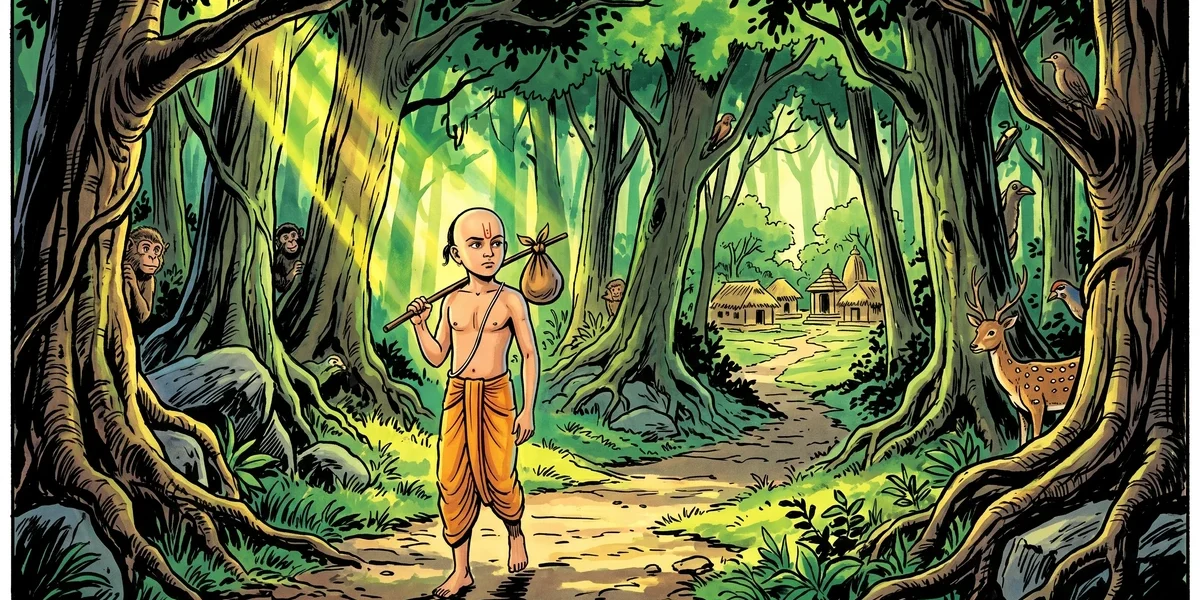
The Conquest of Fate — Panchatantra, Book IV: Labdhapraṇāśam (Loss of Gains) and Book III: Kākolūkīyam
This tale engages one of the deepest philosophical tensions in the Panchatantra, compiled by Vishnu Sharma around 300 BCE: the debate between fate and human effort — daiva (divine decree, destiny) versus puruṣakāra (personal action, industry). The Panchatantra’s position on this debate is consistent across all five books: human effort is always worth making, because even when fate ultimately governs outcomes, the effort of the prepared person extracts more from whatever fate provides than the passivity of the resigned one. The Conquest of Fate does not argue that fate can be overridden — it argues that effort and fate are not opposites, and that the person who acts in the face of fate encounters its decrees from a position of strength rather than helplessness.
Beat I — The Scholar’s Prophecy and the Parents’ Choice
A learned astrologer, examining the horoscope of a merchant’s newborn son, delivered his assessment with the gravity of one who has read the stars honestly: the boy would grow to be prosperous, capable, and intelligent — but he was fated to die young, by snakebite, on a specific day in his eighteenth year. The astrologer could not say whether any remedy existed. He could only report what he had read.
The merchant and his wife heard this prophecy and faced a choice that the Panchatantra presents as its central question: what do you do with a fate that has been announced? The fatalist position — accept it, make peace with it, allow the boy to live normally and meet what is destined — was available to them. They chose differently. They did not know whether the prophecy could be defeated. They chose to act as if it could, because acting as if it could was the only position that offered any chance of defeating it. They raised the boy in a household that was, from his earliest consciousness, aware of the danger and preparing against it.
The boy grew up knowing his fate. This knowledge, which might have paralysed a less resilient nature, produced in him instead a particular kind of alertness. He learned everything available to learn about snakes — their habits, their habitats, their seasons of aggression, the plants that repelled them, the antidotes that countered their venom. He learned the geography of risk: where snakes nested, where they hunted, what conditions made encounters likely. He became, by his seventeenth year, more knowledgeable about snake avoidance than most people twice his age who had lived their entire lives in snake country.
Beat II — The Fated Day and the Prepared Mind
The day of the prophecy arrived. The boy — now a young man — did not hide in his room. He did not consider hiding in his room. The Panchatantra is explicit about this: hiding is not conquest. He went about his day with the heightened attention that years of preparation had made natural to him, alert to every sound and movement in the way of a person who has spent years training a specific vigilance.
In the late afternoon, crossing a garden path, he heard the sound that years of study had trained him to recognise: the subtle displacement of leaves by a creature moving with a particular deliberation. He did not freeze. He identified the direction, assessed the distance, and moved — not in panic but in the practiced evasion of someone who had rehearsed exactly this kind of response. The snake struck. It missed.
What followed was a sequence of actions so rapid and so precisely ordered that it appeared, to witnesses, to happen all at once: the young man pinned the snake with a forked stick he habitually carried (the carrying of the stick was itself a years-long habit of preparation); he secured it; and he rendered it harmless. He was not harmed. The day ended. The prophecy had announced the occasion but had not determined the outcome.
The Panchatantra notes this without triumphalism: fate had arranged the encounter. Effort had arranged the survival. Both were real; neither had cancelled the other. What the young man’s preparation had done was to change his position in the encounter from unprepared victim to prepared actor — and in that difference, the fate’s decree had found its limit.
Beat III — The Panchatantra’s Position on Fate and Effort
The philosophical argument the Panchatantra develops through this story is not that fate is an illusion or that determination can override destiny. It is more subtle and more defensible: fate determines what happens to us; effort determines what we are when it happens. These are not the same thing, and the difference between them is everything.
The snake was fated. The encounter was fated. What was not fated was the level of preparation, alertness, and specific knowledge the young man brought to that moment. Fate had specified the occasion; it had not specified the condition of the person who would face it. Years of preparation had changed that condition so fundamentally that the same encounter — snake, young man, garden path, late afternoon — produced a different outcome than it would have produced for an unprepared person at the same spot.
The Arthashastra of Kautilya makes an administrative version of this argument: a king cannot prevent every threat to his kingdom, but he can ensure that when threats arrive his kingdom is in the best possible condition to face them. Preparation does not eliminate fate; it changes the person fate meets. The better-prepared king loses less to the same disaster than the unprepared one. This is not the conquest of fate in the sense of overriding it. It is the conquest of fate in the sense of meeting it on the best available terms.
Beat IV — What the Story Teaches About Human Agency
Vishnu Sharma’s royal students needed to navigate a culture saturated with fatalism — the karma tradition, the astrological tradition, the philosophical tradition of daiva that attributed outcomes to divine decree. The danger for a ruler was that fatalism, correctly applied to genuinely uncontrollable outcomes, could be incorrectly extended to outcomes that were actually within the ruler’s influence. A king who shrugged at a preventable famine as fate, or at a correctable administrative failure as destiny, was using a valid philosophical position to excuse a failure of effort.
The Conquest of Fate distinguishes these cases precisely. The astrologer’s prophecy was real — the encounter with the snake was fated. The young man’s response was his own — the preparation, the stick, the trained reflexes, the practiced evasion. The Panchatantra does not tell us fate can be overridden. It tells us that between the decree of fate and its landing on us, there is a space in which human effort operates — and that filling that space with the best preparation available is not hubris but wisdom.
“Fate determines the occasion; effort determines the person who faces it. These are different things, and the difference is everything.”
Why This Story Has Lasted 2,300 Years
The Conquest of Fate endures because its central argument — that preparation changes what fate meets, even when it cannot change what fate decrees — is among the most practically useful ideas in world wisdom literature. Every tradition that has seriously engaged the question of fate versus free will has arrived at some version of this position: the field of human agency is not the decree itself but the condition of the person who receives it. The Panchatantra puts it through a snake and a stick and a forked-stick habit, and the vividness of the image carries the argument further than any abstract philosophical treatment could reach.
About the Panchatantra
The Panchatantra (“Five Treatises”) was composed by Vishnu Sharma circa 300 BCE as a compendium of nītiśāstra — statecraft, ethics, and worldly wisdom — expressed through interlocking animal and human fables. The tension between daiva (fate) and puruṣakāra (human effort) runs throughout all five books, with the Panchatantra consistently taking the position that effort is always worthwhile because it changes the condition of the actor even when it cannot change the decree. Translated into Pahlavi in the 6th century CE and subsequently into Arabic, Hebrew, Latin, and all major European languages, the Panchatantra became one of the most widely read books in the pre-modern world.
Frequently Asked Questions
**Q: Why is this story important?**
You May Also Like
 Panchatantra Stories
Ages 3-5
Panchatantra Stories
Ages 3-5
Light Makes Prosperity
Light Makes Prosperity: There is a Tamil proverb dîpam lakshmîkaram, meaning, “light makes prosperity,” and the following story is related to explain it: The
 Panchatantra Stories
Ages 9-12
Panchatantra Stories
Ages 9-12
The Story of the Camel with a Bell Round His Neck
The Story of the Camel with a Bell Round His Neck: In a certain town, there lived a cart-maker, by the name of Ujjwalaka. As he got no contracts, he The moral
 Panchatantra Stories
Ages 6-8
Panchatantra Stories
Ages 6-8
Shandili and Sesame Seeds
Shandili's endless greed for sesame seeds transforms a magical gift into the agent of her doom.