The Calabash Children
A traditional Chaga folk tale from Mount Kilimanjaro, Tanzania: a lonely widow grows children from calabash gourds, then loses them to one careless, cruel word.
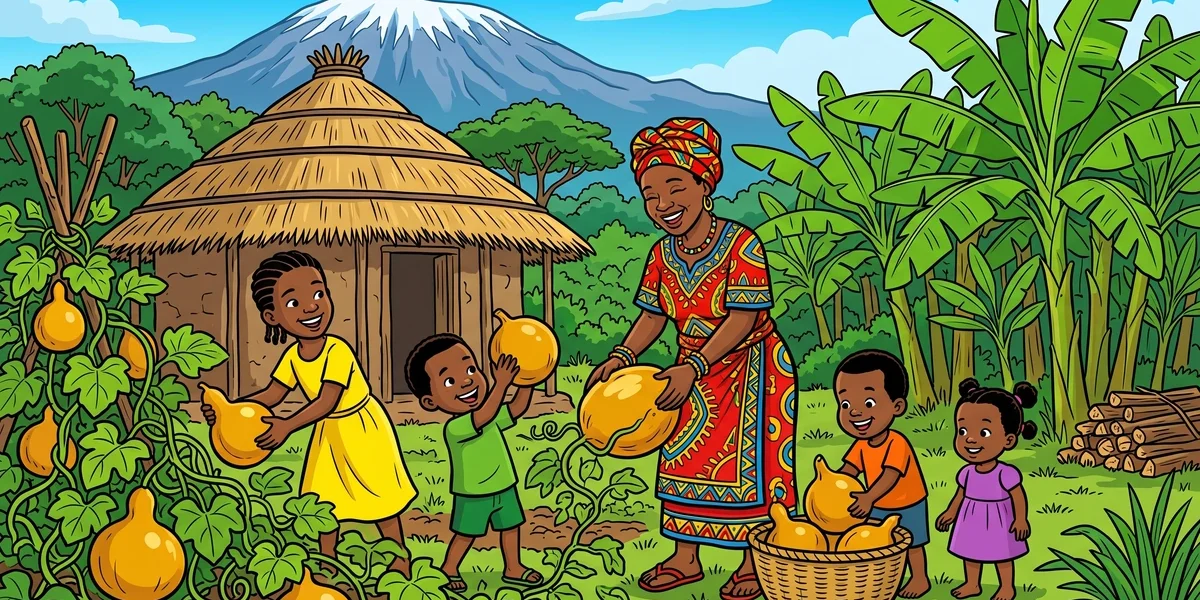
Origin & Canonical Attribution. “The Calabash Children” (also widely told as “The Calabash Kids”) is a traditional folk tale of the Chaga (Chagga) people, a cluster of Bantu-speaking communities living on the fertile southern and eastern slopes of Mount Kilimanjaro in northern Tanzania. The story was recorded among the legends, laws and customs of the Wachagga by the British colonial administrator and ethnographer Charles Dundas in Kilimanjaro and Its People: A History of the Wachagga, their Laws, Customs and Legends (London: H. F. & G. Witherby, 1924). The motif at its heart — children who grow from gourds — belongs to the international family of miraculous birth tales (Stith Thompson motif T543, “Birth from plant”), and its turning point belongs to the worldwide pattern of the broken prohibition, in which a single forbidden act or word undoes an enchantment. A celebrated modern picture-book retelling, The Calabash Kids: A Tale from Tanzania retold by Aaron Shepard (Charles Scribner’s Sons, 1994), remains in copyright; the retelling below returns to the older traditional tale and is told in fresh words.
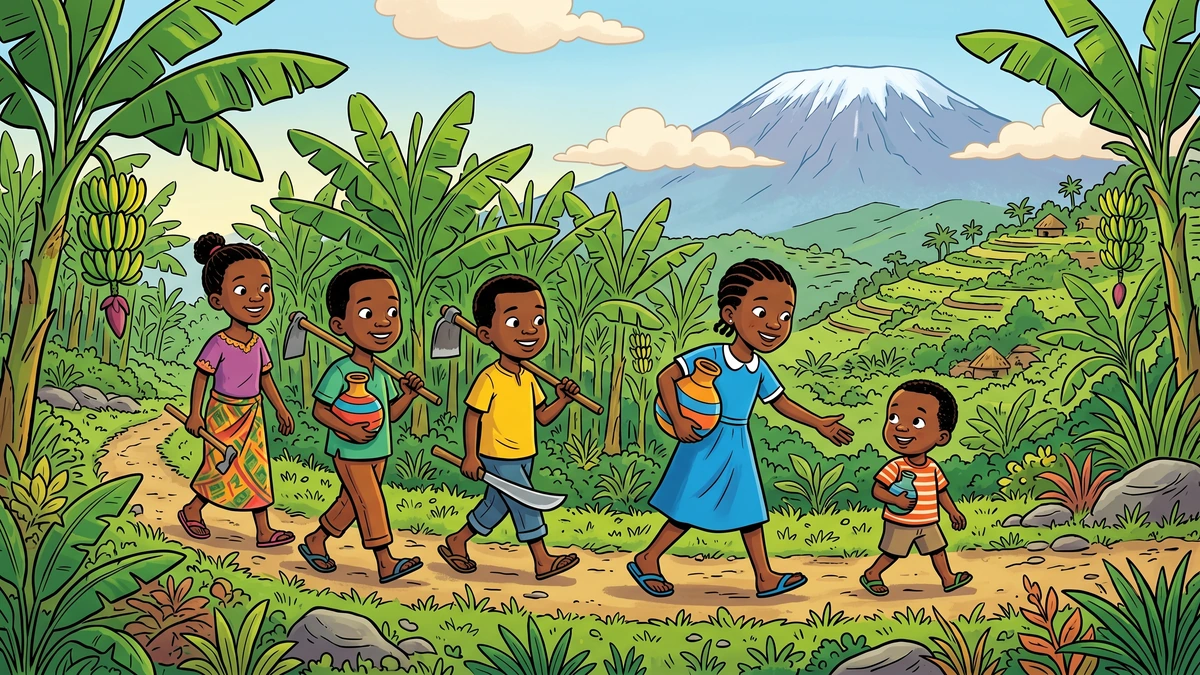
High on the green shoulders of Kilimanjaro, where the banana groves climb in long terraces toward the snow and the streams run cold and quick from the mountain’s heart, there lived a widow named Shindo. Her house stood at the edge of the cultivated land, a round house of poles and thatch, neat enough but very quiet. Shindo had no husband and no child. Each morning she rose in the grey light alone, and each night she banked her fire alone, and the silence of the house sat with her like a second, colder shadow.
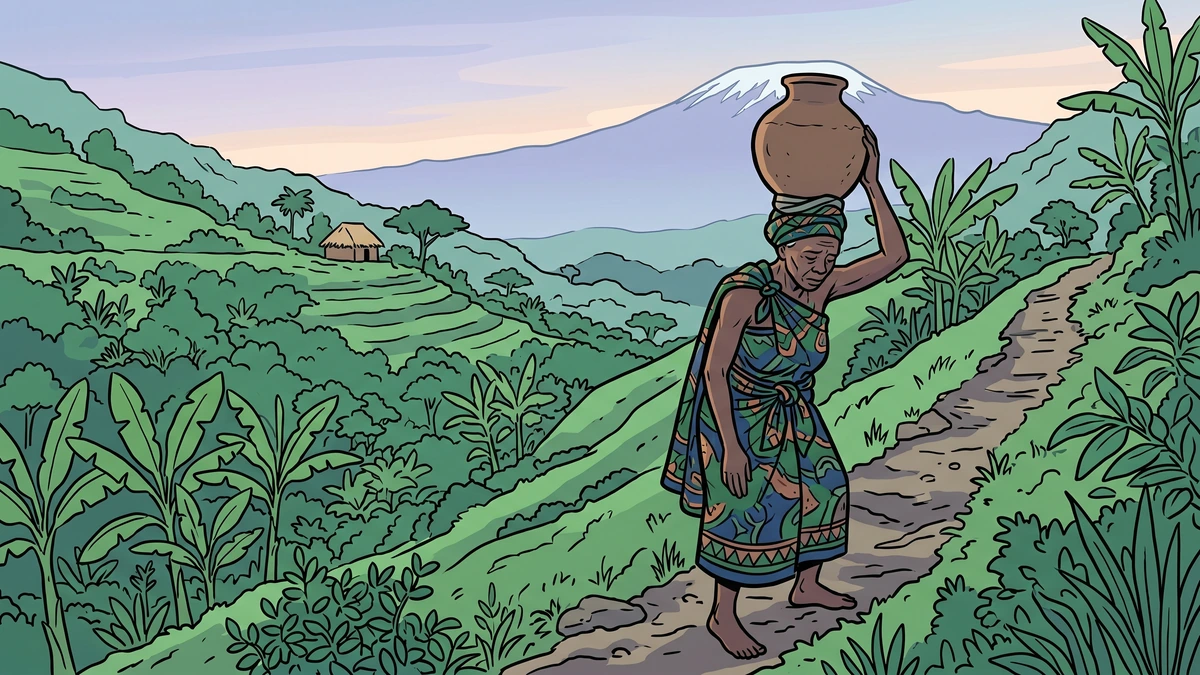
Among the Chaga, a household is measured not in cattle alone but in children — in the laughter that fills the courtyard, in the small hands that fetch and carry, in the voices that will one day remember you. Shindo had none of this. And the work of a Chaga homestead is endless: water to be carried up the steep paths, firewood to be gathered, the banana grove to be weeded, the goats to be driven out and driven home, grain to be ground between two stones until the arms ache. All of it fell on Shindo, and on Shindo alone.
The Gift of the Gourd Seeds
One evening, when her back was bent and her spirit lower than it had ever been, Shindo walked down to the homestead of the village healer — the wise man whom the Chaga call upon for medicine and for counsel. She did not ask him for a charm to bring her riches, nor for a spell to bring her a husband. She asked only for help with her work, for she was so very tired.
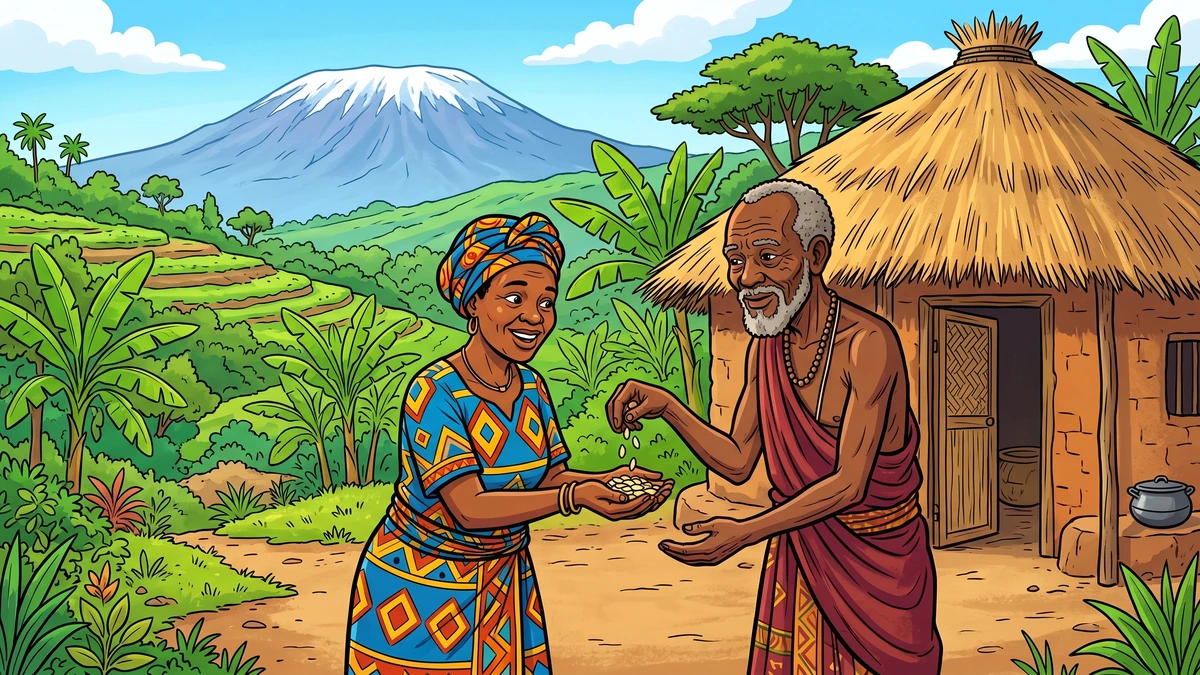
The old man listened, and he did not laugh at her. He went into his house and came back with a small gourd, and from the gourd he shook into her palm a handful of seeds — ordinary calabash seeds, pale and flat. “Plant these,” he told her. “Tend them well. When the gourds are ripe, pick every one. Scrape them clean, and set them by the fire to dry. Do this exactly, and do not be careless — and you shall have the help you long for.”
Shindo thanked him and carried the seeds home cupped in both hands as though they were live coals. The next morning she broke the earth behind her house and pressed each seed into the soft soil, and she watered them from the stream, and she waited.
The vines came up quick and strong. They ran along the ground and curled their tendrils around every stick she gave them, and broad leaves opened like green hands, and pale flowers followed, and behind the flowers swelled the gourds — round and heavy and golden-skinned, more gourds than Shindo had ever grown in her life. She tended them as if they were guests of honour. She pulled every weed. She frightened away every bird. And when at last the gourds were ripe and their skins rang hollow under a tapping finger, she gathered every single one and carried them inside.
The Calabashes by the Fire
All that day Shindo worked at the gourds the way the healer had told her. She cut each one open, scooped out the seeds and the soft pulp, and scraped the insides smooth, for a hollow calabash is a useful thing — a Chaga household keeps milk and beer and grain and water in calabashes, and a good one is treasured. When each gourd was clean, she set it down near the fire to dry, ranging them in a row along the wall.
There were so many that her shelf and her floor were soon crowded. The last gourd of all was the smallest — a little crooked calabash, not as fine as the others. Shindo set it up on the highest shelf, close to the warmth of the smoke, and thought no more about it. Then, weary to the bone, she went out to drive the goats home before dark.
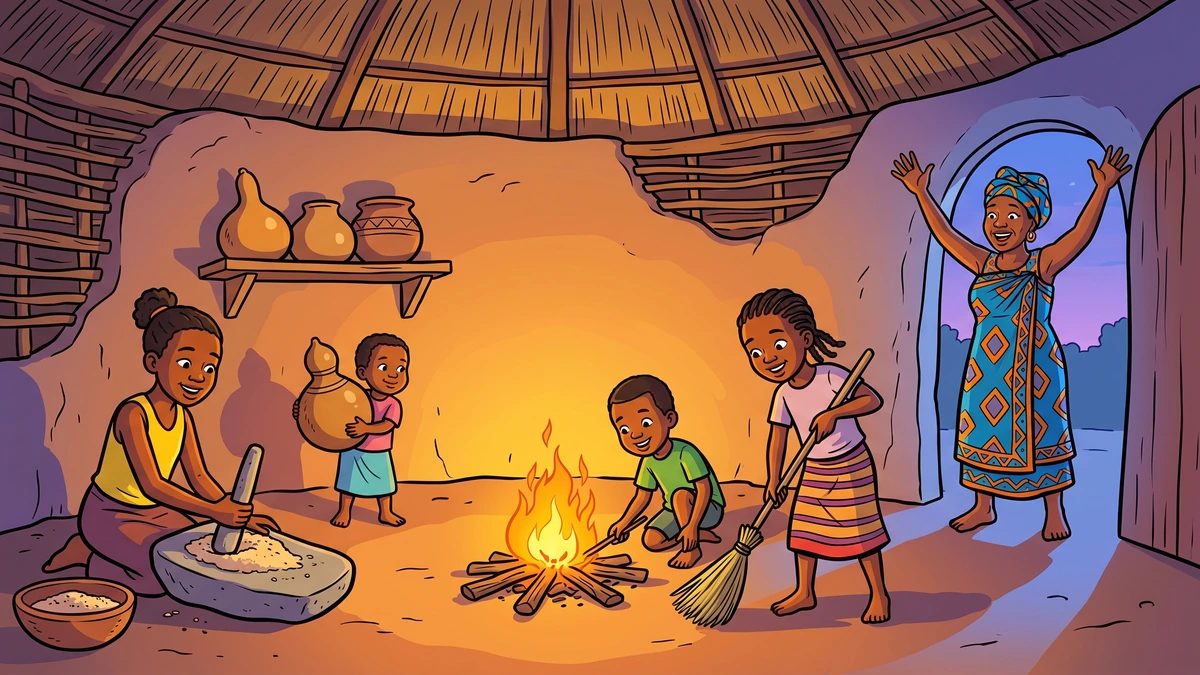
When she pushed open her door at dusk, Shindo stood still in astonishment. The fire was burning bright and tended. The water gourds by the door were full. The floor had been swept clean, the grain had been ground, and a pot of food stood ready and steaming. And the calabashes — the calabashes were gone. In their place, filling her quiet house with noise and motion, were children.
Children everywhere — tall ones and small ones, boys and girls, every one of them busy, every one of them laughing. The dried gourds had become children, just as the healer had promised, and they had done all her work while she was away. Shindo’s heart, which had been folded shut for so many years, opened all at once like one of her own pale flowers. She went among them touching their heads and learning their faces, and she could not stop her tears, but for once they were not lonely tears.
Kitete, the Quiet Child
From that day Shindo’s homestead was the liveliest on the mountainside. The children carried water singing. They weeded the banana grove and minded the goats and ground the grain, and they did it gladly, because they had been made from a wish for help freely given. Neighbours who passed by stopped to wonder at the widow who had been so alone and was now so rich in family.
One child among them was different from the rest. He had grown from that last small crooked gourd set high on the shelf, and so he was named Kitete — which is to say, in the speech of the people, “the little calabash.” Kitete was not as quick as his brothers and sisters. His legs were slower, his hands less sure; when the others ran ahead up the steep paths, Kitete came along behind, and when they finished a task he was often still at the start of it. But he was gentle, and he was willing, and he tried with his whole small heart. The other children never minded him. They slowed their steps so he could keep up, and they shared their work so he would not be left out, and the house was happy.
For a long season all was well. But happiness, when it becomes ordinary, can make a person forgetful — and Shindo, who had once been so grateful for any help at all, slowly grew used to being helped. She began to expect it. And one hot, hard day, when she came home tired and out of temper, she forgot the most important thing the healer had told her. She forgot to be careful.
The Careless Word
It was a small thing that did it, as it so often is. Shindo came in worn out and short-tempered, and she looked about for the work to be finished, and her eye fell on Kitete — slow Kitete, only halfway through his task while the others had run on ahead. Something ugly and impatient rose up in her, and before she could think, she said the cruellest thing she could have said.
“Look at you,” she snapped. “Slow and useless. You are no child of mine at all — you are nothing but a calabash!”
The words were scarcely out of her mouth before she would have given anything to call them back. For the moment she spoke them, Kitete’s bright eyes went dull. His warm skin hardened and paled. His arms drew in to his sides, and his legs folded up beneath him, and where a gentle, willing little boy had stood there was now only a small crooked gourd, rocking once upon the swept floor and then lying still.
And it did not end there. All around the house, the other children stopped where they stood. One after another, as if a cold wind had passed through the room, they too grew still and pale and hard, and sank down, and became gourds — until the floor of Shindo’s house was covered with calabashes, and the noise and the laughter were gone, and the silence she had hated for so long came flooding back into every corner.
The Mending of What Was Broken
Shindo did not rage and she did not run. She knelt down on the floor of her silent house, and she understood, fully and terribly, what one careless word had cost her. Then she did the only thing that was left to do: she began, gently, to gather up the gourds.
She gathered every calabash and she tended each one as if it were a sick child — and the little crooked gourd that had been Kitete she held longest of all. She warmed the gourds by the fire. She wrapped them and watched over them. She spoke to them now in the soft voice she should have used all along, telling them she was sorry, telling them she loved them, asking them, without any right to ask, to come back to her. Day after day she kept her watch, and her sorrow was real, and her patience did not run out.
And because her remorse was true — not a wish to have her servants back, but a longing to have her children back — the old magic, which had been made out of kindness in the first place, slowly answered her. The gourds grew warm under her hands. Their pale skins flushed and softened. Small fingers uncurled, and bright eyes opened, and one by one the children of the calabashes came back to Shindo’s house. Kitete came back among them — slow, gentle Kitete — and this time, when she lifted him up, Shindo did not see a thing that was less than the others. She saw her child. And never again, to the end of her long and crowded and happy life, did she let a careless word fall from her tongue.
The Moral of the Tale
“The Calabash Children” is, above all, a story about the power of words — their power to make a household and their power to break one. Shindo’s family is created out of a generous wish and undone by a thoughtless insult, and the tale asks its listeners to weigh how easily that happens, and how dearly it costs. It honours, too, the slow and the gentle: Kitete, the child who could not keep up, is precisely the one whose loss teaches the lesson, and the story refuses to measure a child’s worth by speed or strength. The Chaga, who carry water and grain in calabashes every day of their lives and who are often given gourd-names themselves, would have heard in this tale a warning close to home — that the most ordinary things in the house, and the most ordinary people in the family, are not to be despised. The wisdom of the mountain says it plainly:
“Ulimi hauna mfupa.”
— Swahili proverb: “The tongue has no bone” — it is unguarded and can say anything, so the speaker, not the tongue, must do the guarding.
Why the Tale Has Lasted
This small mountain story has travelled a long way from the slopes of Kilimanjaro. It survived first in the spoken tradition of the Chaga, was set down in print by Charles Dundas in 1924, and in the century since has been retold for children across the world in picture books, in classroom readers and in storytelling theatre, because its lesson never grows old. Every family, in every land, knows the danger of the word said in tiredness and temper — and every family knows, too, the slow work of mending afterward. “The Calabash Children” offers both halves of that truth without flinching: it lets one cruel sentence do real and visible harm, and it lets genuine, patient remorse undo it. That honest balance — words can wound, and love that is truly sorry can heal — is why a tale about gourds and a lonely widow is still being told, and still worth telling, on Kilimanjaro and everywhere else.
Frequently Asked Questions
Where does the folk tale “The Calabash Children” come from?
“The Calabash Children” is a traditional folk tale of the Chaga (Chagga) people, a group of Bantu-speaking communities living on the southern and eastern slopes of Mount Kilimanjaro in northern Tanzania. It passed for generations through Chaga oral storytelling and was recorded among the legends and customs of the Wachagga by the British administrator and ethnographer Charles Dundas in his 1924 study Kilimanjaro and Its People. Calabash gourds are central to Chaga daily life as household vessels, and Chaga children are often given gourd-related names, which is why a tale about children grown from calabashes felt natural to its first tellers.
What is the moral of “The Calabash Children”?
The tale is chiefly about the power of words. The widow Shindo’s family is created from a kind wish and destroyed in an instant by one careless, cruel sentence. The story warns that a thoughtless word spoken in tiredness or temper can do real harm, and it shows that mending such harm takes genuine, patient remorse. It also teaches that the slow and the gentle should not be despised: the lesson turns on Kitete, the child who could not keep up, whose worth the story refuses to measure by speed or strength.
Who is Kitete in the story?
Kitete is the gentle, slow-moving child who grew from the smallest and most crooked of the gourds, the one Shindo set high on the shelf. His name means “the little calabash.” He cannot work as quickly as the other children, but he is willing and kind-hearted, and his brothers and sisters never mind his pace. It is Kitete whom Shindo cruelly insults, calling him “nothing but a calabash,” and it is his transformation back into a gourd that triggers the loss of the whole family and drives the story’s lesson home.
Is “The Calabash Children” the same story as “The Calabash Kids”?
Yes. “The Calabash Children” and “The Calabash Kids” are two titles for the same traditional Chaga tale from Tanzania. The best-known modern version is the picture book The Calabash Kids: A Tale from Tanzania, retold by Aaron Shepard and published by Charles Scribner’s Sons in 1994, which remains in copyright. The retelling on this page goes back to the older traditional story as it was preserved in the oral tradition and in early printed records, and is told in its own fresh words.
Why are calabash gourds so important in this tale and in Chaga culture?
Among the Chaga of Mount Kilimanjaro, the calabash is one of the most ordinary and essential objects in any home: dried, hollowed gourds are used to store and carry water, milk, grain and beer, and a well-made calabash is valued and cared for. Children are frequently given names connected to gourds. By imagining children who grow from calabashes, the tale roots its magic in the most familiar thing in the house, and its insult, “you are nothing but a calabash,” stings precisely because it dismisses something humble that the family in fact depends on every single day.
You May Also Like
 African Folk Tales
Ages 6-8
African Folk Tales
Ages 6-8
Why Tigers Never Attack Men Unless They Are Provoked
An Akan pourquoi tale from West African Folk-Tales (Barker & Sinclair, 1917): a hunter and a leopard become friends, and a feigned death tests whether the friendship is true — explaining why the great cats leave men in peace unless provoked.
 African Folk Tales
Ages 9-12
African Folk Tales
Ages 9-12
How the Leopard Got His Spots
The canonical story of how the leopard got his spots: Rudyard Kipling's pourquoi tale from Just So Stories (1902), retold with full scholarly attribution.
 African Folk Tales
Ages 9-12
African Folk Tales
Ages 9-12
The Girl and the River Spirit
The Girl and the River Spirit — a Yoruba folk tale of Nigeria in which the devoted girl Adeola crosses a dangerous river and is tested by the river goddess Osun through three trials of kindness, honesty and love.