The Binding of Fenrir
The Binding of Fenrir: In the halls of Asgard, a darkness grew in the hearts of the gods, a fear that ate at them like rot eats at wood. It began with a

Of all the stories the Norse told around the long fires of winter, few are as quietly terrible as the binding of Fenrir. It is not a tale of a hero slaying a monster. It is a tale of gods who know exactly what is coming, who cannot stop it, and who choose, knowingly, to buy a little more time at a terrible price. The great wolf Fenrir is not defeated in this story. He is only delayed. And the god who makes that delay possible loses something he can never get back.
This is a myth about foreknowledge and its burden, about the difference between strength and trust, and about what courage actually costs when it is real. It has survived for the better part of a thousand years because it refuses to comfort us. Fenrir still waits, in the story and in the imagination, and everyone who hears the tale knows it.
Where the Story Comes From
The binding of Fenrir is one of the best-attested narratives in all of Norse mythology, and its fullest telling belongs to the Prose Edda, the handbook of Norse myth and poetics composed by the Icelandic chieftain, lawspeaker, and historian Snorri Sturluson around the year 1220. The complete account appears in Gylfaginning (“The Beguiling of Gylfi”), the first major section of that work, where it is told as part of chapter 34. Snorri’s prose is the source for nearly every modern retelling, including the dwarven-forged ribbon, the gods’ wager, and the sacrifice of the god Týr.
Behind Snorri’s tidy prose stand the older poems of the Poetic Edda, preserved chiefly in the Icelandic manuscript known as the Codex Regius (GKS 2365 4to), written down in the second half of the thirteenth century but transmitting verse far older. Fenrir moves through several of these poems. In Völuspá (“The Prophecy of the Seeress”), the wolf breaks loose at Ragnarök and devours Odin himself. In Vafþrúðnismál (“The Lay of Vafthrúdnir”), Odin and a wise giant trade riddles about the wolf who will swallow the sun. And in Lokasenna (“Loki’s Quarrel”), the trickster Loki taunts Týr directly, jeering that Týr can never deal fairly between men because it was Fenrir who tore his right hand away. The myth, in other words, is not Snorri’s invention. He gathered and ordered a story the skalds already knew.
Fenrir belongs to a wider pattern that folklorists recognize across many traditions: the monstrous being too dangerous to kill and too dangerous to free, who must instead be bound and held until a foretold end. The chained adversary awaiting release at the world’s last day is a motif the Norse shared, in their own grim key, with several neighboring mythologies. What makes the Norse version unforgettable is that the binding is not a triumph. It is a stay of execution, and the gods know it.
The Wolf the Gods Raised
Fenrir was not born in some distant wasteland. He was raised in Asgard, the home of the gods themselves. He was one of three children born to Loki and the giantess Angrboða, and his siblings were no less ominous: Jörmungandr, the serpent flung into the sea to circle the whole of the world, and Hel, given dominion over the realm of the dead. When the gods learned of these three and heard the prophecies attached to them, they took the children into Asgard rather than leave them to grow unwatched.
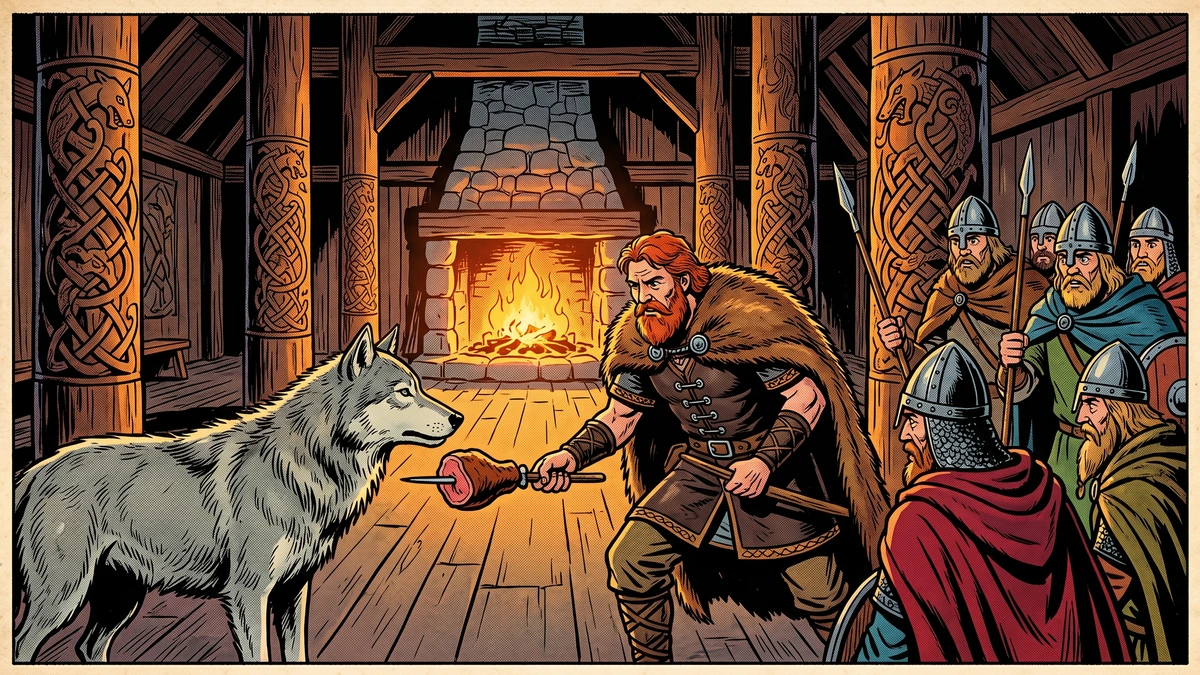
The serpent and the daughter were sent away to the places that would become theirs. The wolf they kept. At first he was only a pup, large but not yet terrible, and the gods reasoned that they could raise him among themselves and so keep him gentle. Yet only one of them was brave enough to go near him to give him meat: Týr, the god of war and of oaths, the keeper of justice. Day after day, Týr fed the wolf with his own hand. And day after day, the wolf grew.
This is the quiet horror at the centre of the tale. Fenrir was not an invader. He was a member of the household. The gods watched him swell into something vast and strong, and they watched the prophecy of his role at Ragnarök grow heavier with every meal. They had raised the instrument of their own ending, and they had done it with open eyes.
Leyding and Drómi: The Chains That Failed
At last the gods could no longer pretend. Fenrir had grown so large and so strong that fear moved openly through Asgard. They resolved to bind him — but they did not dare simply seize him, for the wolf had done no wrong, and the gods were bound by their own laws and oaths. So they turned the binding into a game.
They forged a great fetter of iron and called it Leyding, and they brought it to Fenrir as a test of his famous strength. Would he let them bind him, so that all could marvel at how he burst free? Fenrir looked at the chain, judged it weak, and allowed it. At his first hard kick, Leyding shattered. The gods praised him loudly and hid their dismay.
They made a second fetter, twice as strong as the first, and named it Drómi, and again they framed it as a contest. Fenrir saw that this chain was far heavier, and he understood that some risk attended the game — but he also reasoned that no fame is won without risk, and that a creature who never tests himself wins no renown at all. He let them bind him with Drómi. He strained, he braced, he kicked, and the chain broke apart so violently that its fragments flew far across the field. From that day, the Norse said, came two proverbs for escaping a hard situation: “to loose oneself from Leyding” and “to strike oneself out of Drómi.”
The gods were now genuinely afraid. No iron they could forge would hold this wolf. If brute strength could not bind him, they would need something else entirely — and so they stopped thinking about chains.

Gleipnir: The Ribbon Forged From Impossible Things
Odin sent his messenger, the bright god Freyr’s servant Skírnir, down into the dark country of the dwarves, the master-smiths who lived beneath the mountains and shaped the finest works in all the worlds. The dwarves were asked for a fetter that could not be broken, and what they made did not look like a fetter at all. It was Gleipnir, and it was smooth and supple as a silken ribbon, light enough to coil in one hand.
The Norse listed, with relish, the six impossible ingredients from which the dwarves spun it: the sound of a cat’s footfall, the beard of a woman, the roots of a mountain, the sinews of a bear, the breath of a fish, and the spittle of a bird. These things are absent from the world, the storytellers explained, precisely because the dwarves used them all up making Gleipnir. The ribbon’s strength was not the strength of iron. It was the strength of paradox — a thing woven from what does not exist, and therefore impossible to fight in any ordinary way.
The gods carried Gleipnir to an island in a lake, a place the texts call Lyngvi, and there they invited Fenrir once more to test his strength. But the wolf was no fool. He looked at the slender, silken band and understood at once that there was no glory to be won snapping a ribbon — and that if a ribbon this slight had been brought to him with such ceremony, then some craft, some trick, some magic had gone into it. “If this band is made with cunning,” Fenrir said, “then though it looks slight, it is not coming on my legs.”
The Hand in the Wolf’s Mouth
Fenrir set a condition. He would allow the gods to bind him with Gleipnir — but only if one of them would place a hand between his jaws, as a pledge of good faith, a guarantee that there was no deceit and that he would be freed if he could not break loose. It was a fair demand, and it exposed the gods completely, because there was deceit. They had no intention of freeing him.
The gods looked at one another, and each looked away. Not one of them would do it. To put a hand in Fenrir’s mouth was to lose that hand, and every god in the circle knew it. The silence stretched, and in that silence the whole binding came to the edge of failure.
Then Týr stepped forward. The same god who had fed the wolf since he was a pup, the god of oaths and of justice, walked up to Fenrir and laid his right hand between the great teeth. The gods bound the wolf with Gleipnir. Fenrir kicked, and the ribbon only tightened. He strained with everything in him, and the more he struggled the harder the band held. The gods laughed — all of them except Týr.
Fenrir, understanding at last that he had been betrayed, bit down. Týr lost his hand at the wrist, the joint the Norse afterwards called the “wolf-joint.” He did not cry out, and he did not pull away. He had known the price before he stepped forward, and he had paid it with his eyes open. That is the difference, the myth insists, between recklessness and courage: courage is what you call it when the cost is certain and you go anyway.

The Wolf That Waits
Fenrir could not break Gleipnir, and the gods did not free him. They drew the loose end of the ribbon through a great stone slab and fixed it deep in the earth, and they set another rock to hold it. When the wolf snapped his jaws to seize them, they jammed a sword upright into his mouth, the hilt against his lower jaw and the point against the upper, so that he was gagged and could not close his teeth. From that wedged mouth ran a river of foam, and the Norse said that river was called Ván — “Expectation,” or “Hope” — a name as bleak as anything in the mythology, for it is the river of what is still to come.
And there Fenrir lies, bound but alive, gagged but not silenced, waiting. The myth is precise about why the gods did not simply kill him: it was foretold that he would be the death of Odin, and the gods would not stain their sanctuary with the killing of a creature who had, as yet, done nothing but exist as he was made. So they chose to bind him instead — and so they chose to keep their doom on a leash rather than end it.
The poems are equally precise about how it ends. At Ragnarök, the bonds will break. Fenrir will run free with fire in his eyes, his lower jaw against the earth and his upper jaw against the sky, and he will swallow Odin whole. He will, in turn, be killed by Odin’s son Víðarr, who avenges his father. The binding, in other words, was only ever a delay. The gods bought time. They did not buy escape.

Týr: The God Who Kept Faith
It is worth pausing on the figure who carries the weight of this story. Týr is one of the oldest gods in the Norse pantheon, and his name itself is a clue to how ancient he is. It descends from a Proto-Germanic form, Tīwaz, which in turn goes back to the same root that gave Latin deus and Greek Zeus — a word that once simply meant “god” or “the sky-god.” His name survives in plain sight every week in the English word Tuesday, which is “Týr’s day,” a direct translation of the Latin dies Martis, the day of Mars. To the Romans who first wrote about the Germanic peoples, Týr looked like a war god, and he was.
But in the surviving Norse material, Týr is more precisely the god of the lawful side of conflict — of oaths, of pledges, of the binding word, of justice done in the assembly. That is exactly what makes his role in this myth so pointed. The god of oaths is the one asked to stand surety for a promise the other gods intend to break. He does not refuse, and he does not pretend the promise is honest. He places his sword-hand, his fighting hand, into the wolf’s jaws as a true pledge inside a false bargain, and he loses it. A one-handed god of war and justice is a striking, almost painful image, and the Norse kept it deliberately. It says that keeping faith can cost you the very thing you are best known for — and that it is still worth doing.
The Moral of the Tale
It would be easy to read this story as a simple lesson about cleverness defeating strength — the silken ribbon outdoing the iron chain. But the Norse who told it knew better, and they did not let their gods off lightly. The gods win, but they win by breaking faith. They make a wager they never mean to honour, and the only one of them who behaves honourably is Týr, who keeps the pledge the others abandon and pays for the lie with his own flesh.
The real moral sits with Týr. It is a lesson about the price of doing what is necessary, and about facing a hard fate without flinching. The Norse prized exactly this kind of clear-eyed courage above almost any other virtue, and they said so plainly in their oldest poem of wisdom, the Hávamál:
“Ósnjallr maðr
hyggsk munu ey lifa,
ef hann við víg varask;
en elli gefr
honum engi frið,
þótt honum geirar gefi.”“The cowardly man thinks he will live for ever if he keeps aw
You May Also Like
 Norse Folk Tales
Ages 9-12
Norse Folk Tales
Ages 9-12
Odin’s Quest for Wisdom
Odin's Quest for Wisdom: From the moment of his birth, Odin All-Father burned with a need that nothing could satisfy. While other gods delighted in feasts and
 Norse Folk Tales
Ages 6-8
Norse Folk Tales
Ages 6-8
The Giant Who Had No Heart In His Body
Norwegian Ash-Lad tale — Boots, three grateful animals, and a giant’s heart hidden in an egg — ages 6–8+. Asbjørnsen & Moe / ATU 302.
 Norse Folk Tales
Ages 3-5
Norse Folk Tales
Ages 3-5
The Three Billy-Goats Gruff
Norwegian *De tre bukkene Bruse* — three goats, one bridge, one greedy troll — ages 3–5 / 6–8. Asbjørnsen & Moe.