The Lassie And Her Godmother
The Lassie And Her Godmother: Once on a time a poor couple lived far, far away in a great wood. The wife was brought to bed, and had a pretty girl, but they
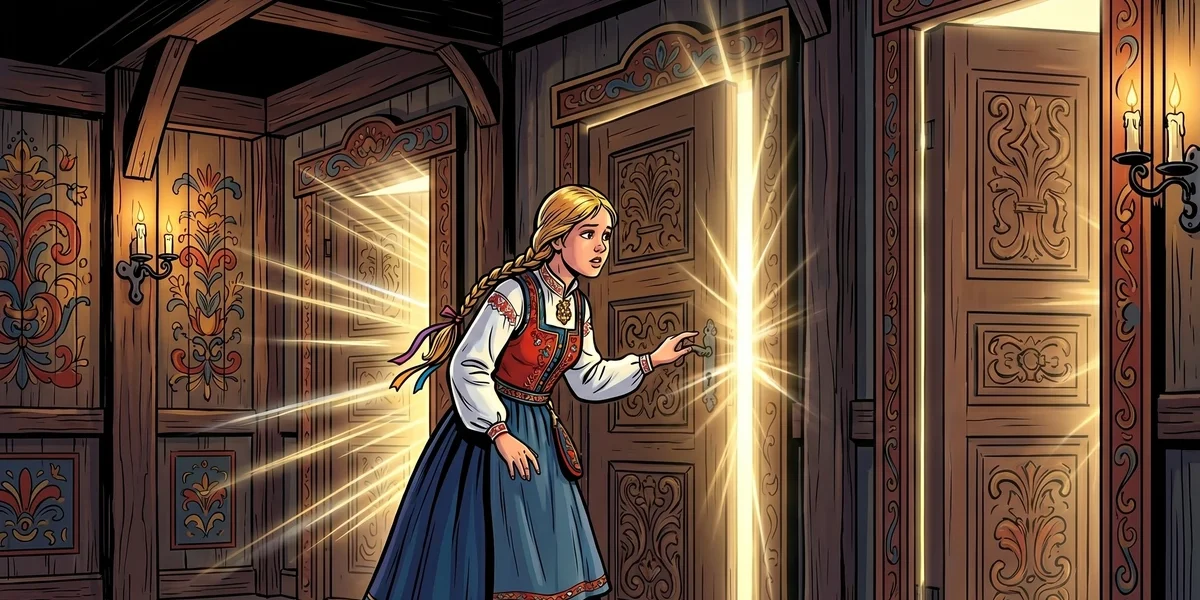
The Lassie and Her Godmother is one of the most haunting tales in the Norwegian canon — a story of a forbidden door, a broken silence, and a punishment that turns out, in the end, to be a kind of mercy. A poor man gives his daughter into the keeping of a radiant lady who proves to be the Virgin Mary herself; the girl breaks her foster-mother’s single rule three times, loses first her home and then her speech, and must suffer through years of grief before her guardian relents. Beneath its quiet, almost liturgical calm, the tale carries one of folklore’s oldest warnings about curiosity, and one of its gentlest promises about forgiveness.
Where the Story Comes From
This tale was collected in Norway by Peter Christen Asbjørnsen (1812–1885) and Jørgen Moe (1813–1882), the two friends whose lifelong partnership gave Norway its national treasury of folktales. They published it in their landmark collection Norske Folkeeventyr (“Norwegian Folktales”), the volumes that first appeared from 1841 onward and did for Norway what the Grimms’ Kinder- und Hausmärchen had done for Germany a generation earlier. The original Norwegian title is “Jomfru Maria som gudmor” — literally “The Virgin Mary as Godmother” — which states outright the secret that the English version withholds until its final lines.
The English text known to readers today comes from Sir George Webbe Dasent (1817–1896), the philologist and Old Norse scholar whose Popular Tales from the Norse (Edinburgh, 1859) introduced Asbjørnsen and Moe to the English-speaking world. It was Dasent who rendered the title as “The Lassie and Her Godmother,” preserving the Scots-flavoured word lassie that gives the heroine her warmth and her anonymity at once — she is never named. The tale was later reprinted in the celebrated 1914 gift-book East of the Sun and West of the Moon, where the Danish illustrator Kay Nielsen gave it the luminous, art-nouveau images by which many readers first met it.
In the international folktale system, the story is classified as ATU 710, “Our Lady’s Child” (also called “The Virgin Mary’s Child”), in the Aarne–Thompson–Uther index. Its closest and most famous cousin is the Brothers Grimm tale “Marienkind” (“Mary’s Child,” KHM 3) — the Grimms themselves noted the kinship. An Italian relative, traced by scholars to Giambattista Basile’s seventeenth-century Pentamerone, survives as “The Goat-faced Girl.” At the heart of all of them lies one of folklore’s most ancient devices: the forbidden chamber, the room one is told not to enter and therefore cannot resist.
The Bargain at the Christening
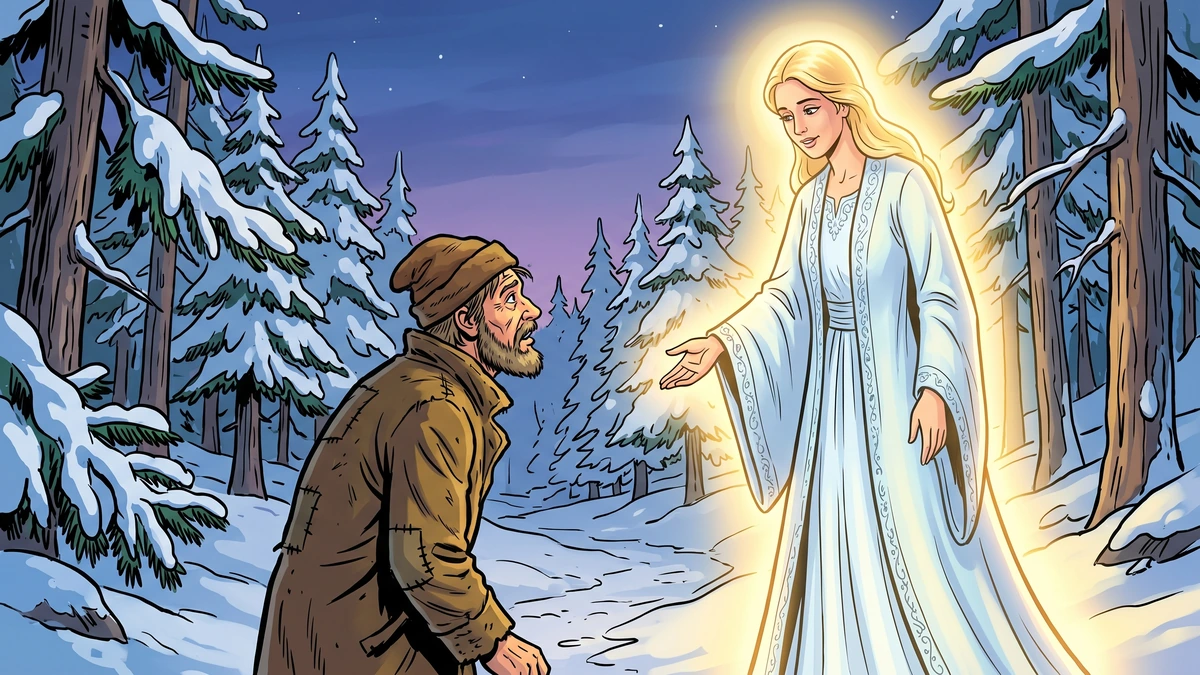
The story opens in hardship. A poor couple living deep in a great wood have a baby daughter, but they cannot afford the fee to have her christened. Day after day the father walks from house to house; neighbours are willing enough to stand as godparents, but none will pay the parson’s charge. Each evening, on his way home, he is met by a lovely lady — finely dressed, “so thoroughly good and kind” — who offers to see the child christened on one condition: afterwards, the girl must be hers to keep.
Twice the wife refuses. On the third day, with no other help in sight, she relents. The lady comes with two men to stand as godfathers, carries the babe to church, and there the christening is done. Then she takes the little girl home to her own house, where the child grows up for several years, and her foster-mother is “always kind and friendly to her.” It is a bargain sealed in poverty and desperation — the oldest kind of folktale contract — and like all such contracts, it will be tested.
The Three Doors: Star, Moon, and Sun
When the lassie is old enough “to know right and wrong,” her foster-mother must travel. She gives the girl the freedom of the whole house save for the rooms she points out, and departs. But the lassie cannot help opening one forbidden door just a crack — and POP! out flies a Star. The lady returns grieved, threatens to send her away, and forgives her only after the child weeps and pleads.
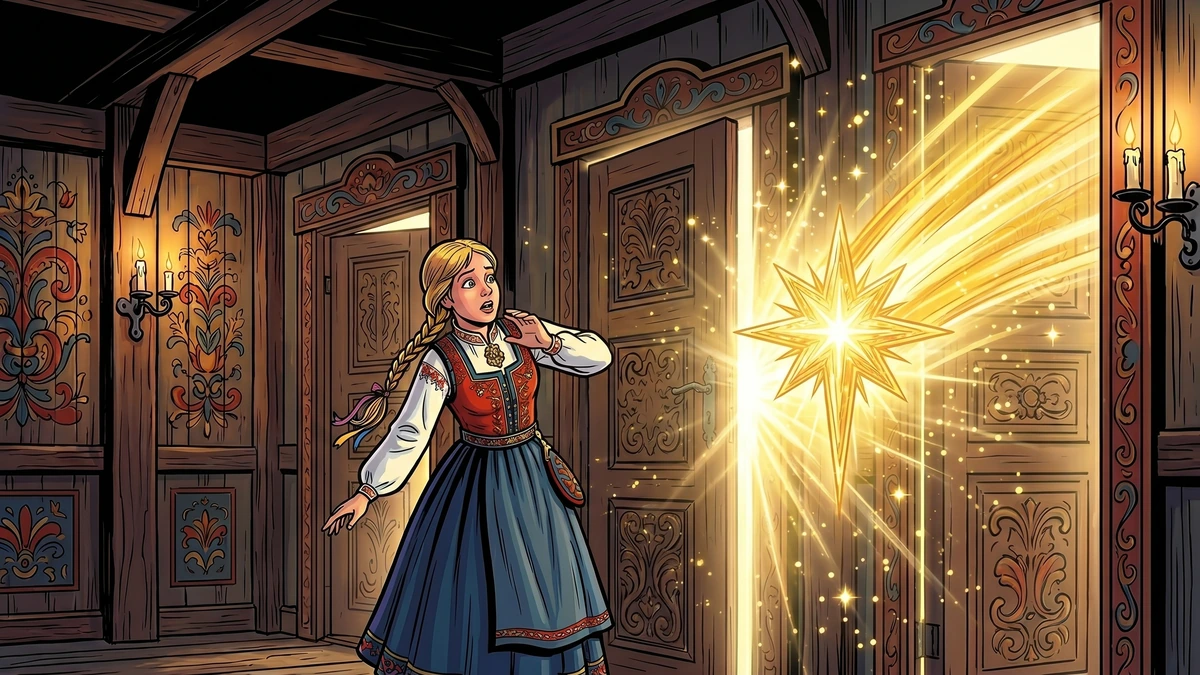
The pattern repeats with the gravity of ritual. On the second journey the girl opens the second door, and out flies the Moon. On the third, no longer able to hold out against the thought — “come what might, she must and would look” — she opens the last door, and out flies the Sun. This third loss cannot be forgiven. The forbidden room, in tale after tale, is the threshold between obedience and self-will; here the rule of three escalates from the smallest light of heaven to the greatest, so that the final transgression is also the most cosmic.
Now the foster-mother offers a terrible choice. The lassie may be “the loveliest woman in the world” but unable to speak, or she may keep her speech and be “the ugliest of all women” — but go she must. The girl chooses beauty, and in that instant becomes “wondrous fair” and forever dumb. The choice is the moral hinge of the whole tale: she trades her voice for her face, and the rest of the story will show her, again and again, unable to defend herself with the one thing she gave away.
The Silent Queen and the Stolen Children
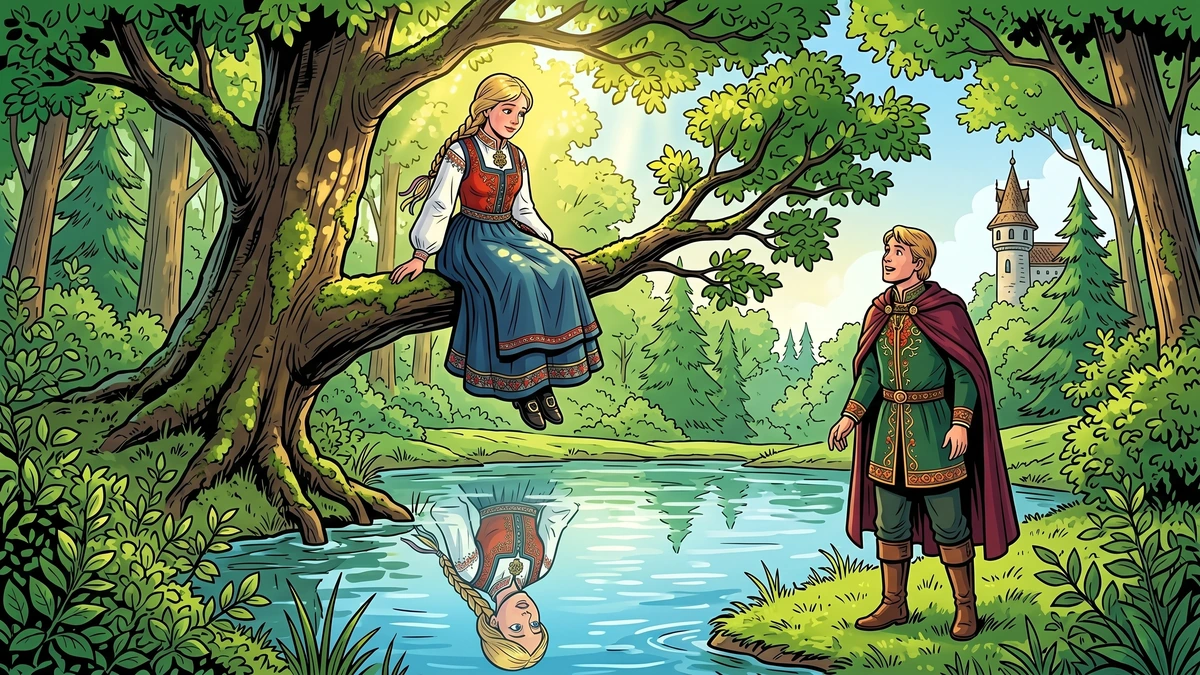
Cast out, the lassie wanders through an endless wood until she climbs a tall tree above a spring to sleep. From a nearby castle a maid comes each morning to draw water; seeing the lovely face mirrored in the spring, the maid mistakes it for her own and flees, declaring herself too pretty to fetch water. A second maid does the same. At last the Prince comes himself, looks up instead of down, and discovers the beautiful silent girl in the tree. He coaxes her down, takes her home, and — over his mother’s sharp objections that a wife who cannot speak “maybe… she’s a wicked witch” — makes her his queen.
Then comes the long ordeal. Three times the young queen bears a child; three times, though the Prince sets ever stronger watches, everyone falls into a deep enchanted sleep at the birth. Each time the foster-mother appears, takes the newborn away, cuts its little finger, and smears the queen’s mouth with blood — saying, in turn, “Now you shall be as grieved as I was when you let out the star… the moon… the sun.” The watchers wake to think the queen has devoured her own babies. Twice the Prince begs her life from his furious mother; the third time he cannot. The silent queen, unable to speak a word in her own defence, is led to the stake to be burned alive.
“I Am the Virgin Mary”
At the very edge of the fire, the foster-mother appears once more — this time leading two children by the hand and carrying the third on her arm. She gives them back to the young queen with words that close the circle of the whole tale: “Here are your children; now you shall have them again. I am the Virgin Mary, and so grieved as you have been, so grieved was I when you let out sun, and moon, and star. Now you have been punished for what you did, and henceforth you shall have your speech.”
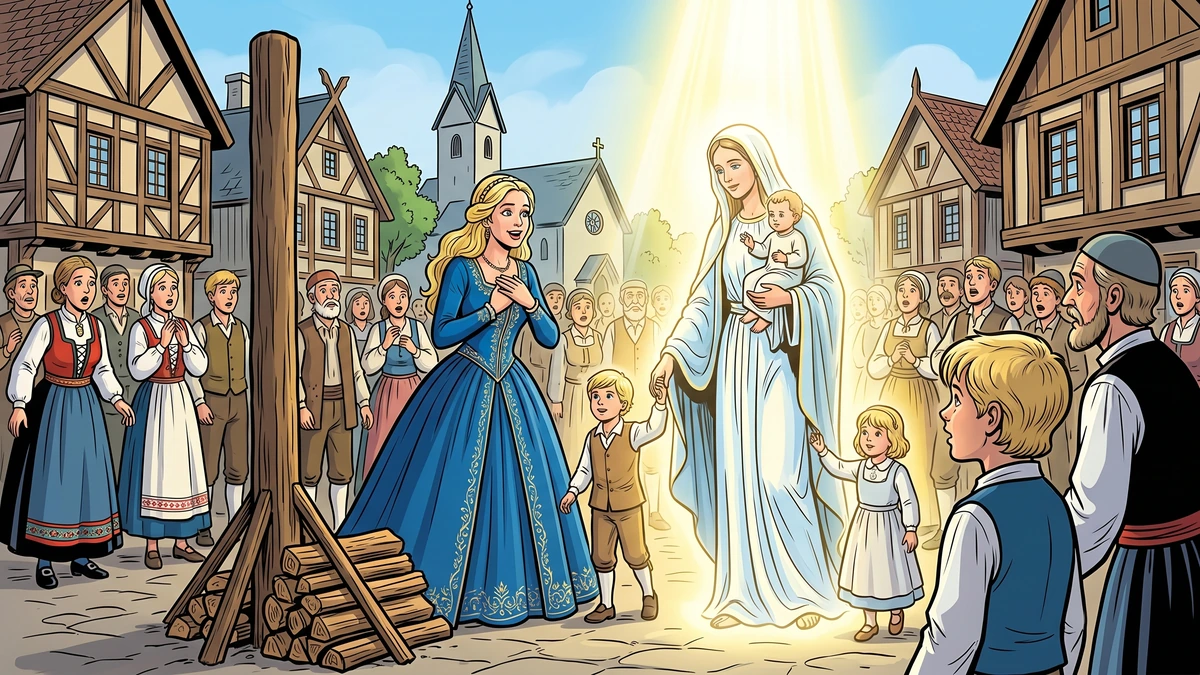
The queen’s voice returns, her children are restored, and the joy of the Prince and Queen, the tale says, is more than anyone can tell. The revelation reframes everything that came before. The guardian was never cruel; she was a grieving mother teaching grief by letting her foster-daughter feel exactly the loss she herself had felt. The punishment was a lesson measured to the offence — star for star, moon for moon, sun for sun — and it ends not in destruction but in reunion.
The Forbidden Chamber: An Ancient Pattern
The three closed doors of The Lassie and Her Godmother belong to one of the most widespread story-shapes in the world. Folklorists call it the forbidden chamber motif — catalogued by Stith Thompson under motif C611, “Forbidden room” — and it surfaces wherever stories are told. In Greek myth, Pandora is told not to open the jar; in the French tale of Bluebeard, set down by Charles Perrault in 1697, a young wife is forbidden a single locked room and cannot resist its key; in the Book of Genesis, the first humans are told not to eat from one tree in a garden of plenty. The prohibition always works the same way. To name a boundary is to make it visible, and to make it visible is to make it tempting. The forbidden room is less a trap than a mirror: it shows the listener their own restless mind.
What sets the Norwegian tale apart is the content of its rooms. Where Bluebeard’s chamber holds horror — the bodies of murdered wives — the lassie’s doors release light: a star, the moon, the sun. Her transgression does not uncover a crime; it lets something escape that ought to have been kept. The escalation from star to sun gives the tale a cosmic scale, as though the girl were undoing the order of the heavens one lamp at a time. And crucially, the consequence is not death but exile and silence — a punishment that can be served and, eventually, lifted. The Norwegian forbidden chamber is a tale of curiosity that wounds rather than kills, and that is precisely why it can end in healing.
Mary as Godmother: A Christian Tale in Folk Dress
The revelation that the radiant foster-mother is the Virgin Mary places this story in a particular family of European folktales — the “legendary” tales (ATU 710 sits among the religious tale-types) in which a Christian holy figure walks into a folk plot and quietly governs it. Mary, in medieval and early-modern popular devotion, was the great intercessor and the patron of mothers and children; for a poor couple unable to pay even a christening fee, a godmother who is the Mother of God is the ultimate reversal of fortune. Yet the tale never preaches. Mary behaves throughout like an ordinary, if formidable, foster-mother — setting house rules, going on journeys, growing “very vexed” and “downcast” and “cut to the heart” in turn. Her divinity is hidden inside domestic feeling.
That hiddenness is the tale’s real artistry. By withholding the secret until the last lines — even as the Norwegian title “Jomfru Maria som gudmor” gives it away — the English version turns the whole story into a slow act of recognition. The reader, like the watchers at the stake, has spent the tale fearing the foster-mother as a child-stealer and a witch; the final speech transforms her, retroactively, into a sorrowing teacher whose every harsh act was a measured lesson. The Brothers Grimm kept the same figure in their “Marienkind”; the persistence of the motif across Germany, Norway, and Italy shows how readily a Christian legend could be absorbed into the deep grammar of the wonder-tale — the rule of three, the forbidden room, the silent heroine, the rescue at the burning.
The Silent Heroine
The lassie’s muteness links her to a small, poignant sisterhood of folktale heroines who must endure in silence. In the Brothers Grimm’s “The Six Swans” and “The Twelve Brothers,” a sister may not speak or laugh for years while she works to disenchant her brothers; in Hans Christian Andersen’s “The Little Mermaid,” the heroine trades her voice for human form and so cannot tell the prince who saved him. In every case the silence is a test of constancy, and in every case it nearly destroys the heroine, because it strips her of the power to explain herself at the moment she most needs it. The Lassie and Her Godmother belongs squarely to this pattern — yet it sharpens it. Here the silence is not a quest the heroine undertakes for love but a punishment she half-chooses out of vanity, picking beauty over speech. That choice makes her ordeal feel earned rather than merely cruel, and it gives the tale its unusually clear moral spine: the gift she clung to, beauty, is the one that nearly burns her, while the gift she surrendered, her voice, is the one that would have saved her.
The Moral of the Story
At its surface, The Lassie and Her Godmother is a warning against curiosity that will not respect a boundary — the same warning carried by Pandora’s jar, by Bluebeard’s bloody key, by Eve and the forbidden fruit. But the Norwegian tale is gentler and more searching than a simple prohibition. Its deeper lesson is about the cost of evasion: the lassie’s real punishment is not ugliness or exile but silence — she chooses to keep her beauty and lose her voice, and so loses the power to confess, to explain, to set the record straight. Years of suffering follow not from the broken doors alone but from her inability to speak the truth.
And the tale insists that grief, honestly suffered, is what finally teaches. The foster-mother does not lecture; she lets the girl feel what loss is, and only then forgives. A Norwegian proverb catches the tale’s double wisdom about speech and its keeping:
“Tale er sølv, men taushet er gull.”
— “Speech is silver, but silence is gold” — yet a silence that hides the truth is the heaviest burden of all.
Forgiveness, the story says, is real but not free; it is earned through honest sorrow, and it is offered at last by a guardian who was patient enough to wait for it.
Why the Tale Has Lasted
For more than a century and a half, The Lassie and Her Godmother has held its place among the best-loved Norwegian folktales because it joins a thrilling structure to a tender heart. The three escalating doors, the rule of three, the slow tightening dread of the three stolen children and the three watches — these give the tale the architecture of a fairy tale at its most satisfying. Yet its emotional core is unusually humane: a foster-mother who is stern only because she loves, a heroine punished into wisdom rather than crushed by it, and an ending that restores everything the heroine lost.
Children meet it as a suspenseful story of a magic house and a girl who must not speak; older readers recognise in it the ancient pattern of trespass, consequence, and grace. That layering — folktale on the outside, parable within — is exactly why Asbjørnsen and Moe’s collection became Norway’s national book, and why this particular tale still rewards every reader who climbs, with the lassie, into the tall tree above the spring and waits to see how the silence will finally be broken.
You May Also Like
 Norse Folk Tales
Ages 9-12
Norse Folk Tales
Ages 9-12
Soria Moria Castle
Soria Moria Castle: Once on a time there was a poor couple who had a son whose name was _Halvor_. Ever since he was a little boy he would turn his hand to
 Norse Folk Tales
Ages 9-12
Norse Folk Tales
Ages 9-12
The Creation of the World from Ymir’s Body
The Creation of the World from Ymir's Body: In the beginning, before the world was formed and before time itself had meaning, there existed only Muspelheim and
 Norse Folk Tales
Ages 9-12
Norse Folk Tales
Ages 9-12
Tyr and the Binding of Fenrir
Tyr and the Binding of Fenrir: In the time before Ragnarok, when the gods still believed they could prevent the end times through cunning and sacrifice, there