1003+ Stories from Ancient India — Free to Read! Explore all stories →

The Three Billy-Goats Gruff

The Three Billy-Goats Gruff

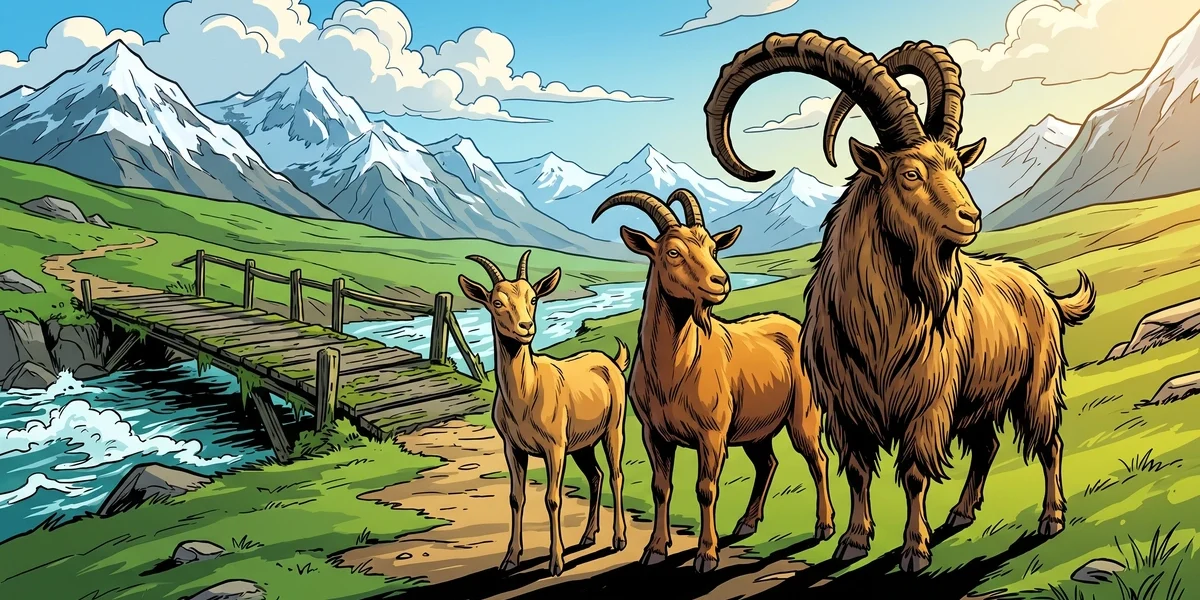
The three billy goats Bruse of increasing size on a green Norwegian mountain pasture before the troll's plank bridge - vibrant Amar Chitra Katha comic style
Ad Space (header)

High in the green folds of the Norwegian mountains, where the summer grass grows sweet and the meltwater rivers run cold and loud, there lived three billy goats who shared a single family name: Bruse. They were brothers — a small one, a middling one, and a great shaggy elder with horns like curved oak roots — and they had one ambition between them, which was to climb to the hillside pasture and grow fat. Standing between them and that bright meadow was a plank bridge, and beneath the plank bridge, in the cold churning shadow, lived a troll.

“The Three Billy-Goats Gruff” is one of the most economical and most beloved tales in the European nursery canon. It has no princess, no enchantment, no long quest — only three goats, one bridge, one troll, and the steady, building rhythm of trip, trap, trip, trap. Yet generations of children have memorised it word for word, and folklorists have given it its own catalogue number. This retelling restores the tale to its scholarly setting: a Norwegian mountain folktale, collected in the 1840s, carried into English in 1859, and still read aloud somewhere in the world almost every single day.

A Tale from the Norwegian Mountains: Origins and Attribution

The story is Norwegian, and its proper title is De tre bukkene Bruse — “The Three Billy-Goats Bruse.” It was collected by Peter Christen Asbjornsen (1812–1885) and Jorgen Moe (1813–1882), the two friends whose lifelong partnership did for Norwegian folktale what the Brothers Grimm did for German. Asbjornsen, a zoologist by training, and Moe, a clergyman and poet, gathered tales directly from rural storytellers and published them in instalments as Norske Folkeeventyr (“Norwegian Folktales”) between 1841 and 1844, with expanded editions following. “De tre bukkene Bruse” belongs to that first great wave of collecting, which appeared in the decades after Norway’s 1814 constitution, when a young nation was urgently searching for a literature and an identity of its own.

The tale reached English readers through George Webbe Dasent, whose Popular Tales from the Norse (1859) translated a generous selection of Asbjornsen and Moe. It is Dasent who gave the goats the surname “Gruff.” The Norwegian Bruse is not “gruff” at all; it refers to the tuft or shaggy crest of hair on a goat’s forehead, and is sometimes connected to the verb meaning to fizz or roar like rushing water. “Gruff” was, strictly speaking, a mistranslation — but it was an inspired one. The blunt, growling English word suits the elder goat and the troll so perfectly that it has stuck for more than a century and a half, and no one now would dream of changing it.

Folklorists classify the story as Aarne–Thompson–Uther tale type ATU 122E, “Wait for the Fat Goat” (also called “Wait Until I Am Fat Enough”). It sits inside the larger ATU 122 family of “the predator’s delayed dinner” stories, in which an intended victim escapes by persuading a hungry hunter to wait for a bigger, better meal that never actually arrives. The illustrators Erik Werenskiold and Theodor Kittelsen, whose drawings defined the visual world of Norwegian folktale in the later nineteenth century, fixed the look of the troll for generations of readers. In English the tale’s most famous picture-book form is Marcia Brown’s edition of 1957, which was named a Caldecott Honor Book.

The hungry green valley and the old plank bridge over a rushing mountain river, the three billy goats on the bank and a mossy troll lurking beneath - Norwegian folk tale, ACK style

The Hungry Valley and the Troll’s Bridge

To understand the goats’ hunger, it helps to understand the Norwegian farming year. For centuries, mountain families practised seterdrift — the seasonal movement of livestock up to high summer pastures, the seter, where the grass was richest. The valley floor near the farm was grazed thin and bare by midsummer; the real feast lay up the slope. The three billy goats Bruse are simply doing what every Norwegian goat of the period did: setting off “to the hillside to make themselves fat.” Their problem is that the route to the good grass crosses a river, and a river in this country meant a bridge, and a bridge meant the possibility of a troll.

The troll is the oldest and most Norwegian of monsters. In the folk imagination he is not a clever devil but a creature of the wild margins — of caves, ridges, dark water, and the spaces under bridges. He is enormous, ugly, slow-witted, and ravenously hungry, and the tale describes him with a child’s relish for the grotesque: eyes “as big as saucers” and a nose “as long as a poker.” He owns nothing, builds nothing, and produces nothing; he merely lurks at the crossing point and demands a toll of flesh from anyone who tries to pass. He is, in the plainest terms, the obstacle — wilderness itself, refusing to let the small and the hungry reach what they need.

Trip, Trap: The Littlest Billy-Goat Bruse

The smallest billy goat goes first, because that is how these tales are built, and his hooves on the planks make the sound every listening child waits for: trip, trap, trip, trap. Up roars the troll: “WHO’S THAT tripping over my bridge?” The little goat answers in a voice as thin as a reed — it is only him, the smallest Billy-Goat Bruse, on his way up to the hillside to make himself fat.

“Now I’m coming to gobble you up!” bellows the troll. And here the tale turns on a single clever sentence. The little goat does not run, and he does not beg. He simply offers the troll a better idea. “Oh no, pray don’t take me. I’m too little, that I am. Wait a bit till the second Billy-Goat Bruse comes. He’s much bigger.” The troll, whose appetite is larger than his wits, weighs a small mouthful against the promise of a larger one and lets the little goat trot safely across. It is the first move in a trap the goats are laying without ever seeming to lay it — the victim redirecting the predator’s greed against itself.

The smallest billy-goat Bruse trotting across the plank bridge as the huge ugly troll rises up roaring - Norwegian folk tale, ACK style

The Second Billy-Goat and the Troll’s Growing Hunger

A little while later the second billy goat steps onto the bridge, and his hooves make a louder, heavier music: TRIP, TRAP, TRIP, TRAP. Again the troll roars his question, and again he threatens to gobble up the traveller. The middle goat, following his brother’s example exactly, answers that he is not worth eating either. “Wait a little till the big Billy-Goat Bruse comes. He’s much bigger.” The repetition is the heart of the tale’s craft. Each crossing is the same scene at a higher pitch — the same sound, the same question, the same threat, the same answer — and a young listener feels the pattern lock into place, knowing precisely what is coming and savouring the wait.

The troll lets the second goat pass, and now he has talked himself into a corner. He has refused two meals on the strength of a promise. His hunger has not lessened; it has been stretched and sharpened by waiting. He has, without noticing, staked everything on the arrival of the largest goat — which is exactly what the goats intended, and exactly the wrong thing for a troll to wish for. The trap is now fully set, and the only creature who cannot see it is the one crouched beneath the planks.

The middle billy-goat Bruse facing the hungry troll crouched beneath the bridge planks - Norwegian folk tale, ACK style

The Great Billy-Goat Bruse

Then comes the big billy goat Bruse, and the bridge does not go trip, trap — it groans and creaks under his weight, for he is so heavy the timbers complain. His voice, when the troll demands to know who is crossing, is not thin and not middling but a deep, ugly roar of his own: “It’s I! The big Billy-Goat Bruse!” The troll, at last, has his fat goat. He scrambles up onto the bridge crying that now, now he is coming to gobble him up.

The big goat does not argue, and he does not flee. He lowers his head. He has two great horns and the hard hooves to back them, and he uses every ounce of himself: he charges the troll, puts out his eyes, breaks him to pieces bones and all, and tosses him into the rushing water below. Then he walks calmly up to the hillside. The troll’s mistake was complete. By holding out for the biggest meal, he guaranteed himself an opponent he could not possibly beat. In many printed versions the tale closes with a teasing little verse — “Snip, snap, snout, this tale’s told out” — and the three goats, safe at last, grow so fat on the mountain grass that they can scarcely walk home.

The great shaggy billy-goat Bruse charging the troll with lowered horns, knocking him into the rushing river - Norwegian folk tale, ACK style

The Moral: Patience, Courage, and the Troll Undone

“The Three Billy-Goats Gruff” carries two lessons folded neatly together, and they belong to different members of the family. The two smaller goats teach the wisdom of the weak: when you cannot win by force, you can still win by wit, by patience, and by knowing your own size. Neither little goat lies outright — there really is a bigger brother coming — but each turns the troll’s own greed into the rope that will hang him. The big goat teaches the duty of the strong: he meets the danger his brothers could not, and he meets it head-on, so that the whole family reaches the good grass.

The troll, meanwhile, is undone by a single flaw: he is never satisfied with enough. He could have eaten the little goat and been fed. Instead he gambled a sure small meal for a promised large one, again and again, until the promise itself walked up and destroyed him. A Norwegian proverb catches the shape of his ruin exactly:

“Liten tue velter ofte stort lass.”

“A little tussock often overturns a great load.”

The troll is the great load — huge, heavy, sure of himself — and the little goat is the small tussock in the road that tips him over. Greed makes the strong stupid; patience makes the small dangerous. That is the bargain the tale strikes, and children grasp it long before they could put it into words.

Tale Type 122E and the Tale’s Worldwide Cousins

The “delayed dinner” trick that drives this story is one of the oldest in the world. ATU type 122 and its many sub-types appear across Europe and Asia: a fox persuades a hen to wait, a wolf is talked into postponing a kill, a small animal escapes by promising the hunter a fatter one further along the road. What makes the Norwegian version unforgettable is not the trick itself but its packaging — the named goats, the named monster, the bridge as a single fixed stage, and above all the sound. “Trip, trap” is onomatopoeia doing structural work: it announces each act of the drama before a word is spoken, and it invites the listening child to join in. The tale is, in effect, built to be performed aloud, with three different voices and a stamping rhythm, and that is a large part of why it has survived so robustly in oral use.

Asbjornsen and Moe understood that they were not merely preserving stories but helping to build a national culture. When they wrote down “De tre bukkene Bruse,” they kept the plain, vigorous speech of the storytellers rather than smoothing it into bookish Danish, and that decision shaped the development of written Norwegian itself. A tale that looks like the simplest thing in the world — a rhyme for very small children — sits, in fact, at the foundation of a country’s literature.

The Troll Beneath the Bridge: A Figure of Norwegian Folk Belief

No element of the tale is more Norwegian than its monster. The troll of folk belief was never a single fixed creature; the word covered a whole spectrum of beings that lived beyond the edge of the farm — from giant mountain trolls who could be mistaken for hills to smaller, sly, malevolent things that haunted forests, fells, and water. What they shared was their place in the world: trolls belonged to the wilderness, to everything the farming community had not tamed, and they were dangerous precisely at the points where a person had to leave safety behind. A bridge is exactly such a point. It is the threshold between the known valley and the open mountain, and in the folk imagination thresholds were where the human world and the troll world rubbed against each other.

The bridge troll is therefore more than a villain; he is a piece of inherited geography. Norwegian children grew up with the understanding that the landscape itself had owners who were not human, and that crossing water, climbing a ridge, or entering a forest meant entering someone else’s territory. Trolls were also, importantly, beatable. Folk tradition held them to be slow, dim, easily tricked, and — in many tales — unable to bear sunlight, which could turn them to stone. The troll under the bridge carries all of this with him. He is frightening, but he is frightening in a way the tale has already promised can be overcome, first by a small goat’s quick tongue and finally by a large goat’s horns. That blend of real menace and reliable defeat is what makes him the perfect monster for a very young audience.

Why the Tale Has Lasted

“The Three Billy-Goats Gruff” has lasted because it is perfectly proportioned. It is short enough to tell before sleep and structured clearly enough that a three-year-old can predict every beat — which is not a weakness but the entire point. Its repetition gives a small child the rare pleasure of mastery: of knowing what comes next, of joining in the “trip, trap,” of bracing happily for the troll’s roar. Its escalation, from the thin little voice to the bridge-shaking elder, delivers a satisfying release of tension that has been honestly earned. And its meaning is generous enough to grow with the reader. To a toddler it is a thrilling story about a scary monster who gets what he deserves. To an older child it is a lesson in patience, cleverness, and courage. To an adult it is a small, sharp parable about greed defeating itself and about the strong owing protection to the weak. Few stories so brief have ever done so much, and that is why, nearly two centuries after two Norwegian friends wrote it down, the goats are still crossing the bridge.

Ad Space (in-content)
Ad Space (after-content)

Get a New Story Every Week!

Join thousands of parents and teachers who receive our hand-picked folk tales every Friday. Stories with morals your kids will love.

Free forever. No spam. Unsubscribe anytime.