Samurai!”
Samurai!”: The samurai represent one of history's most fascinating warrior traditions. For nearly a thousand years, from roughly the 11th century until the

Origin & Tradition
Samurai! belongs to the tradition of Japanese instructional tales about the nature of true mastery — stories that circulated among warrior classes, Zen practitioners, and the educated public of the Edo period as illustrations of what the highest level of martial cultivation actually looks like. Such tales are collected in texts like the Hagakure (葉隠, “Hidden in Leaves”) and the Gorin no Sho (五輪書, “Book of Five Rings”), and they share a consistent theme: that the warrior who has genuinely mastered combat expresses that mastery through restraint, stillness, and the refusal to demonstrate — because a warrior who needs to demonstrate has not yet transcended the need for other people’s recognition of his skill.
Beat I — The Insult and the Undrawn Sword
A young samurai, proud of his training and eager to establish his reputation, encounters an older warrior on a narrow road. The older man gives no ground — he is clearly of lesser social status, a ronin perhaps, or a wandering swordsman without a lord. The young samurai expects deference; he receives none. Words are exchanged. The young samurai’s hand moves toward his sword.
The older warrior does not move. He does not reach for his sword, does not shift his stance, does not acknowledge the threat in any way that a duellist would recognise as preparation. He simply stands, looking at the young samurai with an expression that contains nothing readable — not fear, not contempt, not aggression. Nothing.
The young samurai finds he cannot draw. He is fully trained; he knows the motions; there is no physical impediment. But something in the quality of the older man’s stillness makes the drawing of his sword feel, inexplicably, like a mistake — as if the old man already knows the outcome of the duel and finds it uninteresting. The young samurai’s hand drops. He steps aside. The older warrior passes without a word.
Beat II — The Teacher’s Explanation
The young samurai goes to his teacher and describes what happened — not as a victory or a defeat but as a confusion he cannot name. He had every right to draw; the older man had insulted him; his training was sound; and yet drawing felt impossible. His teacher listens without interrupting.
When the young samurai finishes, his teacher asks: “What was in the older man’s eyes?” The young samurai thinks. “Nothing,” he says. “No fear. No anger. Nothing I could read.” His teacher nods: “You encountered a man who has passed through the other side of swordsmanship. He no longer fights to prove anything, because there is nothing left for him to prove. And you felt that — because a sword drawn against such a man is a sword drawn against a mirror.”
The teacher explains further: the young samurai’s inability to draw was not weakness. It was the first moment of his genuine education — the moment he encountered something beyond technique, something that technique alone cannot produce and cannot defeat. The older warrior’s stillness was not passive; it was the active expression of a mastery so complete it had become indistinguishable from peace.
Beat III — Mushin and the Paradox of Martial Perfection
The Japanese Zen tradition that shaped samurai culture in the medieval and early modern periods introduced the concept of mushin (無心, no-mind) as the highest state of martial cultivation. Mushin is not the absence of awareness — it is the absence of the ego’s involvement in awareness. A warrior in mushin does not calculate, does not react to provocation from a position of wounded pride, does not need to establish superiority through the sword because the self that needed that establishment has been set aside.
The older warrior in the tale is in mushin — which is why the young samurai cannot read him. A warrior who is afraid or angry or eager to prove himself is readable: the body speaks the emotion, the body telegraphs the intention. A warrior in mushin has no intention to telegraph. He will act when action is necessary and not before; he will not act when action is unnecessary; and the distinction between these two states is entirely internal, invisible from outside, and uncorruptible by provocation.
This is the paradox the tale illustrates: the most dangerous warrior is the one who gives you nothing to react to. The young samurai’s training prepared him to respond to aggression, to fear, to challenge — all the readable states of an opponent. Against emptiness, his training has no purchase. He cannot draw on an enemy who is not, in any emotional sense, there.
Beat IV — The Sword That Is Not Drawn
Japanese sword tradition distinguishes between battōjutsu (抜刀術, the art of drawing and cutting) and the deeper principle sometimes called saya no uchi no kachi (鞘の内の勝ち, victory within the scabbard) — the idea that the highest form of swordsmanship is winning without drawing at all. The older warrior in the tale has achieved this: not because he is passive or because he lacks skill, but because his skill has carried him to the point where the sword in the scabbard is sufficient. The young samurai felt the victory of the undrawn sword against him and could not overcome it with his own drawn blade.
Edo-period samurai culture, which simultaneously produced the Hagakure’s famous meditation on death as the foundation of the warrior’s freedom and the peaceful domestic world of merchants and craftsmen, found in this paradox its most productive tension. The warrior who has passed through the other side of swordsmanship is, finally, someone who can live in peace — not because he has renounced violence but because he has so fully prepared for it that its necessity has become vanishingly rare.
“The warrior who has mastered the art of combat is most dangerous not when he draws his sword but when he chooses not to — and the willingness to absorb an insult without reaction is the mark of a warrior who has nothing left to prove.”
Why This Story Lasted
Tales of this type have lasted in Japanese tradition because they articulate the highest aspiration of the warrior culture: not the accumulation of victories but the transcendence of the need for them. The young samurai who cannot draw his sword has encountered, for the first time, something his training has been trying to prepare him for without being able to name it. The older warrior’s gift — unintentional, delivered without a word — is the most efficient lesson he will ever receive.
The Warrior’s Inner Life in Japanese Tradition
The Edo period (1603–1868), paradoxically the era of Japan’s longest domestic peace, produced the most systematic philosophical elaboration of samurai ethics. Texts like the Hagakure (c. 1716), the Gorin no Sho (1645), and the Budō Shoshinshu (武道初心集, c. 1730) all grapple with the question of what the warrior’s cultivation is for in a time when the sword is rarely drawn. Their consistent answer — that the warrior’s cultivation is for the quality of the person, not the frequency of combat — is the philosophical context from which tales of the undrawn sword emerge. Zen influence on samurai culture from the Kamakura period onward established mushin as the language in which this answer was expressed.
Frequently Asked Questions
What is the moral of Samurai?
Genuine mastery of any art, carried to its highest level, transforms the practitioner into someone who no longer needs to demonstrate the mastery — and this transformation is itself the most powerful expression of the art. The warrior who cannot be provoked has transcended the self that needed provocation to respond to, which is the state that all martial training is ultimately moving toward.
What is mushin and why is it important in Japanese martial arts?
Mushin (無心, no-mind) is the state in which the ego’s involvement in awareness and action has been set aside — the warrior acts without calculation, without fear, without the need to protect a self-image. In this state, the warrior does not telegraph intentions through emotional states, does not react to provocation from wounded pride, and does not draw the sword unless drawing is genuinely necessary. It is the highest attainment of Zen-influenced martial cultivation.
Why can’t the young samurai draw his sword against the older warrior?
Because his training has prepared him to respond to readable opponents — people who telegraph fear, anger, or aggression — and the older warrior gives him nothing to read. Against the emptiness of mushin, his technique has no purchase. He senses, without being able to articulate it, that drawing his sword against this particular stillness would be a mistake — and that sense is the beginning of his real education.
What is saya no uchi no kachi?
Saya no uchi no kachi (鞘の内の勝ち, victory within the scabbard) is the principle that the highest form of swordsmanship is winning without drawing the sword — through the opponent’s recognition that drawing would be futile, or through de-escalation that removes the necessity of combat. It represents the endpoint of the warrior’s cultivation: not the fastest draw or the most powerful cut, but the presence that makes drawing unnecessary.
How does Zen Buddhism influence samurai culture in Japanese folklore?
Zen entered samurai culture from the Kamakura period (1185–1333) onward, providing a philosophical framework for the warrior’s cultivation that went beyond technique. Zen’s emphasis on the dissolution of ego, on direct experience uncorrupted by conceptual overlay, and on the unity of life and death gave samurai culture the language to express what the highest martial training was actually developing. The mushin ideal, the acceptance of death, and the practice of seated meditation (zazen) all entered warrior practice through this influence and shaped the folk narratives that circulated around what a great warrior looked and felt like.
You May Also Like
 Japanese Folk Tales
All Ages
Japanese Folk Tales
All Ages
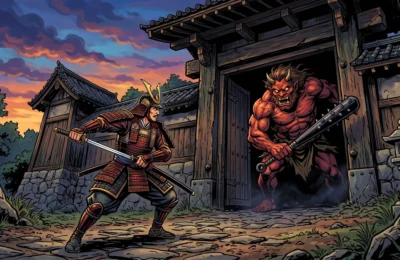
The Ogre Of Rashomon
The Ogre Of Rashomon: Long, long ago in Kyoto, the people of the city were terrified by accounts of a dreadful ogre, who, it was said, haunted the Gate of
 Japanese Folk Tales
All Ages
Japanese Folk Tales
All Ages
The Story Of Urashima Taro, The Fisher Lad
The Story Of Urashima Taro, The Fisher Lad: Long, long ago in the province of Tango there lived on the shore of Japan in the little fishing village of
 Japanese Folk Tales
All Ages
Japanese Folk Tales
All Ages
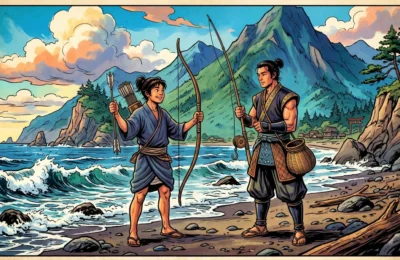
The Happy Hunter And The Skillful Fisher
The Happy Hunter And The Skillful Fisher: Long, long ago Japan was governed by Hohodemi, the fourth Mikoto (or Augustness) in descent from the illustrious