A Bridegroom For Miss Mole
A Bridegroom For Miss Mole: By the river Kingin stands the great stone image, or Miryek, that was cut out of the solid rock ages ago. Its base lies far beneath

Origin & Tradition
A Bridegroom for Miss Mole (두더지 신랑 찾기, Dudeoji Sillang Chatgi) belongs to a widely distributed East Asian story type that scholars classify as “The Sun’s Son-in-law” or “The Most Powerful Suitor” — a tale type found in the Korean, Japanese, Chinese, Vietnamese, and Indian traditions, and recorded in Sanskrit sources including the Panchatantra. In each version, a family with an only daughter declares that she must marry the most powerful being in the world, and they proceed to consult a chain of apparently supreme powers, each of which defers to something more powerful, until the chain curves back to reveal that the family’s own kind is the most powerful of all. The Korean version, in which a mole family consults the Sun, Cloud, Wind, and Wall in succession, is one of the most beloved in the Korean folk repertoire — beloved not only for its circular logic but for the gentle humour of the mole family’s earnest ambition and the story’s mild but clear-eyed verdict on social climbing.
Beat I — The Most Powerful Bridegroom in the World
A mole family has a daughter of exceptional quality — at least, in their devoted parents’ estimation. She is beautiful, accomplished, and deserves only the very best. The mole father, surveying the mole suitors who present themselves, finds them all inadequate: too ordinary, too underground, too much like himself. His daughter deserves the most powerful being in the world. He will find her such a husband.
The logic of his decision is impeccable within its own premises. If one’s daughter is the finest of all daughters, she requires the finest of all husbands. The finest of all husbands is the most powerful being. The most powerful being in the world is, obviously, the Sun — that great golden presence that rules the sky, brings warmth, makes crops grow, and determines the rhythm of all earthly life. The mole father sets off to petition the Sun.
The encounter with the Sun is conducted with the formality appropriate to a cosmic audience. The mole father presents his proposal with dignity: his daughter is exceptional; the Sun is the most powerful being in the world; would the Sun honour the mole family by becoming his son-in-law? The Sun, touched but honest, must decline on grounds that challenge the father’s premise: “I am not the most powerful being in the world. The Cloud is more powerful than I — when the Cloud covers me, I am entirely hidden. You should speak to the Cloud.”
Beat II — The Chain Consults Itself
The mole father accepts this with good grace and proceeds to the Cloud. The Cloud, similarly touched and similarly honest, demurs: “I am not the most powerful — the Wind is more powerful than I. When the Wind blows, I am scattered and dispersed in an instant. You should speak to the Wind.” The mole father proceeds to the Wind.
The Wind, with perhaps a slight pride in its own ferocity — it has after all just been described as more powerful than both Cloud and Sun — is nevertheless obliged to be truthful: “The Wall is more powerful than I. When the Wind blows, the Wall does not move. The Wall withstands everything I can bring against it.” The mole father, now slightly confused by the logic that has led him from the Sun to a wall, proceeds dutifully to the Wall.
The Wall receives the proposal with solidity and, after a moment of what might be described as architectural reflection, provides the answer that collapses the entire chain: “I am not the most powerful. The Mole is more powerful than I. The Mole burrows through me, makes tunnels through my foundations, and undermines my stability from below. You should speak to the Mole.” The mole father stands before the Wall, absorbing the information that the creature more powerful than the Wall — which was more powerful than the Wind, which was more powerful than the Cloud, which was more powerful than the Sun — is a mole.
He goes home. He arranges his daughter’s marriage to the finest young mole in the neighbourhood. The wedding is a mole wedding, underground and excellent in every mole respect.
Beat III — The Circular Chain and Its Philosophical Logic
The story’s structural joke — the power chain that begins at the Sun and ends at the Mole, which turns out to be more powerful than the Wall that withstands the Wind that disperses the Cloud that covers the Sun — encodes a philosophical proposition that is more serious than the comic framing suggests: every apparent hierarchy of power is circular, and circularity collapses hierarchy into a network of mutual dependencies.
Sun, Cloud, Wind, Wall, and Mole form not a pyramid with a single apex but a loop — each element superior to one neighbour in the chain and inferior to another. The Mole is “at the bottom” of the social ladder that the mole father wishes to climb, but it is also at the top of the power chain when the chain is understood correctly. The question “what is the most powerful?” cannot be answered by pointing to a single element in this system; the answer depends on what kind of power is relevant and in what relationship it is exercised.
This circular structure is not unique to the Korean tradition — it appears in the Panchatantra’s version (where a mouse family pursues a similar chain and returns to a mouse suitor), in Japanese variants, and in folk traditions across the Indian subcontinent. The story type is so widely distributed because it dramatises something structurally true about complex systems: power is relational, not absolute. The Sun is more powerful than the Cloud in most relevant ways; but the Cloud has a specific capability — coverage, obscuration — that renders the Sun temporarily null. The Wind is more powerful than the Cloud in dispersion; but the Wall resists the Wind entirely. The Mole is more powerful than the Wall in undermining; but the Sun evaporates the Mole’s tunnels and scorches the earth.
In Korean cultural context, this circular logic connects to the folk wisdom concept of bun (분수, one’s proper sphere, the appropriate range of one’s ambitions and activities). Bun is not a call to passive acceptance of social position; it is an observation that excellence is most fully expressed within the domain to which one is genuinely suited. The mole father’s error is not ambition per se but a category error — he applies a linear, universalist concept of power to a world that is actually organised by relational, contextual capability. The finest mole husband is the finest husband for a mole daughter precisely because mole excellence in mole contexts — burrowing, underground navigation, subterranean community — is more relevant than any borrowed cosmic prestige.
Beat IV — The Story’s Gentle Verdict on Social Climbing
The genius of “A Bridegroom for Miss Mole” is that it delivers its verdict on social climbing without cruelty. The mole father is not punished for his ambition — he is simply educated by the logic of his own inquiry. He sets out to find the most powerful being and conducts his search with genuine rigour; the chain of consultations is earnest and thorough. The conclusion — that the most powerful candidate is a mole — is delivered by the Wall with no sense of mockery; it is simply the truth that the father’s own methodology produces.
Korean folk narrative frequently uses this pattern of gentle comedic correction: the character whose overreach is being satirised is allowed to discover the truth through their own initiative rather than having it imposed from outside. The mole father is not lectured by a wise elder or warned by a supernatural figure; he is corrected by the internal logic of his own search. This is a more satisfying form of instruction than external moralising — the lesson arrives as discovery rather than imposition, and the character’s dignity is largely preserved in the process.
Miss Mole herself is largely absent from the narrative, which is both a product of the story’s historical gender assumptions and its satirical focus: the story is not really about the daughter but about the father’s epistemological journey. She receives an excellent husband by her father’s circuitous route to the obvious conclusion — the same conclusion he would have reached immediately had he not been distracted by a universalist theory of power incompatible with the actual structure of the world.
“The Sun defers to the Cloud, the Cloud to the Wind, the Wind to the Wall, and the Wall to the Mole. The Mole goes home and finds the finest mole in the neighbourhood. This is the most powerful choice.”
— Distilled from the Korean mole-bridegroom folk tradition
Why This Story Has Lasted
“A Bridegroom for Miss Mole” has persisted because it skewers, with perfect economy and zero cruelty, one of the most universal forms of human error: the assumption that the best match, the best outcome, the best solution must be found by ascending the hierarchy of prestige rather than by attending to relational fitness. The circular power chain demonstrates, more elegantly than any abstract argument, that “most powerful” is a question with no universal answer — only contextually specific ones. The mole who is most powerful in relation to walls is the same mole who is most appropriate for a mole daughter. The father’s cosmic odyssey returns him to his own backyard, and the story has the generosity to treat this return not as defeat but as the correct conclusion of a genuine inquiry.
Frequently Asked Questions
What is the lesson of A Bridegroom for Miss Mole?
The story teaches that “most powerful” is a relational question with no universal answer — every apparent hierarchy of power is circular, with each element superior to one neighbour and inferior to another. The Sun is covered by the Cloud; the Cloud is dispersed by the Wind; the Wind is withstood by the Wall; the Wall is undermined by the Mole; and the Mole, presumably, is scorched by the Sun. The mole father’s search for the universally most powerful being ends in the discovery that his own kind is the most appropriate — and therefore the most powerful — match for his daughter. The story argues for relational fitness over borrowed prestige.
What is the power chain in the mole bridegroom story?
Sun → Cloud (covers the Sun) → Wind (disperses the Cloud) → Wall (withstands the Wind) → Mole (burrows through the Wall) → and implicitly back to the Sun (which scorches the earth the Mole inhabits). The chain is circular: there is no single element that is most powerful in all relationships simultaneously. Each element has a specific capability that exceeds one neighbour’s in one context and is exceeded by another neighbour’s in a different context. The circularity is the story’s philosophical point, not a flaw.
Is the mole bridegroom story unique to Korea?
No — it belongs to a widely distributed story type found across East and Southeast Asia and the Indian subcontinent. A similar narrative appears in the Panchatantra (where a mouse family conducts an equivalent search and returns to a mouse suitor), in Japanese variants, and in folk traditions across Vietnam and other Asian cultures. The story type’s wide distribution reflects its structural universality: the circular power chain and the return to one’s own kind are propositions that resonate across very different cultural contexts. The Korean version is distinctive in its specific chain (Sun, Cloud, Wind, Wall, Mole) and its gentle comedic tone.
What does bun (분수) mean in Korean culture?
Bun (분수) refers to one’s proper sphere — the appropriate domain of one’s ambitions, activities, and relationships, defined by one’s actual nature and capacities rather than by social fantasy. It is not a call to passive acceptance of social hierarchy; it is an observation that excellence is most fully expressed within the context for which one is genuinely suited. The mole bridegroom story illustrates this: the father’s error is not ambition but a category mistake — he applies a universalist concept of power to a world organised by relational, contextual fitness, and discovers that the finest match for his mole daughter was always another mole.
Why is Miss Mole’s perspective absent from the story?
In most traditional tellings, Miss Mole is the prize of the quest rather than an agent within it — a reflection of historical gender assumptions in Korean folk narrative, where marriage stories were often told from the perspective of the parents negotiating on behalf of a daughter. The story’s satirical energy is directed at the father’s epistemological journey, not at any question of the daughter’s preferences. This framing is worth noting, though it does not diminish the story’s philosophical point: the circular power chain and the return to relational fitness are independent of the gender dynamics of the particular narrative frame.
You May Also Like
 Korean Folk Tales
Ages 6-8
Korean Folk Tales
Ages 6-8
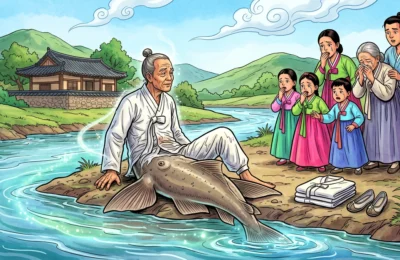
The Old Man Who Became A Fish
The Old Man Who Became A Fish: Some years ago a noted official became the magistrate of Ko-song County. On a certain day a guest called on him to pay his
 Korean Folk Tales
Ages 9-12
Korean Folk Tales
Ages 9-12
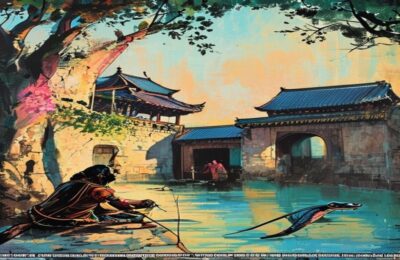
The Snake’s Revenge
The Snake's Revenge: There lived in ancient days an archer, whose home was near the Water Gate of Seoul. He was a man of great strength and famous for his
 Korean Folk Tales
Ages 6-8
Korean Folk Tales
Ages 6-8
Heungbu and Nolbu: Virtue Rewarded and Greed Punished
Heungbu and Nolbu: Virtue Rewarded and Greed Punished: Heungbu and Nolbu: The Tale of Two Brothers and the Seeds of Fortune In a village where mountains met