1003+ Stories from Ancient India — Free to Read! Explore all stories →

The Man On The Road

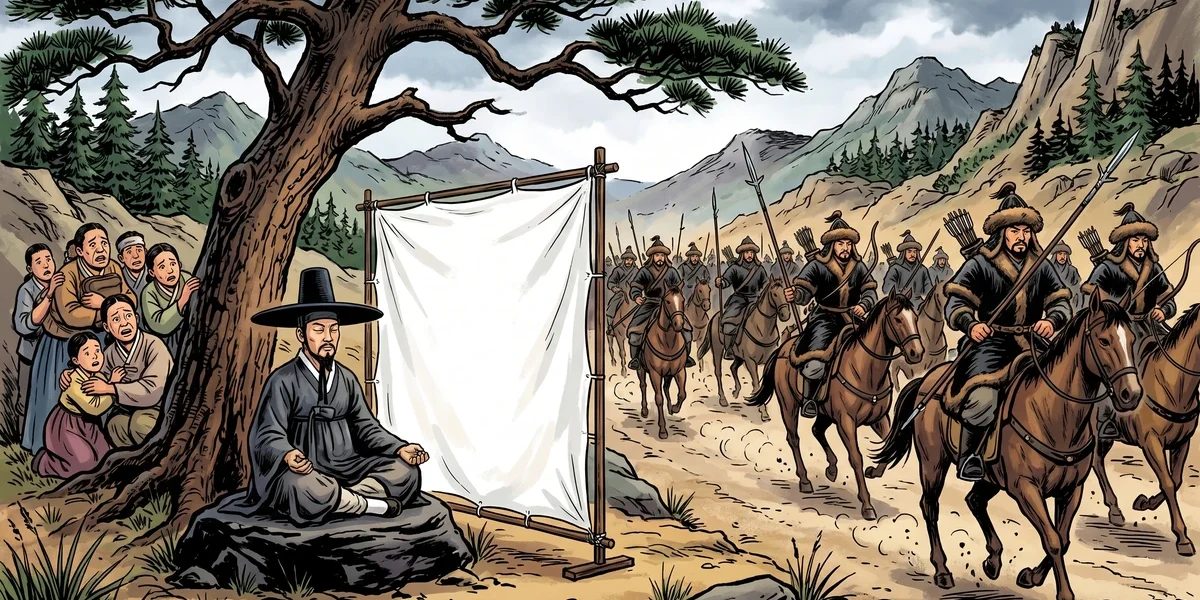
During the 1636 Manchu invasion, a quick-witted man uses observation and calm judgment to survive.

The Man On The Road - Cover - Amar Chitra Katha Style
Ad Space (header)

Origin & Tradition

“The Man on the Road” belongs to the extensive Korean tradition of nageune iyagi (나그네 이야기, traveler stories)—narratives in which a stranger encountered on the road serves as a moral test, a vehicle for social observation, or a disguised supernatural figure whose true nature is revealed through the quality of the encounter. The road (gil, 길) in Korean folk culture was a distinctively liminal space: a place between settled identities where ordinary social hierarchies and local knowledge did not apply, where travelers were equally vulnerable and equally unverifiable, and where the ethical obligations of hospitality operated without the reinforcement of community surveillance. The Joseon dynasty’s extensive road network, maintained for official postal service and military movement, was also a conduit for merchants, pilgrims, scholars traveling to examinations, and ordinary people making the movements that seasonal and life events required. On these roads, the question of how to treat strangers was practical rather than abstract: one was, at various points, the stranger in need of treatment and the settled person or fellow traveler whose response defined their character. Stories about men on the road used this recurring, universal experience as a vehicle for ethical reflection without the abstractness of philosophical argument.

Beat I — The Encounter

A prosperous merchant traveling with attendants passes a man sitting by the road in evident distress—not dramatically collapsed or obviously injured, but clearly in the condition of someone who has walked too far on too little and has reached the point where continuing without help is genuinely difficult. The man is shabbily dressed, which establishes his social position as below the merchant’s. He makes no dramatic appeal; he simply sits with the posture of someone who has stopped because stopping was necessary. He does not call out to the passing group.

The merchant has several options, all of which the narrative makes available without endorsing any of them in advance. He can stop and assist: share food and water, invite the man to ride in his cart for the remaining distance to the next village. He can stop briefly, make a small gesture that addresses his own discomfort at passing without acknowledging the situation, and continue. He can calculate that his attendants are watching, that his reputation is involved in how he handles this encounter, and act accordingly. Or he can continue without acknowledgment, which has the practical advantage of losing no time and the ethical disadvantage of being the choice the story will need to account for.

The specific texture of the merchant’s deliberation is presented with unusual care. He is not a villain; he is a person with competing legitimate considerations: he has a schedule, the man is a stranger with no verified claim on his assistance, and the road has its own dangers that include performed distress as a prelude to robbery. The story allows him the full weight of these considerations before presenting his choice.

Beat II — The Choice and Its Consequence

Different versions of this narrative type pursue different choices, and the Korean tradition is rich enough to include both: the merchant who stops and the merchant who does not, each story developing the consequences of the choice rather than the choice itself as the narrative’s substance. In the most structurally interesting version, two merchants pass the same man: the first, calculating that the stranger’s needs are not his problem, continues with his attendants after the smallest possible gesture of acknowledgment—tossing a small coin without stopping. The second, traveling alone with less than the first, stops, shares what he has, and helps the man to the next village.

The man on the road, once helped, turns out to be neither a disguised celestial being rewarding the virtuous with magical gifts nor a helpless victim rescued from mortality. He is something more interesting and more typical of the best Korean folk narrative: simply a person with his own social connections, practical knowledge, and the particular quality of memory that attaches to those who have been genuinely helped in difficult circumstances. When the second merchant’s commercial dealings bring him to a situation where he needs a specific kind of assistance that none of his ordinary connections can provide, the man on the road is positioned to provide it—not supernaturally, but through the ordinary mechanics of a network that now includes one person who feels genuinely obligated rather than merely politely acquainted.

Beat III — Namsalp’i and the Epistemology of Road Virtue

The concept of namsalp’i (남의 살피, attentiveness to others, literally “looking at others carefully”) in Korean ethical tradition refers to the quality of genuine concern that goes beyond formal obligation: not the performance of socially required gestures but the actual perception of another person’s real condition and the willingness to respond to it. On the road, this quality is tested in its purest form because it operates without the reinforcement structures that sustain it in ordinary social life. At home, in one’s community, the failure to help a neighbor has social consequences: one’s reputation suffers, one’s relationships are affected, community disapproval is expressed through the subtle mechanisms of village life. On the road, none of these reinforcers are present. The merchant who passes the man on the road without proper help loses nothing observable; no one in his home community will know, his business relationships will not be affected, and his self-presentation as a generous person can continue undisturbed.

This is why the road encounter is the purest ethical test available to Korean folk narrative: it isolates the virtue from every social scaffold that might otherwise explain or sustain it. The merchant who helps is not doing so to protect his reputation, to fulfill a specific social obligation, or to gain the social credit that visible generosity confers. He is doing it because the man is on the road and needs help and he is in a position to provide it. This is namsalp’i in its undiluted form: perception of need followed by response, without calculation of return.

Confucian ethical thought, which provided the official framework for Joseon social virtue, treated this quality as the practical expression of in (인, 仁, benevolence/humaneness)—the foundational virtue from which all others derived. In at its simplest is the capacity to feel another person’s condition as something that matters to you. The road test measures this capacity in conditions where no external pressure supports its expression, which makes the result a more reliable indicator of genuine character than any formally witnessed demonstration could provide.

Beat IV — The Moral and Its Reach

The story’s resolution is deliberately undramatic: the second merchant’s business difficulty is addressed through the man on the road’s practical assistance, the first merchant’s corresponding difficulty is not addressed (the man on the road has no particular reason to help him and does not), and the outcome—measured in commercial terms that the merchant world understands—reflects the quality of the original road encounter. Nothing magical has occurred. The virtue has produced its consequence through the ordinary mechanics of human memory and reciprocal obligation.

The story’s moral does not promise that every roadside act of generosity will produce a proportionate practical return; it simply demonstrates that the road is where character is revealed, and that revealed character accumulates consequences that eventually become visible. The merchant who helped did not help in order to accumulate these consequences; if he had, the quality of his helping would have been different, and the man on the road would have felt the difference. He helped because the man was on the road and needed help. The consequences follow from that act as they follow from any genuine expression of character: not as reward but as continuation.

“The road shows you who a person is when no one they know is watching; this is the only time the showing is reliable.”
— Korean proverb associated with nageune (traveler) narrative tradition

Why This Story Has Lasted

“The Man on the Road” endures because it stages the ethical question in its most stripped-down form: not “how should one treat people one knows?”—which every social framework addresses with specific obligations and reinforcements—but “how should one treat a stranger, without witness, without obligation, without expectation of return?” The road removes everything except the person and the choice, and the choice reveals everything. Korean folk narrative returns to this setting repeatedly because it is the laboratory condition for ethical character: minimal context, minimal reinforcement, maximum revelatory power. The story’s resolution—practical rather than magical, proportionate rather than dramatic—honours the ordinariness of what it is describing. Genuine virtue produces genuine consequences through the ordinary operations of a world that pays attention to what people actually do when no one is watching.

Road Culture and Hospitality Ethics in Joseon Korea

The Joseon dynasty’s road network served both administrative and commercial functions, with official postal stations (yeok, 역) providing accommodation and horses for government travel and private inns (juchang, 주창, or jusik-jeom, 주식점) serving commercial travelers. The obligation to assist travelers in distress was embedded in Korean folk ethics through several reinforcing traditions: Confucian in (仁, benevolence) as a general principle, Buddhist merit-accumulation through acts of charitable assistance, and the shamanic tradition’s recognition that disguised supernatural figures occasionally tested human virtue through precisely such encounters. This convergence of ethical frameworks around roadside assistance made the road encounter a standard setting for ethical folk narratives. The specific Korean contribution to this universal narrative type is its emphasis on the encounter’s function as a pure character test—stripped of social reinforcement and therefore revealing true rather than performed virtue.

Frequently Asked Questions

What is the moral of “The Man on the Road”?
That the road—where social scaffolding, community surveillance, and expectation of return are all absent—is where genuine character is most reliably revealed. How a person treats a stranger without witness is the most accurate indicator of who they actually are, as opposed to who they manage to appear to be in contexts where reputation, obligation, and social pressure are all shaping their behavior.
What happens in “The Man on the Road”?
Two merchants pass a man in distress on the road. One makes a minimal gesture and continues; the other stops, shares what he has, and helps the man to the next village. Later, when the second merchant faces a commercial difficulty that his ordinary connections cannot resolve, the man on the road is positioned to provide precisely the help needed. The first merchant faces the same difficulty without the same resource.
What does the road represent in Korean folk narrative?
The road (gil, 길) in Korean folk culture is a liminal space between settled social identities where ordinary hierarchies and community surveillance do not apply. It is simultaneously a space of vulnerability (travelers are away from their social networks and support structures) and revelation (behavior on the road is undistorted by the reinforcement structures of home community). For these reasons, the road is the standard setting in Korean folk narrative for testing genuine rather than performed virtue.
How does namsalp’i differ from ordinary politeness?
Namsalp’i (남의 살피) is the quality of genuine attentiveness to others’ real conditions—actually perceiving and responding to need rather than performing the gestures that social convention requires. Ordinary politeness operates within social scripts and produces behavior that meets minimum social expectations. Namsalp’i requires perception of what is actually happening and willingness to respond to it beyond the minimum social requirement, especially in conditions where the minimum is not enforced by social pressure.
Why does the story’s resolution avoid supernatural reward?
Because the story’s implicit argument is that genuine virtue produces genuine consequences through the ordinary mechanics of human memory, reciprocal obligation, and network effects—not through cosmic intervention. A magical reward would imply that virtue requires supernatural backing to produce results, which would undermine the story’s more interesting claim: that the world pays sufficient attention to what people actually do that honesty and genuine care for others accumulate consequences even without celestial administration of the accounting.
Ad Space (in-content)
Ad Space (after-content)

Get a New Story Every Week!

Join thousands of parents and teachers who receive our hand-picked folk tales every Friday. Stories with morals your kids will love.

Free forever. No spam. Unsubscribe anytime.